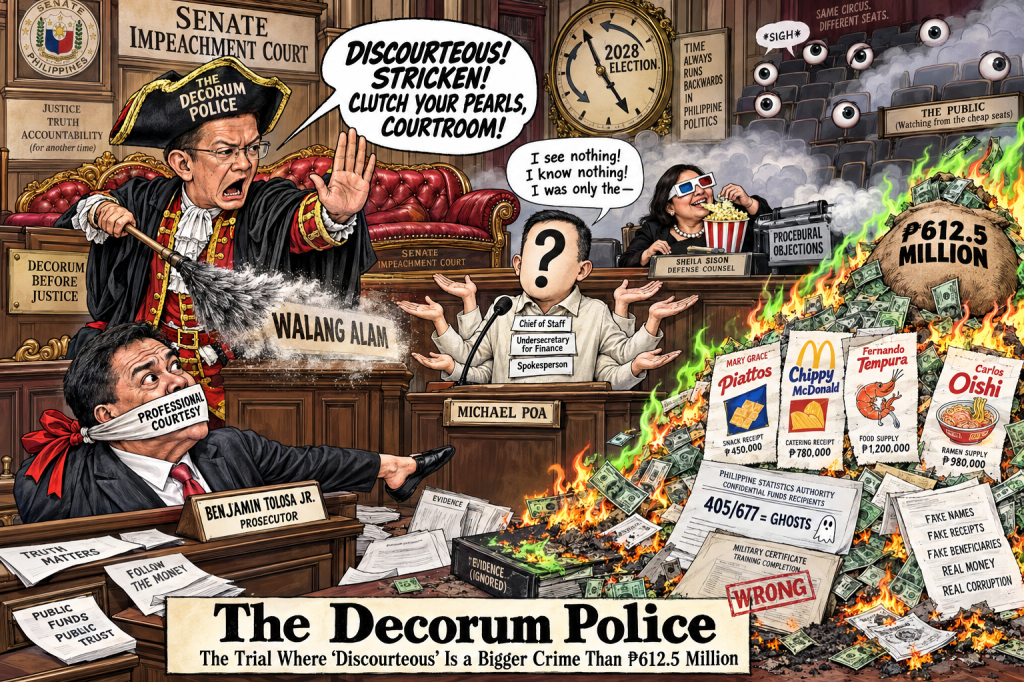
The Trial Where ‘Discourteous’ Is a Bigger Crime Than ₱612.5 Million
By Louis “Barok” C. Biraogo — September 6, 2026
MGA ka-kweba, pull up a chair. Pour yourself something strong—you will need it. What transpired on Day 21 of the Sara Duterte impeachment trial was not merely a procedural skirmish. It was a window into the soul of a proceeding that has become less about constitutional accountability and more about which lawyer can deliver the most quotable sound bite before the 6 p.m. news cycle.
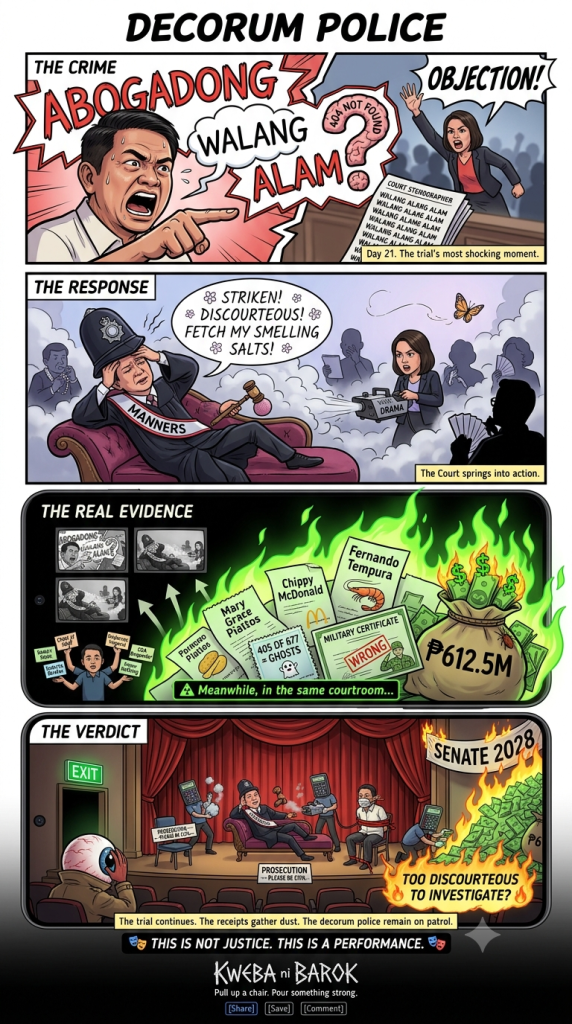
The phrase that launched a thousand think pieces? “Abogadong walang alam.” A lawyer who knows nothing. Oh, the horror. I am clutching my pearls as we speak.
I. THE CRIME AGAINST HUMANITY THAT WASN’T
Prosecutor Benjamin Tolosa Jr., while questioning Michael Poa—a man who served as Sara Duterte’s Chief of Staff, Undersecretary for Finance, and Spokesperson at the Department of Education (DepEd), and who somehow also ended up on her defense team—described him as “abogadong walang alam.”
This was, according to Tolosa, a reference to Poa’s own repeated testimony that he “knew totally nothing” about the disposition of ₱112.5 million in DepEd confidential funds. You know, the funds that produced such luminaries as “Mary Grace Piattos” and “Chippy McDonald” on acknowledgment receipts. The funds where the Philippine Statistics Authority (PSA) confirmed that 405 out of 677 supposed recipients—sixty percent—either did not exist or had no birth certificates.
Defense lead counsel Sheila Sison immediately objected. Her characterization? Tolosa’s statement was “rhetoric to provide drama.”
Rhetoric. To provide drama. In an impeachment trial. Where the evidence includes receipts signed by fictional characters. And we are worried about drama?
Presiding Officer Francis “Chiz” Escudero ordered the phrase struck, finding it “discourteous, to say the least.” Discourteous. In a proceeding where the respondent herself has threatened to dig up the remains of a deceased president and throw them into the sea. But describing a lawyer who claims to know nothing as a lawyer who knows nothing—that, apparently, is a bridge too far.
II. THE CURIOUS CASE OF MICHAEL POA: A Man Who Knew Nothing But Somehow Knew Everything
This is a man who served as Duterte’s Chief of Staff, Undersecretary for Finance, and Spokesperson; reported directly to her; prepared DepEd’s responses to the Commission on Audit (COA) regarding the very confidential funds in question; briefed Duterte on those responses; and confirmed that Duterte knew their contents.
And yet, we are to believe that this same man “knew totally nothing” about the substance of the transactions he was helping to explain to auditors?
Either Michael Poa is the most incompetent public official in the history of the Philippine bureaucracy—a possibility I do not dismiss lightly—or he is playing a game of strategic ignorance that would make Sergeant Schultz from Hogan’s Heroes blush with envy.
“I see nothing! I know nothing! I was only the Chief of Staff, Undersecretary for Finance, Spokesperson, and the person who answered the auditors! What could I possibly know?”
And this is the man whose professional dignity the Senate impeachment court is so desperate to protect?
III. THE HOSTILE WITNESS PARADOX
Here is the delicious irony. The Senate impeachment court declared Michael Poa a hostile witness—a judicial finding that the ordinary rules of direct examination are insufficient to elicit the truth from this particular witness. Hostile enough to abandon normal questioning rules. Hostile enough to justify special procedural tools.
But when the prosecution uses one of those tools—characterizing his repeated claims of ignorance in direct, colloquial terms—suddenly the court reaches for the smelling salts.
The message is clear: You may treat the witness as hostile. You may ask leading questions. You may confront him with prior statements. But heaven forbid you call him “walang alam” on the record.
This is not legal reasoning. This is theater criticism dressed up in judicial robes.
IV. THE SUPREME COURT’S WARNING
The Supreme Court, in its July 2025 decision in Duterte v. House of Representatives (G.R. Nos. 278353 and 278359) on the first impeachment complaint, made something abundantly clear: Impeachment is not a purely political exercise insulated from constitutional scrutiny. It is a sui generis proceeding—primarily legal with political characteristics—subject to due process.
“Impeachment is primarily legal and constitutional while possessing political characteristics. It is not completely insulated from judicial review.”
“Due process or fairness applies during all stages of impeachment process.”
“The Senate and House are not beyond constitutional scrutiny.”
“Grave abuse of discretion may make an otherwise political act judicially reviewable.”
Escudero’s ruling in this instance is almost certainly not grave abuse of discretion. Striking an insulting phrase—however mild—is within the presiding officer’s authority. But the pattern matters. The instinct matters. The priorities of the Senate impeachment court matter.
When the court spends more time policing adjectives than probing the substance of ₱612.5 million in public funds, something has gone wrong. When the court’s first instinct is to protect the professional dignity of a witness rather than demand answers about fabricated receipts and phantom informants, the public is entitled to wonder whether this is a serious constitutional tribunal or a finishing school for sensitive lawyers.
V. THE REAL SCANDAL: What the Decorum Police Are Distracting You From
While the Senate deliberated over whether “abogadong walang alam” violated A.M. No. 22-09-01-SC (Code of Professional Responsibility and Accountability), here is what we already know:
The Mary Grace Piattos Affair: “Mary Grace Piattos.” “Chippy McDonald.” “Fernando Tempura.” “Carlos Oishi.” These are not names. These are menu items from a food court. The PSA confirmed that 60 percent of supposed recipients were either non-existent or lacked birth certificates.
The Military Certification Problem: Army officers denied certifying the propriety of DepEd’s ₱15-million confidential fund expenditures. Their certifications related to youth leadership seminars and information campaigns—not to certifying the expenditure itself. So why were military certifications being used in connection with confidential fund liquidation?
The Nolasco-Fajarda Connection: Edward Fajarda, the DepEd Special Disbursing Officer, testified that he encashed confidential fund advances and turned over the cash to Colonel Dennis Nolasco, then deputy chief of the Vice Presidential Security and Protection Group. Poa testified that he first learned of Nolasco’s involvement during the 2024 House hearings—not while preparing DepEd’s COA response.
And we are supposed to be worried about whether calling him “walang alam” was discourteous?
VI. THE ESCUDERO DOCTRINE: All Decorum, No Accountability
Escudero has now established a clear principle: Attack the testimony, not the testifier. Be aggressive in questioning, but polite in characterization.
This is, I suppose, defensible. It looks good in law review articles. It sounds good in bar association seminars. It is the position of a man who wants to be seen as fair, impartial, and above the political fray.
But here is the problem: The crimes alleged in this impeachment are not polite. The misuse of ₱612.5 million in public funds is not a matter of professional courtesy. Fabricated receipts, phantom informants, military certifications that do not certify what they appear to certify—these are not matters that can be addressed with the gentle, measured tones of a Supreme Court oral argument.
The prosecution is not accusing Sara Duterte of a minor accounting error. It is accusing her of systematic misuse, misappropriation, and irregular liquidation of confidential funds—conduct that, if proven, constitutes graft and corruption, betrayal of public trust, and other high crimes.
And yet, the Senate impeachment court seems more concerned with the tone of the accusations than with their substance.
This is not justice. This is aesthetic preference masquerading as procedural fairness.
VII. THE POLITICAL CALCULUS
Let us not be naive. The Senate impeachment court is composed of 24 senators who will cast a vote with profound implications for their own political futures. Conviction requires a two-thirds vote—16 senators. Every procedural ruling, every evidentiary decision, every decorum intervention is made with one eye on the political consequences.
Escudero must manage not just the trial but the competing political interests of senators who will face the voters in 2028. This is the fundamental tension at the heart of the impeachment process: The Senate is supposed to act as a court of law, but it is composed of politicians who must answer to their constituents.
In that hybrid space, procedural theater flourishes. The “abogadong walang alam” incident is a perfect example: a minor procedural ruling that allowed the Senate to appear fair and impartial without actually advancing the search for truth.
VIII. THE DEFENSE STRATEGY: Drowning the Fish
Sison’s objection was not merely about protecting her client’s witness from a mild insult. It was part of a broader strategy to drown the fish—to bury the substantive evidence under a mountain of procedural objections, personal grievances, and manufactured controversies.
This is a classic defense tactic: when you cannot win on the facts, fight on the process. When the documents show fabricated receipts and phantom informants, object to the characterization of your witness. When the testimony establishes a chain of custody that leads to a military officer with no apparent connection to the department’s educational mission, demand that the prosecution be more polite.
Every time the defense objects to a characterization, every time the presiding officer sustains an objection about decorum, every time the proceedings devolve into a debate about the propriety of a phrase rather than the propriety of ₱612.5 million in expenditures, the defense wins a small victory. Not on the merits, but on the clock. Not on the evidence, but on the narrative.
The public sees a Senate that cannot even decide whether calling someone “walang alam” is acceptable, let alone whether the Vice President should be removed from office. And in that fog of procedural confusion, the substantive case fades into the background.
IX. THE PROSECUTION’S DILEMMA
Let us be fair to the prosecution. Tolosa must prove a complex case of financial impropriety against a vice president who enjoys significant political support, before a tribunal of politicians acutely aware of electoral consequences, under rules applied—shall we say—inconsistently.
The “abogadong walang alam” remark was a calculated risk. It was an attempt to crystallize a complex evidentiary point—that Poa’s claimed ignorance was inconsistent with his role and responsibilities—into a memorable phrase.
Did it work? Perhaps not as intended. The phrase was struck, and the defense characterized the prosecution as engaging in “rhetoric to provide drama.” But the underlying point remains. And the public, watching at home, understood exactly what Tolosa meant.
In the end, the controversy may have done more to advance the prosecution’s narrative than a dozen hours of careful, respectful questioning ever could have.
X. THE LARGER QUESTION
Can this Senate impeachment court actually discharge its constitutional duty? The evidence suggests serious irregularities in confidential fund management. Receipts with fictional names. Military certifications that do not certify. Cash turned over to a security officer with no apparent connection to the department’s mission. The 60 percent of supposed recipients who do not exist.
But the procedural environment is increasingly hostile to the search for truth. The Supreme Court has made clear that impeachment is subject to constitutional due process. But due process, properly understood, is not merely a set of procedural rules designed to protect the respondent. It is also a guarantee that the public has a right to a meaningful, substantive adjudication of the issues.
When the Senate prioritizes the professional dignity of witnesses over the substantive probity of evidence, when it allows procedural wrangling to obscure the search for truth, it fails not just the prosecution or the defense but the public that is the ultimate sovereign in a democratic republic.
XI. CONCLUSION: Fiddling While Rome Burns
The Senate impeachment court, under Escudero’s leadership, is fiddling with the niceties of professional courtesy while the public’s trust in its institutions burns.
The “abogadong walang alam” incident is a microcosm of everything wrong with this proceeding. A minor procedural dispute elevated to a major constitutional crisis. An insult—a mild one—treated as a crime against humanity. A distraction from the substantive issues that actually matter.
And while the Senate debates the propriety of adjectives, the evidence of impropriety piles up. Mary Grace Piattos haunts the receipts of the Department of Education. Phantom informants populate the liquidation documents. Military certifications attest to activities they were never meant to certify. And a vice president who claims to know nothing about any of it remains the frontrunner for the 2028 presidential election.
This is not justice. This is a performance.
The public, watching from the cheap seats, is beginning to understand that the real show is not in the testimony but in the theater of the trial itself. The question is whether, when the curtain finally falls, anyone will remember what the play was supposed to be about.
For now, the decorum police remain on patrol. The lawyers continue to argue about adjectives. And the receipts with fictional names continue to gather dust in the evidentiary record, waiting for someone—anyone—to ask the right question.
But perhaps that is too much to hope for. After all, it might be discourteous.
Key Citations
A. Legal & Official Sources
- The 1987 Constitution of the Republic of the Philippines. Official Gazette of the Republic of the Philippines, 1987, http://www.officialgazette.gov.ph/constitutions/1987-constitution/.
- The 1987 Constitution of the Republic of the Philippines, Article III (Bill of Rights). Official Gazette of the Republic of the Philippines, 1987, http://www.officialgazette.gov.ph/constitutions/the-1987-constitution-of-the-republic-of-the-philippines/the-1987-constitution-of-the-republic-of-the-philippines-article-iii/.
- The 1987 Constitution of the Republic of the Philippines, Article XI (Accountability of Public Officers). Official Gazette of the Republic of the Philippines, 1987, http://www.officialgazette.gov.ph/constitutions/the-1987-constitution-of-the-republic-of-the-philippines/the-1987-constitution-of-the-republic-of-the-philippines-article-xi/.
- Duterte v. House of Representatives. G.R. Nos. 278353 and 278359, Supreme Court of the Philippines, 25 July 2025, en.wikisource.org/wiki/Duterte_v._House_of_Representatives.
- Code of Professional Responsibility and Accountability. A.M. No. 22-09-01-SC, Supreme Court of the Philippines, 11 Apr. 2023, sc.judiciary.gov.ph/wp-content/uploads/2023/05/22-09-01-SC.pdf.
- Commission on Audit. Official Website of the Commission on Audit, http://www.coa.gov.ph/.
- Philippine Statistics Authority. Official Website of the Philippine Statistics Authority, psa.gov.ph/.
B. News Reports
- Panti, Llanesca T. “Senate Impeachment Court Removes ‘Abogadong Walang Alam’ Describing Poa Off the Record.” GMA News Online, 2 Sept. 2026, http://www.gmanetwork.com/news/topstories/nation/1000826/senate-impeachment-court-removes-abogadong-walang-alam-describing-poa-off-the-record/story/.
- “Sara Duterte Impeachment Trial Day 21: Poa Faces Hostile Witness Grilling as Trial Lawyers Clash.” GMA News Online, GMA Network, 3 Sept. 2026, http://www.gmanetwork.com/news/topstories/nation/1000934/sara-duterte-impeachment-trial-day-21-poa-faces-hostile-witness-grilling-as-trial-lawyers-clash/story/.
- Lirio, Gerry. “Duterte Impeachment Trial Day 21: Who Is the ‘Abogadong Walang Alam’?” PhilSTAR Life, 2 Sept. 2026, philstarlife.com/news-and-views/157155-analysis-duterte-impeachment-trial-day-21.
- De Leon, Dwight. “Tolosa Turns Up the Heat in the Courtroom, Sparks Hot Exchanges.” Rappler, 2 Sept. 2026, http://www.rappler.com/newsbreak/inside-track/jay-tolosa-debuts-impeachment-court-style-makes-heated-trial/.
- Flores, Dominique Nicole. “No Record of 60% of 677 Alleged DepEd Confidential Fund Recipients — PSA.” Philstar.com, 9 Dec. 2024, http://www.philstar.com/headlines/2024/12/09/2406157/no-record-60-677-alleged-deped-confidential-fund-recipients-psa.
- Panti, Llanesca T. “405 Recipients of Confi Fund from VP Duterte Have No PSA Birth Record — Chua.” GMA News Online, GMA Network, 9 Dec. 2024, http://www.gmanetwork.com/news/topstories/nation/929405/405-recipients-of-confi-fund-from-vp-duterte-have-no-psa-birth-record-chua/story/.
- “Ang Hirap Maging Mahirap”: The PAO Scandal That Proves Government Contempt Is Nothing New

- “Far-Off” My Axx: Malacañang’s Claire Castro Drowns in Her Own Legal Gaslighting

- “Forthwith” to Farce: How the Senate is Killing Impeachment—And Why Enrile’s Right (Even If You Can’t Trust Him)

- “HINDI AKO NAG-RESIGN!”

- “I Know Nothing”: Baste Duterte’s Amnesia Defense Meets ₱33M in GenCorp Contracts

- “I’m calling you from my new Globe SIM. Send load!”

- “Mahiya Naman Kayo!” Marcos’ Anti-Corruption Vow Faces a Flood of Doubt

- “Manageable” Debt, Unmanageable Lies: DBM’s ₱21 Trillion Fairy Tale

- “Meow, I’m calling you from my new Globe SIM!”

- “Natrabaho”: One Word, One Ombudsman, and a Judiciary on Trial

- “No Special Jail for Crooks!” Boying Remulla Slams VIP Perks for Flood Scammers

- “Philippine-Controlled” or Yankee Gas Station? The Davao Fuel Depot Farce Exposed








Leave a Reply