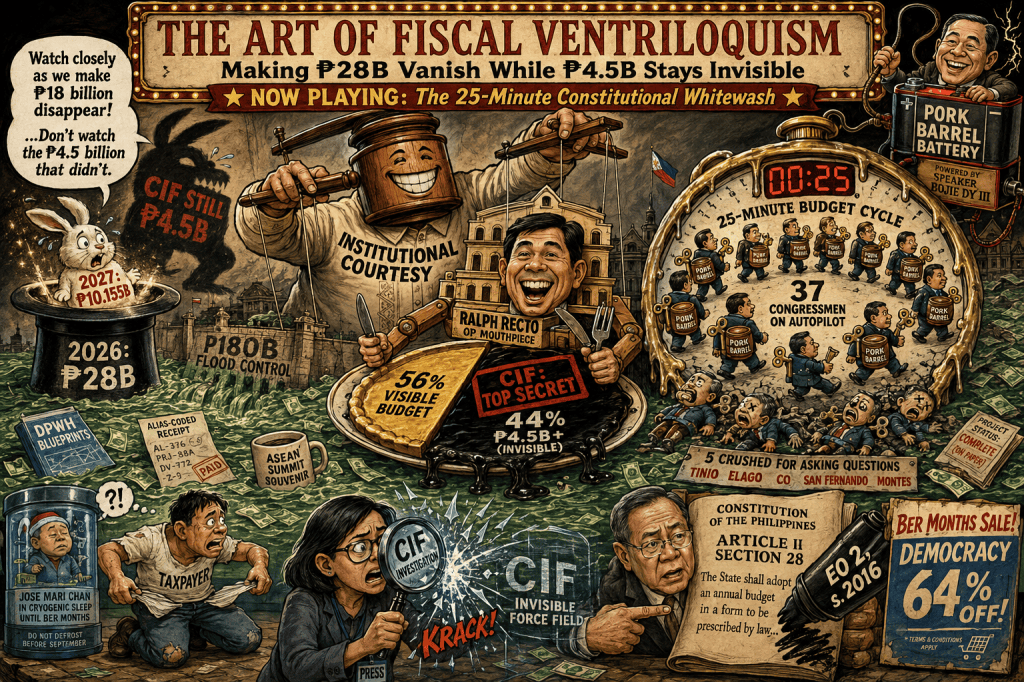
The Art of Fiscal Ventriloquism: Making P28B Vanish While P4.5B Stays Invisible
By Louis ‘Barok‘ C. Biraogo — September 3, 2026
SEPTEMBER in the Philippines. The “ber” months are upon us, Jose Mari Chan is thawed from his cryogenic chamber to haunt every mall speaker, the Christmas carols are warming up, and the House of Representatives is once again performing its annual constitutional duty: the obsequious, breakneck-speed genuflection before the Office of the President (OP).
On September 1, in a display of legislative efficiency that would make a Soviet-era rubber stamp blush, the House Appropriations Committee approved the proposed P10.155 billion OP budget for 2027. The deliberation—and I use that term as loosely as the committee used its constitutional mandate—clocked in at a blistering 25 minutes. The vote: 37 in favor, 5 against. The speed wasn’t for national security reasons. It was for political survival reasons.
The administration’s “Great Explainer,” Executive Secretary Ralph Recto, offered a masterclass in fiscal spin: the 64% drop from the bloated P28 billion of 2026 is just the sound of the government sobering up after the Association of Southeast Asian Nations (ASEAN) Summit hangover. It’s a story so neat, so tidy, that it ignores the fact that within that shrunken pie, the slice dedicated to the Deep State—the Confidential and Intelligence Funds (CIF)—remains as thick and opaque as ever.
Let’s dig into this foul-smelling cave of fiscal rot, because the rats are not just leaving the ship; they are taking the treasury with them.
The Great Disappearing Act: Accounting for the “Savings”
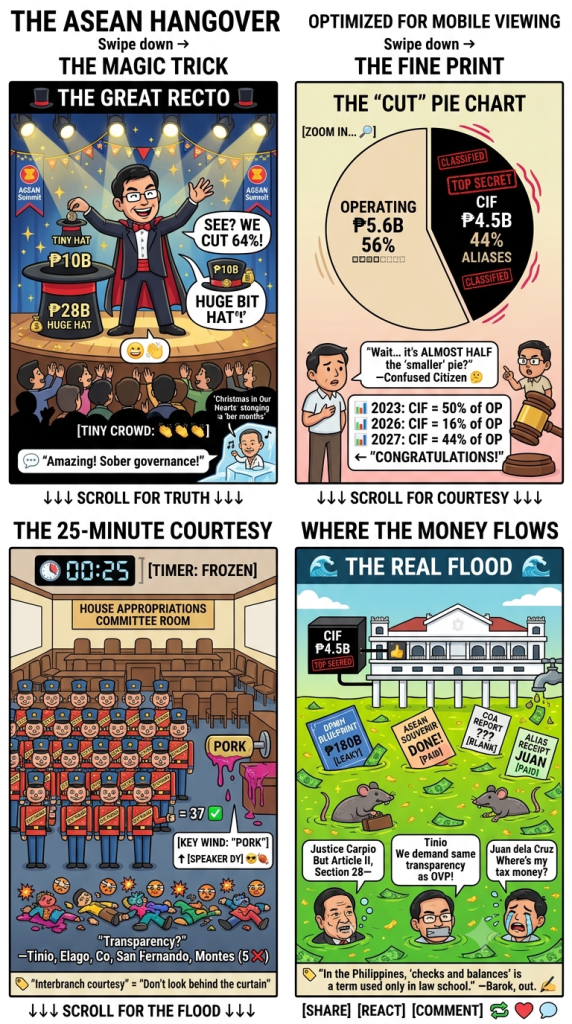
Recto’s narrative is that 2026 was an anomaly—a one-time blowout for hosting ASEAN. He wants us to believe that the “savings” are a sign of good governance. But a bar chart tells a different story.
In 2023, the OP budget was a modest P9.029B. By 2026, it had exploded to P28.028B. That is not an “operating cost.” That is a political war chest. Now, we are told it has been cut by 64% to P10.155B. Adjusted for inflation, that brings us right back to where we started in 2023. This isn’t a diet; it’s a yo-yo.
The real question, the one the 25-minute timer was designed to prevent anyone from asking, is: Where is the P4.5 billion?
While the total budget deflated, the CIF allocation has remained conspicuously constant. Under Duterte, the OP’s CIF was normalized at a hefty P4.5 billion. This administration hasn’t touched it. Let’s do the math the legislature didn’t want to do: if the 2027 CIF remains at that P4.5B level, it constitutes a staggering 44% of the entire OP budget. In 2023, it was about 50%. In 2026, it was just 16%.
Congratulations, Malacañang. You have successfully transformed the Office of the President from a public administration hub into a slush fund with a palace attached.
The “Courtesy” Doctrine: A Constitutional Shield for Mediocrity
The committee justified the 25-minute whitewash by invoking “interbranch and institutional courtesy.” In legal parlance, this is the doctrine of “Don’t look at the man behind the curtain.”
Rep. Antonio Tinio (ACT Teachers) had the audacity—the sheer, unmitigated gall—to demand transparency. He pointed out the glaring, monstrous hypocrisy that any first-year law student should recognize: Congress spent the last two years publicly eviscerating the Office of the Vice President (OVP) over its use of confidential funds, leading to an impeachment and a zero-out of its CIF. But when it comes to the OP, the same committee turns into a group of starstruck fans at a meet-and-greet.
This asymmetry doesn’t just stink of political persecution; it raises a fundamental constitutional issue under the Equal Protection Clause (Article III, Section 1) of the 1987 Constitution. The “courtesy” extended to the OP is a luxury the OVP was never afforded. This is not governance; this is a protection racket orchestrated by House Speaker Faustino “Bojie” G. Dy III, the President’s ally, who finds it much easier to scrutinize a political rival (VP Sara Duterte) than his own patron’s cash box.
The Legal Vacuum: Where the Constitution Fears to Tread
The administration hides behind the need for operational security. Fine. But the legal framework governing these funds is about as solid as the Papal visit traffic plan.
Retired SC Justice Antonio Carpio hit the nail on the head: the 1987 Constitution (Article II, Section 28) demands full public disclosure, with limits prescribed by law. But there is no law. There is only Executive Order No. 2, s. 2016 (Freedom of Information Order) (a Marcos-era afterthought) and a Commission on Audit (COA) Joint Circular No. 2015-01 (an administrative rule). The Supreme Court in Belgica v. Ochoa struck down the Priority Development Assistance Fund (PDAF) because it allowed unbridled discretion. The CIF is the new PDAF—it just comes with a “Top Secret” stamp that makes it immune to the public’s eyes, though not, apparently, to the pockets of corrupt officials.
The Supreme Court in Araullo v. Aquino (DAP Case) said the executive cannot simply shuffle money around without congressional nod. Yet, who is watching the CIF? COA? The Commission on Audit has admitted that liquidation uses aliases. That’s not an audit. That’s a creative writing exercise.
The Great Flood of Cash
Tinio’s mention of the flood control corruption scandal is the key that unlocks the motive here. An estimated P180 billion has been lost to flood control corruption since 2016. Cabinet officials are allegedly implicated. Congressmen are allegedly contractors.
What does this have to do with the OP budget? Everything.
The CIF is the ultimate “get out of jail free” card. When you can move billions of pesos without naming recipients, you can fund political machinery, buy silence, or launder kickbacks from Department of Public Works and Highways (DPWH) projects. The OP doesn’t need a P28B budget for operational costs. It needs it for command responsibility—the ability to ensure that when the flood comes, the bodies of the corrupt are buried under the river of cash, not the journalists investigating it.
The Verdict
Let’s be clear: the OP is not getting P10 billion. It is getting P4.5 billion of unaccountable monopoly money and P5.6 billion for the workers and stationery.
The 2027 budget hearing was not a fiscal exercise. It was a display of institutional capture. The 37 “affirmative” votes weren’t voting for a budget; they were voting for their own political survival, ensuring their district pork barrels remain full and the Speaker’s gaze remains benevolent.
The reduction from P28B to P10B is a conjurer’s trick. They made the visible budget disappear to distract you from the fact that the invisible budget is alive and well, fatter than ever in relative terms.
This isn’t just a governance issue. It is an admission that in the Philippines, “checks and balances” is a term used only in law school, and “interbranch courtesy” is the polite, legal-sounding term for “don’t ask questions, or you’ll never see your district again.”
The 25-minute timer has stopped. The 2027 fiscal year is coming. And the Filipinos are about to get fleeced again, with the utmost courtesy.
Barok, out.
Key Citations
A. Legal & Official Sources
- The 1987 Constitution of the Republic of the Philippines. Official Gazette of the Republic of the Philippines, 1987, http://www.officialgazette.gov.ph/constitutions/1987-constitution/.
- The 1987 Constitution of the Republic of the Philippines, Article II, Section 28. Official Gazette of the Republic of the Philippines, http://www.officialgazette.gov.ph/constitutions/the-1987-constitution-of-the-republic-of-the-philippines/the-1987-constitution-of-the-republic-of-the-philippines-article-ii/.
- The 1987 Constitution of the Republic of the Philippines, Article III, Section 1. Official Gazette of the Republic of the Philippines, http://www.officialgazette.gov.ph/constitutions/the-1987-constitution-of-the-republic-of-the-philippines/the-1987-constitution-of-the-republic-of-the-philippines-article-iii/.
- Executive Order No. 2, s. 2016. Operationalizing in the Executive Branch the People’s Constitutional Right to Information and the State Policies to Full Public Disclosure and Transparency in the Public Service and Providing Guidelines Therefor. 23 July 2016, http://www.officialgazette.gov.ph/2016/07/23/executive-order-no-02-s-2016/.
- COA-DBM-DILG-GCG-DND Joint Circular No. 2015-01. Guidelines on the Entitlement, Release, Use, Reporting and Audit of Confidential and/or Intelligence Funds. 8 Jan. 2015, http://www.coa.gov.ph/wpfd_file/coa-dbm-dilg-gcg-for-goccs-dnd-joint-circular-no-2015-01-january-8-2015/.
- Belgica v. Ochoa, G.R. No. 208566. Supreme Court of the Philippines, 19 Nov. 2013, lawphil.net/judjuris/juri2013/nov2013/gr_208566_2013.html.
- Araullo v. Aquino III, G.R. No. 209287. Supreme Court of the Philippines, 1 July 2014, lawphil.net/judjuris/juri2014/jul2014/gr_209287_2014.html.
B. News Reports
- Ramirez, Renalyn. “House panel OKs sharply reduced 2027 budget for Marcos office.” Philstar.com, 1 Sept. 2026, http://www.philstar.com/headlines/2026/09/01/2553303/house-panel-oks-sharply-reduced-2027-budget-marcos-office.
- “House panel ends OP budget briefing in less than an hour.” Inquirer.net, 1 Sept. 2026, newsinfo.inquirer.net/2296454/house-panel-ends-op-budget-briefing-in-less-than-an-hour.
- Maralit, Kristina. “House approves OP’s ₱10.15-B budget for 2027; ₱4.58-B set for CIF.” The Manila Times, 2 Sept. 2026, http://www.manilatimes.net/2026/09/02/news/house-approves-ops-1015-b-budget-for-2027-458-b-set-for-cif/2416507.
- “Marcos wants P4.58-B confidential funds for 2027 — almost half of proposed OP budget.” Rappler, 1 Sept. 2026, http://www.rappler.com/philippines/office-president-2027-budget/.
- Carpio, Antonio T. “Fundamental constitutional requirements for confidential funds.” Rappler, 1 Oct. 2023, http://www.rappler.com/voices/thought-leaders/analysis-fundamental-constitutional-requirements-for-confidential-funds/.




Leave a Reply