A ₱545 Billion Flood of Cash, A Trickle of Results, and a Tsunami of Excuses
By Louis ‘Barok‘ C. Biraogo — September 3, 2026
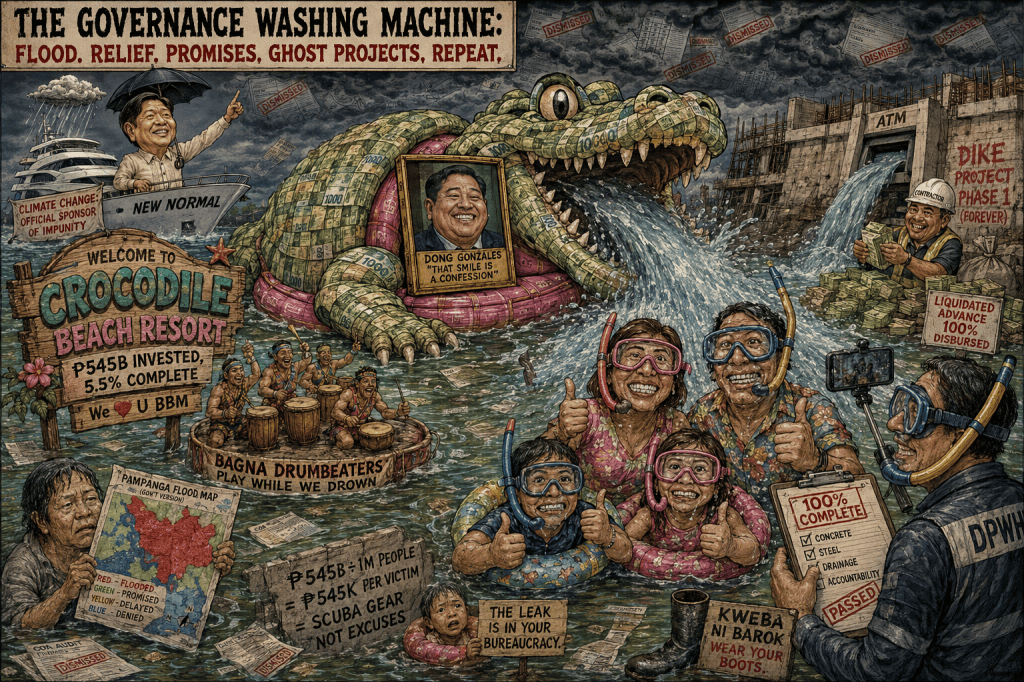
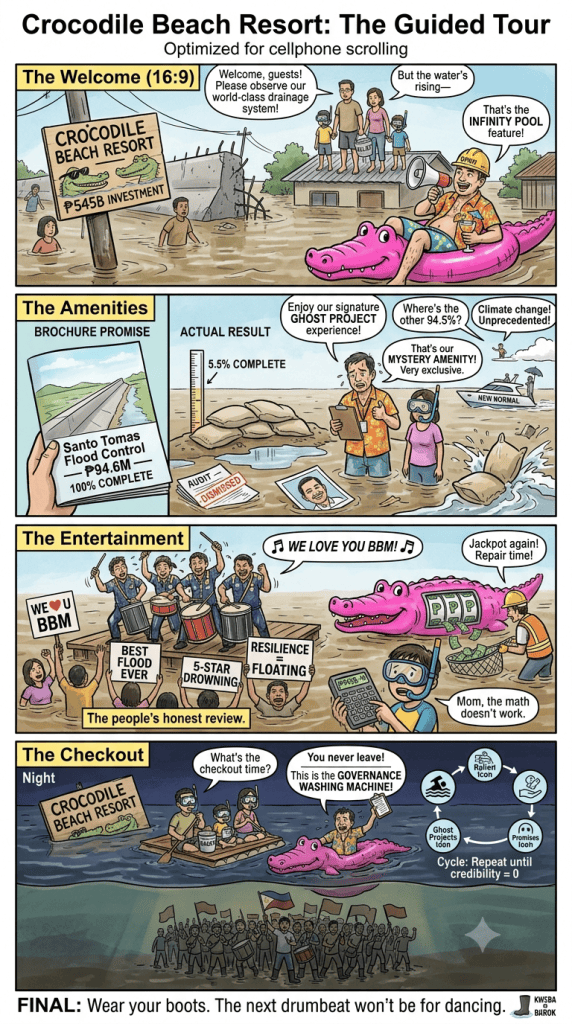
IT IS a scene of grotesque, almost theatrical, absurdity. As the floodwaters of the mighty Pampanga River once again swallowed homes and dreams, some residents did not fall to their knees in tearful supplication. No. They unpacked their drums. They cranked up the music. They danced, and with the world watching, they renamed their devastated province “Crocodile Beach Resort.” They held signs dripping with sarcasm: “We ❤ U BBM.” The laughter, captured by the Daily Tribune, echoed across social media.
It is, perhaps, the most honest review the national government has ever received. The people are not just drowning in water; they are drowning in the irony of a state that has spent billions to keep them dry while allegedly pocketing the cash needed for the towels.
Welcome to the governance washing machine. The cycle is simple: Flood. Relief. Promises. Ghost Projects. Repeat.
In the hallowed halls of Malacañang, the official diagnosis is as predictable as the rain. His Excellency, President Ferdinand Marcos Jr., points to the heavens. Climate change. Unprecedented rainfall. The “new normal.” It is a masterful bit of political alchemy, transforming a scandal of institutionalized graft into a sermon on meteorological fate. But let us not be fooled. The only thing that is “unprecedented” here is the audacity of using climate change as a cover story for the systematic theft of national resilience.
The High-Stakes Game of HVC Framework
Let us be technical, because the government hopes you are too lazy to be. The Hazard-Vulnerability-Capacity (HVC) framework dictates that a disaster is not just a natural event; it is the product of choices. The formula is simple: Disaster Risk ≈ Hazard × Vulnerability ÷ Capacity.
The monsoon is the Hazard. The Vulnerability is the fact that billions meant to elevate dikes, dredge rivers, and build retention basins have vanished into thin air or been set in substandard concrete. The Capacity is the government’s ability to manage that water. Under this framework, the government has been busy multiplying the vulnerability while dividing the capacity.
When Senator Panfilo Lacson points out that a flood control project in Candaba ballooned from ₱20 million to ₱274 million through “repeated repairs,” he isn’t describing engineering; he is describing a lucrative franchise for failure. A project that needs constant repair is not a project; it is an ATM. It is a physical manifestation of the principal-agent problem where the principal is the taxpayer drowning in their living room, and the agent is the contractor sailing away on a yacht.
The Edmundo Jose T. Buencamino v. People (Buencamino v. People) doctrine protects officials from being prosecuted merely for bad results. You can’t jail a governor for rain. Fine. But the residents have a right to be angry not because the rain fell, but because the math doesn’t add up. The government reported 9,855 flood-control projects worth ₱545.64 billion from July 2022 to May 2025. If you divide that by the estimated population affected in Pampanga (1 million people), that is over ₱500,000 per victim. They could have bought every family a boat and a timeshare in Baguio.
Instead, they got “Crocodile Beach Resort.” This is not a failure of engineering; it is a failure of arithmetic, compounded by the brutal economics of rent-seeking.
The Optics of Impunity: The Smiling Idiot
We must discuss the photographs. There is one of former Congressman Dong Gonzales smiling at an event. Is a smile proof of corruption? No. We are not barbarians; we are lawyers. A smile proves nothing except perhaps a lack of emotional intelligence in the middle of a catastrophe.
However, to the constituent standing in chest-deep water, that smile is a confession. The legal case against Gonzales—regarding the children allegedly receiving ₱913 million in Department of Public Works and Highways (DPWH) deals—may have been dismissed by the Office of the Ombudsman, but the political verdict is in. The residents aren’t just fighting water; they are fighting the “Infrastructure of Impunity.”
This brings us to the Trust Deficit Framework. The public no longer believes the government’s audits. Why would they? How can the executive branch audit the executive branch? It is like asking a cannibal to grade his own recipe for roast missionary. The Palace says the Ombudsman and Department of Justice (DOJ) are investigating. The people say, “Is it fun?”
The sarcasm of the flood victims is not resignation; it is deep political resistance. The Bagna Drumbeaters are not just musicians; they are audacious critics performing a satirical obituary for the DPWH. Their message is clear: “We know you stole the money. Now, we are going to dance on the ruins of your promises.”
The “New Normal” Gaslighting
The President’s reliance on climate change is a double-edged sword, and the residents are sharpening it against his throat. Under Republic Act No. 9729 (Climate Change Act of 2009) and Republic Act No. 10121 (Philippine Disaster Risk Reduction and Management Act of 2010 / DRRM Act), the government is legally mandated to mainstream climate change into planning. If this extreme weather is now the “new normal,” it is not a defense for catastrophic flooding; it is an indictment of the government’s failure to prepare. You cannot claim the storm was a surprise and then say the storm is the “new normal” in the same breath. It is an admission of gross negligence in forecasting and adaptation.
If the hazard is increasing, the law says the capacity must increase. What increased instead was the budget, and what increased after that was the greed.
The Candaba Conundrum
Let us look at the forensic evidence the Kweba demands. The Santo Tomas project—₱94.6 million, only 5.5% complete. A ghost project? The mayor denies it. But in a country where ghost projects are proven to exist, denying one just makes you a character in a horror movie insisting the house isn’t haunted while the walls bleed.
The Smartmatic of the story is simple: The flooding in Pampanga is not a “natural disaster.” It is an unnatural outcome of a system that prioritizes the profit of contractors over the safety of citizens. It is the consequence of what scholars call “Relative Deprivation”—the violent disconnect between what people were promised (protection) and what they got (a scuba gear workout).
The Verdict of the Kweba
Do we call for the head of Lilia Pineda? Not necessarily. The Governor has argued for desilting and dams. She is fighting a hydrology problem with a political teaspoon. Do we call for the head of Marcos? Not yet. Due process matters, even for the powerful—especially for the powerful, lest we become the mob they fear.
But we do call for the heads of the ghosts. The government must stop treating the audit process like a state secret. We demand the Track 3 approach: A Public Project Database. Publish every flood control contract, every quantity survey, every inspection photo. Let the engineers, the students, the bloggers, and the angry mothers on Facebook audit the concrete.
We demand Track 2: A Forensic Audit with the color-coded system—Green for good, Red for “ghost.” Let us see the map of Pampanga colored like a Christmas tree of corruption.
Because right now, the only thing flowing faster than the floodwaters is the credibility draining out of the Palace. The people are dancing because if they stopped dancing, they would have to riot.
Mr. President, the water is not the problem. The leak is in your bureaucracy. Fix the leak, or next time, the people won’t be dancing to the beat of drums. They will be marching to the beat of a different kind of drum entirely.
Kweba ni Barok will continue to monitor this swamp. Wear your boots.
Key Citations
A. Legal & Official Sources
- Republic Act No. 9729. An Act Mainstreaming Climate Change into Government Policy Formulations, Establishing the Framework Strategy and Program on Climate Change, Creating for This Purpose the Climate Change Commission, and for Other Purposes (Climate Change Act of 2009). 23 Oct. 2009, http://www.officialgazette.gov.ph/2009/10/23/republic-act-no-9729/.
- Republic Act No. 10121. An Act Strengthening the Philippine Disaster Risk Reduction and Management System, Providing for the National Disaster Risk Reduction and Management Framework and Institutionalizing the National Disaster Risk Reduction and Management Plan, Appropriating Funds Therefor and for Other Purposes (Philippine Disaster Risk Reduction and Management Act of 2010). 27 May 2010, http://www.officialgazette.gov.ph/2010/05/27/republic-act-no-10121/.
- Edmundo Jose T. Buencamino v. People of the Philippines and Sandiganbayan. G.R. Nos. 216745-46, Supreme Court of the Philippines, 10 Nov. 2020, lawphil.net/judjuris/juri2020/nov2020/gr_216745-46_2020.html.
- Office of the Ombudsman of the Philippines. Official Website, http://www.ombudsman.gov.ph/.
- Department of Justice of the Republic of the Philippines. Official Website, http://www.doj.gov.ph/.
- Department of Public Works and Highways of the Republic of the Philippines. Official Website, http://www.dpwh.gov.ph/.
B. News Reports
- Daily Tribune. Home page, Tribune Publishing, tribune.net.ph/.
- Bacelonia, Wilnard. “Lacson Bares Pattern in ‘Systemic’ Flood Control Anomalies.” Philippine News Agency, 20 Aug. 2025, http://www.pna.gov.ph/articles/1257003.
- Bajo, Anna Felicia. “Marcos Bares Total Cost of Flood Control Projects since July 2022 at over P500B.” GMA News Online, GMA Network, 11 Aug. 2025, http://www.gmanetwork.com/news/topstories/nation/955455/marcos-flood-control-projects-p500b/story/.
- De Leon, Dwight. “When Dong Gonzales Was Pampanga Rep, His Children Bagged P900M in DPWH Deals.” Rappler, 31 Aug. 2025, http://www.rappler.com/newsbreak/in-depth/aurelio-dong-gonzales-family-firm-bagged-millions-flood-control-deals-pampanga/.
- Arcellaz, Princess Clea. “Santo Tomas Mayor Denies ‘Ghost’ Flood Control Project.” SunStar Pampanga, 25 Sept. 2025, http://www.sunstar.com.ph/pampanga/santo-tomas-mayor-denies-ghost-flood-control-project.
- “Billions Flow to Flood Control, but Not to Save Us from Rising Waters.” Philippine Daily Inquirer, 30 Aug. 2025, newsinfo.inquirer.net/2101987/billions-flow-to-flood-control-but-not-to-save-us-from-rising-waters.






Leave a Reply