Fugitive Fantasy Crumbles as Global Manhunt Turns Up the Heat
By Louis ‘Barok‘ C. Biraogo — June 20, 2026
THE jig, as they say in the less gilded corners of the world where Ponzi schemers eventually find themselves, is up.
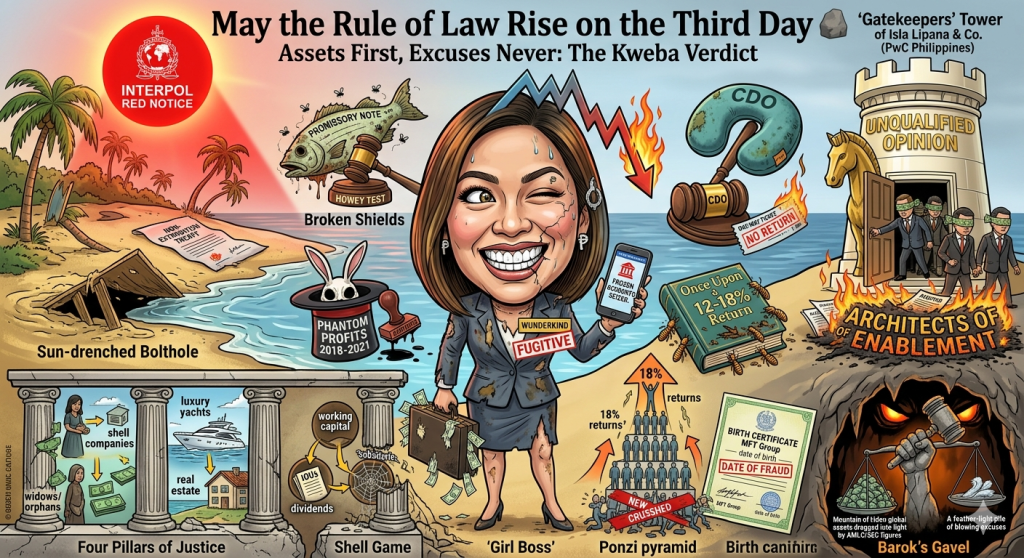
For years, Maria Francesca “Mica” Tan, the so-called wunderkind who supposedly parlayed teenage stock tips into a sprawling private equity empire, has been playing the most dangerous game of hide-and-seek in Philippine corporate history. She built a persona that the business press lapped up like thirsty dogs: the prodigy, the girl-boss, the Shark Tank-style oracle of returns. The Securities and Exchange Commission (SEC), in a move that must have felt like a splash of cold water on her well-manicured designs, has now ensured that her face isn’t just on magazine covers, but on an Interpol Red Notice. The message, published on May 25, 2026, is gloriously simple: the world is now officially too small for Mica Tan.
Let’s not mince words. An Interpol Red Notice is not an international arrest warrant, a nuance the defense will bleat about until their lawyers’ vocal cords snap. But it is the legal equivalent of an eviction notice from the community of nations. It’s a siren, a flare, a massive, 196-member-country-wide “WANTED” poster that transforms every border crossing, every bank transaction, and every visa application into a potential trap door. The “teenage prodigy” narrative is dead. In its place is the new, legally accurate descriptor: fugitive.
Defenses on Trial: Four Flimsy Excuses Meet Their Legal Demise
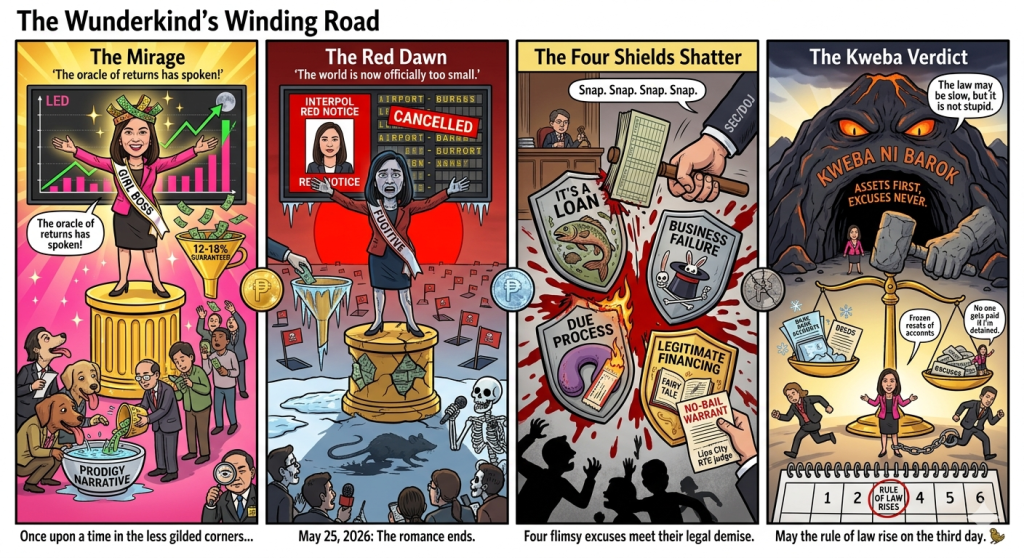
Now, from whatever sun-drenched, non-extradition-treaty bolthole she’s currently festering in, Tan’s legal team is preparing a four-pronged defense. Let’s take each prong and, with the gleeful malice of a prosecutor wielding a ledger, snap them one by one.
1. The “It’s Not a Security, It’s a Loan” Gambit. This is the oldest trick in the unregistered-securities playbook. The defense will argue that the promissory notes and Borrower-Lender Agreements were simple loans, not investment contracts requiring SEC registration. To this, I invoke the legal ghost of the U.S. Supreme Court’s Howey Test, long since adopted by the Philippine Supreme Court in Power Homes Unlimited Corp. v. Securities and Exchange Commission, G.R. No. 164182, February 26, 2008. Was there an investment of money? Yes. In a common enterprise? Yes, MFT Group and its dizzying array of subsidiaries. With an expectation of profits? A guaranteed 12% to 18% return is not a loan’s interest; it’s a profit promise so eye-watering it should have come with a free pair of goggles. Derived primarily from the efforts of others? The investors were passive cash cows, milked for funds while Tan played master-of-the-universe with their capital. A “loan” where the lender does nothing but wait for a magical 18% return is a security. Calling it a fish doesn’t make it one, especially when it stinks of a Ponzi scheme.
2. The “No Fraudulent Intent, Just Business Failure” Canard. Ah, the “dog ate my investors’ money” defense. Tan will weep that her legitimate, globe-spanning business simply suffered a liquidity crisis. This collapses under the weight of its own audited stupidity. The SEC and Department of Justice (DOJ) didn’t just find a business that hit a rough patch; they found a multi-year pattern of allegedly fabricated dividend income from subsidiaries that were either bleeding cash or had no earnings to distribute. The audited financial statements for 2018–2021, blessed by the supposedly infallible gatekeepers at Isla Lipana & Co. (PwC Philippines), were not just wrong; they were, according to the DOJ, a “device, scheme, or artifice to defraud.” A legitimate business failure doesn’t begin with inventing profits out of thin air. That’s not a collapse; it’s a magic trick where the only thing that disappears is the principal.
3. The “Procedural Irregularities and Denial of Due Process” Howl. The defense will scream that the SEC’s Cease-and-Desist Order (CDO) was an act of administrative tyranny. This is the last, desperate howl of the guilty. Citing the foundational Ang Tibay v. Court of Industrial Relations, G.R. No. 46496, 69 Phil. 635, February 27, 1940, we understand that administrative bodies have the power to act with swift, preventive force to protect the public. The CDO is not a conviction; it’s a fire extinguisher. The real due process—the trial on the merits, the right to confront witnesses, to present evidence—is waiting for her back in the Philippines. You cannot flee from a courtroom and then complain you weren’t given your day in it. The procedural argument is not a shield; it’s a travel pillow.
4. The “Legitimate Financing, Not a Ponzi Scheme” Fairy Tale. This is the most brazen lie, and the Lipa City Regional Trial Court has already taken a judicial sledgehammer to it. That court issued a no-bail arrest warrant for syndicated estafa. This is the nuclear option of Philippine criminal law, carrying a penalty of reclusion perpetua. As the Supreme Court held in People v. Balasa, G.R. No. 106357, September 3, 1998, syndicated estafa requires a syndicate of five or more persons formed with the intention of carrying out an unlawful scheme. The court’s finding of probable cause means a judge looked at the evidence and decided there was a strong enough case that Tan and her cohorts formed an organization designed to defraud the public. A “legitimate financing enterprise” is not formed with the intent to swindle. The no-bail warrant is the legal world’s way of saying this is not a debatable business hiccup; it’s a prima facie case of organized theft.
Four Questions That Expose the Ponzi Heart of the Matter
The defense will try to obfuscate, to drown the courtroom in procedural motions and complex-sounding jargon. But justice here will hinge on four simple, factual, and ultimately devastating questions. They are the pillars of estafa under the Revised Penal Code (Act No. 3815) and fraud under Section 26 of Republic Act No. 8799 (The Securities Regulation Code), and they require spreadsheets, not speeches:
- Where did the money go? The 138 frozen bank accounts tell a story of a vast, circulatory system. The prosecution must trace the flow. Did it go to fund “sure projects,” or to finance a lifestyle of a faux-prodigy and her inner circle?
- Were investor funds used as represented? She sold a story of working-capital financing for subsidiaries. The Anti-Money Laundering Council (AMLC) and SEC will need to prove the money was instead used for a classic shell game.
- Were returns generated by business activity or new investor inflows? This is the factual stake through the heart of the Ponzi allegation. If the 18% returns came from new widows and orphans rather than genuine dividends, the “legitimate business” defense is legally cremated.
- Can prosecutors prove deception from the beginning? The linchpin. The multi-year, allegedly fabricated financials are the prosecution’s smoking gun. A business that lies about its fundamental profitability from inception was born a fraud, not a failure.
When Gatekeepers Become Getaway Drivers: The Isla Lipana Reckoning
No autopsy is complete without dragging the enablers into the light. The DOJ’s inclusion of Isla Lipana & Co. partners is the single most terrifying development for the Philippine financial world. The “standalone entity” audit defense is a joke when the parent company’s own books—the very entity they audited—were allegedly a work of fiction. They are the architects of enablement, the high-priests of false comfort who gave a Ponzi scheme the sacred unqualified opinion. They are not just gatekeepers who fell asleep; they are accused of actively opening the gate for the thieves. Their day of reckoning would be a seismic, precedent-setting event for every Big Four firm that thinks a glossy letterhead is a license to overlook billions in phantom assets.
Hatol ng Kweba: Assets First, Excuses Never
The Interpol Red Notice is not the end, but it is the beginning of the end of the romance with Mica Tan. The rule of law must now be supreme. For the SEC and DOJ, this means a prosecution so meticulous that it not only convicts Tan but also creates a jurisprudential template that distinguishes architects from pawns under the Balasa standard. They must not drown in the breadth of their own indictment.
I call for a reasonable and practical compromise: a restitution-first settlement framework. Tan’s own threat that “no one gets paid” if she’s detained is both a confession of control and a perverse offer. The DOJ should call her bluff, conditioning any plea arrangement on the full, transparent surrender of all hidden global assets for victim recovery, not just a token fine.
Demand full transparency. Unmask the full money trail, follow it to every shell company, every real estate purchase, every hidden account. And demand full accountability, not just for the schemer, but for the auditors who waxed their signature on a tower of lies.
The law may be slow, but it is not stupid. The manhunt is on. The trial will grind on. And in the end, the only thing that matters is whether the evidence is strong enough to not only clip the wings of a runaway, but to dismantle the entire, corrupt architecture that lifted her so high.
May the rule of law rise on the third day. 🪨
Key Citations
A. Legal & Official Sources
- Act No. 3815. The Revised Penal Code of the Philippines. 8 Dec. 1930. Lawphil, lawphil.net/statutes/acts/act3815_1930.html.
- Ang Tibay v. Court of Industrial Relations. G.R. No. 46496. Supreme Court of the Philippines, 27 Feb. 1940. Lawphil, lawphil.net/judjuris/juri1940/feb1940/gr_46496_1940.html.
- People v. Balasa. G.R. No. 106357. Supreme Court of the Philippines, 3 Sept. 1998. Lawphil, lawphil.net/judjuris/juri1998/sep1998/gr_106357_1998.html.
- Power Homes Unlimited Corp. v. Securities and Exchange Commission. G.R. No. 164182. Supreme Court of the Philippines, 26 Feb. 2008. Lawphil, lawphil.net/judjuris/juri2008/feb2008/gr_164182_2008.html.
- Republic Act No. 8799. The Securities Regulation Code. 19 July 2000. Lawphil, lawphil.net/statutes/repacts/ra2000/ra_8799_2000.html.
- SEC v. W.J. Howey Co. 328 U.S. 293. Supreme Court of the United States, 1946. Justia, supreme.justia.com/cases/federal/us/328/293/.
B. News Reports
- Abris, Emmanuel John B. “Interpol Red Notice Out for MFT CEO Mica Tan.” Business Inquirer, Inquirer.net, 18 June 2026, business.inquirer.net/596007/interpol-red-notice-out-for-mft-ceo-mica-tan.

- ₱9 Billion in ‘Savings’? DILG’s Fire Truck Deal Smells Like Smoke

- ₱8B BBM Pork: CCTV for Every Captain’s Kumpare?

- ₱8.9 Billion, 331 Ghost Police Stations: The TIKAS Scandal Explained

- ₱8.4 Billion, 42,000 Barangays, 1 Election: The “Bawat Barangay Makikinabang” Vote-Buying Masterclass

- ₱75 Million Heist: Cops Gone Full Bandit

- ₱63 to the Dollar: The Only Thing Falling Faster Than the Peso Is the Government’s Credibility

- ₱6.77B Ghost Haunts Duterte: RTC Dismisses Mans Carpio’s Desperate Plea
- ₱6.77 Billion and Zero Cash: The Sara Duterte SALN Math That Doesn’t Add Up

- ₱6.7-Trillion Temptation: The Great Pork Zombie Revival and the “Collegial” Vote-Buying Circus

- ₱58.53B, Zero Receipts: The LGSF Pork Barrel Nobody Wants to Name
- ₱53 Million Man Tells ₱695-a-Day Workers to Stop Being ‘Mayabang’: The Audacity of BSP’s Remolona

- ₱4.4 Billion and a Witness Who Can’t Explain It: The Duterte Impeachment’s Most Expensive Non-Answer





Leave a Reply