Seven Days After Beijing’s Hit List, Four “Concerned Citizens” Suddenly Remember a 2016 Passport
By Louis ‘Barok’ C Biraogo — June 19, 2026
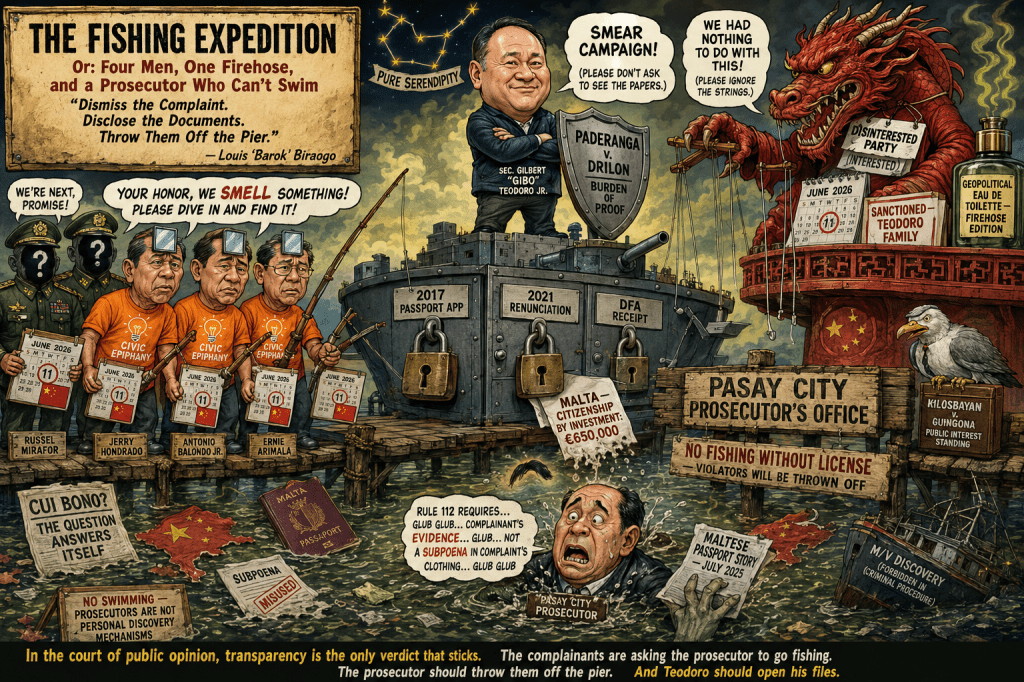
LET us begin with the smell test, dear readers, because any seasoned litigator will tell you that the most important legal instrument is not the Revised Penal Code—it is your nose. And right now, somewhere in Pasay City, a prosecutor is holding a 16-page complaint-affidavit that reeks not of probable cause, but of geopolitical eau de toilette applied with a firehose.
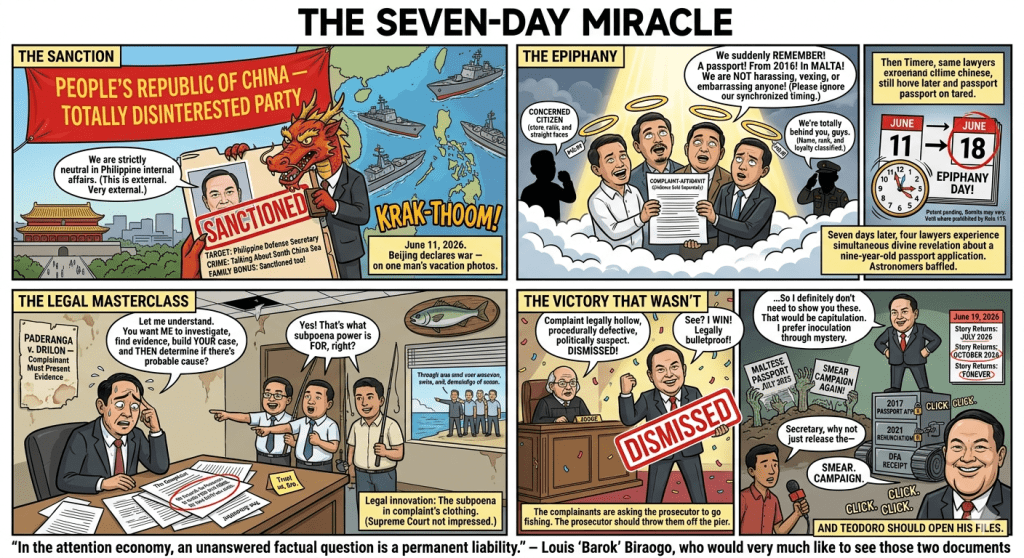
The timeline alone should make any sentient observer’s eyebrow arch so high it detaches from the forehead: On June 11, 2026, the People’s Republic of China—not exactly a disinterested party in Philippine defense politics—imposes unprecedented personal sanctions on Defense Secretary Gilbert “Gibo” Teodoro Jr. and his family over his South China Sea pronouncements. Seven days later, on June 18, four gentlemen named Russel Miraflor, Jerry Hondrado, Antonio Balondo Jr., and Ernie Arimala materialize from the procedural ether to file a criminal complaint before the Pasay City Prosecutor’s Office, accusing Teodoro of falsification and perjury related to a passport application submitted nine years ago.
Seven. Days. Later.
The complainants assure us, with straight faces presumably practiced in bathroom mirrors, that they are “not filing this case to harass, vex, or embarrass respondent.” Of course not. They are simply lawyers and taxpayers who suddenly, in June 2026, experienced an overwhelming civic epiphany about a Maltese passport issued in December 2016. The fact that their epiphany coincided almost to the hour with Beijing’s designation of Teodoro as a geopolitical enemy is, I am certain, pure serendipity. The stars aligned. The muse descended. Cui bono? The question practically answers itself.
Burden-Shifting Masterclass: “Your Honor, Please Investigate and Find Us a Crime”
Let us now dissect this legal creature, which is less a criminal complaint and more a subpoena dressed in a complaint’s clothing.
The petitioners accuse Teodoro of violating Section 10 of Republic Act No. 8239 (The Philippine Passport Act of 1996) for allegedly making false statements in his March 2017 passport application. They throw in Article 172(1) in relation to Article 171(4) of the Revised Penal Code (Act No. 3815) (falsification of public documents) and Article 183 (perjury) for decorative effect. A veritable buffet of criminal allegations.
And what evidence do they present to establish probable cause—that constitutionally mandated threshold under Rule 112 of the Revised Rules of Criminal Procedure (Rules of Court) that separates legitimate prosecution from state-sanctioned harassment?
They present… a request.
I am not making this up. The complainants, in their own complaint-affidavit, ask the prosecutor’s office to produce the evidence for them. They beseech the Pasay City Prosecutor to “produce certified true copies of the relevant passport application records, passport issuance records, travel records, citizenship retention or reacquisition records, and other official documents, so that the existence or non-existence of probable cause may be determined on the basis of authentic records.”
Read that again. Slowly. Let the audacity marinate.
These lawyers—lawyers, mind you—have filed a criminal complaint whose central theory is essentially: “Your Honor, we don’t know if a crime was committed, but if you could kindly investigate and find one, that would be splendid.”
The Department of National Defense (DND), through Assistant Secretary Erik Dy, correctly identified this as a “fishing expedition.” But let me be more precise: it is not even a fishing expedition. A fishing expedition implies you have a boat, a rod, and some idea of where the fish might be. This complaint is four people standing on the shore, pointing at the ocean, and demanding that the prosecutor swim.
The Supreme Court has been unambiguous on this point. In Paderanga v. Drilon (G.R. No. 96080), the Court emphasized that a preliminary investigation requires the complainant to present evidence sufficient to engender a well-founded belief that a crime has been committed. The DOJ’s own National Prosecution Service Rules mandate that the complaint-affidavit must be accompanied by the complainant’s evidence. The prosecutor is not your personal discovery mechanism. The burden of proof rests on the accuser—a principle so fundamental that it predates the Republic itself.
What makes this particularly galling is that the complainants effectively admit their own evidentiary bankruptcy. Rappler reports that the complaint contains language conceding that certain matters are “not yet clear up to this time.” Not yet clear. This is not the language of an accuser who knows a crime occurred. This is the language of someone hoping to find one in discovery. But criminal procedure does not permit discovery before probable cause is established. That is the entire point of probable cause—it is the filter that protects citizens from being dragged into the machinery of prosecution on the basis of speculation, rumor, or, in this case, suspiciously timed geopolitical convenience.
The elements of perjury under Article 183 are well-settled: (1) a false statement under oath, (2) on a material matter, (3) made with knowledge of its falsity. The Supreme Court in Lumancas v. Intas (G.R. No. 133472) reiterated that perjury requires willful and deliberate assertion of falsehood. Where is the false statement? What did Teodoro write on that 2017 application form? The complainants do not know. They want the prosecutor to find out for them.
This is not a complaint. It is an invitation to a fishing expedition. And the Rules of Court do not require prosecutors to RSVP.
Phantom Patriots or Proxy Warriors? The Complainants’ Sudden Civic Epiphany
Who are these civic-minded avengers? The complaint identifies them as lawyers and taxpayers with “legitimate legal and public interest.” Their public-interest standing is, I will concede, colorable in the tradition of Kilosbayan v. Guingona (G.R. No. 113375) and other taxpayer suits. But this is not a taxpayer suit seeking to enjoin an unconstitutional expenditure. This is a criminal complaint seeking to brand a sitting Cabinet secretary a falsifier and perjurer.
The opacity of their identity and sudden emergence is analytically significant. One complainant reportedly claimed, as reported by Philstar, that “active generals” promised to also file cases. Active generals? Which generals? Generals loyal to whom? Generals disgruntled by what—promotions denied, procurement contracts lost, policy disagreements with Teodoro’s hardline South China Sea posture?
I am not alleging coordination with Beijing. I am noting that when you file a criminal complaint against the official Beijing just sanctioned, and you do so with the evidentiary substance of cotton candy, and you hint that uniformed military personnel are backing your play, reasonable minds may entertain reasonable questions about whose interests are being served.
The complainants protest too much about their pure motives. In Philippine political culture, the legal complaint-as-reputational-weapon is a venerable tradition. Even a dismissed complaint generates headlines, forces the target to expend political capital, and leaves a permanent smear—the “where there’s smoke” fallacy that the public devours. The complaint itself is the punishment; the dismissal is merely the postscript nobody reads.
Legally Strong, Politically Tone-Deaf: Teodoro and the DND’s Transparency Failure
Now, let me turn my fire where it also belongs: upon the respondent himself and his department.
Legally, Teodoro’s position is strong. He reportedly renounced Maltese citizenship in 2021 before filing his certificate of candidacy for senator, complying with Section 5(3) of Republic Act No. 9225 (The Citizenship Retention and Re-acquisition Act of 2003), which requires elective office-seekers to execute a “personal and sworn renunciation of any and all foreign citizenship.” He disclosed the Maltese passport to the Commission on Appointments (CA) before his 2023 confirmation as Defense Secretary—a confirmation that proceeded without objection. The CA is a constitutional body under Article VI, Section 18 of the 1987 Constitution. Its vetting is not meaningless theater (or at least, it is not supposed to be).
The Supreme Court has long distinguished between dual citizenship and dual allegiance—Mercado v. Manzano (G.R. No. 135083) and Cordora v. Commission on Elections (G.R. No. 176947) being the canonical citations. The Constitution, under Article IV, Section 5 of the 1987 Constitution, condemns “dual allegiance,” not the passive possession of a second citizenship acquired through foreign law. Teodoro’s camp can credibly argue that acquiring Maltese citizenship in 2016 (reportedly through that nation’s citizenship-by-investment program, the “golden passport” route), holding it passively, and then formally renouncing it in 2021 before seeking public office is exactly the kind of cured defect Philippine jurisprudence contemplates.
But here is where I abandon legal analysis and pick up the sledgehammer of political judgment: Why in God’s name has DND not simply released the documents?
This story first surfaced in July 2025. The Manila Times reported the Maltese passport. DND called it a “smear campaign” and moved on. Now, a year later, the same story returns as a formal criminal complaint, and DND’s response is… another press statement calling it a smear campaign?
Do they not understand how this works? In the attention economy, an unanswered factual question is a permanent liability. The complainants’ entire case collapses if Teodoro produces: (a) the actual 2017 passport application showing what he declared, and (b) the 2021 Maltese renunciation certificate. That is it. Two documents. One news cycle. Problem solved.
Instead, DND has chosen the strategy of rhetorical defiance—a strategy that guarantees this story will recur, zombie-like, every time geopolitical winds shift or political rivals need a cudgel. The refusal to release exculpatory documents transforms a legal weakness (the complainants’ nonexistent evidence) into a political vulnerability (the perception that Teodoro has something to hide).
As of this writing, one complainant has specifically noted that there is no public proof the Maltese government itself acknowledged the renunciation. Malta’s citizenship law may require an affirmative governmental act to terminate citizenship—not merely a personal declaration by the citizen. If that act of formal termination is undocumented or incomplete, the “dual citizen while Defense Secretary” allegation has more legs than DND’s dismissive press releases suggest.
Transparency is not capitulation. It is inoculation. Release the documents. End the story. The fact that DND has spent a year refusing to do so is either arrogance, incompetence, or the quiet acknowledgment that the documents are less exculpatory than advertised. None of these possibilities reflects well on the Defense Secretary.
The Real Scandal: Weaponizing Criminal Process at the Worst Possible Moment
Let us speak plainly about what is happening here.
The Philippine criminal justice system has a preliminary investigation mechanism designed precisely to filter out complaints like this—complaints built on speculation, complaints that demand the state build the complainant’s case for them, complaints that appear timed less to vindicate the public interest than to serve an undisclosed agenda.
Whether Miraflor et al. are Beijing proxies, disgruntled military faction operatives, or simply overzealous public-interest litigators who failed to do their homework, the effect is the same: a sitting Defense Secretary—at the very moment he is managing the Philippines’ most volatile external security challenge in decades—is distracted by a criminal complaint that cannot even articulate what false statement he allegedly made.
The Supreme Court has repeatedly held that perjury and falsification charges require specificity. The allegedly false statement must be identified. The falsity must be demonstrated. The knowledge of falsity must be shown. A complaint that effectively says “we suspect something might be wrong, please investigate” fails this threshold not by a little, but entirely.
The Mandatory Conclusion: Dismiss the Complaint, Disclose the Documents
I therefore make two demands, one to the prosecutor and one to the respondent:
To the Pasay City Prosecutor’s Office: Dismiss this complaint for lack of probable cause. Rule 112 does not permit complainants to outsource their evidentiary burden to your subpoena power. The Revised Penal Code’s perjury and falsification provisions require proof of a specific false statement, not speculation that one might exist. The Supreme Court’s jurisprudence from Paderanga to Lumancas demands evidence at the point of filing, not promises of evidence to be discovered later. This complaint does not meet that standard. Dismiss it, and dismiss it with a resolution that makes clear the preliminary investigation process is not a toy for geopolitical proxy warfare.
To Secretary Teodoro: You are not criminally liable on this record. But you are politically foolish. Release the 2017 passport application. Release the 2021 Maltese renunciation certificate. Release the Department of Foreign Affairs (DFA) or Maltese government acknowledgment of that renunciation. Do it today. Do it publicly. Do it completely. The legal battle you will win by dismissal. The political battle you are losing every day you allow the perception of concealment to fester. In the court of public opinion, transparency is the only verdict that sticks.
The complaint against Gilbert Teodoro is legally hollow, procedurally defective, and politically suspect. It should be dismissed. But the controversy it feeds will not die until the documents see sunlight.
The complainants are asking the prosecutor to go fishing. The prosecutor should throw them off the pier.
And Teodoro should open his files.
— Louis ‘Barok’ C. Biraogo
Kweba ni Barok
June 19, 2026
Key Citations
A. Legal & Official Sources
- The 1987 Constitution of the Republic of the Philippines. Official Gazette of the Republic of the Philippines, 1987, http://www.officialgazette.gov.ph/constitutions/1987-constitution/.
- Act No. 3815. Revised Penal Code of the Philippines, 8 Dec. 1930. Official Gazette of the Republic of the Philippines, http://www.officialgazette.gov.ph/1930/12/08/act-no-3815-s-1930/.
- Republic Act No. 8239. An Act Providing for the Issuance of Philippine Passports and for Other Purposes (The Philippine Passport Act of 1996), 22 Nov. 1996. Lawphil, lawphil.net/statutes/repacts/ra1996/ra_8239_1996.html.
- Republic Act No. 9225. An Act Making the Citizenship of Philippine Citizens Who Acquire Foreign Citizenship Permanent, Amending for the Purpose Commonwealth Act No. 63, as Amended, and for Other Purposes (The Citizenship Retention and Re-acquisition Act of 2003), 29 Aug. 2003. Lawphil, lawphil.net/statutes/repacts/ra2003/ra_9225_2003.html.
- Paderanga v. Drilon. G.R. No. 96080. 19 Apr. 1991. Supreme Court of the Philippines. Lawphil, lawphil.net/judjuris/juri1991/apr1991/gr_96080_1991.html.
- Lumancas v. Intas. G.R. No. 133472. 5 Dec. 2000. Supreme Court of the Philippines. Lawphil, lawphil.net/judjuris/juri2000/dec2000/gr_133472_2000.html.
- Kilosbayan, Inc. v. Guingona, Jr. G.R. No. 113375. 5 May 1994. Supreme Court of the Philippines. Lawphil, lawphil.net/judjuris/juri1994/may1994/gr_113375_1994.html.
- Mercado v. Manzano. G.R. No. 135083. 26 May 1999. Supreme Court of the Philippines. Lawphil, lawphil.net/judjuris/juri1999/may1999/gr_135083_1999.html.
- Cordora v. Commission on Elections. G.R. No. 176947. 19 Feb. 2009. Supreme Court of the Philippines. Lawphil, lawphil.net/judjuris/juri2009/feb2009/gr_176947_2009.html.
B. News Reports
- Cupin, Bea “Complaint vs Teodoro Seeks Answers to ‘Lingering Questions’ on Citizenship.” Rappler, 18 June 2026, http://www.rappler.com/philippines/complaint-gibo-teodoro-maltese-citizenship/.
- “China Bars Philippines Defence Chief as South China Sea Spat Sails Onwards.” Al Jazeera, 11 June 2026, http://www.aljazeera.com/news/2026/6/11/china-bars-philippines-defence-chief-as-south-china-sea-spat-sails-onwards.
- Chi, Cristina. “Teodoro Gave Up Maltese Passport Before 2022 Senatorial Run.” Philstar.com, 14 July 2025, http://www.philstar.com/headlines/2025/07/14/2457879/teodoro-gave-maltese-passport-2022-senatorial-run.
- Laqui, Ian “Lawyers Seek Probe into Teodoro’s Already-Denounced Maltese Passport.” Philstar.com, 18 June 2026, http://www.philstar.com/headlines/2026/06/18/2536135/lawyers-seek-probe-teodoros-already-denounced-maltese-passport.
- Teodoro, Gilberto “Gibo” Jr. “Defense Chief Issues Clarification on Maltese Passport.” The Manila Times, 17 July 2025, http://www.manilatimes.net/2025/07/17/opinion/letters-to-the-editor/defense-chief-issues-clarification-on-maltese-passport/2150724.

- ₱9 Billion in ‘Savings’? DILG’s Fire Truck Deal Smells Like Smoke

- ₱8B BBM Pork: CCTV for Every Captain’s Kumpare?

- ₱8.9 Billion, 331 Ghost Police Stations: The TIKAS Scandal Explained

- ₱8.4 Billion, 42,000 Barangays, 1 Election: The “Bawat Barangay Makikinabang” Vote-Buying Masterclass

- ₱75 Million Heist: Cops Gone Full Bandit

- ₱63 to the Dollar: The Only Thing Falling Faster Than the Peso Is the Government’s Credibility

- ₱6.77B Ghost Haunts Duterte: RTC Dismisses Mans Carpio’s Desperate Plea

- ₱6.77 Billion and Zero Cash: The Sara Duterte SALN Math That Doesn’t Add Up

- ₱6.7-Trillion Temptation: The Great Pork Zombie Revival and the “Collegial” Vote-Buying Circus

- ₱58.53B, Zero Receipts: The LGSF Pork Barrel Nobody Wants to Name
- ₱53 Million Man Tells ₱695-a-Day Workers to Stop Being ‘Mayabang’: The Audacity of BSP’s Remolona

- ₱4.4 Billion and a Witness Who Can’t Explain It: The Duterte Impeachment’s Most Expensive Non-Answer






Leave a Reply