Bicam Black Hole Exposed: How P500 Billion Appeared Without a Single Document
By Louis ‘Barok‘ C. Biraogo — June 18, 2026
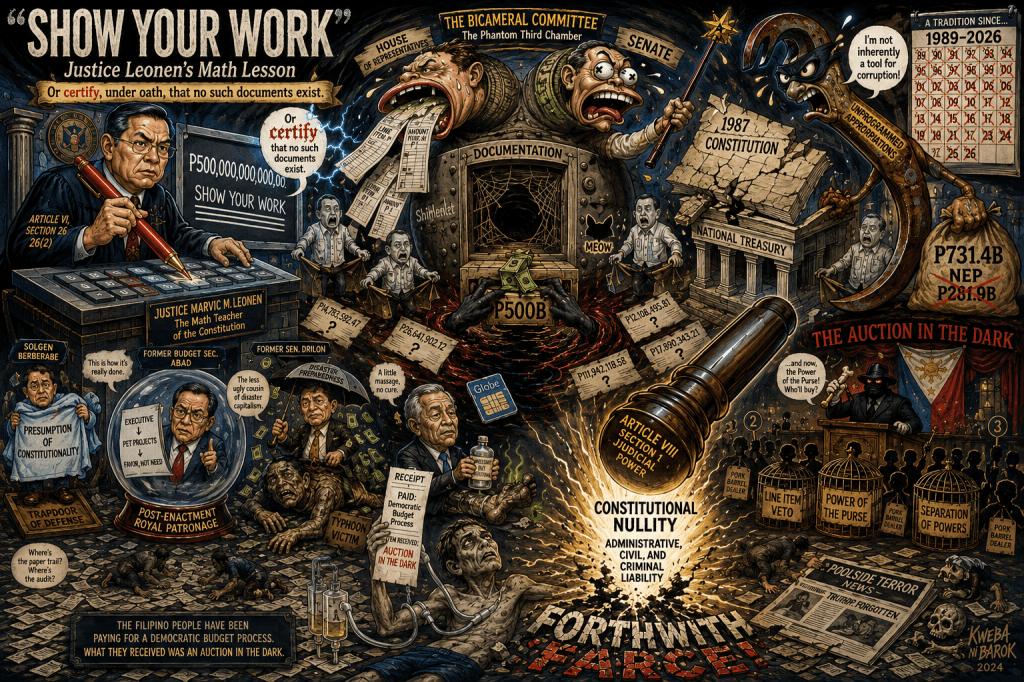
THE air in the Supreme Court’s session hall on June 16, 2026, did not crackle with the usual ponderous legalese. It crackled with the particular electricity of a trap about to snap shut. Senior Associate Justice Marvic Leonen, his voice calibrated to the precise temperature of judicial ice, did not ask a question. He issued a dare dressed as a directive: produce the supporting documents for the P400 to P500 billion in changes conjured into existence by the bicameral conference committee during the 2024 budget deliberations. Or, if you cannot—and here the silence must have been deafening—certify, once and for all, that no such documents exist.
The beauty of the Leonen-Caguioa gambit is not in its complexity. It is in its brutal, almost cruel simplicity. For decades, the General Appropriations Act (GAA) has been treated as a magical ledger, where figures emerge from the bicameral smoke-filled rooms not with the painful, public deliberation Article VI, Section 26(2) of the 1987 Constitution of the Republic of the Philippines demands, but as a fait accompli. The House and Senate versions, we are told, hew closely to the Executive’s National Expenditure Program. Then, like a fiscal Holy Spirit, the bicam report descends, suddenly heavier by half a trillion pesos. Where did it come from? Nemo scit. Nobody knows. That, Justice Leonen effectively declared, is no longer an acceptable answer in a constitutional democracy. The Court has finally asked Congress to show its math. The resulting silence is the sound of institutional corruption being forced into the light.
The UA Crowbar in the Vault: Not Inherently Corrupt—Until It Is
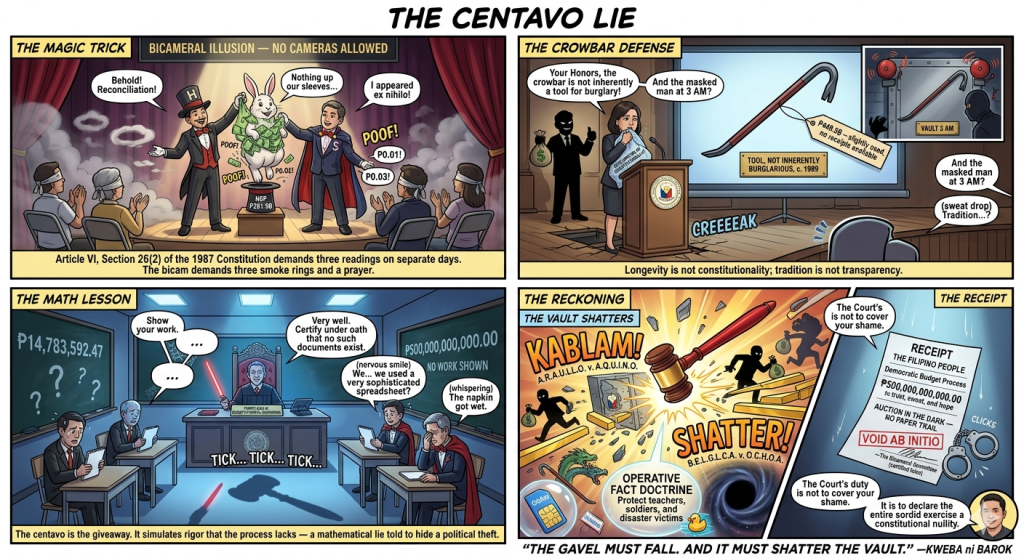
Let us speak plainly. The Unprogrammed Appropriations (UA) mechanism is not a “standby fund.” It is a standing invitation to fiscal debauchery. Solicitor General Darlene Marie Berberabe, performing the obligatory Kabuki dance of executive defense, insists the UA is “not inherently a tool for corruption.” Technically correct—in the same way a crowbar is not inherently a tool for burglary. But when you find the crowbar in the hands of a masked man inside a vault at 3 a.m., you stop debating its “inherent” nature and start asking what was stolen.
The UA has existed since 1989, Berberabe pleads. Indeed, and corruption has existed since the Code of Hammurabi. Longevity is not constitutionality; tradition is not transparency. The SolGen’s invocation of the presumption of constitutionality is a legal security blanket she clutches while standing on a trapdoor. The petitioners—the late Edcel Lagman, Koko Pimentel, and their co-litigants—are not merely challenging an abstract mechanism. They are challenging the P449.5 billion that mushroomed in the 2024 GAA, an increase from the NEP’s P281.9 billion to a staggering P731.4 billion. That is not a contingency fund for typhoons. That is the annual GDP of a small nation, tucked beneath the legislative mattress.
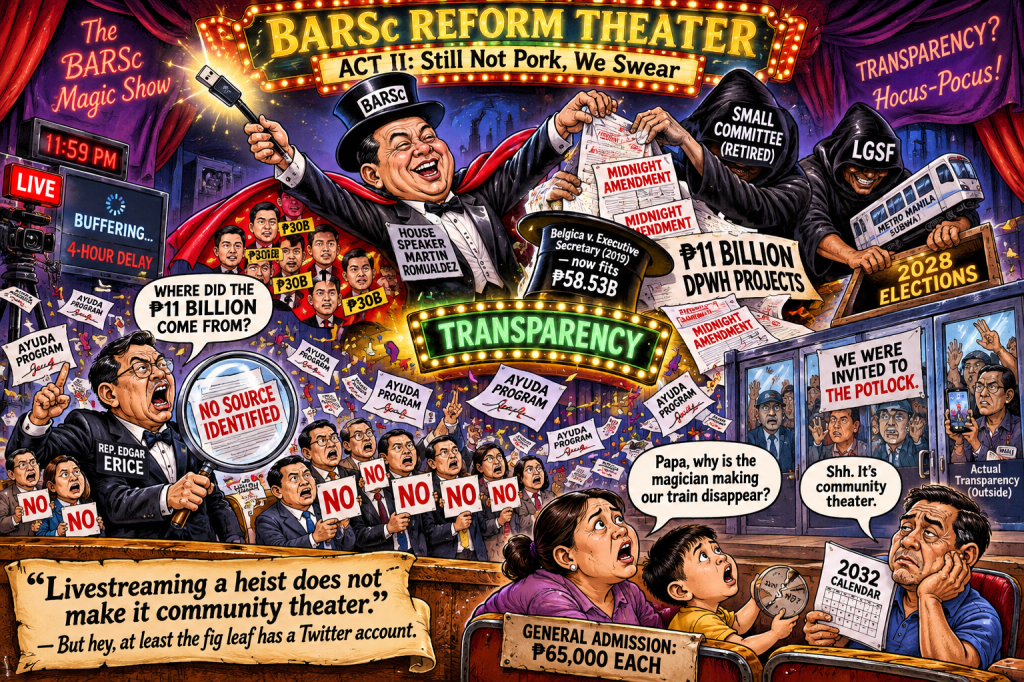
And then comes the testimony that should make every Filipino taxpayer’s blood simmer. Former Budget Secretary Florencio Abad—hardly a stranger to budgetary dark arts himself—delivered the most damning indictment of the regime he once served. The UA, he explained, does not just sit there. When revenues “exceed targets,” the Executive decides which pet projects among the hundreds of billions in standby items get funded. This is not an appropriation by the people’s representatives. This is a post-enactment royal patronage system, a direct violation of the separation of powers that Belgica v. Ochoa (G.R. No. 208566, November 19, 2013) supposedly buried with the pork barrel. The Priority Development Assistance Fund (PDAF) allowed legislators to play god with post-enactment funds; the UA allows the Executive to do the same. The demon has not been slain. It has merely relocated from the Batasan to the Budget department. With reprogramming figures exploding—P395.5 billion in 2023, P564 billion in 2024, P487 billion in 2025—this is not a bug in the system; it is the operating system.
Ghost Pork and the Centavo Lie: Where Is the Paper Trail?
Where is the paper trail? This is the question that will haunt Congress more than any constitutional theory. Leonen noted, with the kind of pointed precision that separates inquisitors from mere judges, that the bicameral insertions featured centavo amounts. Figures down to the last decimal point. How? How does one derive a line-item appropriation of precisely P14,783,592.47 without a spreadsheet, an agency request, a feasibility study, or at the very least, a napkin with some drunken arithmetic on it? The centavo is the giveaway. It simulates a rigor that the process itself lacks—a mathematical lie told to hide a political theft.
Joey Salceda, the ever-articulate defender of disaster capitalism’s less ugly cousin, offers the only argument that passes a straight-face test: the Philippines needs standby funds because it is a geological and meteorological punching bag. True. Supplements take 62 days on average; typhoons do not wait. But this is the argumentative equivalent of a magician’s flourish—a distraction. No one is arguing against a legitimate, transparent, and pre-documented contingent fund for genuine emergencies. They are arguing against P500 billion in line items with no discernible origin, inserted at the last mile of the legislative process, to be released at the pleasure of the Executive. If Salceda’s disaster fund requires P500 billion in undocumented pork as a rider, he is not defending disaster preparedness; he is defending a protection racket for legislative plunder that uses typhoon victims as human shields.
Former Senate President Franklin Drilon, playing the wise elder statesman, suggests the mechanism is “constitutional but unnecessary.” This is the bureaucratic equivalent of diagnosing a patient with a gangrenous limb but recommending a light massage. If the President already has the line-item veto, the power to withhold releases, and the power to seek supplemental appropriations, then the UA is constitutionally redundant. Redundancy that costs P500 billion in opaque slush is not a policy quirk; it is a structural cancer.
Constitutional Crucifixion: The Bicam as Third Chamber
The defense will scream “political question” and wave the enrolled bill doctrine like a crucifix. Let them. Article VIII, Section 1 of the 1987 Constitution grants this Court the duty to strike down acts tainted by grave abuse of discretion. A budget forged in the dark, where legislators cannot explain the provenance of half a trillion pesos, is the very definition of arbitrariness that crosses the line from political wisdom to justiciable offense. Araullo v. Aquino (G.R. No. 209287, July 1, 2014) already held that the Disbursement Acceleration Program (DAP)’s cross-border transfers were unconstitutional. The UA, as Abad testified, is the same concept in reverse: the Executive deciding which appropriations to “activate,” bypassing Congress’s exclusive power of the purse under Article VI, Section 29(1) of the 1987 Constitution.
The bicameral committee, by inserting P400-500 billion not found in either the House or Senate versions, did not “reconcile” differing bills. It created a third bill, a monstrous legislative chimera that never underwent three readings on separate days as Article VI, Section 26(2) of the 1987 Constitution demands. The bicam has become a third chamber, meeting in secret, wielding a power the Constitution never granted it: the power to invent appropriations ex nihilo.
The Verdict: Guardrails Won’t Save a System Driven Off the Cliff
The Supreme Court must resist Justice Rodil Zalameda’s siren song of mere “guardrails.” Guardrails are for functioning highways, not for a legislative process that has driven the budget off a cliff and into an abyss of opacity. Congress has had decades to self-correct. It chose not to. The reduction of the UA in the 2026 budget is an admission of guilt, not a reform.
The Court should follow Araullo’s operative fact doctrine: protect the good-faith recipients of any already-disbursed funds—the teachers, the soldiers, the disaster victims—but expose the authors, proponents, and implementors of these undocumented insertions to the full force of administrative, civil, and criminal liability.
Let this be the legacy of this case, which we shall prematurely christen Lagman v. The Pork Reborn: any item inserted in a bicameral report without line-item documentation is void. Let Congress certify, under oath, the paper trail for every centavo. And if that certification proves false, let the penalties be severe enough to make even the most entrenched budgetary warlord tremble.
The Filipino people have been paying for a democratic budget process. What they received was an auction in the dark. Justice Leonen has asked for the receipts. If Congress cannot produce them, it is not the Court’s duty to cover their shame. It is the Court’s duty to declare the entire sordid exercise a constitutional nullity, and in doing so, finally serve justice, transparency, and genuine pro-people governance to a citizenry bled dry by a system designed to be unaccountable. The gavel must fall. And it must shatter the vault.
Key Citations
A. Legal & Official Sources
- The 1987 Constitution of the Republic of the Philippines. Official Gazette of the Republic of the Philippines, 1987, http://www.officialgazette.gov.ph/constitutions/1987-constitution/.
- Araullo v. Aquino, G.R. No. 209287, Supreme Court of the Philippines, 1 July 2014, lawphil.net/judjuris/juri2014/jul2014/gr_209287_2014.html.
- Belgica v. Ochoa, G.R. No. 208566, Supreme Court of the Philippines, 19 Nov. 2013, lawphil.net/judjuris/juri2013/nov2013/gr_208566_2013.html.
B. News Reports
- Magadia, Carl. “SC Requests House, Senate to Explain P500-B Bicam Budget Changes.” Tribune.net.ph, 16 June 2026, https://tribune.net.ph/2026/06/16/sc-requests-house-senate-to-explain-p500-b-bicam-budget-changes.
- “Ang Hirap Maging Mahirap”: The PAO Scandal That Proves Government Contempt Is Nothing New
- “Far-Off” My Axx: Malacañang’s Claire Castro Drowns in Her Own Legal Gaslighting
- “Forthwith” to Farce: How the Senate is Killing Impeachment—And Why Enrile’s Right (Even If You Can’t Trust Him)
- “HINDI AKO NAG-RESIGN!”

- “I Know Nothing”: Baste Duterte’s Amnesia Defense Meets ₱33M in GenCorp Contracts
- “I’m calling you from my new Globe SIM. Send load!”

- “Mahiya Naman Kayo!” Marcos’ Anti-Corruption Vow Faces a Flood of Doubt

- “Manageable” Debt, Unmanageable Lies: DBM’s ₱21 Trillion Fairy Tale
- “Meow, I’m calling you from my new Globe SIM!”

- “Natrabaho”: One Word, One Ombudsman, and a Judiciary on Trial
- “No Special Jail for Crooks!” Boying Remulla Slams VIP Perks for Flood Scammers
- “Philippine-Controlled” or Yankee Gas Station? The Davao Fuel Depot Farce Exposed



Leave a Reply