
Why Macapagal Might Be the Only Figure Who Can Turn This Gamble into Real Filipino Gains
By Louis “Barok” C. Biraogo — June 16, 2026
The Official Pitch for Pax Silica’s Golden Node — Dreams, Details, and Dangerous Gaps
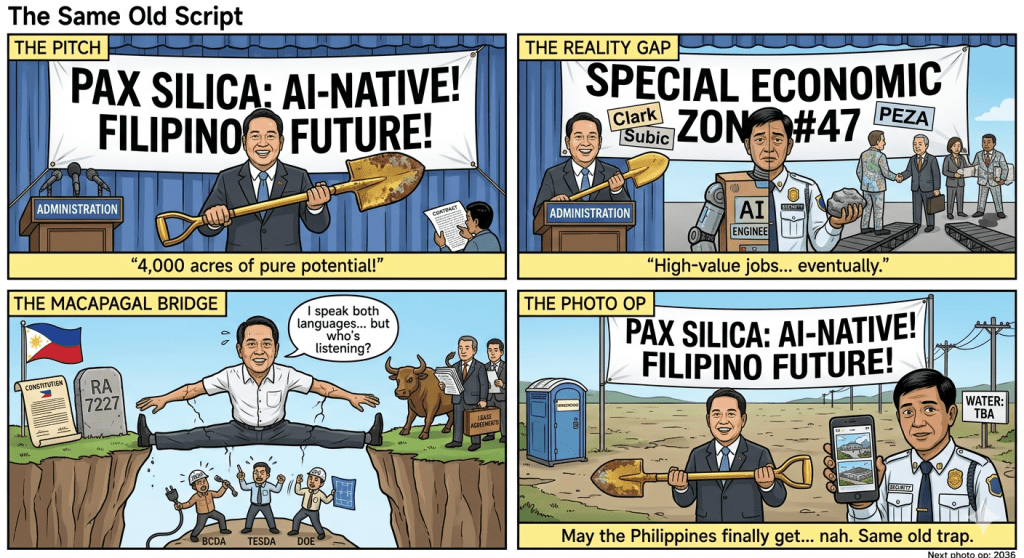
Official announcements present the 4,000-acre AI industrial hub in New Clark City as the first “AI-native” facility under Pax Silica. The project is framed as a commercial development under Philippine law within the Luzon Economic Corridor, with promises of moving the country up global supply chains in semiconductors and critical minerals, creating high-value jobs, and attracting major foreign investment.
Yet the pitch leaves several dangerous gaps. It offers no concrete plan for the enormous energy demands of AI and semiconductor facilities, stays silent on binding technology transfer and local content requirements, and provides little clarity on the fiscal costs of incentives and lease concessions. The historical pattern of Philippine special economic zones delivering uneven results is also ignored.
This optimistic vision identifies a real strategic window. Whether the Philippines can turn it into genuine transformation — or whether powerful interests will allow the same old gaps to persist — will depend on the stakeholders and incentives now shaping the project.
Stakeholder Interests and Balancing Act
The interests at play are substantial and sometimes in tension. The Marcos administration sees a potential legacy-defining economic achievement timed for the final years of the term — a concrete demonstration of infrastructure and investment momentum that also deepens security cooperation with the United States amid ongoing West Philippine Sea challenges.
The United States, through the State Department and figures like Undersecretary Jacob Helberg, views the hub as part of a broader effort to build resilient, trusted technology and critical minerals supply chains. The Bases Conversion and Development Authority (BCDA) has long sought to transform New Clark City from planning documents into a functioning smart city; the Pax Silica designation and foreign investor interest provide the scale and capital that could finally make that possible.
Foreign companies are evaluating access to Philippine nickel and other minerals, incentives under CREATE MORE and related laws, and proximity to Subic’s port facilities. Local communities in Tarlac and surrounding areas stand to gain employment and infrastructure spillovers but also face questions about land use changes, water demand for advanced facilities, and the quality of jobs that will actually be created. Progressive organizations have raised legitimate concerns about agricultural displacement, environmental impacts, transparency in long-term commitments, and the risk that the project could become overly entangled in great-power competition without sufficient safeguards for Philippine interests. These perspectives are not automatically in conflict, but they require deliberate balancing.
Compelling Arguments in Support
The strongest arguments in favor of the initiative are compelling. The global reconfiguration of semiconductor, AI, and critical minerals supply chains creates a genuine opening. Countries that position themselves credibly now can secure long-term contracts and investment that might otherwise flow elsewhere.
The Philippines possesses significant nickel reserves and other minerals that are essential to the energy transition and advanced manufacturing; capturing more of the processing and downstream value at home would represent a structural upgrade from the historical pattern of raw material export or low-value assembly. The legal framework on paper — anchored in RA 7227 and the Investors’ Lease Act — offers investors predictability while remaining under Philippine jurisdiction. The proposed two-year lease grace period and the broader incentive package can help attract the initial wave of locators.
If the project delivers on its job projections and draws genuine technology and skills transfer, it could accelerate the Luzon Economic Corridor and provide a model for future economic security zones. The timing aligns with U.S. policy priorities that favor trusted partners, which in turn can strengthen the Philippines’ overall strategic position.
Serious Risks and Counterarguments
The counterarguments and risks are equally serious and cannot be wished away. Historical precedent shows that special economic zones and large-scale industrial projects in the Philippines have often delivered uneven results: foreign capital and technology have tended to retain control of higher-value segments while domestic participation remained concentrated in lower- and mid-tier roles. Without strong, enforceable mechanisms for technology transfer, local supplier development, and skills upgrading, the hub could replicate that pattern rather than break it.
Energy infrastructure is a critical constraint; AI data centers and semiconductor facilities are highly power-intensive, and current capacity and reliability in the New Clark area fall short of what would be required at scale. Fiscal incentives and lease concessions represent real public resources whose returns depend on actual investment, job quality, and long-term economic linkages materializing. Geopolitical dimensions add complexity: deeper integration into U.S.-aligned supply chains carries both benefits and the possibility of economic friction with other partners.
Environmental and social safeguards — including full environmental impact assessments, water resource management, labor standards, and respect for any affected communities or ancestral domains — must be robust from the outset, not retrofitted later. These risks are manageable, but only with deliberate design and rigorous implementation.
Structural Governance Challenges
Philippine governance faces well-documented structural challenges that have repeatedly turned promising announcements into under-delivered outcomes. Infrastructure projects have often suffered from fragmented agency coordination, right-of-way delays, and power sector constraints that keep industrial electricity costs high by regional standards. Education and training systems have not consistently produced the advanced technical workforce needed for higher-value manufacturing at the pace required. Elite and bureaucratic incentives have sometimes prioritized short-term visibility over sustained institution-building.
Lessons from Regional Peers
Regional peers illustrate what consistent execution can achieve: Vietnam has rapidly scaled electronics manufacturing and attracted major semiconductor-related investments through reliable infrastructure and policy predictability; Indonesia has pursued downstreaming policies in nickel that capture more value domestically; Thailand developed a competitive automotive supply chain over decades; Malaysia has moved segments of its electronics sector into higher-value activities. The Philippines has the talent, location, and resource base to match or exceed these trajectories, but closing the gap requires addressing the execution shortfalls that have held it back.
Michael Ted Macapagal’s Unique Positioning
This is precisely where Michael Ted Macapagal’s background and positioning become highly relevant. His experience as a corporate executive in the United States — including pioneering work in title insurance — gives him direct understanding of what institutional investors and multinational companies require: contractual certainty, predictable dispute resolution, and infrastructure that functions on day one. His prior roles as PNR Chairman, Clark Development Corporation director, and Subic Bay Freeport point man provide deep institutional knowledge of the exact corridor where the hub is located and the legal and political realities of operating under RA 7227 and related frameworks.
His roots in Olongapo and family history tied to the post-bases conversion era add a grounded appreciation for both the economic promise and the sovereignty sensitivities that surround any large foreign-linked project in the region. In a landscape where many officials speak primarily in the language of political positioning or domestic constituencies, Macapagal is unusually equipped to serve as an effective interlocutor between Philippine legal and constitutional requirements and the expectations of international capital. He can articulate the project’s opportunities credibly to investors while helping ensure that implementation stays within a clear rule-of-law framework. If the administration wants the Golden Node to succeed rather than become another partially realized vision, empowering figures with this combination of binational fluency, sectoral knowledge, and demonstrated commitment to Philippine interests is a practical necessity.
Defining Success Through Broad-Based Justice
Ultimately, success must be measured not only by investment inflows or headline job numbers but by whether the project advances broad-based economic justice. The Filipino people — particularly workers, engineers, and communities in Central Luzon — deserve more than serving as a platform for foreign-designed technologies and foreign-captured profits. They deserve genuine skills development, pathways into higher-value roles and ownership stakes where feasible, technology transfer that builds domestic capability, and infrastructure that benefits surrounding areas rather than creating isolated enclaves. Environmental and labor protections must have real enforcement teeth. Fiscal incentives should be transparent and conditional on measurable performance. If these elements are missing, the project risks becoming a more sophisticated version of older patterns in which the many bear the costs and risks while concentrated benefits flow elsewhere.
Concrete Recommendations for Implementation
To translate the vision into durable national gains, several concrete measures are essential:
- Establish clear, time-bound technology transfer and local content requirements in all locator agreements, with independent monitoring and consequences for non-compliance.
- Implement binding local hiring and training commitments, including partnerships with state universities and TESDA to build a pipeline of Filipino engineers, technicians, and managers.
- Require full environmental and social impact assessments, including cumulative water and power demand analysis, with meaningful community consultation before major land-use changes.
- Create transparent public reporting on all fiscal incentives, lease terms, and performance metrics, with clawback provisions if commitments are not met.
- Strengthen oversight through a dedicated multi-stakeholder body that includes legislative, local government, and civil society representation with authority to review progress and address issues.
- Prioritize and fund dedicated power and supporting infrastructure ahead of or in parallel with locator groundbreaking, with clear timelines and accountability.
- Ensure all long-term commitments receive appropriate legislative scrutiny and that sovereignty safeguards — including exclusive application of Philippine law — are maintained and publicly reaffirmed.
These steps are not obstacles to investment; they are the conditions that make investment sustainable and nationally beneficial.
Seizing the Historical Window
The Philippines has been presented with a meaningful opening. Global supply chain realignments, domestic mineral resources, and the legal architecture already in place create a window that earlier generations of policymakers would have envied. Realizing the potential of the New Clark City AI hub will require moving beyond announcement to disciplined execution, beyond aspirational language to enforceable safeguards, and beyond elite-level deal-making to genuine inclusion of Filipino workers and communities in the gains. Michael Ted Macapagal’s unique profile positions him to help bridge the gaps between vision and delivery, between investor requirements and Philippine red lines. Whether the country seizes this moment depends on whether its institutions and leaders can finally prioritize long-term national capability over short-term optics and fragmented interests.
The opportunity is real. The obstacles are known. The choice — and the responsibility — rests with Filipinos.
May the Philippines finally get an industrial project that serves the nation instead of just serving as another photo opportunity for those already comfortable.
— Barok
Key Citations
A. Laws and Official Documents
- Republic Act No. 7227. Bases Conversion and Development Act of 1992. Congress of the Philippines, 13 Mar. 1992, lawphil.net/statutes/repacts/ra1992/ra_7227_1992.html.
- Republic Act No. 7652. Investors’ Lease Act, Congress of the Philippines, 4 June 1993. https://lawphil.net/statutes/repacts/ra1993/ra_7652_1993.html.
- Republic Act No. 12066. CREATE MORE Act. Congress of the Philippines, 8 Nov. 2024, lawphil.net/statutes/repacts/ra2024/ra_12066_2024.html.
- United States Department of State. “The United States and the Philippines Launch Plans for 4,000-Acre Economic Security Zone to Shore Up Supply Chains; First AI-Native Industrial Acceleration Hub Under Pax Silica.” 16 Apr. 2026, state.gov/releases/office-of-the-spokesperson/2026/04/the-united-states-and-the-philippines-launch-plans-for-4000-acre-economic-security-zone-to-shore-up-supply-chains-first-ai-native-industrial-acceleration-hub-under-pax-silica.
- Bases Conversion and Development Authority. New Clark City. newclark.ph/.
B. News Articles and Reporting
- “Philippines, US to build industrial hub to strengthen supply chain security.” Reuters, 17 Apr. 2026, reuters.com/world/asia-pacific/philippines-us-build-industrial-hub-supply-chain-security-2026-04-17/.
- Pascual, Jekki. “US official in PH inspects future AI industrial hub.” ABS-CBN News, 20 May 2026, abs-cbn.com/news/business/2026/5/20/us-official-in-ph-inspects-future-ai-industrial-hub-1309.
- “4000-acre AI industrial hub to rise in New Clark City.” Manila Standard, 20 Apr. 2026, manilastandard.net/business/314729347/4000-acre-ai-industrial-hub-to-rise-in-new-clark-city.html.
C. Analysis and Fact Sheets
- “Fact Sheet: Luzon Economic Corridor.” U.S. Embassy Manila, 12 May 2026, ph.usembassy.gov/fact-sheet-luzon-economic-corridor/.
- “The Philippines has a golden chance to get Pax Silica right.” Lowy Institute, 2026, lowyinstitute.org/the-interpreter/the-philippines-has-a-golden-chance-to-get-pax-silica-right.
- Raymundo, R. Industry Career Guide: Mining. Animo Repository, De La Salle University, 2011, animorepository.dlsu.edu.ex4.https.443.g0.ipv6.liuzhou.gov.cn/cgi/viewcontent.cgi?article=1060&context=res_aki.
- Commodity Profile – Nickel. International Institute for Sustainable Development, Feb. 2026, http://www.iisd.org/system/files/2026-02/commodity-profile-nickel.pdf.
- Komolavanij, Somrote, Chawalit Jeenanunta, and Veeris Ammarapala. “Innovation Capability of Thailand’s Automotive Industrial Network.” How to Enhance Innovation Capability with Internal and External Sources, edited by Patarapong Intarakumnerd, ERIA Research Project Report 2010-9, Economic Research Institute for ASEAN and East Asia (ERIA), 2011, pp. 219–272, https://www.eria.org/uploads/media/Research-Project-Report/RPR_FY2010_9_Chapter_5.pdf
- World Bank. “An Investment Perspective on Global Value Chains: Malaysia Case Study.” World Development Report 2020: Trading for Development in the Age of Global Value Chains, World Bank, 2020, pp. 283–295, https://thedocs.worldbank.org/en/doc/c9af0143184de77cb58ddd5adf024508-0350012021/related/9781464816833-ch8-1.pdf
D. Government Websites
- Technical Education and Skills Development Authority. tesda.gov.ph/.
- Bases Conversion and Development Authority. bcda.gov.ph/.
- Fiscal Incentives Review Board. “CREATE MORE Act (R.A. 12066).” firb.gov.ph/resources/create-more/.

- ₱8B BBM Pork: CCTV for Every Captain’s Kumpare?
- ₱8.9 Billion, 331 Ghost Police Stations: The TIKAS Scandal Explained

- ₱8.4 Billion, 42,000 Barangays, 1 Election: The “Bawat Barangay Makikinabang” Vote-Buying Masterclass

- ₱75 Million Heist: Cops Gone Full Bandit

- ₱6.77B Ghost Haunts Duterte: RTC Dismisses Mans Carpio’s Desperate Plea
- ₱6.7-Trillion Temptation: The Great Pork Zombie Revival and the “Collegial” Vote-Buying Circus

- ₱53 Million Man Tells ₱695-a-Day Workers to Stop Being ‘Mayabang’: The Audacity of BSP’s Remolona

- ₱3.06 Billion for Evacuation Centers—But Nobody Knows Where They’ll Stand (Or If They’ll Exist)
- ₱10B Ghost in New Clark City: Matibag’s Haunted Séance for Cayetano

- ₱1.9 Billion for 382 Units and a Rooftop Pool: Poverty Solved, Next Problem Please

- ₱1.35 Trillion for Education: Bigger Budget, Same Old Thieves’ Banquet
- ₱1 Billion Congressional Seat? Sorry, Sold Out Na Raw — Si Bello Raw Ang Hindi Bumili






Leave a comment