How Congress Mastered the Art of Institutional Vote Buying — While Garcia Sounds the Alarm to the Grassroots
By Louis ‘Barok‘ C. Biraogo — July 20, 2026
The Man Who Would Police Purity
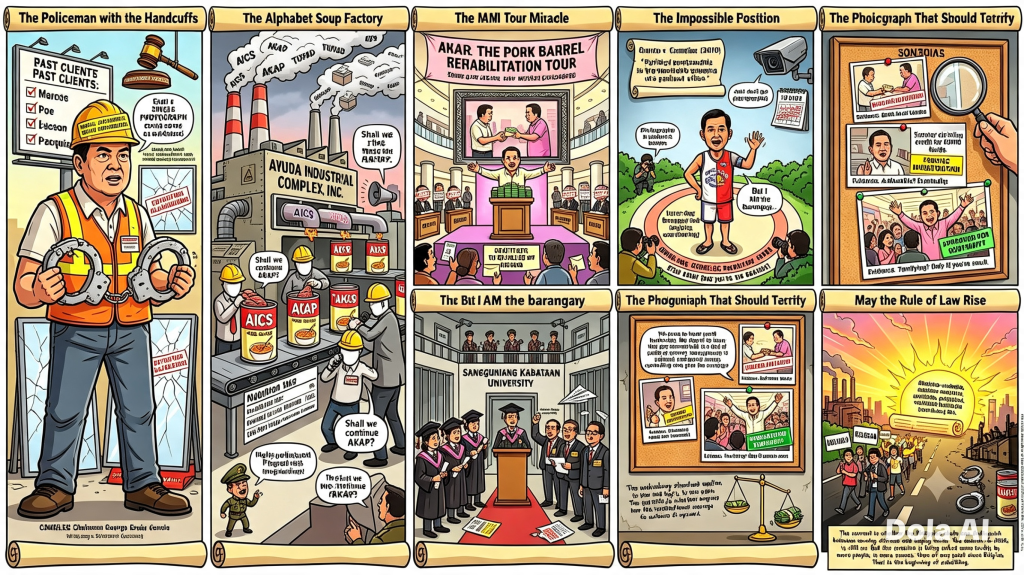
Commission on Elections (COMELEC) Chairman George Erwin Garcia—formerly Ferdinand Marcos Jr.’s election lawyer, representative of Grace Poe, Ping Lacson, and Manny Pacquiao—now stands as the nation’s foremost crusader against politicized government aid. If this strikes you as a rehabilitation project dressed in institutional vestments, you are not alone. A February 2026 disbarment complaint alleging extortion, the Supreme Court’s Smartmatic TIM Corporation and Smartmatic Philippines, Inc. v. Commission on Elections (2024) finding of grave abuse of discretion, and quiet criticism invoking Quinto v. Comelec all suggest the moral authority required to police “abuse of state resources” is, shall we say, under renovation.
And yet the problem he names is real. The question is whether the policeman can be trusted with the handcuffs.
The “Ayuda Industrial Complex” runs on two rules: one for the powerful, another for everyone else.
The Machinery of the Welfare State as the Machinery of Incumbency
The phrase deserves its monument in Philippine political pathology’s rogues’ gallery. AICS. AKAP. TUPAD. 4Ps. An alphabet soup of compassion that doubles as a vote-buying apparatus sophisticated enough to come with its own acronym-generating bureaucracy.
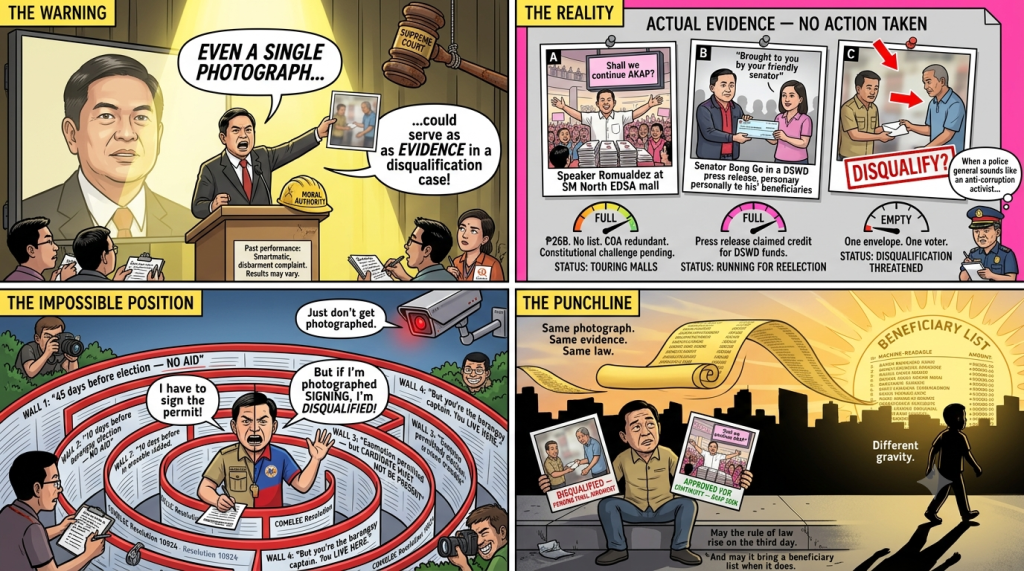
Consider AKAP: Ayuda para sa Kapos ang Kita Program. Twenty-six billion pesos. Inserted into the 2025 General Appropriations Act through bicameral conference after the Senate deleted it. Speaker Martin Romualdez’s “pet project,” touring malls asking crowds, “Shall we continue AKAP?” COA flagging it as “functionally redundant” with existing AICS. Senator Imee Marcos calling it “alien” to the Senate. And DSWD and DOLE admitting—under oath, in a February 2025 Senate hearing—that AKAP had no reference list of qualified beneficiaries. No list. Twenty-six billion pesos, no list.
Baguio Mayor Benjamin Magalong, a retired police general not known for rhetorical excess, called the program “highly politicized” and “plagued with irregularities.” When a police general sounds like an anti-corruption activist, the corruption has achieved escape velocity from normal political gravity.
This is not a bug. It is the feature. AKAP was designed to be indistinguishable from the pork barrel system the Supreme Court struck down in Belgica v. Ochoa (2013). Retired Justice Antonio Carpio, former Ombudsman Conchita Carpio Morales, 1Sambayan, and Sanlakas have petitioned the Court arguing exactly this: legislators identify and endorse beneficiaries in substance even though the GAA’s text omits their formal role. The Belgica problem, wearing a welfare-agency nametag. That petition remains unresolved. And here we are, six months before BSKE 2026, with COMELEC issuing warnings about a program whose constitutionality is under active Supreme Court review. The irony is dense enough to pave EDSA.
Gutting Garcia’s Warning: The Legal and the Ludicrous
Could serve as evidence? Certainly. Could serve as sufficient evidence? That is an entirely different question—one the Supreme Court has answered repeatedly, and not in Garcia’s favor.
In Rodriguez v. COMELEC (2023), the Court was explicit: “It requires more than a mere tenuous deduction to prove the offense of vote-buying. There must be concrete and direct evidence or, at least, strong circumstantial evidence.” And then the dagger: “The mere presence of an incumbent local government official in the implementation of local government projects would not necessarily make him the giver of the benefits.”
Lozano v. Yorac (1991) held that distributing gifts as part of a local government project does not automatically constitute vote-buying if the gift-giver is clearly the government, not the candidate. The Court required proof that the candidate was the giver—not merely present, not photographed, not standing near a table with envelopes.
The real standard is Florido v. Pasillao et al. (2025), where disqualification was upheld because the candidate actively distributed cash with campaign materials in an event clearly intended to gain electoral support. Active participation. Direct distribution. Campaign context. Not a photograph. A totality-of-evidence analysis.
Garcia knows this. His “single photograph” warning is either aspirational deterrence that will not survive judicial scrutiny or deliberate lowering of public expectations designed to generate headlines rather than convictions. Neither flatters the Chairman. Any disqualification based solely on photographic presence will be challenged on due process grounds—and will likely lose, given election offenses carry penalties of one to six years imprisonment, perpetual disqualification from public office, and forfeiture of suffrage.
The BSKE Candidate’s Impossible Position
Batas Pambansa Blg. 881 (Omnibus Election Code), Section 261(v), prohibits release of public funds within 45 days before regular elections. But Republic Act No. 6679 (Barangay Election Act of 1989), as amended by Republic Act No. 10923, shortens this to 10 days for barangay elections. During the rest of the campaign period, aid distribution is permitted with COMELEC exemption—provided candidates are not present. Yet incumbent barangay officials are, by definition, always present in their barangays. The captain who signs permits, whose staff coordinates with DSWD, whose tanods provide security—this person is supposed to “stay away”?
Quinto v. Comelec (2010) holds that elected officials do not resign upon filing their certificates of candidacy and may lawfully engage in partisan political activity, because “political partisanship is the inevitable essence of a political office.” Garcia cannot have it both ways. Either incumbents may campaign—in which case presence at community events is not per se disqualifying—or they may not, in which case Quinto needs revisiting.
The due process problem cuts deeper. Section 68 of the Omnibus Election Code imposes disqualification only upon “final judgment.” Yet COMELEC Resolution No. 10924, Section 600, allows suspension of proclamation of winning candidates who have pending disqualification petitions—a pre-conviction punishment that, while arguably necessary for administrative efficiency, sits uneasily with constitutional presumption of innocence. A candidate photographed at a community event, disqualified on thin evidence, denied office even while appealing—this is the nightmare Garcia’s framework invites, and it will not survive serious due process challenge.
Designed to Corrupt: The Architecture of AKAP and AICS
AICS and AKAP are not welfare programs vulnerable to politicization. They are political programs that distribute welfare.
A welfare program has:
- Standing beneficiary lists
- Transparent eligibility criteria
- Independent verification
- Auditable disbursement records
- Institutional delivery insulated from political interference
A political program has:
- No beneficiary list
- Discretionary eligibility
- Legislator-controlled referrals
- Unauditable cash disbursements
- Delivery mechanisms maximizing political patrons’ visibility
AKAP has all the characteristics of the latter. Senator Grace Poe acknowledged lawmakers would have a role in distribution. The CMFR documented sitting senators—Imee Marcos, Robin Padilla, Bong Go—issuing press releases claiming personal credit for DSWD-administered AICS funds. The program’s design ensures gratitude flows to the politician who “brought” the aid, not the government that funded it. This is Belgica-style pork: post-enactment legislator control over beneficiary identification, disguised as executive implementation.
The 2025 national elections provided proof of concept. AKAP mall tours. Politicians photographed handing envelopes. Press releases claiming credit for government checks. The program functioned as a nationwide vote-buying apparatus, and now Garcia warns barangay candidates not to replicate what national officials normalized. The hypocrisy is breathtaking but strategic: national-level AKAP use has already banked political capital for 2028. The barangay-level crackdown protects those gains by ensuring local challengers cannot build rival patronage networks.
Systemic Corruption from Malacañang to the SK Level
Garcia’s warning targets BSKE candidates, but the corruption he describes is not a barangay invention. It is a national architecture replicated fractally at every governance level.
At the top: a ₱26-billion aid program without a beneficiary list, inserted through bicameral maneuvering, claimed as personal project by the House Speaker, and defended as “continuity of essential services” by an administration that simultaneously floated postponing the BSKE to redirect ₱16 billion toward Middle East crisis measures. The same government pleading fiscal emergency somehow found ₱26 billion for a program COA calls “functionally redundant.”
At the bottom: 42,000 barangays where incumbents control aid distribution levers, challengers lack resources to document violations, voters dependent on cash assistance cannot risk offending the hand that feeds, and COMELEC’s enforcement capacity—294 disqualification petitions in 2023—is a rounding error against the problem’s scale.
The Sangguniang Kabataan level deserves particular evisceration. Created as youth leadership training, it has become youth corruption training. Eighteen-year-old SK chairs learn in real time that government aid is a tool of political control, that transparency is optional, that staying in power means controlling envelope distribution. Garcia’s warning will not reach them—not because they cannot hear it, but because the system they enter was designed by the same people now warning them not to use it.
The Demands: Transparency, Justice, and a Beneficiary List
The call for transparency must begin with the program itself. AKAP needs a verifiable, published, auditable beneficiary list—not as bureaucratic nicety, but as anti-corruption baseline. DSWD must disclose disbursement schedules, exemption approvals, and distribution sites in advance, in machine-readable formats accessible to civil society and ordinary citizens.
Accountability must target national architects of the ayuda-industrial complex. Garcia’s warning to BSKE candidates is a footnote. The real question: who designed AKAP without a beneficiary list? Who inserted it through bicameral process after Senate deletion? Who toured malls asking crowds to vote on continuing a government program? These are investigatory leads the Ombudsman, COA, and COMELEC should pursue. But Garcia’s “Kontra Bigay Committee” targets barangay captains, not House Speakers. Philippine anti-corruption gravity always works against the small.
Justice demands the Supreme Court resolve the pending 1Sambayan petition against AKAP soon. BSKE is being conducted under a program whose constitutionality is actively contested. Candidates are warned not to politicize funds that may themselves be unconstitutional. Legal uncertainty is not a glitch—it is the enabling condition for continued abuse.
Genuine public service requires rethinking what social welfare means in a democracy. Welfare is not a favor, a gift, or a campaign tool. It is an entitlement of citizenship—recognition that the state has obligations to its people existing independent of electoral calendars. The moment a welfare program becomes indistinguishable from a vote-buying apparatus, the distinction between government and political machine collapses. The machine wins. The people lose.
Hope for the youth requires taking the SK seriously as an institution rather than a patronage farm. SK candidates should be trained in budget transparency, participatory governance, and community accountability—not the dark arts of ayuda politics. Republic Act No. 12232‘s mandatory one-term limit for SK officials breaks the incumbency cycle fueling barangay patronage, but it must be paired with capacity-building that teaches young officials to govern without buying votes.
The Photograph That Should Terrify the Powerful
The photograph. The photograph of the warning about photographs. The image supposed to terrify BSKE candidates into compliance.
But a photograph can also terrify the powerful. A photograph of a House Speaker at a mall AKAP tour. A senator claiming credit for DSWD funds. A barangay captain handing envelopes to voters. The evidentiary standard Garcia invokes applies, in law and logic, to everyone. The question is whether anyone has the institutional courage to enforce it upward.
The Belgica Court struck down the pork barrel because citizens demanded it. The machinery of the welfare state as the machinery of incumbency can be dismantled—not by press-conference warnings or “single photograph” deterrents, but by the slow, grinding work of litigation, legislation, investigation, and organization that has moved Philippine democracy forward before.
Garcia’s warning is a surface event—a ripple on a much deeper current. The current is whether the Philippine state can distinguish between serving citizens and buying votes. The answer, in 2026, is still no. But the question is being asked more loudly, by more people, in more venues, than at any point since Belgica. That is the beginning of something.
May the rule of law rise on the third day. And may it bring a beneficiary list when it does.
— Barok
Key Citations
A. Legal & Official Sources
- Batas Pambansa Blg. 881. Omnibus Election Code of the Philippines. 1985, lawphil.net/statutes/bataspam/bp1985/bp_881_1985.html.
- Republic Act No. 6679. An Act to Amend Republic Act No. 6653 to Postpone the Barangay Elections to March 28, 1989, Prescribing Additional Rules Governing the Conduct of Barangay Elections and for Other Purposes. 1988, lawphil.net/statutes/repacts/ra1988/ra_6679_1988.html.
- Republic Act No. 10923. An Act Postponing the October 2016 Barangay and Sangguniang Kabataan Elections, Amending for the Purpose Republic Act No. 9164, as amended by Republic Act No. 9340 and Republic Act No. 10656, Prescribing Additional Rules Governing the Conduct of Barangay and Sangguniang Kabataan Elections and for Other Purposes. 2016, lawphil.net/statutes/repacts/ra2016/ra_10923_2016.html.
- Republic Act No. 12232. An Act Setting the Term of Office of the Barangay Officials and Members of the Sangguniang Kabataan, and for Other Purposes. 2025, elibrary.judiciary.gov.ph/thebookshelf/showdocsfriendly/2/99551.
- Commission on Elections. Resolution No. 10924: General Guidelines and Other Rules and Regulations for the October 30, 2023 Barangay and Sangguniang Kabataan Elections (BSKE) and All Succeeding BSKEs Thereafter. 7 June 2023, http://www.comelec.gov.ph/?r=2023BSKE/Resolutions/res10924.ac0bed
- Belgica v. Ochoa. G.R. No. 208566. Supreme Court of the Philippines, 19 Nov. 2013, lawphil.net/judjuris/juri2013/nov2013/gr_208566_2013.html.
- Quinto v. Comelec. G.R. No. 189698. Supreme Court of the Philippines, 22 Feb. 2010, lawphil.net/judjuris/juri2010/feb2010/gr_189698_2010.html.
- Rodriguez v. COMELEC. G.R. No. 255509. Supreme Court of the Philippines, 10 Jan. 2023, lawphil.net/judjuris/juri2023/jan2023/gr_255509_2023.html.
- Lozano v. Yorac. G.R. No. 94521. Supreme Court of the Philippines, 28 Oct. 1991, lawphil.net/judjuris/juri1991/oct1991/gr_94521_1991.html.
- Florido v. Pasillao et al. G.R. No. 280515. Supreme Court of the Philippines, 12 Aug. 2025, elibrary.judiciary.gov.ph/thebookshelf/showdocsfriendly/1/70087.
- Smartmatic TIM Corporation and Smartmatic Philippines, Inc. v. Commission on Elections. G.R. No. 270564. Supreme Court of the Philippines, 16 Apr. 2024, lawphil.net/judjuris/juri2024/apr2024/gr_270564_2024.html.
B. News Reports
- Partlow, Mary Judaline. “Comelec Chief Warns BSKE Bets vs. Using Gov’t Aid for Campaigns.” Philippine News Agency, 15 July 2026, http://www.pna.gov.ph/articles/1279518.
- Salcedo. “Disbarment Complaint Filed vs Garcia, 5 Other Comelec Officials.” INQUIRER.net, 24 Feb. 2026, newsinfo.inquirer.net/2186984/disbarment-complaint-filed-vs-garcia-5-other-comelec-officials.
- Bordey, Hana. “Politicians May Refer Beneficiaries of AKAP — DSWD Exec.” GMA News Online, GMA Network, 3 Feb. 2025, http://www.gmanetwork.com/news/topstories/nation/935051/dswd-official-politicians-may-refer-beneficiaries-of-akap-dswd-exec/story/.
- Abad, Michelle. “DSWD, DOLE Admit AKAP Has No List of Beneficiaries.” Rappler, 4 Feb. 2025, http://www.rappler.com/philippines/dswd-dole-admit-akap-has-no-list-beneficiaries/.
- Center for Media Freedom and Responsibility (CMFR). “Ayuda: Pork Barrel in New Form.” CMFR Media Ethics and Responsibility Journalism Review, 21 Jan. 2025, cmfr-phil.org/media-ethics-responsibility/journalism-review/ayuda-pork-barrel-in-new-form/.




 KWEBA ni BAROK
Leave a comment