Soft Earmarks, Hard Theft: Why Sin Taxes Mean More Pork for Congress
By Louis “Barok” C. Biraogo — July 20, 2026
LET us speak plainly, because the children cannot afford our euphemisms.
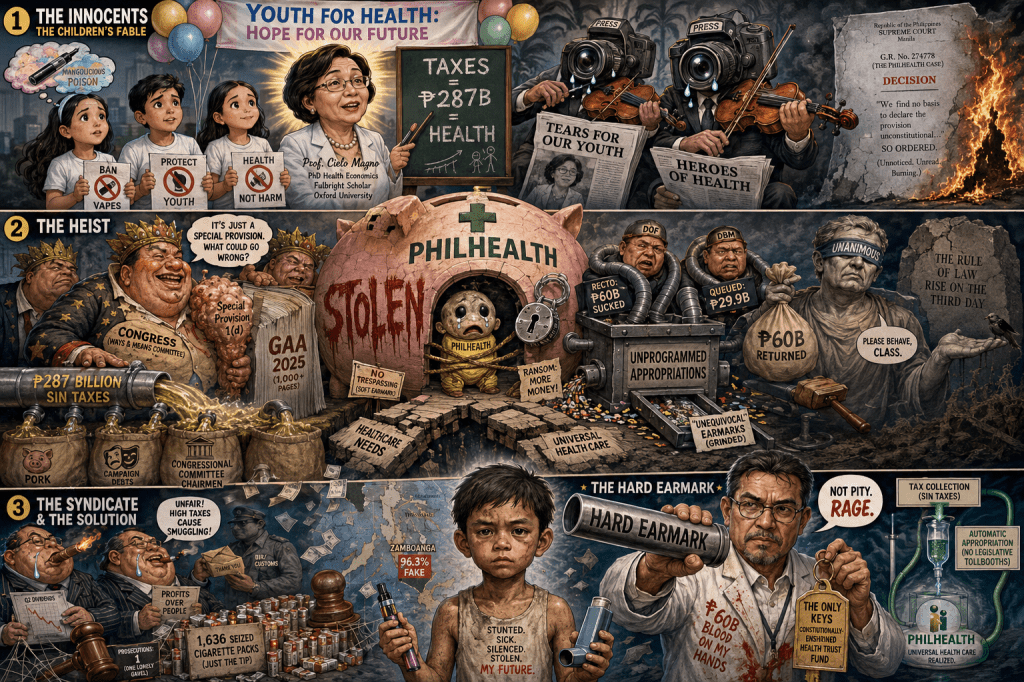
Last Thursday, a coalition of sincere, doe-eyed youth advocates stood before the cameras and begged President Marcos to raise sin taxes. Their cause is unimpeachable: stunting among Filipino children has climbed to 25.3 percent. Adolescent smoking and drinking persist. Vaping has seduced a generation with mango-flavored poison. Professor Cielo Magno, wielding her Fulbright credentials, explained that taxes discourage consumption while generating revenue. The math, she said, would yield ₱287 billion over five years for the Philippine Health Insurance Corporation (PhilHealth).
The press ate it up. The Inquirer ran a heartwarming wire story. Cue the violins.
Now let us discuss what nobody at that press conference had the discourtesy to mention:
this money will be stolen.
Not hypothetically. Not theoretically. Stolen by the very same institutional architecture that the Supreme Court, just seven months ago, caught red-handed with its fingers in the PhilHealth cookie jar. The Youth for Health coalition is not proposing a cure; they are—unwittingly, tragically—proposing to refill a vault to which the burglars still have the combination.
The Ghost of G.R. No. 274778
Let us exhume the cadaver everyone pretends is already buried.
In December 2025, the Supreme Court decided Aquilino Pimentel III, et al. v. House of Representatives (G.R. No. 274778), a case that should have triggered street protests but instead disappeared into the news cycle like a congressman’s PDAF receipt. The facts were obscene in their simplicity.
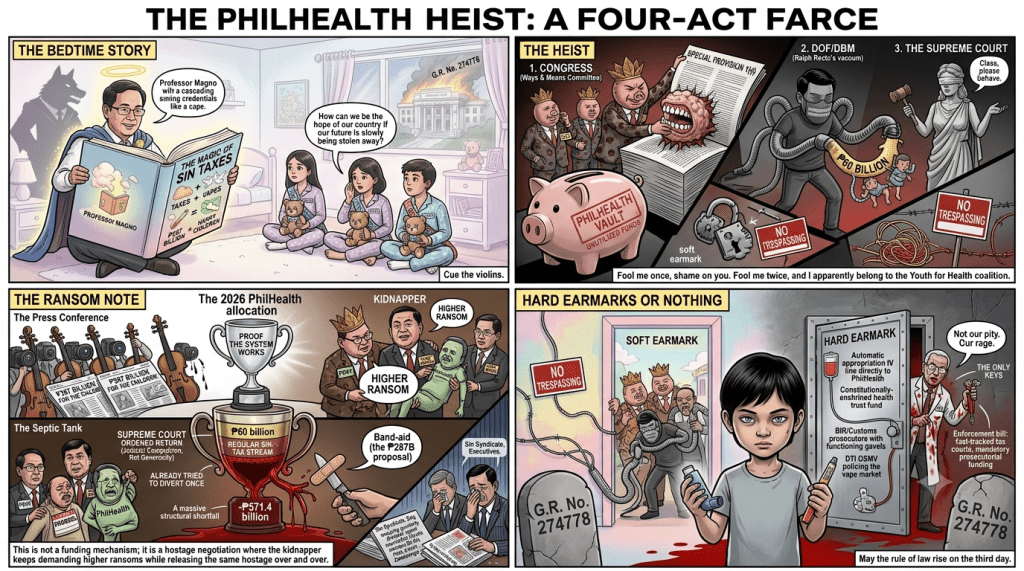
Congress, in its infinite venality, tucked a single provision—Special Provision 1(d)—into Republic Act No. 11975 (2024 General Appropriations Act). This provision, a constitutional tumor masquerading as a budget line, authorized the transfer of PhilHealth’s “unutilized funds” to the national treasury. The Department of Finance, under then-Secretary Ralph Recto, promptly vacuumed ₱60 billion out of PhilHealth, with another ₱29.9 billion queued for extraction.
PhilHealth, mind you, had received zero national government subsidy that year on the theory that its ₱89.9 billion in reserves made it self-sufficient. You cannot invent this level of bureaucratic sadism: the agency was simultaneously too rich to need help and so vulnerable that Congress could legally mug it in a back alley.
The Supreme Court, to its credit, unanimously struck down the provision as an unconstitutional rider—a violation of the germaneness doctrine that requires every word of a GAA to be particular, unambiguous, and appropriate to the act’s purpose. The Court ordered the ₱60 billion returned. The separate opinions from Justices Leonen and Hernando went further, questioning the entire “unprogrammed appropriations” mechanism that makes such raids possible.
Here is what the Court did not do: it did not jail anyone. It did not sanction the lawyers who drafted the provision. It did not bar the same actors from trying again with slightly different language. It returned the money and told the class to behave.
And so, with the ink barely dry on Pimentel, we are now being asked—by the very government that orchestrated this heist—to pour an additional ₱287 billion into the same leaky, compromised, judicially-rebuked pipeline.
Fool me once, shame on you. Fool me twice, and I apparently belong to the Youth for Health coalition.
Three Grounds for Outrage
My objection to this initiative is not philosophical. I support sin taxes. I support PhilHealth. I support children not dying of preventable diseases. My objection is that the proposal is built on three legal and fiscal falsehoods so brazen they would embarrass a first-year law student.
First: The Earmarking Lie.
The proponents cite Republic Act No. 10351 (Sin Tax Reform Law), Republic Act No. 11467, and Republic Act No. 11223 (Universal Health Care Act) as the statutory foundation for their funding mechanism. These laws, they say, “earmark” sin tax revenue for universal health care. The word earmark is doing a lot of heavy lifting here—roughly the same amount of lifting that a cardboard bridge does over a canyon.
These statutes create what I call a “soft” earmark: a statutory promise that is honored or dishonored at the discretion of the Department of Budget and Management (DBM) and the GAA drafting committee. The Supreme Court has now confirmed what budget watchdogs have screamed for years: Congress and the Executive repeatedly violate these earmarks even where the statutory text is, in Senator Pia Cayetano’s word, “unequivocal.” A soft earmark is not a legal obligation; it is a legislative suggestion that can be overridden by a single cryptic provision buried in a 1,000-page appropriations bill.
To claim that these statutes “protect” the revenue is to confuse a “No Trespassing” sign with a barbed-wire fence. The burglars have already demonstrated they can read the sign and proceed directly to the vault.
Second: The Tainted Revenue Stream.
The ₱113-billion PhilHealth allocation for 2026 is now being trumpeted as proof that the system works. But from what septic tank did this money emerge? It is comprised partly of the ₱60 billion that the Supreme Court ordered returned—meaning its presence in PhilHealth’s accounts is not a testament to government generosity but to judicial compulsion—and partly of the regular sin-tax stream that the Executive already tried to divert once.
The advocates want to expand a revenue pipeline whose last major transaction required a Supreme Court temporary restraining order to prevent completion. This is not a funding mechanism; it is a hostage negotiation where the kidnapper keeps demanding higher ransoms while releasing the same hostage over and over.
Third: The Arithmetic of Delusion.
Even if we suspend all disbelief and assume every peso of the proposed ₱287 billion reaches PhilHealth intact, the math remains fatal. Budget watchdogs, including former Budget Secretary Florencio Abad and the group Action for Economic Reforms, have calculated a structural shortfall of ₱571.4 billion—once mandatory premiums, accumulated arrears, and the restored ₱60 billion are counted.
The coalition’s proposal, even if fully enacted, would generate less than half the needed amount over five years. The advocates are offering a band-aid to a patient hemorrhaging from a severed artery. Worse, they are presenting the band-aid as a cure, thereby delaying the tourniquet.
The Supporting Cast of Enablers
A word on the dramatis personae of this farce.
Professor Magno is brilliant, credentialed, and almost certainly sincere. But her framing—”taxes discourage behavior and generate revenue”—is the technocratic equivalent of a children’s fable. It works beautifully in a world where governments honor their own laws. In the Philippine administrative state, it is a bedtime story told to frightened children while the wolves circle outside.
The Youth for Health coalition has been weaponized as a human shield. Their moral authority—”how can we be the hope of our country if our future is slowly being stolen away?”—is undeniable. But they are being deployed, whether they realize it or not, to provide emotional cover for a legislative package whose fiscal architecture has already failed. The actors who designed that failure are counting on the public’s sympathy for teenagers with vape pens to override its memory of ₱60 billion vanishing into the treasury’s maw.
And then there is Congress itself—that venerable institution where the Ways and Means Committee has historically been “dominated by the tobacco industry” and where “unprogrammed appropriations” has become a polite synonym for “pork barrel.” The same legislators who will debate these tax increases are the ones who inserted Special Provision 1(d) into the 2024 GAA. They have not been replaced. They have not been sanctioned. They are simply waiting for the public’s attention span to expire.
“The Sin Syndicate, Esq.” — a polite, pinstriped confederation of profit-maximizing executives who find it deeply unfair that dying children might marginally reduce their quarterly dividends. Their “illicit trade” narrative, blaming high taxes for smuggling, would be more compelling if STOP and Action for Economic Reforms had not found tax-stamp irregularities on the industry’s own branded packs in Mindanao. When 96.3 percent of sampled cigarette packs in Zamboanga bear counterfeit stamps and only one out of 1,636 Bureau of Internal Revenue (BIR) seizures results in a completed prosecution, we are not facing a tax-rate problem. We are facing an enforcement vacuum that the industry is perfectly happy to exploit while blaming the government for its own complicity.
The Only Solution: Hard Earmarks or Nothing
So what is to be done? Surrender to cynicism? Abandon the stunted children and the nicotine-addicted adolescents?
No. We demand better.
The Supreme Court’s ruling in Pimentel has made one thing legally possible that was previously ambiguous: a genuine “hard” earmark. Congress can—and must—pair any sin-tax increase with a mechanism that constitutionally bypasses the annual GAA process. An automatic appropriation provision, a continuing appropriation rider, or a constitutionally-enshrined health trust fund that the DBM cannot touch, delay, or “reprogram.” The money must flow from collection to PhilHealth without passing through the legislative tollbooths where the bandits sit.
Simultaneously, we demand a parallel enforcement bill: mandatory funding for BIR and Customs prosecutorial capacity, fast-tracked tax courts, and a fully-resourced Department of Trade and Industry (DTI) OSMV that can actually police the vape market it was created to regulate two years ago. The illicit trade problem is real; the solution is not lower taxes but a functional state.
Anything less than these structural reforms—any tax increase that simply feeds more money into the soft-earmark pipeline that Pimentel has already condemned—is not public health advocacy. It is fiscal gaslighting. It is asking the victims of a burglary to invest in better locks while the burglars are still inside the house, holding the only set of keys.
The children of this country deserve more than a press conference and a recycled legislative wish list. They deserve a government that honors its own laws. They deserve a PhilHealth that can pay for their dialysis, their asthma inhalers, their cancer treatments, without first obtaining permission from a DBM undersecretary and a congressional committee chairman with campaign debts to settle.
They deserve, in short, not our pity but our rage.
The rule of law does not need more poetry about hope. It needs enforcement, accountability, and a willingness to name the thieves even when they wear the same white coats as the doctors.
May the rule of law rise on the third day. 🪨
— Barok
Key Citations
A. Legal & Official Sources
- Aquilino Pimentel III et al. v. House of Representatives, represented by the Speaker Ferdinand Martin Romualdez, et al.; Bayan Muna Chairman Neri Colmenares, et al. v. President Ferdinand Romualdez Marcos, Jr., et al. Supreme Court of the Philippines, 26 Sept. 2024, sc.judiciary.gov.ph/274778-275405/. �
- Republic Act No. 10351. An Act Restructuring the Excise Tax on Alcohol and Tobacco Products by Amending Sections 141, 142, 143, 144, 145, 8, 131 and 288 of Republic Act No. 8424, Otherwise Known as the National Internal Revenue Code of 1997, as Amended by Republic Act No. 9334, and for Other Purposes. 19 Dec. 2012, http://www.officialgazette.gov.ph/2012/12/19/republic-act-no-10351/.
- Republic Act No. 11467. An Act Amending Sections 109, 141, 142, 143, 144, 147, 152, 263, 263-A, 265, and 288-A, and Adding a New Section 290-A to Republic Act No. 8424, as Amended, Otherwise Known as the National Internal Revenue Code of 1997, and for Other Purposes. 22 Jan. 2020, http://www.officialgazette.gov.ph/2020/01/22/republic-act-no-11467/.
- Republic Act No. 11223. An Act Instituting Universal Health Care for All Filipinos, Prescribing Reforms in the Health Care System, and Appropriating Funds Therefor. 20 Feb. 2019, http://www.officialgazette.gov.ph/2019/02/20/republic-act-no-11223/.
- Republic Act No. 11975. General Appropriations Act of 2024. 2023, http://www.dbm.gov.ph.
B. News Reports
- “Health Advocates Seek Higher Sin Taxes to Curb Unhealthy Youth Habits.” Inquirer.net, 16 July 2026, newsinfo.inquirer.net/2265200/health-advocates-seek-higher-sin-taxes-to-curb-unhealthy-youth-habits.
- Manatlao, Eirene. “Ahead of SONA 2026, Marcos Urged to Focus on Youth Health.” Rappler, 17 July 2026, http://www.rappler.com/philippines/advocates-lawmakers-urge-marcos-jr-focus-youth-health-sona-2026/.
- “Budget Watchers Flag Swelling PhilHealth Fund Gap.” Inquirer.net, 4 Dec. 2025, newsinfo.inquirer.net/2150384/budget-watchers-flag-swelling-philhealth-fund-gap.
- Colina, Antonio L., IV, and Bong S. Sarmiento. “GenSan, Zamboanga lead cigarette smuggling in PH.” MindaNews, 12 Nov. 2025, mindanews.com/top-stories/2025/11/gensan-zamboanga-lead-cigarette-smuggling-in-ph/.

- “Ang Hirap Maging Mahirap”: The PAO Scandal That Proves Government Contempt Is Nothing New
- “Far-Off” My Axx: Malacañang’s Claire Castro Drowns in Her Own Legal Gaslighting
- “Forthwith” to Farce: How the Senate is Killing Impeachment—And Why Enrile’s Right (Even If You Can’t Trust Him)
- “HINDI AKO NAG-RESIGN!”

- “I Know Nothing”: Baste Duterte’s Amnesia Defense Meets ₱33M in GenCorp Contracts
- “I’m calling you from my new Globe SIM. Send load!”

- “Mahiya Naman Kayo!” Marcos’ Anti-Corruption Vow Faces a Flood of Doubt

- “Manageable” Debt, Unmanageable Lies: DBM’s ₱21 Trillion Fairy Tale
- “Meow, I’m calling you from my new Globe SIM!”

- “Natrabaho”: One Word, One Ombudsman, and a Judiciary on Trial
- “No Special Jail for Crooks!” Boying Remulla Slams VIP Perks for Flood Scammers

- “Philippine-Controlled” or Yankee Gas Station? The Davao Fuel Depot Farce Exposed






Leave a comment