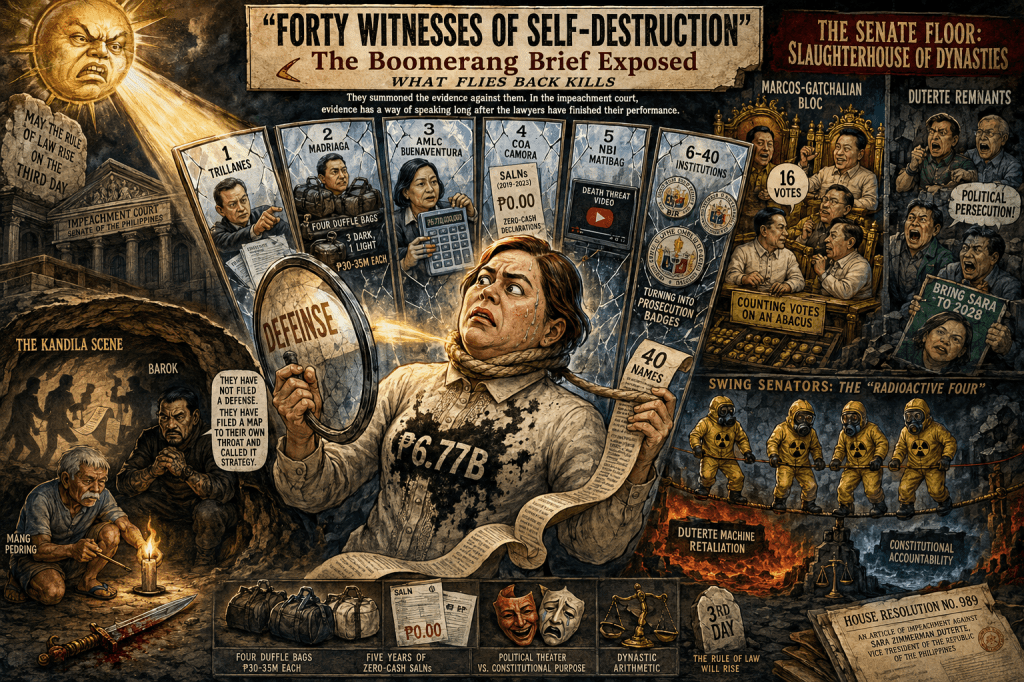
From Shield to Sword: How Sara’s 40-Witness Gambit Hands Prosecution the Ammo
By Louis “Barok” C. Biraogo — June 17, 2026
IN THE cave, Mang Pedring lit a fresh kandila and spread the pre-trial brief across the rough table. “Barok,” he said quietly, “they want to call Trillanes as their own witness. And Madriaga. And the AMLC director. And the Ombudsman. Forty-plus names. They say it is to disprove the Articles of Impeachment and identify documents.”
Barok cracked a knuckle and watched the flame bend in the draft. “They have not filed a defense, Mang Pedring. They have filed a map to their own throat and called it strategy. In the impeachment court, some swords cut both ways. This one may cut deepest into the hand that drew it.”
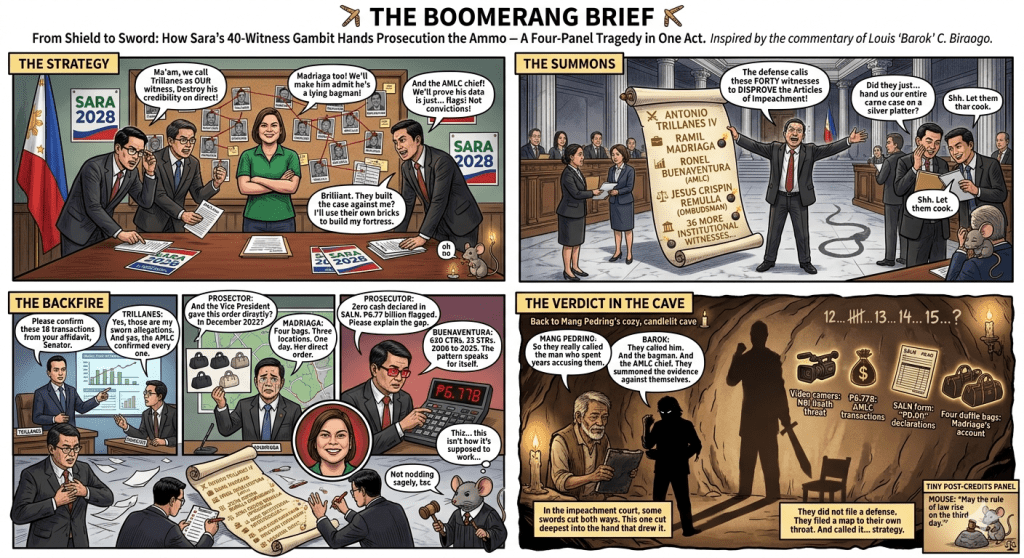
I. I. FORTY WITNESSES OF SELF-DESTRUCTION: Boomerang Brief Exposed
The pre-trial brief filed by Vice President Sara Duterte’s defense panel before the Senate Impeachment Court is more than a procedural document. It is a strategic manifesto that may prove to be the most self-destructive filing in modern Philippine impeachment history. By naming former Senator Antonio Trillanes IV, former aide Ramil Madriaga, Anti-Money Laundering Council (AMLC) Executive Director Ronel Buenaventura, Ombudsman Jesus Crispin Remulla, Bureau of Internal Revenue (BIR) Commissioner Charlito Mendoza, National Bureau of Investigation (NBI) Director Melvin Matibag, Commission on Audit (COA)’s Atty. Gloria Camora, and more than three dozen others, the defense has not prepared a shield.
It has prepared a hall of mirrors in which every reflection already points back at the respondent. This is not routine litigation. It is a declaration of war by bluff—or the most elaborate trap set in plain sight since the Marcos-Duterte alliance fractured into open hostilities. The defense intends to call the very officials whose prior disclosures and findings form the prosecution’s evidentiary spine. In doing so, it has volunteered the prosecution’s most dangerous witnesses and called the move a defense.
II. MARCOS-DUTERTE BLOOD FEUD: Senate as Slaughterhouse
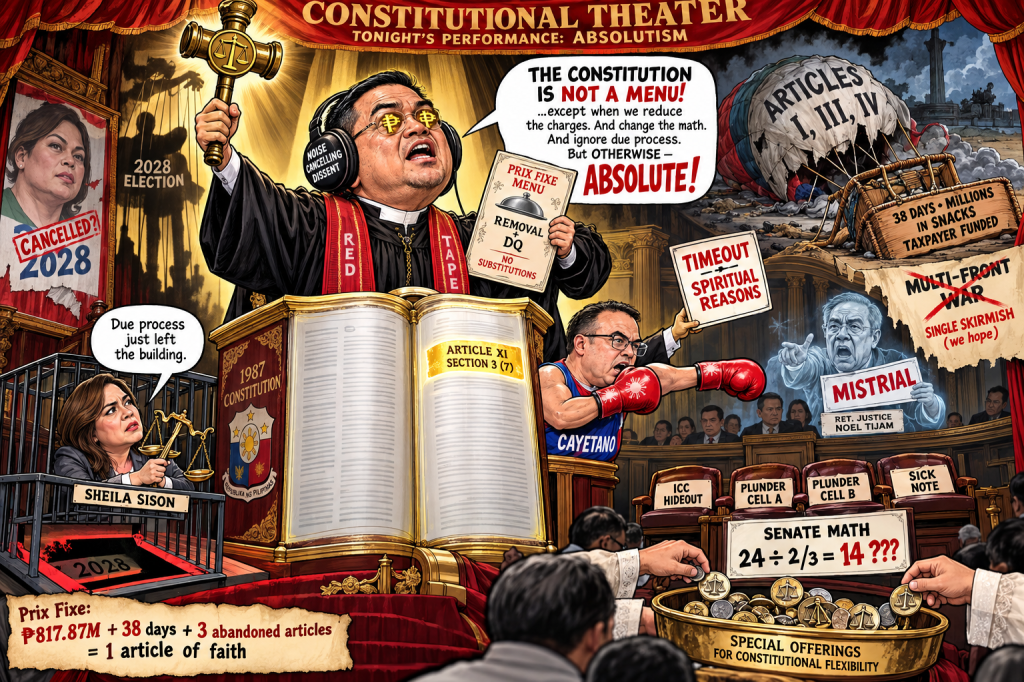
This impeachment is not a trial of one woman. It is the bloodiest and most consequential battle yet in the toxic Marcos-Duterte civil war, a proxy conflict whose real prize is the 2028 presidential election and the survival or destruction of two dynasties. The defense’s witness list is engineered to exploit the Senate’s own fractures: the Gatchalian bloc that seized the presiding officer’s gavel in the 3 June 2026 coup versus the remnants of Cayetano influence, and the swing senators whose four additional votes will determine whether the constitutional threshold of sixteen can be reached.
The Marcos camp sees conviction as the ultimate consolidation of power—the removal of the strongest 2028 rival and the perpetual disqualification that Article XI, Section 3(7) of the 1987 Constitution of the Republic of the Philippines imposes. The Duterte camp sees acquittal not as vindication but as resurrection fuel for a comeback narrative. Every attack on Trillanes as a vendetta-driven accuser, every attempt to paint the entire proceeding as political persecution, every procedural objection to the Gatchalian presiding officer and the quorum precedent of Avelino v. Cuenco is calibrated to make those four swing votes politically radioactive.
The institutions themselves have become the battlefield. By subpoenaing Buenaventura, Remulla, Mendoza, Matibag, and Camora, the defense hopes to neutralize or dilute the very findings that already sit in the transmitted House record. But when the same officials have already confirmed P6.77 billion in flagged transactions, authenticated a death-threat video, and documented confidential-fund liquidation irregularities, the “neutralization” strategy risks turning institutional testimony into prosecution exhibits. In this war, the defense is not fighting the prosecution alone. It is fighting the documented record.
III. COUNTEROFFENSIVE CLOWN SHOW: Brilliant on Paper, Catastrophic in Court
The defense’s implied strategy, reconstructed from the pre-trial brief’s stated purposes (“to disprove the allegations… prove that the allegations… are mere conclusions of law and fact… identify documents”) and the witness roster itself, is a multi-front offensive that blends legal jujitsu with high-stakes political theater. It is brilliant in briefing form. It may be catastrophic in open court.
The Credibility Dismantling Offensive. The plan is to place the prosecution’s most potent witnesses under defense direct examination and then destroy them as biased (Trillanes the eternal adversary), self-interested (Madriaga the disgruntled bagman seeking protection), or institutionally limited (Buenaventura whose Covered Transaction Reports (CTRs) and Suspicious Transaction Reports (STRs) are not criminal convictions). This is a recognized litigation tactic. But it is also the clearest admission that the factual defense on the merits is thin. When your primary strategy is to impeach the other side’s witnesses rather than to produce documentary rebuttal to the Statement of Assets, Liabilities, and Net Worth (SALN) silence, the P6.77 billion AMLC data, the NBI-authenticated video, and the COA findings, you are conceding the battlefield you cannot win on paper.
The “War by Bluff” / “Trap Set in Plain Sight”: The Trillanes Gambit and the Madriaga Paradox. By calling Trillanes to “prove that the allegations in the Articles of Impeachment are mere conclusions of law and fact,” the defense bets it can control the narrative arc, force admissions of political motivation, and taint the entire case as a Trillanes-orchestrated hit. The fatal miscalculation is elementary. Once Trillanes is the defense’s witness, the prosecution’s cross-examination is unbounded. Rule 132, Section 12 of the Revised Rules on Evidence (A.M. No. 19-08-15-SC) and the ordinary rules of hostile-witness examination do not protect the calling party from the consequences of what their own witness says under oath. Trillanes can be walked through every line of his sworn affidavit, including the drug-lord payment allegations. The AMLC’s April 22 confirmation of eighteen specific transactions from that same affidavit—already part of the House record transmitted to the Senate—becomes corroboration that no defense direct examination can erase. The gambit does not contain Trillanes. It liberates him.
The Madriaga Paradox is even more terminal. Madriaga’s supplemental affidavit describes four duffle bags—three dark, one light—containing P30 to P35 million each, distributed in a single day on the direct order of the Vice President to three specific locations in December 2022. There is no coherent legal theory under which this testimony “disproves” the confidential-fund article of impeachment. The defense’s only remaining hope is to savage his credibility so thoroughly—shifting timelines, self-admitted participation, possible immunity deal—that the senator-judges discount the entire account. But operational specificity from an insider is the hardest testimony to impeach. The one-day liquidation detail does not rescue the defense; it makes any claim of proper liquidation under Presidential Decree No. 1445 (Government Auditing Code) even less plausible. The paradox is simple and lethal: the witness the defense most needs to neutralize is the one whose words, once spoken under oath in open Senate session, may be the most difficult to un-hear.
The 16-Vote Strategy. Every delay tactic, every witness challenge, every constitutional objection, and every narrative of political persecution serves one non-negotiable number: preventing sixteen senator-judges from voting to convict. The defense understands that the Marcos-Gatchalian bloc likely commands twelve reliable votes. The acquittal path runs through the swing senators and the Duterte-aligned remainder. By turning Trillanes into the public face of the prosecution and by forcing fights over presiding-officer legitimacy and quorum rules (already settled by precedent and the Supreme Court’s dismissal of the Cayetano petition), the defense hopes to make conviction politically costly for any senator with 2028 ambitions or provincial bases vulnerable to Duterte-machine retaliation. This is not a legal defense. It is political arithmetic conducted inside a courtroom whose constitutional purpose is accountability, not arithmetic.
IV. WITNESS WHACK-A-MOLE: Fatal Flaws in Every Attack
1. Antonio Trillanes IV. The defense will deploy the classic arsenal: long-standing political enmity with the Duterte family, prior legal troubles (later voided), status as a political operator rather than a neutral forensic investigator. They will argue that his allegations rest on hearsay, speculation, and politically motivated conclusions. The fatal flaw is that the AMLC has already performed the institutional corroboration Trillanes could never provide on his own. Buenaventura’s confirmation of the eighteen flagged transactions during the April 22 House hearing is now part of the permanent record. Calling Trillanes as a defense witness does not silence or discredit him. It guarantees that on prosecution cross-examination the drug-lord payment allegations, the bank-transaction architecture, and the family financial flows will enter the Senate trial record under oath, on national television, with AMLC data as backdrop. The “biased accuser” is transformed into the corroborated witness. The vendetta narrative collapses under institutional validation.
2. Ramil Madriaga. The defense will portray him as a disgruntled former aide with shifting stories, a self-admitted participant in the alleged scheme, and therefore inherently unreliable. They will hammer the inconsistency between the original eleven-day liquidation account and the supplemental one-day version. The fatal flaw is that his testimony is not vague political accusation. It is granular, operational, and therefore highly credible: four specific duffle bags, specific amounts per bag, three specific locations, direct order from the Vice President in December 2022. In graft and plunder prosecutions, this is the kind of insider detail that survives credibility attacks precisely because it is difficult to fabricate and easy to test against patterns. The one-day liquidation detail does not help the defense; it makes the claim of compliant liquidation under PD 1445 even more implausible. There is no version of Madriaga’s testimony that exculpates Sara Duterte. The paradox is terminal.
3. AMLC Executive Director Ronel Buenaventura. The defense will argue, correctly as a technical matter under Republic Act No. 9160 (Anti-Money Laundering Act) as amended, that covered transactions and suspicious transaction reports are not findings of guilt, not convictions, and not proof of money laundering. They are merely flags for review. The fatal flaw is arithmetic and evidentiary, not technical. P6.77 billion in flagged transactions across 630 CTRs and 33 STRs from 2006 to 2025, involving the Vice President and her husband, set against SALNs that declared zero cash and bank deposits from 2019 to 2024. The gap between declared liquidity and actual flows is the textbook definition of unexplained wealth under Republic Act No. 3019 (Anti-Graft and Corrupt Practices Act) and betrayal of public trust under Article XI. Buenaventura’s prior House testimony cannot be un-rung. Any examination will proceed against that confirmed backdrop. The defense can parse the AMLA; the senator-judges will see the pattern of concealment.
4. Ombudsman Jesus Crispin Remulla. The defense will seek to elicit that the Office of the Ombudsman has not filed criminal charges on these specific allegations, implying that the absence of a criminal case means no crime was committed. The fatal flaw is constitutional and structural. Impeachment under Article XI is a distinct political accountability mechanism with its own grounds—culpable violation of the Constitution, betrayal of public trust, high crimes—and its own standards. The House found probable cause with 257 votes. The Senate convicts on evidence sufficient to justify removal (historically substantial evidence for the sixteen-vote threshold). The Constitution does not require a prior criminal conviction or even Ombudsman action. By calling Remulla, the defense risks opening the door to questions about why his office has or has not acted on related matters and forces a public clarification that impeachment is not hostage to criminal dockets. It is a high-risk move with minimal upside.
V. RULE OF LAW DEMAND: Facts Over Dynastic Arithmetic
The senator-judges must look past the political theater and the forty-witness circus. The record already contains facts that no witness list can erase: the NBI-authenticated video of the Vice President making explicit death threats against the President, the First Lady, and the former Speaker; the AMLC-confirmed P6.77 billion in transactions against SALNs that declared zero cash and bank deposits for five consecutive years; the COA-documented irregularities in the liquidation of confidential funds; and Ramil Madriaga’s sworn, granular account of P125 million distributed in duffle bags on the direct order of the Vice President to political allies. These are not inferences, conclusions of law, or political narratives. They are documented facts.
A verdict that substitutes Senate headcounts or 2028 positioning for these facts does not serve the Constitution. It serves the dynastic impunity the impeachment power was designed to restrain. The Filipino people are entitled to a proceeding that asks whether the totality of the evidence establishes betrayal of public trust sufficient to remove a sitting vice president—not whether acquittal is politically convenient for swing senators.
VI. PROSECUTION PLAYBOOK & BAROK VERDICT
Strategic Recommendations for the Prosecution. Do not fear the defense’s witness list. Weaponize it.
- Treat Trillanes and Madriaga as hostile witnesses the defense itself has made available. Lock in prior sworn statements. Use the AMLC confirmation as corroboration for Trillanes. Let Madriaga’s operational specificity—four bags, three locations, direct order, one-day liquidation—anchor the confidential-fund article.
- Prioritize the documentary spine that no witness can rehabilitate: play the NBI-authenticated video early; present the AMLC data as a five-year pattern of liquidity the SALNs cannot explain; tie the COA findings directly to Madriaga’s account.
- Prepare hostile examination of OVP and DepEd officials on or related to the defense list. Their administrative subordination permits leading questions that can surface operational details the defense prefers remain buried.
- Keep every presentation relentlessly focused on the constitutional question and the sixteen-vote threshold. Swing senators must see that acquittal purchased by political arithmetic alone is a vote for impunity their own constituents will remember.
The defense has chosen its battlefield. The prosecution must now make that battlefield the place where the evidence speaks loudest and longest.
BAROK VERDICT
Mang Pedring closed the pre-trial brief and looked across the candlelit cave. “So they really called the man who spent years accusing them.”
Barok nodded. “They called him. And in doing so they may have just ensured that the most dangerous testimony in this proceeding enters the record under the defense’s own subpoena. They called the bagman who described the duffle bags in four colors and three locations. They called the AMLC chief whose data exposes the SALN silence. They called the Ombudsman to argue that the absence of a criminal case excuses constitutional betrayal. They called the very institutions whose findings form the prosecution’s spine and asked them to testify for the defense. This is not a counteroffensive. This is a catalog of vulnerabilities dressed as strategy. The sword they drew in the pre-trial brief cuts both ways—deeper into their own case with every witness they named.”
He stood. The shadows of old decisions danced on the cave walls.
“The sixteen votes will not be decided by who controls the narrative in the cave. They will be decided by whether the senator-judges can look past the theater and still see the authenticated video, the P6.77 billion, the zero-cash SALNs, and the sworn account of cash ordered by the Vice President herself. In the end, the defense has not summoned witnesses. They have summoned the evidence against them. And in the impeachment court, evidence has a way of speaking long after the lawyers have finished their performance.”
May the rule of law rise on the third day. 🪨
Key Citations
A. Legal & Official Sources
- The 1987 Constitution of the Republic of the Philippines. Official Gazette of the Republic of the Philippines, 1987, http://www.officialgazette.gov.ph/constitutions/1987-constitution/.
- Republic Act No. 3019. An Act Declaring Forfeiture in Favor of the State Any Property Found to Have Been Unlawfully Acquired by Any Public Officer or Employee and Providing for the Procedure Therefor. 18 Aug. 1960, lawphil.net/statutes/repacts/ra1960/ra_3019_1960.html.
- Republic Act No. 6713. An Act Establishing a Code of Conduct and Ethical Standards for Public Officials and Employees. 20 Feb. 1989, lawphil.net/statutes/repacts/ra1989/ra_6713_1989.html.
- Republic Act No. 7080. An Act Defining and Penalizing the Crime of Plunder. 12 July 1991, lawphil.net/statutes/repacts/ra1991/ra_7080_1991.html.
- Republic Act No. 9160. An Act Defining the Crime of Money Laundering, Providing Penalties Therefor and for Other Purposes. 29 Sept. 2001, lawphil.net/statutes/repacts/ra2001/ra_9160_2001.html.
- Presidential Decree No. 1445. Ordaining and Instituting a Government Auditing Code of the Philippines. 11 June 1978, lawphil.net/statutes/presdecs/pd1978/pd_1445_1978.html.
- Francisco v. House of Representatives, G.R. No. 160261, 10 Nov. 2003, lawphil.net/judjuris/juri2003/nov2003/gr_160261_2003.html.
- Avelino v. Cuenco. G.R. No. L-2821, Supreme Court of the Philippines, 4 Mar. 1949, https://lawphil.net/judjuris/juri1949/mar1949/gr_l-2821_1949.html.
- Revised Rules on Evidence. A.M. No. 19-08-15-SC, Supreme Court of the Philippines, 2019, https://lawphil.net/courts/rules/am_19-08-15-sc_2019.html.
- Senate Resolution No. 48. Revised Rules of Procedure on Impeachment Trials, Senate of the Philippines, 9 June 2026, https://www.philstar.com/headlines/2026/06/10/2534136/senate-publishes-impeach-rules-amendments.
- House Resolution No. 989. A Resolution Setting Forth the Articles of Impeachment against Vice President Sara Z. Duterte, House of Representatives of the Philippines, 11 May 2026, https://newsinfo.inquirer.net/2228460/house-articles-of-impeachment-vs-sara-duterte-sent-to-senate.
B. News Reports
- Lalu, Gabriel Pabico. “Duterte camp wants Trillanes, 40 others to testify in impeachment trial.” Newsinfo.inquirer.net, Inquirer, 17 June 2026, newsinfo.inquirer.net/2247389/duterte-camp-wants-trillanes-40-others-to-testify-in-impeachment-trial.
- ₱9 Billion in ‘Savings’? DILG’s Fire Truck Deal Smells Like Smoke

- ₱8B BBM Pork: CCTV for Every Captain’s Kumpare?

- ₱8.9 Billion, 331 Ghost Police Stations: The TIKAS Scandal Explained

- ₱8.4 Billion, 42,000 Barangays, 1 Election: The “Bawat Barangay Makikinabang” Vote-Buying Masterclass

- ₱75 Million Heist: Cops Gone Full Bandit

- ₱6.77B Ghost Haunts Duterte: RTC Dismisses Mans Carpio’s Desperate Plea
- ₱6.77 Billion and Zero Cash: The Sara Duterte SALN Math That Doesn’t Add Up

- ₱6.7-Trillion Temptation: The Great Pork Zombie Revival and the “Collegial” Vote-Buying Circus

- ₱58.53B, Zero Receipts: The LGSF Pork Barrel Nobody Wants to Name
- ₱53 Million Man Tells ₱695-a-Day Workers to Stop Being ‘Mayabang’: The Audacity of BSP’s Remolona
- ₱4.4 Billion and a Witness Who Can’t Explain It: The Duterte Impeachment’s Most Expensive Non-Answer
- ₱3.06 Billion for Evacuation Centers—But Nobody Knows Where They’ll Stand (Or If They’ll Exist)




Leave a Reply