Impeachment Chess, Not Palace Embrace: What Bangko’s Narrative Misses
By Louis ‘Barok‘ C. Biraogo — June 18, 2026
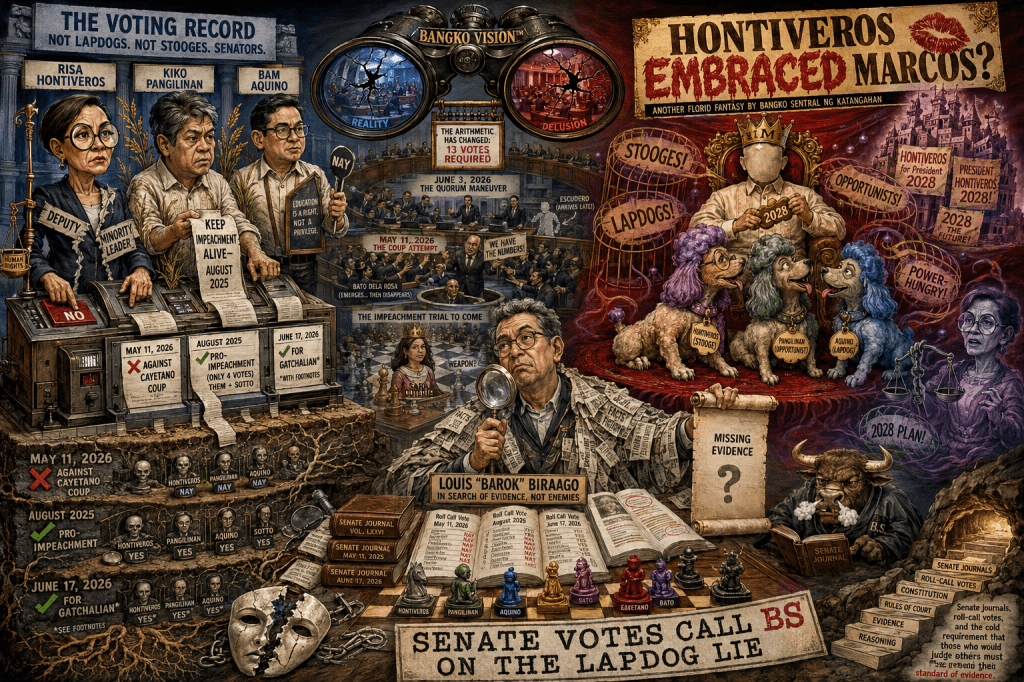
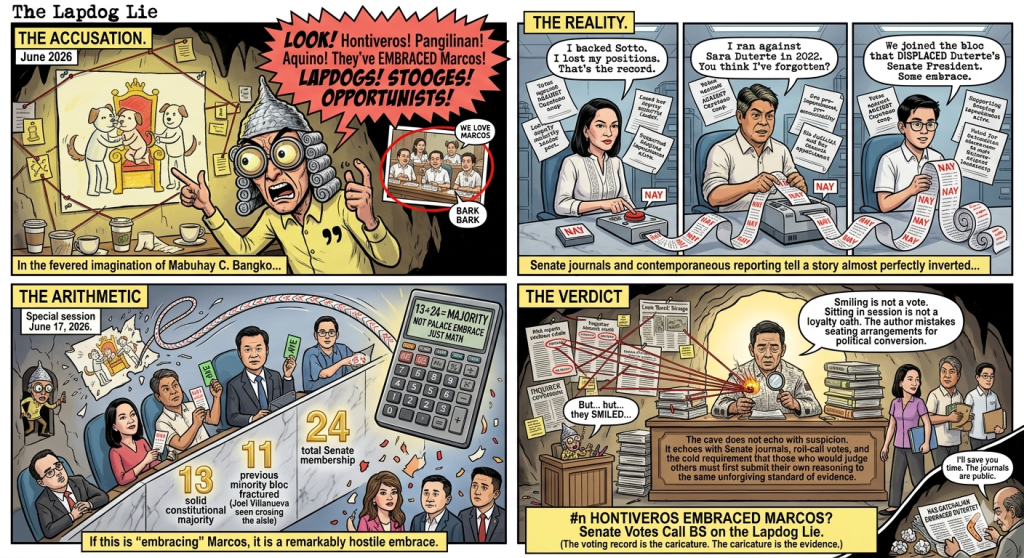
In the fevered imagination of Mabuhay C. Bangko—one of the cave’s most brilliant followers, a formidable lawyer widely regarded as a genius in legal and political circles—Senators Risa Hontiveros, Kiko Pangilinan, and Bam Aquino have not merely crossed the aisle—they have flung themselves into the waiting arms of President Bongbong Marcos. They are now, in the florid prose of Mabuhay C. Bangko, nothing more than political stooges, lapdogs, and opportunists who have sold their voters for committee perks and a government-paid shot at humiliating Vice President Sara Duterte during her impending impeachment trial.
It is a tidy narrative. It is also forensic malpractice.
The Bangko thesis rests on a single, spectacularly unproven leap: that visible cooperation inside the Senate chamber with senators who are not card-carrying members of the “dilawan” camp equals a secret political marriage to Malacañang. From this wobbly premise the author constructs an entire morality play—complete with warnings that these three will betray Marcos before 2028, invocations of every Liberal Party sin from Parity Rights to Hacienda Luisita, and the confident prediction that Hontiveros will be repackaged as the “ideal” alternative to both Marcos and Duterte.
The only thing missing is evidence.
The Voting Record That Refuses to Cooperate
Senate journals and contemporaneous reporting tell a story almost perfectly inverted from Bangko’s script.
After the May 11, 2026 leadership coup that installed Alan Peter Cayetano—widely understood as a move by pro-Duterte forces to seize control of the impeachment narrative—Hontiveros, Pangilinan, and Aquino voted against the change. They ended up in the minority bloc alongside Tito Sotto and Panfilo Lacson.
Hontiveros lost her deputy majority leader post and committee chairmanships precisely because she had backed the ousted Sotto amid the documented Senate realignments.
In August 2025, when the Senate considered archiving an earlier batch of impeachment articles against Sara Duterte, only Aquino, Hontiveros, Pangilinan, and Sotto voted to keep the process alive. They have been, in other words, the most consistent pro-impeachment, pro-accountability voices on that specific question—not Marcos enablers shielding anyone.
Most recently, on June 17, 2026, Win Gatchalian was elected Senate President with the support of Aquino, Hontiveros, Pangilinan, Lacson, Sotto and others—after a June 3 quorum maneuver that ousted Cayetano. The bloc that displaced the Duterte-aligned leadership is the same bloc these three senators joined.
If this is “embracing” Marcos, it is a remarkably hostile embrace. It looks far more like a tactical coalition aimed at preventing one rival faction from controlling the very chamber that will try Sara Duterte.
Bangko’s piece never engages this chronology. It leans instead on the vivid visual: “smiling side by side certain senators known for their dogged loyalty to the current tenant in Malacañang.” Smiling is not a vote. Sitting in session is not a loyalty oath. The author mistakes seating arrangements for political conversion.
Bangko’s Perspective and Its Limits
The article’s method is suspicion as substitute for evidence. It asserts without proof that the three senators are “political stooges,” “lapdogs,” and “opportunists” who have abandoned every promise they made to voters. No leaked memo, no sudden reversal on Maharlika Fund or other signature Marcos priorities, no administration directive, no quid pro quo.
Just the old Philippine political reflex: if they are not with us in pure, performative opposition, they must be with the administration in secret.
This is the same rhetorical move that has poisoned Philippine discourse for decades. It flattens a three-dimensional chess game—where senators maneuver for committee influence, legislative leverage, institutional survival, and 2028 positioning—into a binary morality tale of embrace or betrayal.
The historical indictment of the Liberal Party is similarly selective and weaponized. The Parity Rights controversy under Roxas, the dirty 1953 election under Quirino, the Stonehill scandal under Macapagal, the Hacienda Luisita exemption attempt and the Corona impeachment under Noynoy Aquino—these are real episodes.
But to chain them across eighty years and hang them around the necks of Hontiveros (whose political formation owes more to Akbayan’s progressive, human-rights tradition than to the old LP dynasties) and even Pangilinan and Aquino is guilt by distant association. It is the intellectual equivalent of disqualifying every current Nacionalista because of some 1950s scandal. Bangko offers no limiting principle. By his logic, every party that has ever held power in this country is permanently radioactive.
The 2028 Speculation as Castle-in-the-Air
The article’s most revealing tell is its confident prediction of the trio’s next move: hit Sara Duterte during the trial, then, in the closing months of the Marcos administration, peel away and present one of their own—probably Hontiveros—as the clean 2028 alternative.
Hontiveros has indeed said publicly that she is open to a presidential run in 2028 if the opposition coalesces around her. That is not a secret. It is also not evidence of treachery. Ambition is not betrayal. Every serious senator with a national profile thinks about higher office.
The question is whether that ambition is being pursued by prostituting the impeachment process or by maintaining a consistent record on accountability.
Bangko never bothers to distinguish. For him, the mere existence of future ambition is proof of present corruption of duty. It is a standard that, applied evenly, would disqualify almost every politician who has ever eyed Malacañang—including those currently aligned with either Marcos or Duterte.
The Real Three-Dimensional Game
What is actually happening in the Senate is far more interesting and far less cartoonish than Bangko allows.
The chamber is riven by overlapping conflicts: institutionalists versus personality cultists; those who want a full, evidence-based impeachment trial versus those who prefer to derail or delegitimize it; senators positioning for 2028 versus those still calculating how to survive the remainder of the current term; and a Marcos camp that may see tactical advantage in weakening a Duterte rival without necessarily wanting to own the trial’s outcome.
Hontiveros, Pangilinan, and Aquino are not neutral arbiters. Pangilinan ran against Sara Duterte for vice president in 2022 as part of the opposition ticket. Hontiveros has been her most persistent Senate critic on human rights and ICC issues for years.
These are legitimate grounds for asking whether personal and political history compromises their ability to sit as impartial senator-judges. That is a serious institutional question.
It is not, however, the question Bangko is asking. He is asking a different, partisan one: have they become Marcos’s creatures? The record says no. They have become part of a fluid coalition that ousted a Duterte-aligned Senate president and kept impeachment proceedings from being archived.
Whether that coalition ultimately serves the public interest depends on what happens next—on whether the trial is conducted with fairness and transparency or descends into score-settling. Bangko’s binary framing (“with us or against us”) is precisely what prevents that more serious conversation.
Barok Verdict
Mabuhay C. Bangko has written a piece that begins with its conclusion and then selects only the facts that can be twisted to fit it. It substitutes political suspicion for evidence, generational guilt for analysis, and speculation about 2028 for an honest reckoning with what the Senate’s voting record actually shows.
In doing so, it performs a disservice to every reader who wants to understand the real stakes of the moment: who will control the presiding officer of an impeachment trial that could shape the 2028 field, and whether any senator is still capable of placing constitutional duty above factional advantage.
The senators in question are not above criticism. Hontiveros must decide whether her long record of anti-impunity advocacy survives the perception that she is now aligned with forces that may benefit from Sara Duterte’s political destruction. Pangilinan must confront whether personal rivalry has overtaken institutional judgment. Aquino must demonstrate that his legislative agenda is not hostage to whichever coalition offers the most committee leverage this month.
But the more significant shortcoming lies in the commentator’s framing, which blurs the line between tactical Senate realignment and full political conversion, applies a strict purist lens to complex alliances, and offers the public a narrative centered on the conspiracy of an embrace that the voting record does not fully support.
The cave does not echo with suspicion. It echoes with Senate journals, roll-call votes, and the cold requirement that those who would judge others must first submit their own reasoning to the same unforgiving standard of evidence.
Key Citations
- Bangko, Mabuhay C. “Has Senator Hontiveros Finally Embraced PBBM?” Kweba ni Barok, 2026, https://kwebanibarok.com/wp-content/uploads/2026/06/wp-1781751770911.pdf. PDF file.
- Philippine News Agency. “Cayetano Takes Senate Helm Amid VP Sara Impeachment.” Philippine News Agency, 11 May 2026, https://www.pna.gov.ph/articles/1274753.
- Inquirer.net. “Some Senators Express Intentions to Move to Minority.” Inquirer.net, 25 May 2026, https://newsinfo.inquirer.net/2233978/some-senators-express-intentions-to-move-to-minority-hontiveros.
- Inquirer.net. “Senate Row Ends: Gatchalian Takes Helm, Cayetano Yields.” Inquirer.net, 18 June 2026, https://newsinfo.inquirer.net/2248388/senate-row-ends-gatchalian-takes-helm-cayetano-yields.
- Britannica. “Parity Amendment.” Britannica, Encyclopædia Britannica, 2024, https://www.britannica.com/topic/Parity-Amendment. Accessed 18 June 2026.
- Wikipedia Contributors. “1953 Philippine General Election.” Wikipedia, The Free Encyclopedia, Wikimedia Foundation, 15 June 2026, https://en.wikipedia.org/wiki/1953_Philippine_general_election. Accessed 18 June 2026.
- Wikipedia Contributors. “May 2026 President of the Senate of the Philippines Election.” Wikipedia, The Free Encyclopedia, https://en.wikipedia.org/wiki/May_2026_President_of_the_Senate_of_the_Philippines_election.
- Wikipedia Contributors. “2028 Philippine Presidential Election.” Wikipedia, The Free Encyclopedia, https://en.wikipedia.org/wiki/2028_Philippine_presidential_election.
- Inquirer.net. “Risa Hontiveros Wants Single Opposition Bet in 2028.” Inquirer.net, 23 May 2026, https://newsinfo.inquirer.net/2233074/risa-hontiveros-wants-single-opposition-bet-in-2028.
- Wikipedia Contributors. “2022 Philippine Presidential Election.” Wikipedia, The Free Encyclopedia, https://en.wikipedia.org/wiki/2022_Philippine_presidential_election.
- Wikipedia Contributors. “Hacienda Luisita.” Wikipedia, The Free Encyclopedia, https://en.wikipedia.org/wiki/Hacienda_Luisita.
- Wikipedia Contributors. “Impeachment of Renato Corona.” Wikipedia, The Free Encyclopedia, https://en.wikipedia.org/wiki/Impeachment_of_Renato_Corona.
- Wikipedia Contributors. “International Criminal Court.” Wikipedia, The Free Encyclopedia, https://en.wikipedia.org/wiki/International_Criminal_Court.





Leave a Reply