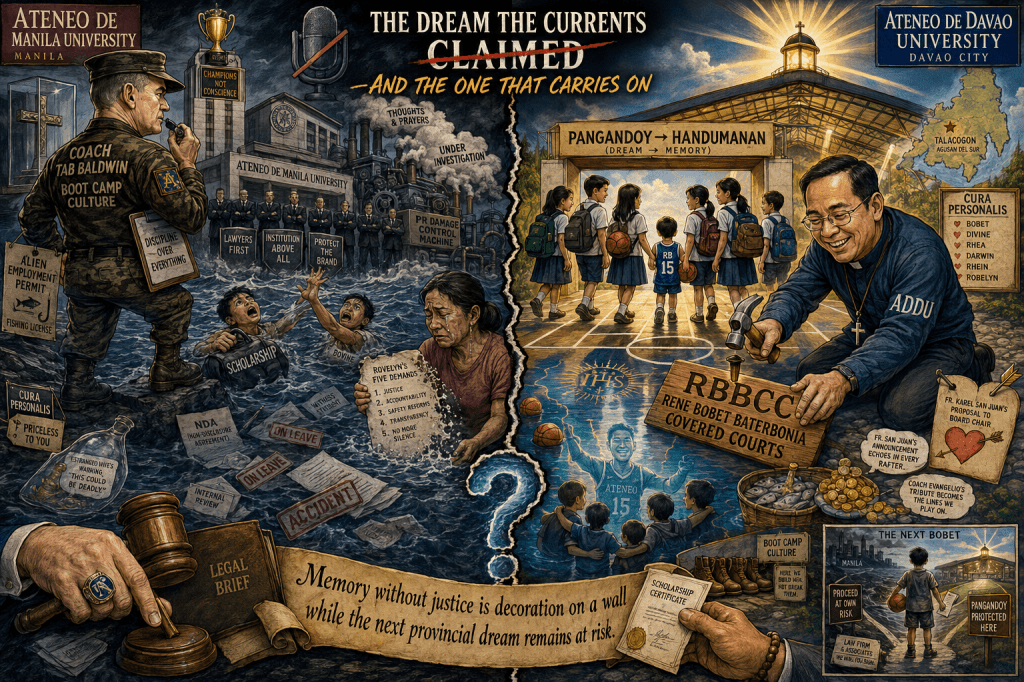
Pangandoy Drowned in Aurora, Handumanan Honored in Davao — While Manila Lawyered Up
By Louis ‘Barok‘ C. Biraogo — June 15, 2026
IN THE fluorescent-lit cavern of a covered court, amid the scent of floor wax and the ghost echoes of bouncing balls, a nation’s grief has found its altar. The Ateneo de Davao University (ADDU) has renamed its Senior High School courts the Rene Bobet Baterbonia Covered Courts—the RBBCC—ensuring that a gentle giant’s name will be whispered by generations of young athletes who chase their pangandoy on its polished floors.
But 600 miles north, in the hushed administrative corridors of the Ateneo de Manila University (ADMU) along Katipunan Avenue, the silence is of a different kind. It is the silence of lawyers calculating liability, of brand managers assessing reputational damage, of an institution that preached cura personalis—care for the whole person—until caring became legally inconvenient.
Two Jesuit universities. Two responses to the same unfathomable tragedy. And between them, the body of an 18-year-old boy from Agusan del Sur who only ever wanted to lift his family out of poverty.
This is not merely a story about a drowning. This is a parable about what happens when the lofty rhetoric of elite institutions collides with the cold machinery of self-preservation. And in that collision, the poor are always the first to be swept away.
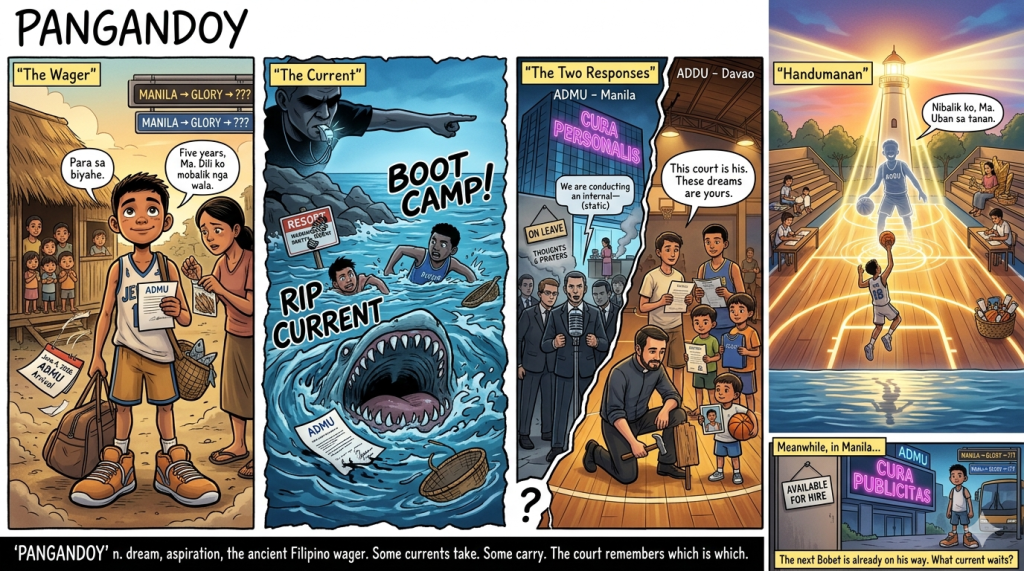
The Dream That Drowned in Aurora
Before we dissect the institutional machinations, we must first sit with the weight of what was lost.
Rene Clert “Bobet” Baterbonia was not a generic prospect. He was the Palarong Pambansa Most Valuable Player in 2025, a boy who steered the Davao Region to a historic gold medal in secondary basketball. His parents sold fish in the market. His family was a 4Ps beneficiary—the government’s conditional cash transfer program for the poorest of the poor. Bobet was the second of seven children, and on his broad shoulders rested the hopes of an entire family’s escape from generational hardship.
When he told his ADDU Blue Knights coach Jess Evangelio that he would not return to Davao for five years because “gusto nako madato ko, ma-ahon nako ako pamilya sa kapobre”—I want to be rich so I can lift my family out of poverty—he was not speaking in metaphor. He was reciting a life plan. Basketball was not a game to Bobet. It was a rescue mission.
On June 4, 2026, he arrived at the ADMU campus, wide-eyed and ready to spread his wings as a Blue Eagles recruit. He had no signed contract. He had not yet been formally enrolled. His mother, Rovelyn, had not been consulted about any off-campus activities. Four days later, he was dead—drowned along with teammate Divine Adili of Nigeria during a “team building” conditioning exercise in Dipaculao, Aurora, 300 meters from the shore, in waters the resort management had warned against.
Let those facts settle like sediment in stirred water. An 18-year-old, recruited from poverty, brought to a strange place, handed over to a foreign coach with a documented appetite for brutal “boot camp” conditioning methods adopted from Bear Bryant’s Alabama playbook, and dead within 96 hours of arrival. His mother’s words are the only indictment that matters: “Had they explained it to me, I wouldn’t have allowed him to go. Despite our hardships, I wouldn’t have sent him there.”
Informed consent was never secured. Duty of care was never exercised. And now a family that sold fish to survive must bury a son who dreamed of buying them a better life.
The Davao Response: Grief Made Concrete
Into this void of accountability stepped ADDU, and what they have done merits genuine admiration—alongside measured scrutiny.
Fr. Karel San Juan, the university president, stood before thousands of mourners at the Christ the King Chapel on Sunday night and made two announcements of seismic significance. First, the university would provide full scholarships from basic education through college for all six of Bobet’s siblings. Second, the covered courts where Bobet practiced and played would bear his name henceforth.
The scholarship package is the more consequential gesture. It is not symbolic. It is a multi-year, multi-million-peso commitment that directly answers Bobet’s stated pangandoy—his dream. When he told his coach he wanted his siblings educated, he was sketching a blueprint. ADDU is now laying the foundation. This is the Jesuit preferential option for the poor made flesh, not merely recited in a mission statement. It is concrete charity, and it deserves unqualified applause.
The court naming is more complex. Fr. San Juan acknowledged the proposal still requires Board of Trustees approval—a detail he mentioned almost parenthetically, yet it looms large. Announcing a memorial before the board that must ratify it creates a fait accompli; the trustees now face the unenviable choice of endorsing a presidential impulse or appearing callous before a grieving public. This is governance by emotional steamroller, however well-intentioned.
Yet there is undeniable beauty in the specific geography of the honor. These were Bobet’s courts. He prayed in the adjacent chapel. His wake drew 12,142 visitors in two days, queues spilling onto the highway. The naming transforms a facility from mere infrastructure into a permanent pedagogical tool—every young athlete who sweats on that floor will learn the name and story of the boy who proved that no dream is too big when you are willing to work for it. Coach Evangelio said it plainly: “This court will stand as a reminder of the life you lived and the lives you continue to inspire.”
ADDU has done what a university should do when tragedy strikes its community: it has wrapped its arms around the bereaved and refused to let go. It has chosen memory and mission over memo and mitigation.
The Manila Silence: Accountability Deferred
And then there is ADMU.
The contrast is so stark it requires no rhetorical embellishment, but let us catalog the particulars anyway. Bobet died on June 8. For days, the university issued no substantive statement. Coach Tab Baldwin—the American-New Zealander who imported the “boot camp” philosophy that has now claimed two young lives—was placed “on leave” and instructed not to speak publicly. When he finally surfaced, it was through a pre-recorded video released on ADMU’s Facebook page, an apology so mediated and lawyered that it functioned as anti-grief.
The Aurora police, with a swiftness that beggars belief, declared the deaths an accident. The Baterbonia family’s attorney, Israelito Torreon, noted that even the mother found this “very questionable.” The family has issued five demands that read like a primer on what genuine institutional accountability should look like:
- A dedicated human liaison
- Freedom for the surviving teammates to speak without fear
- A complete chronological account of events
- Formal acknowledgment of responsibility
- Proactive support offered as an act of justice rather than strategy
These are not unreasonable requests. They are the minimum moral requirements for any institution that has presided over the death of a minor in its care. And yet ADMU has met them with the defensive crouch of a corporation facing a class-action lawsuit.
The most devastating indictment comes not from lawyers or journalists but from the estranged wife of Tab Baldwin herself. “The deaths of your kids were not only predictable, but preventable,” she stated. “The bodies of your kids are still warm and he’s talking about moving on… that’s terrible.” When a coach’s own family warns an institution that children are not safe around him, and the institution does nothing, the moral calculus shifts from negligence to something approaching complicity.
Atty. Torreon has now trained his sights on the most exquisite irony of the entire affair. ADMU, he noted, is fond of invoking “accountability” as a core value—it is, after all, emblazoned on their promotional materials and recited in their graduation speeches. “Tumingin sila sa mirror,” he challenged. Let them look in the mirror. The institution that demands accountability from the nation’s politicians and business leaders is now being asked to apply the same standard to itself. The mirror, it seems, is unbearable to gaze upon.
The Dangerous Theater of Grief
We must also examine the uneasy intersection of authentic mourning and institutional optics. ADDU’s gestures, however sincere, exist within a context they did not create but cannot escape. Bobet died under the supervision of a rival Ateneo institution. ADDU’s lavish memorialization—the scholarships, the court naming, the facilitation of GCash donations—functions inevitably as an implicit rebuke of ADMU’s barren silence. The Davao Ateneo is now, in the national imagination, the “caring Ateneo.” The Manila Ateneo is the one that let a poor boy drown and then lawyered up.
This is not to accuse ADDU of cynicism. Fr. San Juan himself visited Bobet at the ADMU Jesuit Residence just two days before his death; the pastoral connection is genuine, the grief authentic. But institutional actions have institutional meanings that transcend individual intentions. ADDU has, whether deliberately or not, engaged in a masterclass of competitive compassion. ADMU, equally, has demonstrated that its commitment to cura personalis is contingent on the absence of legal exposure.
The danger, of course, is that charity becomes a substitute for justice. The scholarships are magnificent. The court naming is poignant. The donations, now flowing through ADDU-facilitated channels, are concrete help. But none of this answers the question of what exactly happened 300 meters from the shore in Dipaculao on June 8, 2026. None of it secures the accountability that the family’s five demands seek. Memory without justice is just decoration—beautiful, heartfelt decoration, but decoration nonetheless.
Recommendations: What Must Follow the Mourning
The grieving will continue, as it should. Bobet’s remains are now on their way to Talacogon, where an entire province prepares to welcome their hero home. But when the funeral masses end and the covered court’s new signage is installed, the following must happen:
- The National Bureau of Investigation and the Department of Justice task force must pursue their probe with the rigor that the Aurora police so conspicuously lacked. The “pure accident” finding must be tested against the evidence of ignored safety warnings and a documented culture of hazardous training methods.
- ADMU must provide the Baterbonia and Adili families with everything they have requested: a full, point-by-point, chronological account of the events leading to their sons’ deaths. No more mediated apologies. No more institutional silence. The teammates present at Dipaculao must be freed to speak without fear of reprisal. Transparency is the first installment of accountability.
- The Department of Labor and Employment’s investigation into Baldwin’s Alien Employment Permit must proceed without political interference. If he was coaching without valid authorization, that is not merely an administrative violation—it raises fundamental questions about the legality of his entire engagement with student-athletes.
- The UAAP and all Philippine collegiate athletic bodies must immediately review and regulate off-campus training protocols, particularly those involving water, extreme physical exertion, or hazardous environments. The “boot camp” culture that Baldwin imported from American football has no place in the formation of young Filipino athletes. Bobet Baterbonia and Divine Adili are not the first casualties of this philosophy; they must be the last.
- ADDU’s Board of Trustees should ratify the court naming not as a rubber stamp but as a deliberate, considered act of institutional memory. Simultaneously, they must ensure that the scholarship commitments made to Bobet’s six siblings are properly endowed and legally protected against future budgetary pressures. A promise made in grief must be honored in permanence.
- Finally, and most uncomfortably, the Philippine public must resist the seduction of sentimental closure. The RBBCC will be a place of inspiration. The scholarships will transform lives. But neither will bring Bobet back, and neither will deliver justice. That can only come through the unglamorous, frustrating, and essential work of legal accountability. The Baterbonia family deserves not only our tears but our insistence that those responsible for their son’s death be named, held accountable, and prevented from ever endangering another child.
Verdict
In the Visayan language of Bobet’s homeland, Fr. San Juan spoke of pangandoy and handumanan—dream and memory. These twin concepts now frame the contested moral territory on which this tragedy sits.
Bobet’s pangandoy was to rescue his family from poverty. ADDU is now ensuring that dream, at least in part, survives its dreamer. That is grace. His handumanan will endure in the covered courts that bear his name, in the photographs that will hang on its walls, in the young athletes who will learn his story and perhaps draw courage from it.
But there is a third Visayan word that demands utterance: katarungan. Justice. Without it, the dreams and the memories risk becoming a monument to impunity rather than a memorial to a life. The covered courts of Davao now honor a boy who played with all his heart. The courts of law must now ensure that his death was not merely an accident to be managed but a wrong to be righted.
Bobet Baterbonia told his coach he would not return to Davao for five years. He made the journey home in just ten days, in a coffin. The least we can do—the absolute moral minimum—is to ensure that his family gets the truth, his dream for his siblings endures, and the institution that failed him learns to say something more than a lawyerly “sorry.”
Let the cave echo with unyielding truth — for memory without justice is mere decoration. 🪨
— Barok
Key Citations
A. News Articles
- Arguillas, Carolyn O. “ADDU Names SHS Covered Courts after Rene ‘Bobet’ Baterbonia.” MindaNews, 14 June 2026, mindanews.com/top-stories/2026/06/addu-names-shs-covered-courts-after-rene-bobet-baterbonia/.
- Arguillas, Carolyn O. “Lawyer Says Families Want 5 Things from ADMU.” MindaNews, 13 June 2026, mindanews.com/top-stories/2026/06/lawyer-says-families-want-5-things-from-admu/.
- “Tab Baldwin’s Bootcamp Comes Under Scrutiny After Ateneo Deaths.” Spin.ph, 9 June 2026, spin.ph/basketball/uaap-men/tab-baldwin-s-bootcamp-comes-under-scrunity-after-ateneo-deaths-a2437-20260609.
- SunStar Davao. “The Dream Rene Clert ‘Bobet’ Baterbonia Played for Cut Short at 19.” SunStar, June 2026, sunstar.com.ph/davao/sports/the-dream-rene-clert-bobet-baterbonia-played-for-cut-short-at-19.
B. Institutional Sources
- Ateneo de Davao University. Official Website, www.addu.edu.ph.
- Ateneo de Manila University. Official Website, www.ateneo.edu.
- ₱9 Billion in ‘Savings’? DILG’s Fire Truck Deal Smells Like Smoke

- ₱8B BBM Pork: CCTV for Every Captain’s Kumpare?

- ₱8.9 Billion, 331 Ghost Police Stations: The TIKAS Scandal Explained

- ₱8.4 Billion, 42,000 Barangays, 1 Election: The “Bawat Barangay Makikinabang” Vote-Buying Masterclass

- ₱75 Million Heist: Cops Gone Full Bandit

- ₱6.77B Ghost Haunts Duterte: RTC Dismisses Mans Carpio’s Desperate Plea
- ₱6.77 Billion and Zero Cash: The Sara Duterte SALN Math That Doesn’t Add Up

- ₱6.7-Trillion Temptation: The Great Pork Zombie Revival and the “Collegial” Vote-Buying Circus

- ₱58.53B, Zero Receipts: The LGSF Pork Barrel Nobody Wants to Name

- ₱53 Million Man Tells ₱695-a-Day Workers to Stop Being ‘Mayabang’: The Audacity of BSP’s Remolona
- ₱4.4 Billion and a Witness Who Can’t Explain It: The Duterte Impeachment’s Most Expensive Non-Answer
- ₱3.06 Billion for Evacuation Centers—But Nobody Knows Where They’ll Stand (Or If They’ll Exist)








Leave a Reply