Loopholes So Big, Even Cousins Can Run for President – The Ultimate Dynasty Shield
By Louis ‘Barok‘ C. Biraogo — June 22, 2026
THE silence was the only honest thing in the room.
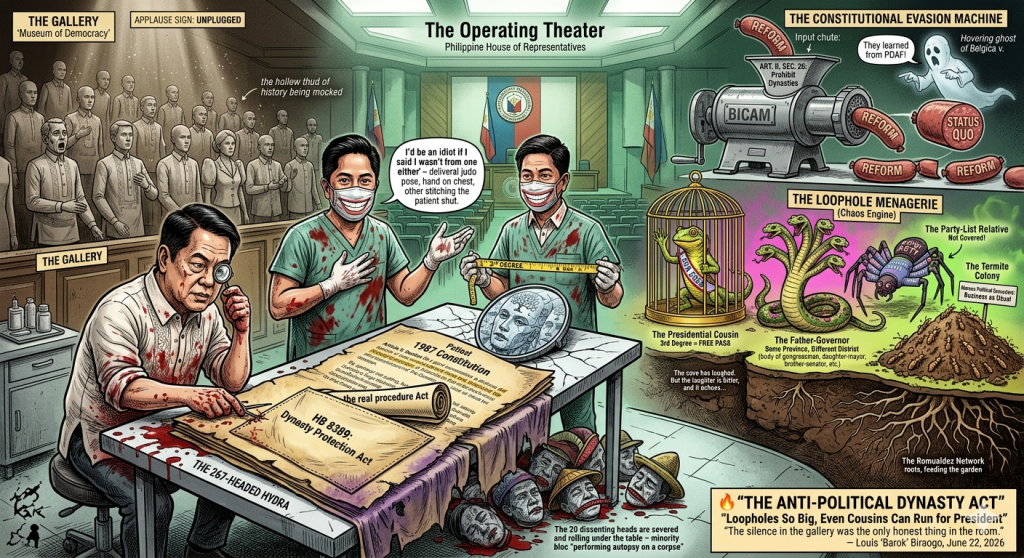
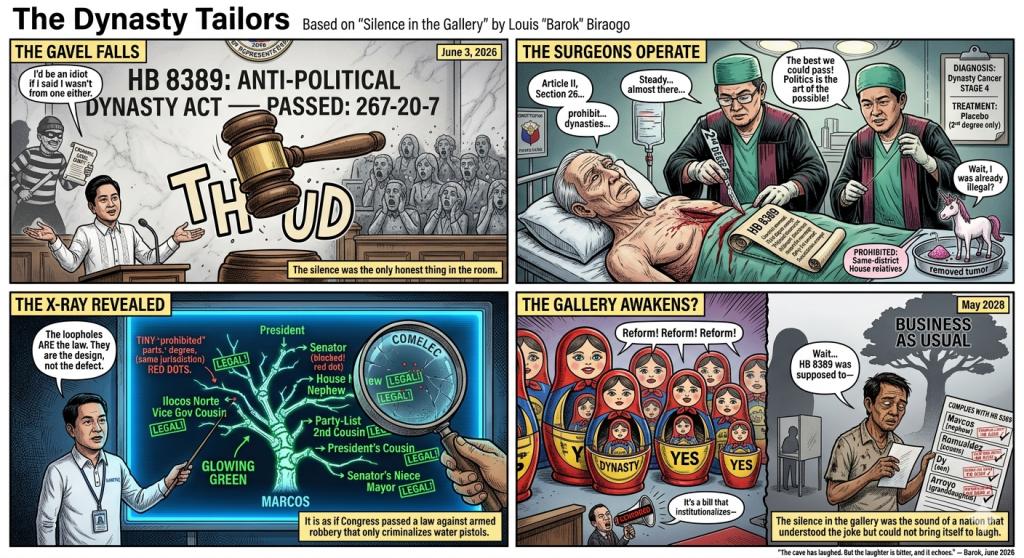
When the gavel fell on June 3, 2026—267 votes for, 20 against, 7 abstentions—the House gallery did not erupt. No applause. No backslapping. Just the hollow thud of history being mocked in real time. For nearly an hour afterward, the minority bloc took turns flaying the corpse on the floor, performing an autopsy on a bill that was, by then, already dead on arrival if you measure a law by its constitutional purpose rather than its political function.
The bill was House Bill No. 8389 (Anti-Political Dynasty Act). The so-called Anti-Political Dynasty Act. And the silence that greeted its passage was the sound of a nation realizing it had just been conned.
Let’s call a spade a spade. Actually, let’s let the Majority Leader do it himself. “I’d be an idiot if I said I wasn’t from one either,” Ferdinand Alexander “Sandro” Marcos III declared with the practiced candor of a man who has learned that admitting the obvious is cheaper than defending the indefensible. This is not humility. This is a rhetorical judo throw—using the admission of guilt as a shield against the charge of hypocrisy, then leveraging that shield to justify whatever compromised product emerges from the legislative sausage factory. It is the political equivalent of a burglar telling you he is a burglar, then offering to write the criminal code.
The product that emerged is not an anti-dynasty law. It is a Dynasty Protection Act dressed in the borrowed robes of constitutional compliance. And it is, by some measures, a legislative masterpiece—not because it solves the problem, but because it solves the problem of solving the problem. It gives the appearance of action while ensuring that nothing, absolutely nothing, changes.
The Nothingburger Exposed: Loopholes Designed to Let Dynasties Thrive
To understand why HB 8389 is a constitutional nullity in spirit, one must simply read what it actually does—and, more importantly, what it does not do.
The bill prohibits spouses and relatives within the second degree of consanguinity or affinity from simultaneously holding elective office within the same governmental level or jurisdiction. A president cannot have a sibling in the Senate. A governor cannot have a spouse as vice governor of the same province. A mayor cannot install a son on the same city council. So far, so cosmetic.
Now consider what remains perfectly legal under this supposed prohibition:
A father may serve as governor. His son may serve simultaneously as a congressman from a different district in the same province. His daughter may be mayor of a city within that province. His brother may be a senator. And if the family is feeling particularly ambitious, a cousin—untouched entirely because cousins fall outside the bill’s second-degree cap—can run for president. None of this is a “prohibited dynastic relationship” under HB 8389. None of it.
The bill’s critics, from NAMFREL to the Makati Business Club to the minority bloc’s increasingly exasperated members, have converged on the same diagnosis: this is not a loophole-ridden law. The loopholes are the law. They are the design, not the defect.
“Philippine political dynasties do not function through tightly-knit webs of uncles, aunts, nephews, nieces, and first cousins,” the National Citizens’ Movement for Free Elections (NAMFREL) noted in its statement on the bill’s passage. All of those fall in the third and fourth degree of kinship—meaning they are completely untouched by HB 8389. The bill thus draws its line precisely where the real dynastic architecture of the Philippines begins. It is as if Congress had passed a law against armed robbery that only criminalizes the possession of water pistols.
Then there is the congressional exemption. The bill disallows spouses or second-degree relatives from holding House seats within the same legislative district—a restriction so laughably redundant it deserves its own comedy special. The Constitution already limits each district to one representative. The bill’s “prohibition” on same-district relatives is thus the legislative equivalent of outlawing unicorn poaching. It bans something that was already impossible.
What the bill does not ban is a congressman’s sibling, child, or parent running for a House seat in a different district—even an adjacent one, even in the same province. The Marcos family tree, which Sandro himself has helpfully volunteered as Exhibit A in this entire affair, would remain beautifully undisturbed. His aunt, Senator Imee Marcos, would have to leave the Senate if her brother were simultaneously president (the bill does at least get that right), but her nephew in the House? Perfectly fine. The Ilocos Norte vice governor cousin? Untouched. The sprawling Romualdez network in the House? Business as usual. Under HB 8389, the Marcos political ecosystem would survive with barely a scratch, like a termite colony whose outermost mound has been gently kicked.
Caloocan Representative Edgar Erice, a lonely voice of clarity in this fog of self-interest, put it with devastating precision: “It’s a bill that institutionalizes or legalizes the existence of political dynasties. They agreed to it because nothing will change.”
The Great Constitutional Evasion: How Congress Finally ‘Complied’ by Nullifying the Mandate
Article II, Section 26 of the 1987 Constitution of the Republic of the Philippines (1987 Constitution) is a beautifully simple command: “The State shall guarantee equal access to opportunities for public service, and prohibit political dynasties as may be defined by law.” For thirty-nine years, Congress simply ignored it. The provision was, by judicial consensus, non-self-executing—meaning it required an enabling law to have any teeth. And for thirty-nine years, the body tasked with passing that enabling law was composed overwhelmingly of the very families that would be regulated by it. The foxes were asked to design the henhouse security system. They declined, year after year, Congress after Congress, with a consistency that bordered on the heroic.
Now, at last, they have produced something. And that something is a law that defines “political dynasty” so narrowly, so artfully, with such exquisite attention to the preservation of existing power structures, that it effectively constitutionalizes the very thing it purports to dismantle. This is not compliance with the constitutional mandate. It is a sophisticated form of constitutional evasion.
In Belgica v. Ochoa (G.R. No. 208566, November 19, 2013), the Supreme Court struck down the Priority Development Assistance Fund because, among other reasons, the mechanism allowed legislators to accomplish indirectly what the Constitution forbade them to do directly. The parallel here is not perfect, but it is illuminating: HB 8389 formally implements Article II, Section 26 while substantively frustrating its purpose. It wears the language of prohibition while engineering the conditions for permission. It is a wolf in sheep’s clothing, except the wolf is a political dynasty and the sheep’s clothing is a law that the dynasty itself tailored.
The equal protection dimension is equally troubling. Under the rational basis test that Philippine courts apply to social and economic legislation, a statutory classification must rest on substantial distinctions germane to the law’s purpose. If the purpose of HB 8389 is to dismantle dynastic concentration of power, and its classifications are drawn precisely to leave the dominant real-world dynastic structures untouched, then an argument exists that the classifications are not germane to the stated purpose but are instead reverse-engineered to protect the status quo. The rational basis for the second-degree limit, for the single-jurisdiction rule, for the congressional exemption—all of these begin to look less rational and more tactical when examined against what the bill leaves unregulated.
Committee Charade: Public Consultations Trashed, Pre-Cooked Bill Forced Through
The procedural genesis of HB 8389 only compounds the stench. According to Representative Erice and an anonymous source quoted in the Inquirer report, the “game plan” was straightforward: lock in the leadership’s preferred version at the committee level, then tell opposing lawmakers to raise their amendments on the floor, where the sheer weight of the majority bloc would crush them. The Adiong committee, which had supposedly spent more than a month holding exhaustive public consultations, was “ordered to immediately pass the bill” days after Sandro Marcos circulated his version. Public hearing recommendations—where, according to Erice, most participants wanted House posts covered by the ban—were ignored. The committee did not entertain amendments before sending the bill to plenary.
Majority Leader Marcos’s defense is the classic realist shrug: this is the best that could pass. Politics is the art of the possible. A weak law is better than no law. In a chamber where eight of every ten members belong to political clans, what did you expect?
The response to this is simple: if the House cannot pass a genuine anti-dynasty law, then the House should admit that it cannot pass a genuine anti-dynasty law. It should not pass a counterfeit and then demand applause for its courage. The claim that an imperfect law is better than no law rests on the assumption that the imperfect law will serve as a foundation for future improvement. But HB 8389, by legalizing the very dynastic arrangements it pretends to regulate, may actually make future reform harder. Once Congress has “complied” with Article II, Section 26, the political pressure to do so again will dissipate. The constitutional command will have been, in the legislature’s view, discharged. The bill does not open a door to stronger reform; it slams that door shut and bolts it from the inside.
The Enablers in the Dock: Dy, Marcos III, and the 267 Who Chose Self-Preservation
A word about the key players, because a critique that spares individuals their share of accountability is merely an abstraction.
Speaker Faustino “Bojie” Dy III and Majority Leader Sandro Marcos are not villains in the cartoon sense. They are something more dangerous: competent operators who understand that in Philippine politics, the appearance of reform is often more valuable than reform itself. They have delivered a bill that allows the administration to claim a legislative trophy—the first anti-dynasty law in Philippine history—while preserving the structural dominance of the families that actually run the country. It is a neat trick, and it deserves recognition as such. It also deserves contempt.
The 267 representatives who voted yes are not off the hook either. A vote for HB 8389 was not a vote for reform. It was a vote for self-preservation, cast by members who know perfectly well that the bill leaves their own dynastic arrangements intact. The silence in the gallery after the vote was the most honest reaction possible: even the audience understood that nothing historic had occurred. The minority bloc’s hour-long denunciation was a eulogy delivered over a patient who had been murdered by the very surgeons claiming to operate.
And what of the Senate? The upper chamber has its own version of an anti-dynasty bill, co-authored by Senators Padilla, Lacson, Pangilinan, Hontiveros, Aquino, Legarda, and Tulfo. It is reportedly stronger—covering party-list groups, including an anti-succession provision, and extending restrictions beyond the House bill’s cramped second-degree, single-jurisdiction framework. But the Senate version has not yet passed second reading, and the coming bicameral conference committee is, in Philippine practice, the place where strong floor-passed provisions go to die. Bicameral conference committees are small, opaque, unaccountable, and composed of appointed conferees who deliberate without the safeguards of plenary debate. Marcos has already previewed the strategy, predicting the Senate will not simply adopt the House version and that “another opportunity to amend” will arise in bicam. Translated from political dialect: the House expects the Senate to push for a stronger bill, at which point a handful of conferees in a closed room will “reconcile” the two versions into something that looks more like the House’s anemic text.
This is not a prediction. It is a script.
The Cave’s Call: Four Demands to Rescue the Constitution from Legislative Fraud
Let us be clear about what is at stake. Political dynasties are not a cultural quirk or a harmless tradition. They are the primary mechanism by which a small number of families capture the state and convert it into a family asset. They throttle political competition, discourage new leaders from emerging, and concentrate power in the hands of those who have a direct personal interest in preventing the kind of structural reforms—progressive taxation, land redistribution, genuine anti-corruption enforcement—that would threaten their economic dominance. As Ateneo’s Professor Arjan Aguirre observed, “Strong democracies are built on strong institutions, not on the continued dominance of political families.” HB 8389, by contrast, builds a strong institution for the continued dominance of political families.
This is not hyperbole. It is a structural diagnosis. The dynastic system is not a bug in Philippine democracy; it is the operating system. And HB 8389 is not a patch designed to fix it; it is an update designed to make the operating system harder to challenge.
So what is to be done? A few modest recommendations from this cave, offered in the spirit of a man who has spent too long watching the legislature treat the Constitution as a suggestion box:
First, the Senate must not buckle. The stronger provisions in the Senate bill—the anti-succession rule, the party-list coverage, the expansion of prohibited relationships—must survive bicam. If they do not, the Senate will have been complicit in the same constitutional fraud the House has just perpetrated.
Second, the bicameral conference committee must be conducted in full public view. No closed-door reconciliation. No conferee horse-trading. The Filipino people have a right to watch the sausage being made, especially when the sausage is made of their own disenfranchisement.
Third, the electorate must remember. The 267 representatives who voted yes on June 3, 2026, have placed their names on a roll of dishonor. They have chosen to protect their families at the expense of the nation. In the next election, they should be reminded of that choice. The ballot is the only weapon that dynasties cannot legislate away—at least not yet.
Fourth, and most fundamentally, we must stop accepting the logic of the possible. When Majority Leader Marcos says that this is the best the House could pass, the appropriate response is not admiration for his realism. It is anger that the House, by its own composition, has rendered itself incapable of complying with the Constitution. If the chamber cannot pass a genuine anti-dynasty law, then the chamber is constitutionally defective. That defect does not excuse non-compliance; it demands structural remedy—perhaps a people’s initiative that bypasses Congress entirely and writes a real anti-dynasty prohibition directly into the fundamental law, this time in self-executing language that no legislature can neuter.
The Constitution’s promise was simple: equal access to public office. No dynasty shall rule us. Thirty-nine years later, the House has finally answered that promise—with a bill that legalizes dynasty, dignifies it with statutory language, and calls it reform. The silence in the gallery was the sound of a nation that understood the joke but could not bring itself to laugh.
The cave has laughed. But the laughter is bitter, and it echoes in a chamber that has once again proven that the more things change, the more they remain exactly, exhaustingly, dynastically the same.
Key Citations
A. Legal & Official Sources
- The 1987 Constitution of the Republic of the Philippines. Official Gazette of the Republic of the Philippines, 1987, http://www.officialgazette.gov.ph/constitutions/1987-constitution/.
- Belgica v. Ochoa. G.R. No. 208566. Supreme Court of the Philippines, 19 Nov. 2013. Lawphil, lawphil.net/judjuris/juri2013/nov2013/gr_208566_2013.html.
- House of Representatives of the Philippines. House Bill No. 8389, Anti-Political Dynasty Act. 20th Cong., 1st Reg. Sess., 2026. https://docs.congress.hrep.online/legisdocs/first_20/CR00143.pdf�. Accessed 22 June 2026.
B. News Reports
- National Citizens’ Movement for Free Elections (NAMFREL). “A Hollow Victory: Why HB 8389 Falls Short of a Genuine Anti-Political Dynasty Law.” Asian Network for Free Elections, 10 June 2026, anfrel.org/namfrel-statement-on-the-passage-of-house-bill-no-8389/.
- Basilio, Kenneth Christiane.“The House Anti-Dynasty Bill: Approved, but Not Applauded.” Inquirer.net, 20 June 2026, newsinfo.inquirer.net/2249344/the-house-antidynasty-bill-approved-but-not-applauded.
- Reganit, Jose Cielito. “House Passes Anti-Political Dynasty Bill on Final Reading.” Philippine News Agency, 3 June 2026, http://www.pna.gov.ph/articles/1276504.

- “Ang Hirap Maging Mahirap”: The PAO Scandal That Proves Government Contempt Is Nothing New

- “Far-Off” My Axx: Malacañang’s Claire Castro Drowns in Her Own Legal Gaslighting
- “Forthwith” to Farce: How the Senate is Killing Impeachment—And Why Enrile’s Right (Even If You Can’t Trust Him)

- “HINDI AKO NAG-RESIGN!”

- “I Know Nothing”: Baste Duterte’s Amnesia Defense Meets ₱33M in GenCorp Contracts

- “I’m calling you from my new Globe SIM. Send load!”

- “Mahiya Naman Kayo!” Marcos’ Anti-Corruption Vow Faces a Flood of Doubt

- “Manageable” Debt, Unmanageable Lies: DBM’s ₱21 Trillion Fairy Tale

- “Meow, I’m calling you from my new Globe SIM!”

- “Natrabaho”: One Word, One Ombudsman, and a Judiciary on Trial

- “No Special Jail for Crooks!” Boying Remulla Slams VIP Perks for Flood Scammers

- “Philippine-Controlled” or Yankee Gas Station? The Davao Fuel Depot Farce Exposed








Leave a Reply