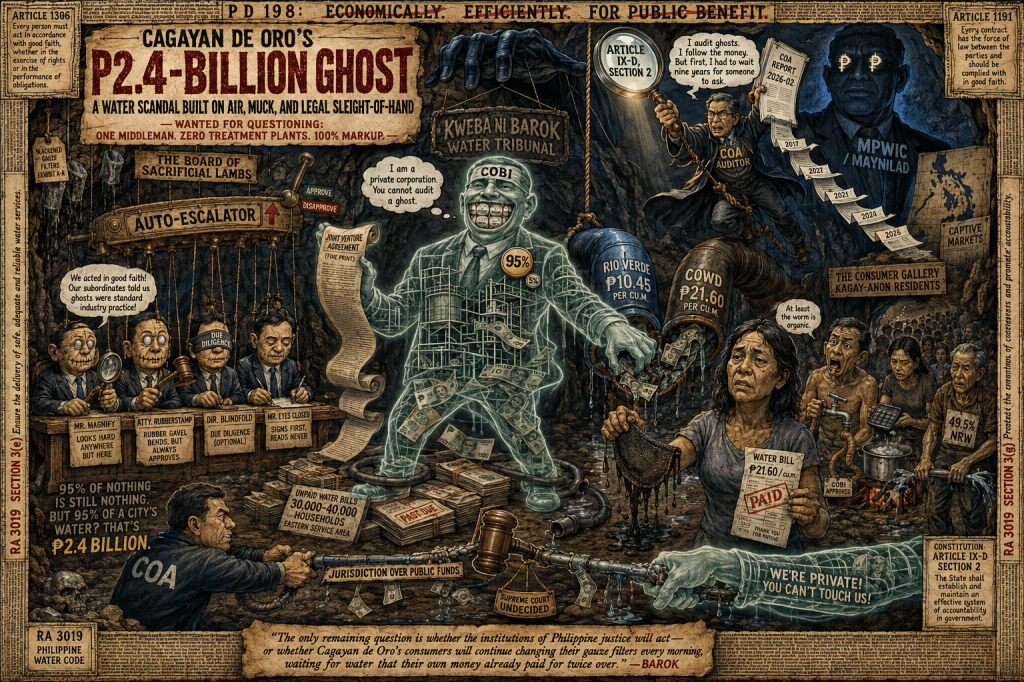
COBI built nothing but a fat billing margin—while residents filter earthworms from their taps.
By Louis ‘Barok‘ C. Biraogo — June 22, 2016
The Gauze Filter: Prelude to a Water Reckoning
Before we speak of billions, let us speak of gauze.
Every morning in Barangay Consolacion, Aida Naliponguit wraps a filter around her faucet—a ritual of survival, not hygiene. By four in the afternoon, that gauze is black with muck. She changes it daily. In another home, an earthworm squirmed out of a tap mid-bath.
This is not a metaphor. This is the end product of a joint venture that was supposed to deliver a ₱2.4-billion water treatment plant to Cagayan de Oro City. Instead, it delivered a legal fiction: a private corporation that built nothing, produced nothing, and simply inserted itself between a public water district and its original supplier—then nearly doubled the price.
The Commission on Audit (COA), in its Special Audit Office Report No. 2026-02, has finally followed the muck back to its source. What it found was not a failed infrastructure project. It found a billing intermediary with a 95-5 equity split, a locked-in price escalator, and the audacity to claim immunity from audit while collecting public funds.
We are not here to ask questions. We are here to present the case for the prosecution—against every party that touched this deal—built on unassailable logic, applicable law, verified evidence, and the cold, binding precedents of the Supreme Court.
Let the evisceration begin.
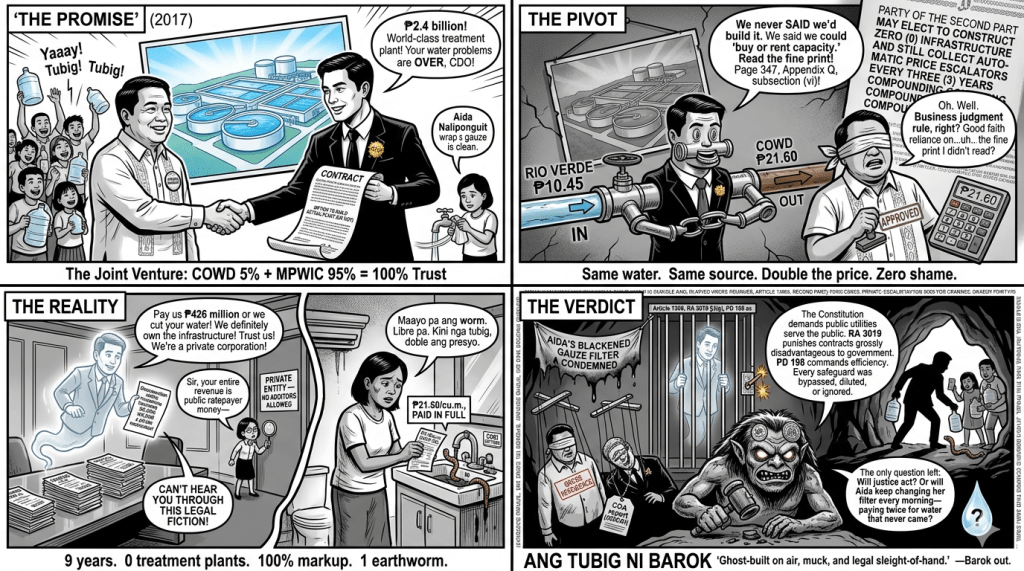
Anatomy of a Pipeline Middleman: How COBI Wedged Itself In
To understand the scandal, one must first understand its architecture.
Before 2017, the Cagayan de Oro City Water District (COWD) sourced bulk water directly from Rio Verde Water Consortium Inc. The price: ₱10.45 to ₱11.52 per cubic meter. This arrangement was later disallowed by COA’s Fraud Audit Office through Audit Observation Memorandum 2009-0019—the contract lacked legal basis, having been structured outside the terms of a valid public bidding. A court eventually voided it.
Enter Metro Pacific Water Investments Corp. (MPWIC), a Pangilinan-led behemoth that already controlled Maynilad. In 2017, MPWIC and COWD formed Cagayan de Oro Bulk Water Inc. (COBI)—a joint venture (JV) with a singular pitch: COBI would build an independent, ₱2.4-billion water treatment plant, freeing the city from Rio Verde and from the legal cloud hanging over the old contract.
The equity split told you everything before a single pipe was laid: MPWIC took 95%; COWD, the public utility whose franchise territory and captive consumer base made the entire venture viable, received 5%—down from an originally proposed 10%. COA flagged this dilution specifically. It stripped COWD of dividend income and governance leverage at the exact moment leverage was most needed.
And then came the pivot.
COBI never built the treatment plant. Instead, it exercised a contractual provision—buried in the fine print—that allowed it to “buy or rent out” capacity rather than construct its own. And who did it buy from? Rio Verde. The same supplier. The same water. Except now, a private corporation was wedged between COWD and its old source, and that corporation was marking up every cubic meter.
The arithmetic is the scandal in miniature:
| Period | Supplier Regime | Rate (₱/cu.m.) |
|---|---|---|
| Pre-2017 | Rio Verde direct | ₱10.45–₱11.52 |
| 2017 (COBI inception) | COBI middleman | ~₱16.00 |
| 2024 | COBI middleman | ₱21.60 |
A 100% increase. Same water. No new plant. Nothing built. Just a contract.
This was not a hidden surprise. During a 2024 City Council fact-finding inquiry, former COWD manager Engr. Rachel Beja testified that the fine print explicitly gave COBI the option to buy rather than build. The contract further contained a built-in escalator clause entitling COBI to a ₱3.97 increase every three years—automatic, compounding, and completely divorced from any actual capital expenditure.
When COWD’s board invoked force majeure during the COVID-19 pandemic and declined to honor one such increase, COBI claimed ₱426 million in unpaid collectibles and threatened to disconnect water service to the city’s eastern service area—home to an estimated 30,000 to 40,000 households. The only problem? COBI didn’t own the infrastructure. COWD’s own general manager confirmed that the treatment plant serving the western areas remained owned by Rio Verde, not COBI. The disconnection threat was, legally speaking, a bluff backed by nothing but corporate bravado.
COA’s Five-Count Indictment: The Audit Autopsy
COA’s Special Audit Office Report No. 2026-02 did not merely flag irregularities. It constructed a legal roadmap for accountability across five distinct findings:
The Middleman Count: A Plant That Never Rose
COBI built nothing. It inserted itself between COWD and Rio Verde and collected a margin. The ₱2.4-billion treatment plant that justified the entire joint venture’s existence remains unbuilt. This converts the JV from an infrastructure partnership into a reselling arrangement—raising the question of whether COWD ever received the consideration that justified surrendering 95% equity and accepting automatic rate escalations.
The Bypassed-Guidelines Count: NEDA’s Shield Ignored
The 2013 National Economic and Development Authority (NEDA) Joint Venture Guidelines—issued under Section 8 of Executive Order No. 423, s. 2005—require competitive challenge procedures, fairness opinions, and transparency mechanisms precisely to prevent insider deals masquerading as partnerships. COA found the COWD-COBI deal bypassed these safeguards. This is not a procedural oversight. It is a finding that the deal escaped the very framework designed to protect public funds from precisely this outcome.
The Equity Dilution Count: The 5% Sting
The halving of COWD’s stake from 10% to 5% was flagged as “disadvantageous” on its face. It cost the public utility dividend income and governance influence—at the exact moment it needed leverage to negotiate favorable bulk rates for its captive consumers.
The Consumer Impact Count: Wormy Taps and Failing Grades
COA’s survey of 290 consumers found only 33% consider their water safe to drink, 44% suffer from low water pressure, and a dismal 19% are satisfied with complaint handling. These numbers are the human translation of Aida Naliponguit’s gauze filter and the earthworm in someone’s bath. COA’s inclusion of consumer-survey data in a financial-compliance audit signals that the audit team understood the rate-and-governance failures as inseparable from service-quality failures.
The Non-Revenue Water Count: Paying Double While Losing Half
COWD’s non-revenue water (NRW)—treated water lost to leaks, theft, or unbilled connections—has catastrophically exceeded the Local Water Utilities Administration (LWUA) regulatory ceiling of 20%. COWD’s NRW registered at 54.84% in 2019 and remained at 49.50% by 2024. Translation: approximately half of all treated water produced is lost before it generates a single peso of revenue. This compounds the bulk-rate scandal: COWD is paying COBI’s inflated per-cubic-meter rate for water, then losing roughly half of it before billing consumers. Basic mathematics dictates that this forces either higher tariffs or financial collapse.
The Legal Iron Cage: Where the Deal Meets the Code
Let us now construct the legal cage around these facts.
The Constitutional Audit Mandate
Article IX-D, Section 2 of the 1987 Constitution of the Republic of the Philippines vests COA with the power to audit all government agencies, including government-owned and controlled corporations and water districts. Water districts created under Presidential Decree No. 198, s. 1973 (Creating the Local Water Utilities Administration) are quasi-public corporations subject to COA audit—a settled point reaffirmed across decades of jurisprudence. COBI’s refusal to participate in the audit, claiming COA lacked jurisdiction over a private entity, is legally provocative but ultimately should fail. COA’s long-standing doctrine holds that its audit power can reach private entities to the extent of government funds, government equity, or government assets entrusted to or commingled with them. COWD’s 5% equity stake, COBI’s use of a public utility franchise and public infrastructure to conduct its business, and the fact that COBI’s revenues are ultimately paid by ratepayers through a public utility’s billing system all support COA’s jurisdiction over the JV’s dealings with COWD.
RA 3019’s Disadvantageous Contract Trap
Section 3(e) of Republic Act No. 3019 (The Anti-Graft and Corrupt Practices Act) penalizes any public officer who causes “undue injury to any party, including the Government, or giving any private party any unwarranted benefits, advantage or preference in the discharge of his official administrative or judicial functions through manifest partiality, evident bad faith, or gross inexcusable negligence.”
Section 3(g) is more specific still: it penalizes any public officer who enters into a contract or transaction “manifestly and grossly disadvantageous to the Government, whether or not the public officer profited or will profit thereby.”
COA’s express characterization of the JV as “highly disadvantageous to both the government and the consuming public” tracks the statutory language of Section 3(g) of RA 3019 with clinical precision. It functions as a roadmap for any future Ombudsman complaint.
The Supreme Court has consistently held that conviction under Section 3(e) of RA 3019 requires proof of manifest partiality, evident bad faith, or gross negligence—mere poor judgment is insufficient (Arias v. Sandiganbayan; Cruz v. Sandiganbayan). However, the defense of good-faith reliance on subordinates established in Arias has its limits. When the contract’s own fine print reveals an option to build nothing, when the equity split strips the government of leverage, and when the price escalation mechanism guarantees automatic markups—reasonable board members should have seen red flags the size of water treatment plants.
PD 198’s Fiduciary Reckoning
Presidential Decree No. 198, s. 1973 (Creating the Local Water Utilities Administration) charges water district boards with fiduciary duties to operate the district “economically, efficiently, and for public benefit.” A board that approves a joint venture that doubles water costs without new infrastructure, that surrenders 95% equity to a private partner, and that locks in automatic price escalators for a product it could have sourced directly—that board has arguably breached its statutory duty. The fiduciary obligation under PD 198 is not a suggestion. It is a legal command.
Civil Code Escape Hatches and Dead Ends
Article 1306 of the Civil Code of the Philippines (Republic Act No. 386) permits parties to stipulate terms not contrary to law, morals, good customs, public order, or public policy. A joint venture found to bypass mandatory NEDA JV Guidelines and to disadvantage a public utility’s core public-service function arguably runs against public policy—rendering its terms voidable under Article 1409 of the Civil Code of the Philippines (Republic Act No. 386).
Article 1191 of the Civil Code of the Philippines (Republic Act No. 386) allows rescission of reciprocal obligations where one party fails to comply with what is incumbent upon it. However, the 2024 council inquiry complicates a straightforward breach-of-contract theory. Former manager Beja’s testimony indicates the contract expressly authorized COBI to buy rather than build. Exercising a bargained-for contractual option is not a breach. A rescission theory would therefore need to locate breach elsewhere—perhaps in undisclosed self-dealing between COBI and Rio Verde, in a failure to satisfy conditions attached to the option itself, or in COBI’s contractual overreach via disconnection threats that the contract did not authorize.
Supreme Court Guardrails
In Cagayan de Oro City Water District v. Pasal (G.R. No. 202305), the Supreme Court emphasized the separability of arbitration clauses and judicial restraint in interfering with arbitration. This precedent matters because the COWD-COBI contract reportedly contains an arbitration clause. Any path to rescission or reformation will likely face an initial jurisdictional hurdle: whether the dispute must first be arbitrated.
In Madera v. Commission on Audit (G.R. No. 244128), the Court clarified that COA findings do not automatically establish criminal liability. Separate proceedings—before the Ombudsman, the Sandiganbayan, or regular courts—are required. COA’s report is the starting point, not the finish line, for criminal accountability.
Audit Chicken: COBI’s Jurisdictional Bluff
COBI’s refusal to participate in the special audit, insisting that COA has no jurisdiction over a private entity, is the most legally interesting subplot of this affair—and the most revealing.
COBI’s argument is not frivolous on its face. It is a private stock corporation. COA’s constitutional jurisdiction under Article IX-D, Section 2 of the 1987 Constitution of the Republic of the Philippines extends to “the Government, or any of its subdivisions, agencies, or instrumentalities, including government-owned or controlled corporations with original charters.” A private JV corporation, even one in which a water district holds 5% equity, sits in genuinely contested territory.
But the counter-argument should prevail. COA’s jurisdiction is not limited to auditing GOCCs as entities; it extends to government funds, government equity, and government assets wherever they may be commingled. COBI’s entire revenue stream originates from a public water district’s ratepayers. Its business is conducted through public infrastructure. Its equity includes a government stake. The Supreme Court has long recognized that COA’s audit power follows public money—not merely public entities.
By declining to participate, COBI denied COA direct access to its books, contracts, and internal cost structure. This means the SAO Report’s findings about COBI’s margin and its actual capital expenditure (or lack thereof) are reconstructed from COWD’s records rather than COBI’s own disclosure. This gap may serve as a future defensive argument—“COA never even looked at our actual books”—but it also strengthens the inference that COBI has something it would rather not have examined.
Sunlight, after all, is the best disinfectant. And COBI just slammed the curtains shut.
The Rogues’ Gallery: Who Built Nothing, Who Approved It, Who Watched
COBI: You did not build. You did not produce. You wedged yourself into the pipeline and extracted a markup from water you did not treat, through infrastructure you did not own, to consumers you did not serve. Your legal strategy—dodging audit jurisdiction while threatening disconnections you had no physical capacity to execute—reveals a corporation that believes accountability is for public servants, not private partners. You are the middleman the 2013 NEDA JV Guidelines were designed to prevent. And when those guidelines were “bypassed,” you became the middleman that RA 3019 was written to punish.
COWD (Former Board): You approved a 95-5 equity split. You accepted a contract that gave your partner an explicit option to build nothing. You locked in automatic, compounding price escalators. You allowed non-revenue water to hemorrhage at over 50% while paying inflated bulk rates for water that never reached consumers. The business judgment rule protects honest errors in commercial decisions—it does not protect board members who surrender public leverage, ignore red flags, and preside over a utility that pays double for water while losing half of it through unrepaired pipes. The Arias defense requires good faith. Good faith requires due diligence. Where is yours?
COWD (Current Board): You requested the special audit. You welcomed its findings. You now coordinate with the Office of the Government Corporate Counsel. These are correct institutional reflexes. But let us be clear: your 10-year development plan to address non-revenue water requires rate increases that will fall on the same consumers already paying ₱21.60 per cubic meter for worm-infested water. You are asking Kagay-anons to pay more to fix a system that already charges them double for undelivered water. The political economy of that proposition is combustible. The legal necessity of NRW reduction is undeniable. The question is whether you will pursue COBI with the same vigor with which you pursue rate increases.
COA: Your findings are devastating, precise, and legally sound. Your institutional lag is inexcusable. The deal was signed in 2017. The City Council raised alarms in 2024. You only arrived in 2025—after the board formally requested you—and your report emerged in 2026. Nine years of consumer overpayment. Nine years of missing infrastructure. Nine years of a middleman collecting margins on water it never treated. The audit is correct; the timing is a scandal of its own.
Metro Pacific Water Investments Corp.: You hold 95% of COBI. You brought the corporate expertise. You structured the deal. You drafted the fine print that allowed you to buy rather than build. You are the parent. The subsidiary’s conduct is your responsibility. The question for the consuming public is whether Metro Pacific—already dominant in Philippine water through Maynilad—views Cagayan de Oro as a partner in development or a captive market for extraction.
The Fork in the Pipeline: Four Roads Forward (and One Dead End)
Let us lay out the terrain of possible resolutions with clinical precision.
Option 1: Renegotiation. The most practical and least destabilizing path. COWD and COBI restructure the agreement: reduce the bulk rate, compel actual infrastructure investment, rebalance equity, eliminate automatic escalators. Advantages: avoids litigation, maintains supply stability, delivers immediate consumer relief. Disadvantages: requires COBI to voluntarily surrender what the contract currently guarantees—and a corporation that just dodged a COA audit is unlikely to volunteer concessions.
Option 2: Contract Rescission under Article 1191 of the Civil Code. Legally viable but burdened by the buy-rather-than-build option in the contract’s fine print. A rescission theory would need to find breach in something beyond the mere absence of a treatment plant—perhaps in COBI’s disconnection threats, perhaps in a failure to satisfy conditions attached to the contractual option, perhaps in undisclosed self-dealing with Rio Verde. This is a fact-intensive inquiry that will require discovery COBI has so far refused to provide.
Option 3: Ombudsman Investigation under RA 3019. The most serious accountability mechanism. A complaint alleging violation of Section 3(g) of RA 3019—entering into a manifestly and grossly disadvantageous contract—would target the COWD officials who approved the 2017 JV. The COA report provides the prima facie evidence. The hurdle: proof of corrupt intent or gross negligence, not mere poor judgment. But a contract that “bypassed” NEDA JV Guidelines, surrendered government equity, and locked in automatic price escalators for undelivered infrastructure moves the needle toward gross inexcusable negligence—and potentially beyond.
Option 4: Arbitration. The contract reportedly contains an arbitration clause, and the Supreme Court in Cagayan de Oro City Water District v. Pasal has shown deference to arbitration agreements. Arbitration is faster than litigation but private—the public will not see the evidence, the arguments, or the settlement. For a scandal built on lack of transparency, arbitration may resolve the legal dispute while perpetuating the accountability deficit.
The Worst-Case Scenario: If evidence emerges of intentional circumvention of JV Guidelines, knowing inflation of prices, preferential treatment, or personal enrichment, the consequences include contract nullification, graft charges, civil damages, and criminal liability for responsible officers. The Plunder Law (Republic Act No. 7080) would require proof of at least ₱50 million in ill-gotten wealth amassed through a combination of acts—a threshold the current record does not yet establish but that further investigation could illuminate.
The Best-Case Scenario: If COBI demonstrates legitimate financing costs, risk premiums, and actual infrastructure investments that justify the rate—and if the contract’s buy-rather-than-buildThe Best-Case Scenario: If COBI demonstrates legitimate financing costs, risk premiums, and actual infrastructure investments that justify the rate—and if the contract’s buy-rather-than-build provision is defended as a commercially reasonable flexibility mechanism—the controversy may resolve as a governance failure: poorly designed, poorly negotiated, poorly overseen, but not criminally corrupt.
The difference between these two scenarios is evidence. And evidence requires investigation. And investigation requires cooperation—which COBI has so far withheld.
The Cave’s Verdict: Laws Bypassed, Prices Doubled, Plant Never Built
The COWD-COBI joint venture is not merely a failed PPP. It is a case study in the legal architecture of Philippine corruption—where public assets are privatized through contracts, where oversight is bypassed through fine print, and where accountability is dodged through jurisdictional objections.
The 1987 Constitution of the Republic of the Philippines demands that public utilities operate in the public interest. RA 3019 penalizes contracts manifestly and grossly disadvantageous to government. Presidential Decree No. 198, s. 1973 commands water districts to operate economically and efficiently. The 2013 NEDA JV Guidelines exist to prevent insider deals from masquerading as partnerships.
Every single one of these legal safeguards was either bypassed, diluted, or ignored.
Meanwhile, in Barangay Consolacion, Aida Naliponguit changes her gauze filter every morning. It is black with muck by four in the afternoon. An earthworm once came out of someone else’s tap while they bathed.
The price of water doubled. The plant was never built. And the corporation that profited from both facts now claims it is beyond the reach of audit.
Action Now: Wake the Watchdogs Before the Next Filter Turns Black
To the Office of the Ombudsman: Investigate the 2017 COWD board for potential violation of Section 3(e) and 3(g) of RA 3019. The COA report is your prima facie evidence. The contract’s equity dilution, rate escalator, and bypassed NEDA Guidelines are your exhibits.
To the Commission on Audit (COA): Assert your jurisdiction over COBI’s transactions with COWD in court. A definitive ruling on audit jurisdiction over GOCC-private JVs is needed not just for this case, but for the entire genre of partnerships proliferating across Philippine LGUs and water districts nationwide. Do not let COBI’s jurisdictional bluff stand as precedent.
To COWD’s Current Board: Pursue legal remedies—but do not forget the consumer. Every rate increase demanded for NRW reduction must be matched with visible enforcement against the middleman that doubled bulk water costs. The public will accept shared sacrifice only if they see shared accountability.
To the City Council of Cagayan de Oro: You raised alarms in 2024. You filed resolutions requesting COA review. Your institutional instincts were correct. Now demand public hearings on the audit findings. Demand transparency from both COWD and COBI. Demand a timeline for rate reduction or contract reformation.
To the Department of Economy, Planning, and Development: Review every JV agreement approved by LGUs and water districts under the 2013 Guidelines. If the COWD-COBI deal bypassed safeguards in Cagayan de Oro, similar deals have bypassed similar safeguards elsewhere. The systematic review you undertake now is the only thing standing between the next audit and the next scandal.
To the Consuming Public of Cagayan de Oro: Your gauze filters are evidence. Your complaint logs are data. Your water bills are the financial trail of a deal that enriched a middleman while delivering muck to your taps. Demand accountability. Demand transparency. Demand that the water you pay double for is, at minimum, free of earthworms.
The Kweba ni Barok has spoken. The case is built. The law is clear. The evidence is on the public record.
The only remaining question is whether the institutions of Philippine justice will act—or whether Cagayan de Oro’s consumers will continue changing their gauze filters every morning, waiting for water that their own money already paid for twice over.
Barok out.
Key Citations
A. Legal & Official Sources
- The 1987 Constitution of the Republic of the Philippines. Official Gazette of the Republic of the Philippines, 1987. http://www.officialgazette.gov.ph/constitutions/1987-constitution/.
- Republic Act No. 3019. An Act Providing for the Repression of Unlawful Acts of Public Officers and Employees (The Anti-Graft and Corrupt Practices Act). 17 Aug. 1960. http://www.officialgazette.gov.ph/1960/08/17/republic-act-no-3019/.
- Presidential Decree No. 198, s. 1973. Creating the Local Water Utilities Administration. 25 May 1973. lawphil.net/statutes/presdecs/pd1973/pd_198_1973.html.
- Executive Order No. 423, s. 2005. Prescribing the Rules and Procedures for the Review and Approval of Government Contracts and the Procurement of Consultancy Services. 30 Apr. 2005. lawphil.net/executive/execord/eo2005/eo_423_2005.html.
- Republic Act No. 386. An Act to Ordain and Institute the Civil Code of the Philippines. 18 June 1949. lawphil.net/statutes/repacts/ra1949/ra_386_1949.html.
- Republic Act No. 7080. An Act Defining and Penalizing the Crime of Plunder. 12 July 1991. lawphil.net/statutes/repacts/ra1991/ra_7080_1991.html.
- Cagayan de Oro City Water District v. Pasal, G.R. No. 202305. Supreme Court of the Philippines, elibrary.judiciary.gov.ph/thebookshelf/showdocs/1/68073.
- Madera v. Commission on Audit, G.R. No. 244128. 8 Sept. 2020. lawphil.net/judjuris/juri2020/sep2020/gr_244128_2020.html.
- Arias v. Sandiganbayan, G.R. Nos. 81563 & 82512. 19 Dec. 1989. lawphil.net/judjuris/juri1989/dec1989/gr_81563_1989.html.
- Cruz v. Sandiganbayan, G.R. No. 134493. 16 Aug. 2005. lawphil.net/judjuris/juri2005/aug2005/gr_134493_2005.html.
- Commission on Audit. Special Audit Office Report No. 2026-02. 2026.
B. News Reports
- Ombay, Giselle, and others. “COA Flags Bulk Water Supply Deal in Cagayan de Oro.” Inquirer.net, Inquirer Interactive, Inc., June 2026, newsinfo.inquirer.net/2248631/coa-flags-bulk-water-supply-deal-in-cagayan-de-oro.
- “Ang Hirap Maging Mahirap”: The PAO Scandal That Proves Government Contempt Is Nothing New
- “Far-Off” My Axx: Malacañang’s Claire Castro Drowns in Her Own Legal Gaslighting
- “Forthwith” to Farce: How the Senate is Killing Impeachment—And Why Enrile’s Right (Even If You Can’t Trust Him)
- “HINDI AKO NAG-RESIGN!”

- “I Know Nothing”: Baste Duterte’s Amnesia Defense Meets ₱33M in GenCorp Contracts
- “I’m calling you from my new Globe SIM. Send load!”

- “Mahiya Naman Kayo!” Marcos’ Anti-Corruption Vow Faces a Flood of Doubt

- “Manageable” Debt, Unmanageable Lies: DBM’s ₱21 Trillion Fairy Tale
- “Meow, I’m calling you from my new Globe SIM!”

- “Natrabaho”: One Word, One Ombudsman, and a Judiciary on Trial
- “No Special Jail for Crooks!” Boying Remulla Slams VIP Perks for Flood Scammers
- “Philippine-Controlled” or Yankee Gas Station? The Davao Fuel Depot Farce Exposed




Leave a Reply