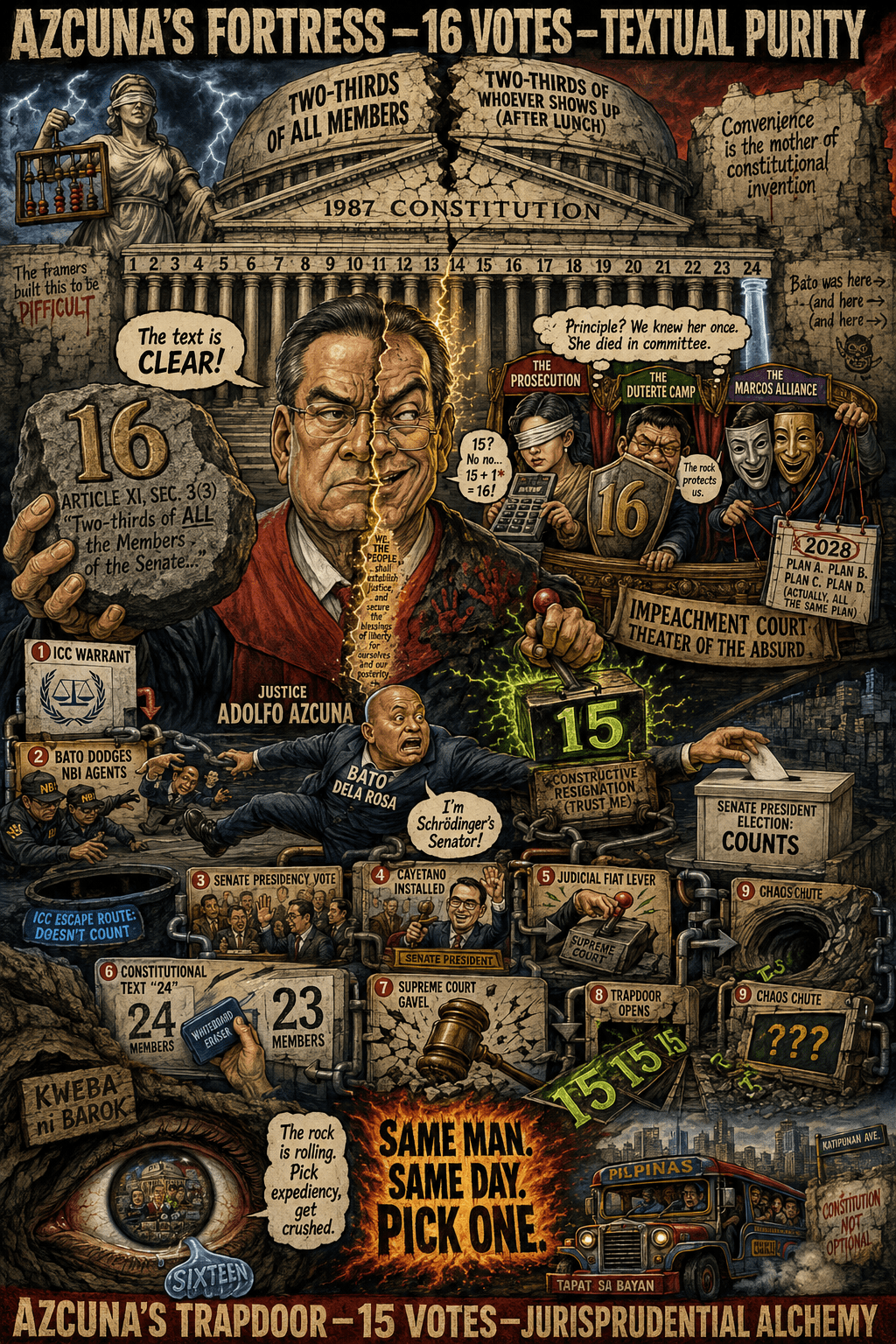
Azcuna’s Textual Rock Meets His Own Pragmatic Trapdoor
By Louis “Barok” C. Biraogo — June 23, 2026
ONE vote. That’s the chasm between the political graveyard and the presidential palace.
In the marble halls of the Senate, where red robes now cloak political calculation as legal reasoning, retired Justice Adolfo Azcuna has tossed a grenade into the arithmetic of conviction. It has two settings: 16, a fortress of textualist purity; and 15, a trapdoor greased with jurisprudential hallucination.
The first is law. The second is alchemy. Let us dissect both before the Republic swallows either whole.
The trial of Vice President Sara Duterte begins July 6. Bank records lay bare a trail of ₱612.5 million in confidential funds and ₱6.77 billion in flagged transactions. The prosecution insists it focuses on evidence, not arithmetic. How noble. How precious. How utterly disingenuous.
Representative Chel Diokno can wax poetic about convincing proof, but we all know the back-channel tallies hum through Manila’s humidity like a jeepney engine on the verge of explosion: nine to thirteen firm votes for conviction, a bloc of five or six for acquittal, and the rest—the swing senators, the political weathervanes—waiting for the wind to blow. In that pressure cooker, whether the magic number is 16 or 15 is not a lawyer’s footnote. It is the game.
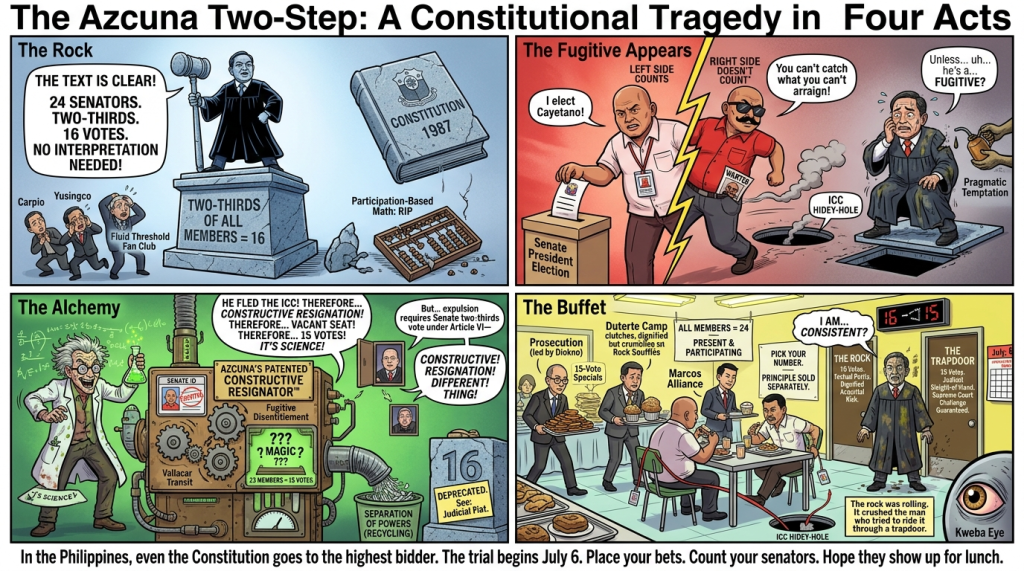
The 16-Vote Fortress: Azcuna’s Textual Rock
Enter Adolfo Azcuna, framer of the 1987 Constitution, a man whose very presence in a debate should cause lesser mortals to sit down and shut up. He offers a thesis of two halves, and they are at war with each other.
First, the good law. Azcuna’s baseline is unassailable. Article XI, Section 3(6) of the 1987 Constitution of the Republic of the Philippines (1987 Constitution) does not stutter: “No person shall be convicted without the concurrence of two-thirds of all the Members of the Senate.” Not two-thirds of those present. Not two-thirds of those who bothered to show up after lunch. Not two-thirds of those not in hiding from the International Criminal Court (ICC). All the Members. Twenty-four. Sixteen votes.
The plain meaning rule, that stubborn gatekeeper of constitutional interpretation, slams the door on any other reading. When the text is clear, interpretation ends. The Supreme Court has told us this so often it must be hoarse. Francisco v. House of Representatives demands strict adherence to impeachment provisions. The framers, Azcuna among them, deliberately reduced the threshold from three-fourths under the 1935 Constitution to two-thirds—still a supermajority, still a bulwark against the political winds that shift with every cocktail reception at the Manila Peninsula.
The counter-doctrine, championed by retired Justice Antonio Carpio and academic Michael Henry Yusingco, is a constitutional obscenity masquerading as practicality. The “present and participating” standard is not interpretation; it is an invitation to anarchy. Imagine a Senate majority engineering absences to shrink the denominator. Schedule the trial on a Friday afternoon, declare a quorum of whoever wanders in, and convict a Vice President with 12 votes.
The framers built the impeachment process to be difficult, not convenient. They wanted removal to be a national trauma, not a parliamentary sleight of hand. Azcuna’s fixed denominator of 24 is the only reading that respects this design. It is predictable, administrable, and immune to the gamesmanship that defines Philippine legislative politics. On this point, Azcuna is right, and those arrayed against him are peddling a dangerous, fluid standard that would make conviction a function of attendance, not evidence. The rock rests squarely on the constitutional text.
The 15-Vote Trapdoor: Azcuna’s Fugitive Bomb
Now, the bad law. Having built a textualist cathedral, Azcuna proceeds to drill a hole in its foundation and pack it with jurisprudential dynamite. His claim: Senator Ronald “Bato” dela Rosa, if formally adjudicated a fugitive, effects a “constructive resignation” from the Senate, shrinking the denominator to 23 and the threshold to 15. This is not legal reasoning. It is a magic trick. Look at the text while I tamper with the arithmetic.
Let us be precise about what Azcuna is doing. The fugitive disentitlement doctrine is real. Vallacar Transit, Inc. v. Yanson and its American cousins stand for the proposition that a person who flees the jurisdiction to avoid prosecution cannot simultaneously demand the protection of its courts. You cannot flip the bird at the legal system and then ask it for a temporary restraining order. Fine. Settled law.
But Azcuna does not stop at disentitlement from judicial relief. He vaults from procedural forfeiture to the vacation of elective office. That is a leap across a constitutional chasm with no bridge, no safety net, and no precedent.
The Constitution is painfully specific about how a Senate seat becomes vacant. Article VI, Section 9 of the 1987 Constitution: death, resignation, disqualification. Batas Pambansa Blg. 881 (Omnibus Election Code) echoes this. Resignation is a voluntary, formal act—a letter submitted, a courtesy call made, a sinecure accepted. It is not a status inferred from hiding in a safehouse with Senator Robinhood Padilla’s assistance while National Bureau of Investigation (NBI) agents exchange gunfire with the Senate Sergeant-at-Arms.
Dela Rosa has not resigned. He has fled. There is a difference, one the Constitution recognizes and Azcuna elides. He is, in effect, inventing a fifth mode of vacancy: “constructive resignation by being accused of mass murder and having the good sense or corrupt instinct to disappear.” That category appears nowhere in the organic law of the Republic.
And what of separation of powers? The Senate holds the exclusive power to expel its own members, and it requires a two-thirds vote to do so. Article VI, Section 16(3) of the 1987 Constitution is not decorative. It is a deliberate allocation of institutional authority. Azcuna’s theory would allow a court—through a declaration of fugitive status—to accomplish by judicial fiat what the Constitution reserves to a supermajority of the Senate itself. If a single Sandiganbayan ruling or a Supreme Court resolution can effectively shrink the denominator, we have handed the judiciary a lever over the legislative branch’s internal composition. That is not a doctrine. It is a coup dressed in a barong.
The absurdity metastasizes when you interrogate the logic. Dela Rosa is a fugitive from an International Criminal Court (ICC) warrant, not from Senate proceedings. He has, by all accounts, fled to avoid the ICC, not the impeachment trial. Indeed, he surfaced on May 11, 2026, just long enough to install Senator Alan Peter Cayetano as Senate President—a vote that reshaped the chamber’s leadership and, by extension, the machinery of the trial itself. He was functional enough to participate in a legislative coup. He is functional enough to count.
You cannot have a senator whose vote decides who presides over the impeachment court but whose membership evaporates for purposes of calculating the conviction threshold. That is not law. It is a buffet where you pick the legal consequences you like and discard the rest. If Dela Rosa is sufficiently a senator to elect the Senate President, he is sufficiently a senator to count in the denominator. The rock will not have it both ways.
Where does Azcuna’s alchemy end? If a senator flees a plunder conviction, has he “constructively resigned”? If a senator goes underground to avoid a frustrated murder warrant, is his seat suddenly vacant? Who adjudicates this—the Supreme Court in a certiorari petition, the Senate President with a press release, the barangay tanod with a loudspeaker? The doctrine is a slippery slope greased with constitutional cooking oil, and at the bottom waits chaos.
The Masked Coalition: Who Really Wants 15 Votes?
The motivations here are as transparent as a glass coffin. The prosecution, desperate to lower the bar from an unreachable 16 to a more attainable 15, sees Dela Rosa’s fugitive status as the perfect arithmetic loophole. The Duterte camp clings to the fixed 16-vote fortress to shield their principal. Meanwhile, the Marcos alliance calculates coldly: a swift 15-vote conviction delivers the knockout blow that permanently bars Sara from 2028, while a messy 16-vote acquittal or deadlock lets the Duterte machine bleed slowly without handing them martyr status. In Philippine politics, principle is the first casualty when power arithmetic enters the room.
The Only Lawful Exit: Sixteen Votes, No Judicial Sleight of Hand
The Senate impeachment court faces a menu of disasters:
- It can adopt the full 16-vote rule, grounding itself in textual fidelity and risking acquittal.
- It can exclude Dela Rosa and invite a Supreme Court challenge that delegitimizes any conviction.
- It can embrace a fluid, participation-based threshold and turn the trial into a daily lottery of attendance and arm-twisting.
The only path consistent with the rule of law is this: adopt the 16-vote rule as the non-negotiable denominator, and force the Dela Rosa question to be resolved independently and transparently. If the Senate believes Dela Rosa’s fugitive status warrants removal from the chamber, let it exercise its constitutional expulsion power under Article VI. A two-thirds vote, on the record, in full public view. Let the political branches bear political accountability. Do not smuggle a vacancy through the backdoor of a judicial doctrine never intended to vacate elective office.
The Republic demands transparency, accountability, and a legal system that is fair, accessible, and consistent. It demands that laws be applied equally, free from influence or corruption. It demands that a Vice President be convicted or acquitted on the evidence, not on the inventive arithmetic of a well-meaning framer who has allowed his textualist discipline to be seduced by a pragmatic temptation.
The rock has spoken. Sixteen votes are required. Dela Rosa, until expelled or dead, is a Senator. The Constitution is not a suggestion box. The trial begins July 6. Let the Senate remember that it sits as a court of law, not a theater of political convenience. The Kweba is watching. The rock is rolling. And it will crush whoever puts expediency above the organic law of the Republic.
Key Citations
A. Legal & Official Sources
- The 1987 Constitution of the Republic of the Philippines. Official Gazette of the Republic of the Philippines, 1987, http://www.officialgazette.gov.ph/constitutions/1987-constitution/.
- Batas Pambansa Blg. 881. Omnibus Election Code of the Philippines. 3 Dec. 1985, http://www.officialgazette.gov.ph/1985/12/03/batas-pambansa-blg-881/.
- Francisco v. House of Representatives. G.R. No. 160261. Supreme Court of the Philippines, 10 Nov. 2003, lawphil.net/judjuris/juri2003/nov2003/gr_160261_2003.html.
- Vallacar Transit, Inc. v. Yanson. G.R. No. 259337. Supreme Court of the Philippines, 25 Nov. 2025, lawphil.net/judjuris/juri2025/nov2025/gr_259337_2025.html.
B. News Reports
- Macairan, Evelyn. “Azcuna: Convicting VP Needs 16 Votes, Unless….” The Philippine Star, 22 June 2026, http://www.philstar.com/headlines/2026/06/22/2536901/azcuna-convicting-vp-needs-16-votes-unless/.cfe37b8b2e82
- Baroña, Franco Jose C. “16 to Convict Not Hard-and-Fast Rule.” The Manila Times, 21 June 2026, http://www.manilatimes.net/2026/06/21/news/16-to-convict-not-hard-and-fast-rule-carpio/2369432/.fb3ab1
- Wikipedia contributors. “Attempts to arrest Ronald dela Rosa.” Wikipedia, The Free Encyclopedia, Wikimedia Foundation, https://en.wikipedia.org/wiki/Attempts_to_arrest_Ronald_dela_Rosa.

- “Ang Hirap Maging Mahirap”: The PAO Scandal That Proves Government Contempt Is Nothing New

- “Far-Off” My Axx: Malacañang’s Claire Castro Drowns in Her Own Legal Gaslighting

- “Forthwith” to Farce: How the Senate is Killing Impeachment—And Why Enrile’s Right (Even If You Can’t Trust Him)

- “HINDI AKO NAG-RESIGN!”

- “I Know Nothing”: Baste Duterte’s Amnesia Defense Meets ₱33M in GenCorp Contracts

- “I’m calling you from my new Globe SIM. Send load!”

- “Mahiya Naman Kayo!” Marcos’ Anti-Corruption Vow Faces a Flood of Doubt

- “Manageable” Debt, Unmanageable Lies: DBM’s ₱21 Trillion Fairy Tale

- “Meow, I’m calling you from my new Globe SIM!”

- “Natrabaho”: One Word, One Ombudsman, and a Judiciary on Trial

- “No Special Jail for Crooks!” Boying Remulla Slams VIP Perks for Flood Scammers

- “Philippine-Controlled” or Yankee Gas Station? The Davao Fuel Depot Farce Exposed










Leave a Reply