By Louis ‘Barok‘ C. Biraogo — October 11, 2024
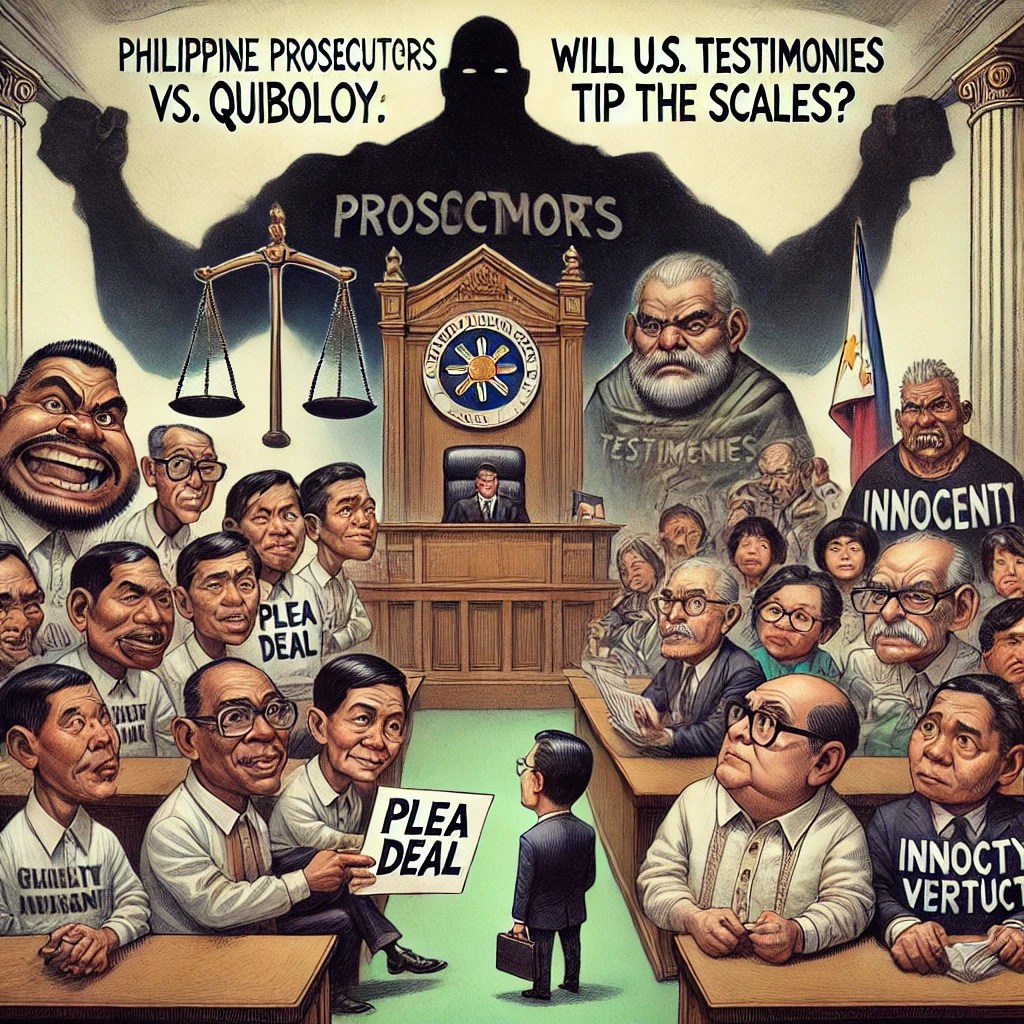
A legal tidal wave is building against Apollo Quiboloy, the embattled leader of the Kingdom of Jesus Christ. In a stunning move, his human resources manager, Marissa Duenas, has entered a plea deal in the U.S., potentially unleashing a ripple effect that could upend Quiboloy’s legal battles at home. With Philippine prosecutors gearing up to leverage this U.S. conviction, the question looms: Can two nations’ legal systems converge, or will this case fall into a tangle of conflicting laws and jurisdictions?
The question now is whether Duenas’ guilty plea for conspiracy to commit marriage fraud in the U.S. will carry enough weight to bolster the prosecution’s case against Quiboloy in the Philippines, where he faces serious charges, including child abuse and human trafficking. The answer lies in navigating a labyrinth of legal precedents, international procedures, and political dynamics.
Legal and Political Quicksand: Quiboloy’s Entanglements in the Philippines
In the Philippines, Quiboloy’s influence extends beyond the pulpit. For years, he has been an ally of high-ranking political figures, most notably former President Rodrigo Duterte. His church wields immense power among his followers, some of whom view him as the “Appointed Son of God.” This political and religious stature has made his prosecution a matter of intense public and legal scrutiny.
Quiboloy is charged with qualified trafficking and child abuse, charges that are serious enough to cause widespread concern even before Duenas’ plea deal surfaced. The Philippine prosecution now faces the challenge of integrating this new evidence, with the Justice Department stating it will attempt to introduce the plea bargain from the U.S. into Philippine courts. However, this is no simple process. As Justice spokesperson Mico Clavano pointed out, the plea deal doesn’t automatically apply to the cases in the Philippines—legal procedures must be followed, and it may face challenges in admissibility.
A Transnational Legal Struggle: The U.S. Connection
On the other side of the Pacific, Quiboloy’s troubles are even graver. The U.S. Department of Justice (DOJ) has charged him with sex trafficking by force, fraud, and coercion, as well as child sex trafficking. These charges could lead to life imprisonment if he’s found guilty. While the U.S. has not yet requested his extradition, the plea bargain entered by Duenas provides a new weapon for both U.S. and Philippine prosecutors.
Duenas’ admission in the U.S. court system strengthens the narrative that KOJC engaged in systemic fraud and criminal activity—potentially linking Quiboloy directly to illegal actions. Under U.S. law, her plea may be used as a basis to support broader criminal charges. According to the U.S. Federal Rules of Evidence, guilty pleas are typically admissible as admissions by a party-opponent, which could set a precedent for its use in other trials involving related criminal activity.
The DOJ’s Strategy: Using the Plea Deal to Their Advantage
For the DOJ, the introduction of Duenas’ plea in Philippine courts could be a strategic win, but the success of such an effort depends on key legal maneuvers. First, the plea bargain provides valuable evidence: Duenas admitted to conspiring to commit fraud, acknowledging her role in marriage schemes orchestrated by the KOJC. The prosecution could argue that this admission of guilt is directly relevant to Quiboloy’s broader pattern of alleged criminal behavior.
Philippine courts could potentially use this plea as evidence under the doctrine of res gestae—allowing acts committed during the course of a conspiracy to be used as evidence against all conspirators. Philippine prosecutors would argue that the admission in the U.S. strengthens the cases of child abuse and trafficking, particularly if Duenas testifies to similar patterns of coercion and fraud in the Philippines.
Furthermore, under U.S. legal precedents like United States v. Patterson, plea bargains can be used to demonstrate systemic fraud within an organization. If Philippine prosecutors invoke similar logic, they could establish that KOJC, under Quiboloy’s leadership, had a culture of criminal activity that spanned borders, thus linking the U.S. admissions directly to Quiboloy’s Philippine charges.
Quiboloy’s Defense: Fighting Back Against Cross-Border Legal Intrusions
However, the defense has a formidable arsenal of counterarguments. First and foremost is the issue of jurisdiction. Quiboloy’s legal team can argue that the U.S. plea deal holds no binding authority in Philippine courts. As Clavano rightly stated, just because Duenas admitted guilt in the U.S. doesn’t mean the same admission automatically applies in the Philippines. Quiboloy’s lawyers would likely argue that the plea is not directly relevant under Philippine law, as the crimes in question occurred under different circumstances, in a different jurisdiction.
Moreover, under the Philippine Rules of Evidence, Duenas’ plea could be classified as hearsay unless Duenas testifies directly before a Philippine court. The defense could challenge the relevance of the U.S. plea by citing the materiality rule, which mandates that evidence be directly related to the facts in the specific case at hand. They could also invoke constitutional protections, arguing that using a foreign court’s ruling as evidence in a Philippine trial violates Quiboloy’s right to a fair trial and presumption of innocence, principles enshrined in the Philippine Constitution.
Lastly, the defense could argue that attempting to use this plea deal in the Philippine legal system could set a dangerous precedent, potentially discouraging future plea bargains by suggesting that they can be exploited across borders to bring down co-conspirators elsewhere.
A Question of Law: The Legal Validity of the Duenas Plea Deals in the Philippines
The potential for Duenas’ plea to make an impact in Quiboloy’s Philippine cases remains uncertain. On the one hand, it could provide a critical piece of evidence linking KOJC’s international operations to a pattern of criminal behavior. But the hurdle of admissibility remains. Philippine courts will likely scrutinize whether the U.S. admission meets the threshold of relevance and materiality, and whether it falls within an exception to the hearsay rule.
Ultimately, this is a high-stakes legal chess match that will depend heavily on procedural tactics. Philippine prosecutors will need to navigate both domestic legal standards and cross-border evidentiary hurdles. If they can successfully introduce Duenas’ admissions and secure her testimony, it would be a devastating blow to Quiboloy’s defense.
Moving Forward: Resolutions and Recommendations
For the DOJ and Philippine prosecutors, the next steps are clear: formalize the plea deal’s introduction as evidence, ensure Duenas’ cooperation in testifying in Philippine courts, and push for a U.S. extradition request for Quiboloy. The prosecution should leverage any similarities between the charges in both jurisdictions to bolster their case while keeping a close eye on how Philippine courts handle cross-jurisdictional evidence.
For Quiboloy’s defense, the focus should be on contesting the admissibility of the U.S. plea under Philippine law, emphasizing the right to a fair trial and jurisdictional boundaries. The defense must prepare to counter the plea’s introduction by challenging its relevance and potential prejudicial effect.
As this case continues to unravel, it holds a mirror up to the fragile nature of global justice. The verdict will not only shape Apollo Quiboloy’s future, but could also reverberate through the halls of international law, forcing nations to confront how they prosecute power across borders. In a world growing ever smaller, the outcome of this trial could mark a turning point in how we define accountability on a global scale.

- ₱75 Million Heist: Cops Gone Full Bandit

- ₱6.7-Trillion Temptation: The Great Pork Zombie Revival and the “Collegial” Vote-Buying Circus

- ₱1.9 Billion for 382 Units and a Rooftop Pool: Poverty Solved, Next Problem Please

- ₱1.35 Trillion for Education: Bigger Budget, Same Old Thieves’ Banquet

- ₱1 Billion Congressional Seat? Sorry, Sold Out Na Raw — Si Bello Raw Ang Hindi Bumili

- “We Will Take Care of It”: Bersamin’s P52-Billion Love Letter to Corruption

- “Skewed Narrative”? More Like Skewered Taxpayers!

- “Scared to Sign Vouchers” Is Now Official GDP Policy – Welcome to the Philippines’ Permanent Paralysis Economy

- “Robbed by Restitution?” Curlee Discaya’s Tears Over Returning What He Never Earned

- “My Brother the President Is a Junkie”: A Marcos Family Reunion Special

- “Mapipilitan Akong Gawing Zero”: The Day Senator Rodante Marcoleta Confessed to Perjury on National Television and Thought We’d Clap for the Creativity

- “Just Following Orders” Is Dead: How the Hague Just Turned Tokhang’s Finest Into International Fugitives




 KWEBA ni BAROK
Leave a comment