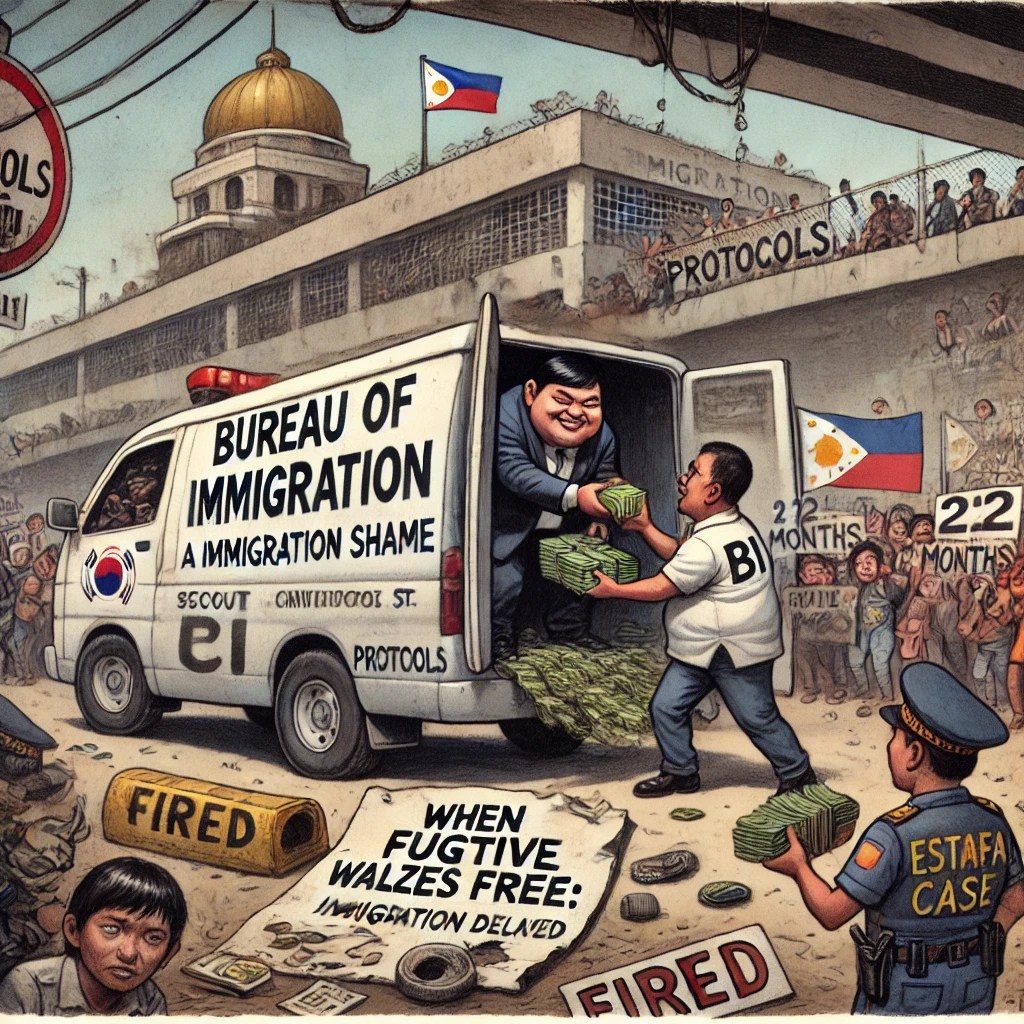
IN A Quezon City courtroom, a 28-year-old South Korean fugitive, Na Ikhyeon, sits surrounded by Bureau of Immigration officers. He’s been in custody since May 2023, wanted in his homeland and caught in a fraud case filed by a Filipina. On March 4, 2025, he’s supposed to face justice. Instead, he walks out—not through a dramatic bathroom escape, but in a BI vehicle, escorted by the very agents sworn to guard him. Moments later, he vanishes into the chaos of Manila’s streets. Five days later, a predawn raid in Angeles City drags him back into custody, alongside another Korean fugitive who helped him flee. But how did he slip away in the first place? And what does his escape say about the system that failed to hold him?
This isn’t a script for a thriller. It’s the latest embarrassment for the Philippines’ Bureau of Immigration, a stark tableau of institutional failure painted with the brushstrokes of negligence, corruption, and a system too porous to hold those it’s meant to contain. Na’s escape—and the swift rearrest that followed—lays bare a troubling question: How does a high-profile detainee slip through the fingers of an agency charged with protecting a nation’s borders? The answer points to a rot that runs deeper than one man’s breakout.
Caught Napping: How Oversight Crumbled
Na’s escape wasn’t a solo act of brilliance. He had help—three BI employees, two contractual workers now sacked, and one permanent staffer whose fate was sealed by the Department of Justice last Friday. They didn’t just lose sight of him; they drove him to freedom, letting him slip away near Scout Chuatoco Street in Quezon City. Commissioner Joel Viado, the BI’s beleaguered chief, insists it wasn’t a restroom caper, as early rumors suggested, but a failure in plain sight. The guards at the prosecutor’s office saw it unfold: Na, bundled into a BI van with his escorts, only to vanish moments later.
This wasn’t a lapse in protocol—it was a collapse of accountability. Na, arrested nearly two years ago, should have been flagged as a flight risk from the start. A fugitive facing deportation, entangled in a local estafa case, he wasn’t some low-level overstayer. Yet the BI didn’t classify him as “high-risk” until after he bolted, a reactive label slapped on as he and his accomplice, Kang Changbeom, were hauled to Camp Bagong Diwa with promises of “special security arrangements.” Why wasn’t this vigilance in place before? The agency’s risk assessment seems less a science and more a shrug, a systemic flaw that turned a routine hearing into a jailbreak.
Cash or Complicity? The Corruption Question
Then there’s the stench of corruption wafting through this mess. Viado admits they’re probing whether Na bribed his way out—“Kung may ganyang pangyayari, kailangang malaman po namin,” he told reporters, a hedge that feels more like a shield than a vow. The facts scream louder than his caution: three BI personnel didn’t just falter; they facilitated. Kang, a fraudster wanted in Korea, was waiting with a van, suggesting a plan greased by more than luck.
This isn’t a one-off. Whispers of a scheme have long circulated—foreign nationals hiring local lawyers to file cases against themselves, like Na’s estafa charge, to clog the courts and stall deportation. It’s a clever dodge: Philippine law demands local cases be resolved before the BI can ship someone out. Na’s 22-month limbo hints at this playbook, though no hard evidence ties him to orchestrating the Filipina’s complaint. Whether he did or not, the escape suggests a payoff turned delay into deliverance. The BI’s own staff, now facing criminal and administrative charges, are the weakest link—pawns or profiteers in a game where custody is for sale.
Viado’s Tightrope: Leadership or Lip Service?
To his credit, Viado didn’t duck. He owned the failure, launched a manhunt, and snared Na and Kang in Angeles City within days, a feat of coordination with the BI’s Fugitive Search Unit and local police. His press conference on March 9 was blunt: no excuses, just facts—Na didn’t slink out a bathroom, he was let loose by those in uniform. The terminations were swift, the DOJ referral decisive. “Our priority was to regain custody,” he said, and he delivered.
But his candor has limits. On bribery, he’s cagey, promising to dig but offering no timeline or transparency. His focus on deportation as the next step—Na and Kang bundled off to South Korea—dodges the harder task: rooting out the rot within. Viado’s a firefighter dousing flames, not an architect rebuilding a crumbling house. He’s shown backbone, yes, but the public deserves more than a recapture—they need assurance this won’t happen again.
Same Old Song: Accountability’s Broken Record
Zoom out, and Na’s escape is a symptom of a broader malaise in Philippine governance. The BI isn’t alone in its stumbles. Recall the 2018 scandal at the Bureau of Customs, where billions in shabu slipped through Manila’s ports, or the perennial tales of police planting evidence in drug busts. Accountability here is a mirage—agencies lurch from crisis to crisis, patching holes with press releases while the seams fray. The Philippines, a nation of warm smiles and resilient spirits, too often sees its institutions falter under the weight of petty graft and poor oversight.
Na’s case echoes this. A system that lets foreign fugitives linger—whether by legal manipulation or lax enforcement—invites abuse. South Korea, pressing for Na and Kang’s return, must wonder: How many more slip through? The BI deported 128 fugitives in 2023, a stat Viado might tout, but it’s cold comfort when one escape exposes how fragile the net is.
Fixing the Fiasco: A Blueprint for Reform
This doesn’t have to be the story’s end. Na’s rearrest is a chance to pivot—to demand more than a scapegoat’s firing. First, the BI needs a reckoning: an independent audit of its custody protocols, not just a self-serving probe. Why weren’t high-risk detainees like Na tagged sooner? How did three employees turn rogue without a whisper of suspicion? Second, close the legal loophole. Foreign nationals gaming the courts with proxy cases shouldn’t paralyze deportation—let the BI and DOJ fast-track extradition while local cases grind on, ensuring justice doesn’t become a delay tactic.
Viado should lead this charge. He’s shown he can act—now let him speak. A public report on the bribery probe, names and numbers included, would signal resolve over reticence. And the Philippine government must invest: better training, higher pay, stricter vetting for BI staff. Corruption festers where morale sags.
Conclusion: A Mirror Held Up to Failure
Na Ikhyeon’s dash for freedom wasn’t just his failure—it was ours. A young man in a van, vanishing into Manila’s sprawl, is a mirror held up to a system that too often blinks. The BI caught him again, yes, but the real test is what comes next. Reform isn’t a luxury here—it’s a necessity, for a nation that deserves borders as strong as its people’s spirit.

- ₱8B BBM Pork: CCTV for Every Captain’s Kumpare?
- ₱75 Million Heist: Cops Gone Full Bandit

- ₱6.7-Trillion Temptation: The Great Pork Zombie Revival and the “Collegial” Vote-Buying Circus

- ₱1.9 Billion for 382 Units and a Rooftop Pool: Poverty Solved, Next Problem Please

- ₱1.35 Trillion for Education: Bigger Budget, Same Old Thieves’ Banquet

- ₱1 Billion Congressional Seat? Sorry, Sold Out Na Raw — Si Bello Raw Ang Hindi Bumili

- “We Will Take Care of It”: Bersamin’s P52-Billion Love Letter to Corruption

- “Skewed Narrative”? More Like Skewered Taxpayers!

- “Scared to Sign Vouchers” Is Now Official GDP Policy – Welcome to the Philippines’ Permanent Paralysis Economy
- “Robbed by Restitution?” Curlee Discaya’s Tears Over Returning What He Never Earned

- “No Pressure” Luistro? The House Pork Bazaar Exposed
- “My Brother the President Is a Junkie”: A Marcos Family Reunion Special





 KWEBA ni BAROK
Leave a reply to John Joseph D. Cancel reply