By Louis ‘Barok’ C Biraogo — May 6, 2025
A Vendor’s Hunger, A Nation’s Betrayal
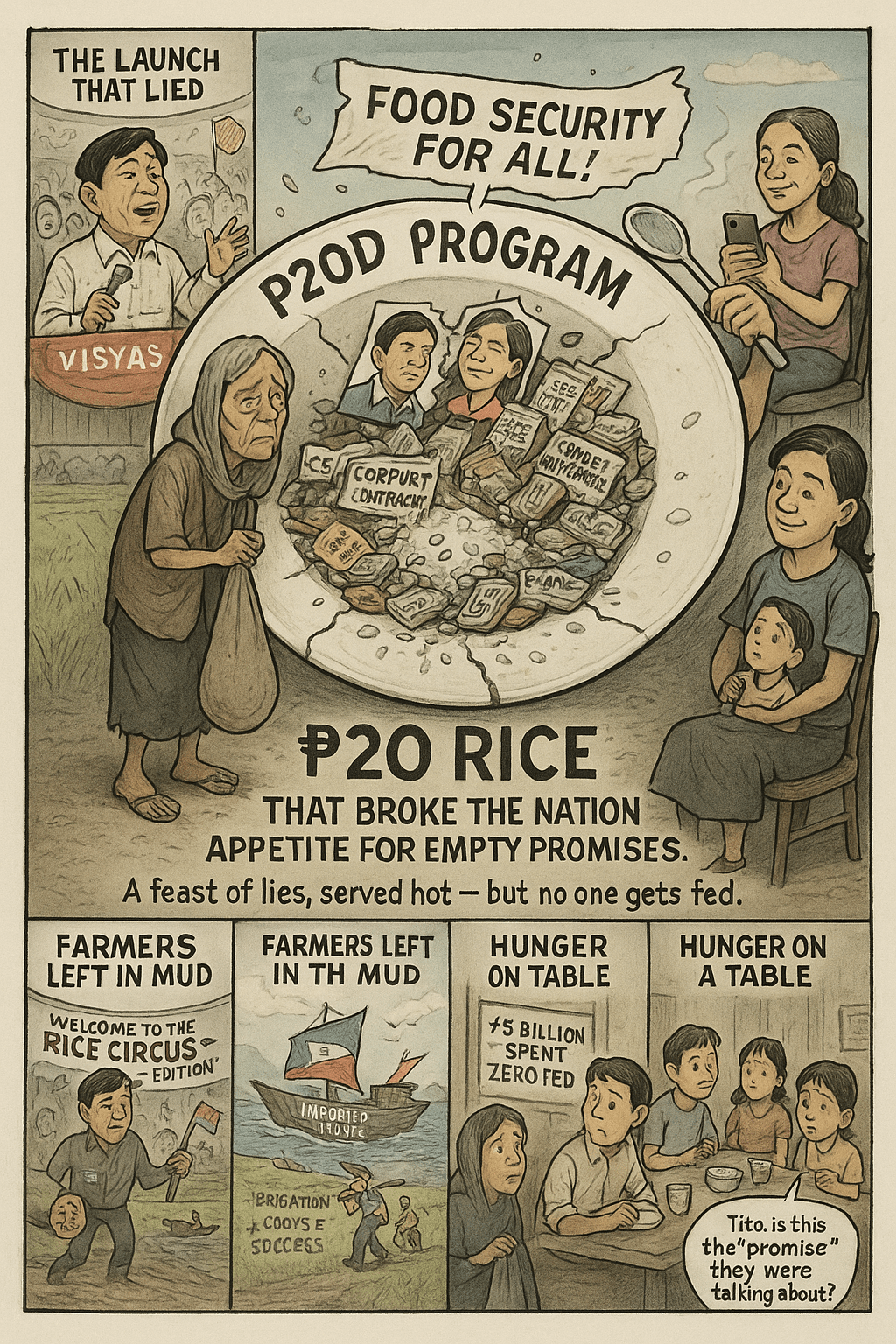
In a sweltering Manila market, Aling Maria, 62, grips a tattered sack of rice, her only shield against hunger for six grandchildren. At ₱50 per kilo, she stretches every peso, but it’s never enough. When the Marcos administration trumpeted rice at ₱20 per kilo—half the market price—her weathered face flickered with hope. Within a day, that hope was snuffed out as the program imploded. “They toy with our survival,” she murmurs, voice heavy with betrayal. Aling Maria’s despair isn’t just hers; it’s the cry of millions of Filipinos caught in a government’s cynical game, where food security is a campaign prop, not a promise kept. The collapse of the ₱20 rice program lays bare a deeper rot: a system that dangles relief before the poor only to yank it away for political gain.
Political Circus: Is Hunger Just a Vote-Grab?
The ₱20 rice scheme’s launch in the Visayas, weeks before the 2025 midterms, was no coincidence—it was a calculated spectacle. The region, a political battleground, was primed for this populist stunt, but the program’s collapse exposed its flimsiness. Vice President Sara Duterte pounced, accusing the Marcos administration of making a promise “they knew they couldn’t keep” and dismissing the rice as “fit only for pigs” (Philippine Star, 2025). Her words are a Molotov cocktail, but they’re laced with self-interest. Duterte, eyeing the 2028 presidency, is exploiting the rift with Marcos to recast herself as a populist crusader (Rappler, 2025). Her critique lands because it taps into a raw truth: Filipinos are weary of leaders who peddle miracles they can’t deliver.
The Commission on Elections (Comelec) halted the program, citing rules against voter manipulation (Inquirer, 2025). The Department of Agriculture (DA) complied, pausing sales until May 13, post-election, claiming they sought Comelec clarification that never came (GMA News, 2025). This smells less like integrity and more like bureaucratic cowardice. Why launch a program without Comelec’s green light? The DA’s 370,000 metric tons of rice—6 million bags—could have fed millions but now sits in warehouses, a cruel tease for the 14 million Filipinos scraping by below the poverty line (PSA, 2024). Comelec’s caution may protect elections, but it starves families caught in the crossfire.
Economic House of Cards: Can ₱20 Rice Survive Reality?
The ₱20 rice dream is a fiscal tightrope. The DA planned to sell NFA buffer stocks at half the market price (₱48–₱55/kg), subsidizing the gap with ₱5 billion in public funds (BusinessWorld, 2025). With 370,000 metric tons, they could limp until December, but that’s a drop in the bucket against the Philippines’ 33,000-ton daily rice consumption (NFA, 2025). Scaling nationwide would either bankrupt the NFA or demand a taxpayer bailout that dwarfs the current budget. Economists flagged this as unsustainable from day one: cheap rice distorts markets, invites smuggling, and risks a repeat of the 2018 rice crisis, when NFA mismanagement spiked prices to ₱56/kg (ABS-CBN News, 2018).
Farmers, already crushed by soaring fertilizer costs and typhoon losses, face the worst fallout. Selling rice at ₱20 could flood markets with cheap imports, slashing their income—half of rice farmers earn under ₱20,000 yearly (PhilRice, 2023). The 2019 Rice Tariffication Law, meant to stabilize prices via imports, has instead enriched cartels, with smuggling scandals tainting even Duterte’s tenure (CNN Philippines, 2020). The ₱20 program doesn’t fix this; it’s a Band-Aid on a broken system, ignoring lessons from past failures.
Globally, the Philippines lags behind. Thailand’s 2011 rice subsidy scheme, which overpaid farmers, collapsed under $20 billion in losses and corruption (Reuters, 2014). Vietnam, by contrast, keeps prices stable through irrigation and cooperatives, producing rice at half the cost (World Bank, 2023). The Philippines’ reliance on subsidies over infrastructure is a recipe for collapse.
Who’s Left Hungry? The Human Cost
The fallout is brutal. For families like Aling Maria’s, rice eats 20% of their budget; the program’s failure means more skipped meals (FNRI, 2024). Farmers fear a price crash that could deepen rural poverty—many already pawn land to survive (IRRI, 2023). Taxpayers shoulder the ₱5 billion subsidy, money siphoned from schools or clinics for a program that may never deliver (DBM, 2025). This isn’t policy; it’s a high-stakes gamble with the poor as collateral.
Public trust is another casualty. Marcos’ 2023 claim that ₱20 rice was “always possible” now rings hollow as prices hit ₱56/kg that year (Manila Bulletin, 2023). The DA’s flip-flopping—promising, pausing, then blaming Comelec—echoes the NFA’s history of fund misuse and smuggling (Philippine Daily Inquirer, 2019). When food becomes a political weapon, it poisons the social contract, leaving cynicism where hope once stood.
Breaking the Cycle: Real Solutions, Not Rice Stunts
Short-Term Fix: The DA must salvage the ₱20 program with transparency. Limit sales to verified indigents and persons with disabilities via Kadiwa centers, bypassing politicians’ hands. Secure Comelec clearance to avoid voter manipulation while feeding the neediest (Kadiwa Program, 2025). Publish stock and subsidy data to rebuild trust.
Long-Term Reform: Ditch subsidy addiction for systemic change. Invest ₱10 billion yearly in irrigation—only 30% of farmland has reliable water—and subsidize seeds and fertilizers, not retail prices (DA, 2024). Vietnam’s model proves this works: double yields in a decade by empowering farmers (FAO, 2023). Jail smugglers and audit NFA contracts to crush cartels (BOC, 2025). These aren’t sexy, but they’re honest—unlike the ₱20 mirage.
Stop Feeding Politics, Start Feeding People
The ₱20 rice fiasco is a snapshot of Philippine dysfunction: grand promises, botched delivery, and a public left hungry. Sara Duterte’s attacks may be self-serving, but they expose a grim reality: the Marcos administration’s hunger for votes trumps its duty to the starving. Aling Maria deserves more than broken dreams. The path to food security isn’t paved with subsidized rice but with hard-won reforms—fixing farms, crushing cartels, and putting people over power. Until then, the ₱20 promise will remain a cruel hoax, mocking the millions who believed it.

- ₱75 Million Heist: Cops Gone Full Bandit

- ₱6.7-Trillion Temptation: The Great Pork Zombie Revival and the “Collegial” Vote-Buying Circus

- ₱1.9 Billion for 382 Units and a Rooftop Pool: Poverty Solved, Next Problem Please

- ₱1.35 Trillion for Education: Bigger Budget, Same Old Thieves’ Banquet
- ₱1 Billion Congressional Seat? Sorry, Sold Out Na Raw — Si Bello Raw Ang Hindi Bumili

- “We Will Take Care of It”: Bersamin’s P52-Billion Love Letter to Corruption

- “Skewed Narrative”? More Like Skewered Taxpayers!

- “Scared to Sign Vouchers” Is Now Official GDP Policy – Welcome to the Philippines’ Permanent Paralysis Economy
- “Robbed by Restitution?” Curlee Discaya’s Tears Over Returning What He Never Earned
- “No Pressure” Luistro? The House Pork Bazaar Exposed
- “My Brother the President Is a Junkie”: A Marcos Family Reunion Special

- “Mapipilitan Akong Gawing Zero”: The Day Senator Rodante Marcoleta Confessed to Perjury on National Television and Thought We’d Clap for the Creativity



 KWEBA ni BAROK
Leave a comment