Technocrat in the Typhoon: Herbosa’s Tightrope Over a Sea of Shortfalls
By Louis ‘Barok‘ C. Biraogo — January 2, 2026
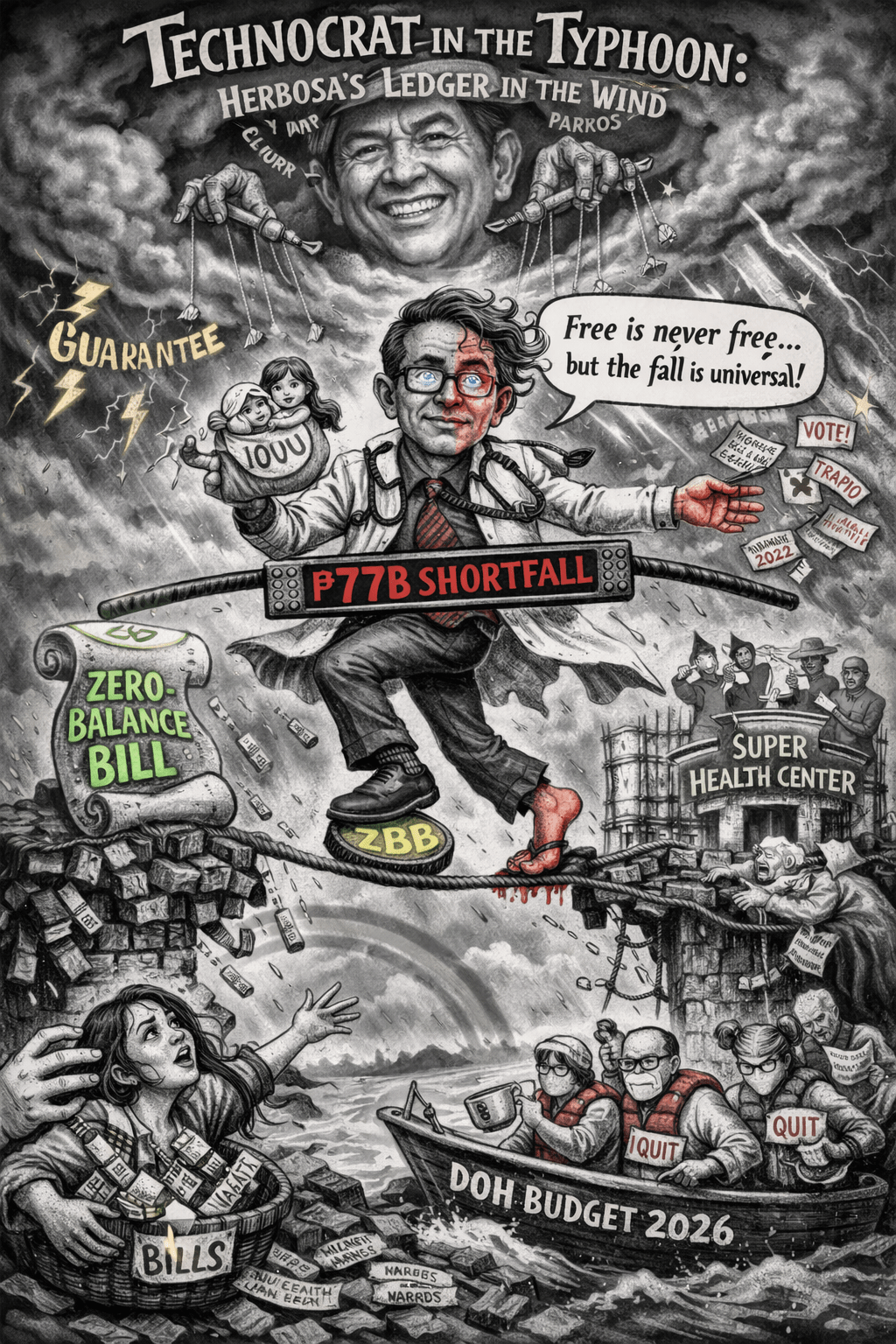
FANCY Maria, the 42-year-old Tondo vendor peddling fish by day, now cradling her ailing son in a DOH hospital swarm. For the first time in her life, she walks out without a bill crumpling in her fist—no demands for payment at the pharmacy counter, no frantic calls to relatives for loans. Over one million Filipinos like Maria have tasted this relief since July 2025, thanks to Health Secretary Teodoro Herbosa’s bold rollout of zero-balance billing (ZBB) in public hospitals.
It is a policy that feels like mercy made law, a direct nod to President Marcos’s promise that basic care should not bankrupt the poor.
But as Maria returns home to her cramped barangay, relieved yet wary, one wonders: How long can this promise hold? Is Herbosa building a bridge to true universal health care, or is he erecting a beautiful facade over a foundation cracking under fiscal strain?

The Promise and the Ledger
The intent behind ZBB is undeniably noble. By covering room charges, medicines, tests, and even doctors’ fees in basic accommodations at DOH hospitals and specialized centers like the Philippine Heart Center, the policy strikes at the heart of what drives millions into poverty: catastrophic health costs.
It operationalizes the Universal Health Care Act of 2019, which dreamed of automatic enrollment and equitable access for all. In just months, it has delivered tangible hope—over a million patients spared from balance billing, many from the poorest families.
Yet the ledger tells a harsher story.
Medical societies, led by the Healthcare Professionals Alliance Against COVID-19, warn that the 2026 PhilHealth allocation of P69.78 billion for indigent premiums falls far short of the P147 billion needed to sustain UHC commitments. That is a P77-billion gap staring us down.
Hospitals, already stretched thin with workforce shortages and supply delays, risk deeper underfunding as reimbursements lag. ZBB’s scope remains limited to basic wards in public facilities—no private rooms, no private hospitals. Controversial exclusions, like denying coverage to road crash victims who violated traffic laws, have drawn fire for punishing the reckless at the expense of universal compassion.
The Ghosts in the System
Then there are the ghosts haunting the system.
Out of 878 super health centers funded under the Health Facilities Enhancement Program since 2021:
- Only 196 are fully operational.
- 300 sit idle—empty shells despite billions spent.
- The rest are under construction or partially functional.
Herbosa’s response—welcoming probes, launching citizen participatory audits where the public sends photos of these abandoned structures—is pragmatic, even humble. He points to memoranda of agreement shifting staffing responsibility to local governments, insisting he seeks functionality, not blame.
But what does it say about governance when a department must crowdsource the whereabouts of its own billion-peso assets?
These “ghost centers” are not mere construction failures; they symptomize a deeper malaise—the chasm between national ambition and local capacity, or perhaps political will. LGUs, often cash-strapped or distracted by electoral priorities, fail to hire staff. Billions vanish into concrete without delivering care, echoing broader scandals of wasted infrastructure.
The Battle for the Purse
The battlefield for UHC’s future lies in the budget wars.
The Supreme Court’s December 2025 ruling ordering the restoration of P60 billion diverted from PhilHealth reserves was a victory for sustainability, barring future raids on the insurer’s funds. Herbosa rightly welcomed it as reinforcement for sound financing.
Yet parallel to PhilHealth’s insurance model runs the Medical Assistance for Indigent and Financially Incapacitated Patients (MAIFIP), ballooned to P51 billion in 2026. Critics, including dozens of medical societies, argue MAIFIP perpetuates patronage—lawmakers dispensing aid letters like political favors—undermining the pooling of risks essential to true insurance.
Why sustain a stopgap that fragments care when PhilHealth could absorb it with proper funding? The alliance’s plea to phase out MAIFIP rings true: It risks turning a universal right into discretionary charity—patients groveling for lawmakers’ “guarantee letters” like scraps from a political feast, transforming healthcare into pork barrel patronage for the dying.
A Technocrat in a Political Storm
Herbosa stands apart from his predecessors.
Francisco Duque III steered through pandemics and scandals, pushing cheaper medicines amid controversies. Paulyn Ubial championed tobacco control with fierce advocacy, cut short by politics. Enrique Ona brought clinical precision to operations.
Herbosa’s era is defined by operationalizing UHC—expanding access, chairing global assemblies—yet shadowed by these execution hurdles. He inherits Duque’s cleanup while facing unique pressures: a populist president’s promises, congressional scrutiny, and a public quick to sense overpromise.
A Gamble at a Crossroads
At its core, Herbosa’s gamble is this:
Can “free” care expand without collapsing the system?
The potential is extraordinary—relieving families like Maria’s, inching toward equity. But the perils are familiar: unfunded mandates leading to overcrowded wards, stock-outs, and eroded trust.
To illuminate a path forward, consider these targeted, actionable steps:
- Reform HFEP agreements to require LGUs to certify staffing and operational budgets before funds flow. Tie releases to milestones, with citizen audits institutionalized as mandatory oversight, not ad hoc appeals.
- Reject any institutionalization of MAIFIP and kill SB 1593 outright. Redirect the full ₱51.6 billion MAIFIP allocation immediately into PhilHealth to expand UHC benefits, close funding gaps, and strengthen zero-balance billing. Administer all assistance solely through DOH/PhilHealth via objective, automated processes—no political guarantee letters, no patronage. This delivers health as a right, not electoral bait.
- Mandate transparent dashboards tracking ZBB quality—wait times, stock-outs, patient outcomes—published quarterly. Pair this with adjusted case rates reflecting inflation, ensuring hospitals aren’t squeezed.
Herbosa’s vision deserves support, but not blind faith. The high cost of “free” isn’t just fiscal; it’s the trust forfeited if promises crumble.
For Maria and millions more, we cannot afford another ghost in the machine.
From the Kweba’s shadows: Promises are free, but reality bites hard.
- – Barok, dodging the bill.
Source:
- ₱75 Million Heist: Cops Gone Full Bandit

- ₱6.7-Trillion Temptation: The Great Pork Zombie Revival and the “Collegial” Vote-Buying Circus

- ₱1.9 Billion for 382 Units and a Rooftop Pool: Poverty Solved, Next Problem Please

- ₱1.35 Trillion for Education: Bigger Budget, Same Old Thieves’ Banquet

- ₱1 Billion Congressional Seat? Sorry, Sold Out Na Raw — Si Bello Raw Ang Hindi Bumili

- “We Will Take Care of It”: Bersamin’s P52-Billion Love Letter to Corruption

- “Skewed Narrative”? More Like Skewered Taxpayers!

- “Scared to Sign Vouchers” Is Now Official GDP Policy – Welcome to the Philippines’ Permanent Paralysis Economy
- “Robbed by Restitution?” Curlee Discaya’s Tears Over Returning What He Never Earned

- “No Pressure” Luistro? The House Pork Bazaar Exposed
- “My Brother the President Is a Junkie”: A Marcos Family Reunion Special

- “Mapipilitan Akong Gawing Zero”: The Day Senator Rodante Marcoleta Confessed to Perjury on National Television and Thought We’d Clap for the Creativity


 KWEBA ni BAROK
Leave a comment