The Final Chop: Pulong, Ungab, and the Ghost of Pork Barrel Past Enter the Ring
By Louis ‘Barok‘ C. Biraogo — January 2, 2026
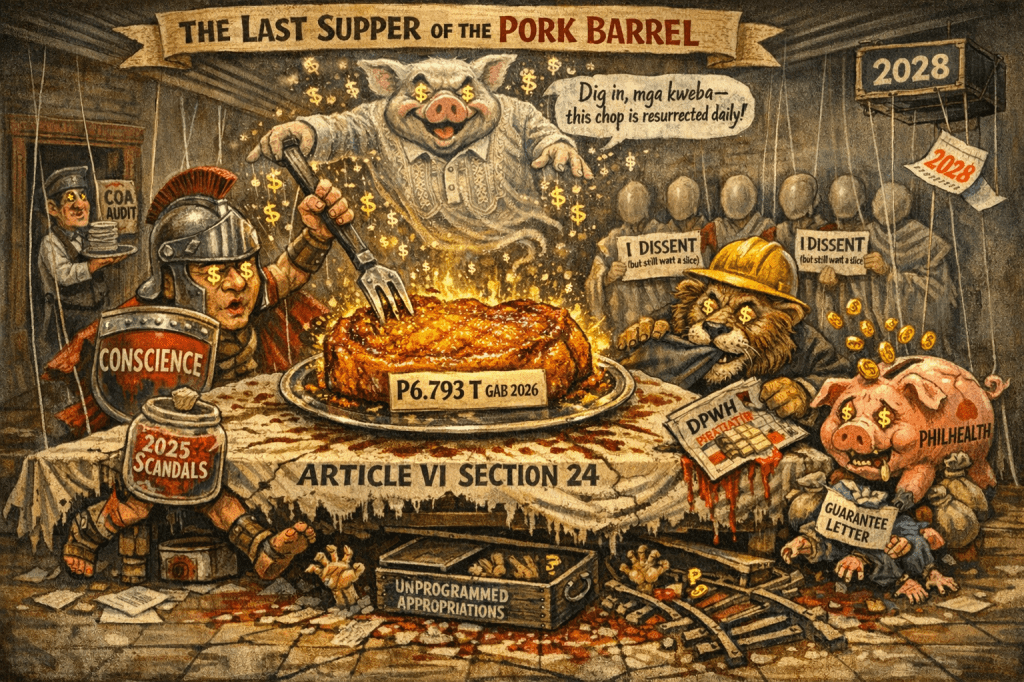
MGA ka-kweba, welcome back. It’s January 1, 2026, and while the rest of the country recovers from New Year festivities, Congress has served us a fresh political hangover: the dramatic refusal of the Davao bloc to ratify the P6.793-trillion General Appropriations Bill (GAB) for fiscal year 2026. Representatives Paolo “Pulong” Duterte, Isidro Ungab, and their allies have taken a stand, citing lingering corruption, executive overreach, and opaque budget practices that echo last year’s scandals (SunStar Davao, 30 Dec. 2025). But is this a principled defense of public funds, or another chapter in Philippine politics’ endless telenovela—complete with fractured alliances and calculated outrage?
Let’s cut through the noise with precision.
1. The Grandstanding & The Grievance: Separating Theatre from Substance
The Davao lawmakers’ objections sound impeccable on the surface. Pulong Duterte declares he cannot “in good conscience” support a budget riddled with unresolved questions from 2025, warning that the “mastermind” behind last year’s alleged corruption remains free while a new budget is “ready to be plundered.” He famously compared the process to a cookie jar that no one in Congress can resist. Ungab highlights executive interference and drastic cuts to infrastructure. Harold Duterte calls 2025 a year of “shocks and revelations.”
These concerns are legitimate. Unresolved 2025 allegations cast a long shadow, and demanding transparency before ratification—rather than after public outcry—aligns with constitutional principles.
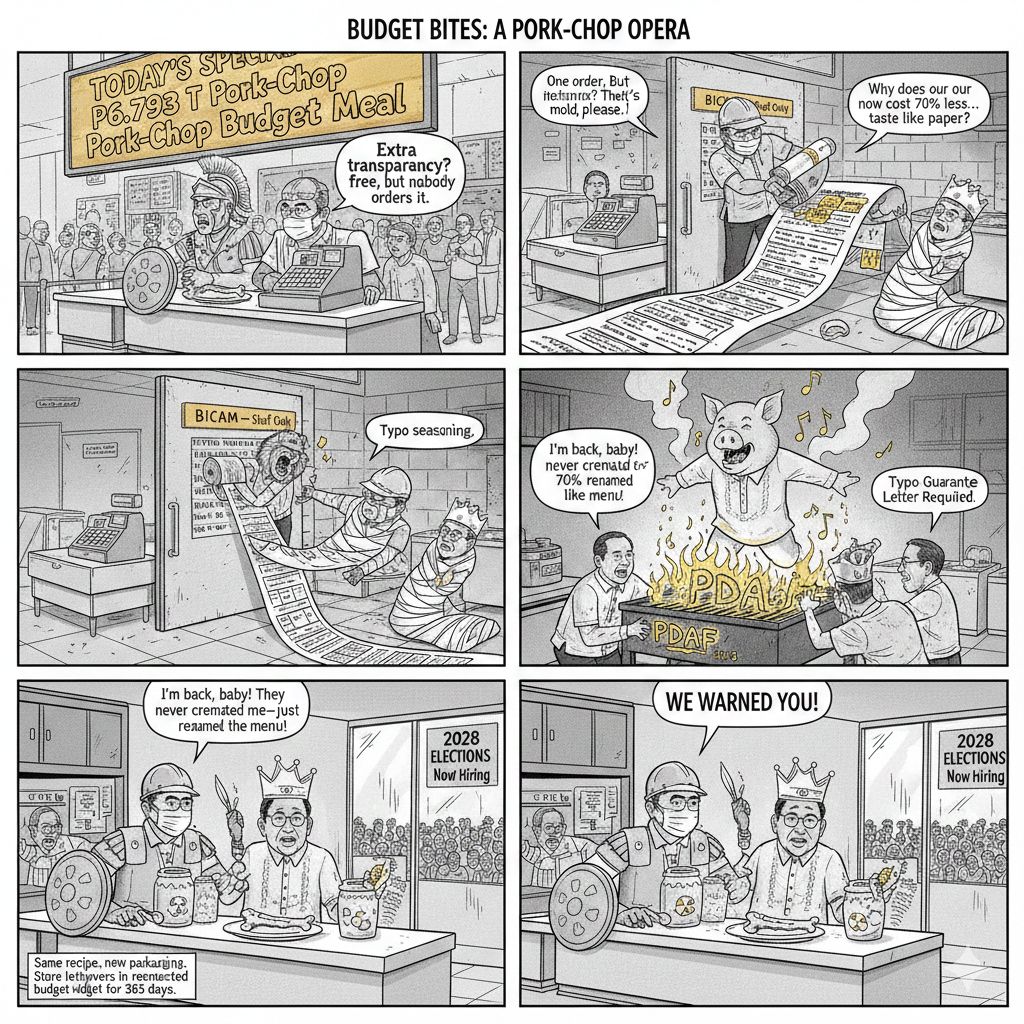
Yet the subtext is unmistakable. The once-solid UniTeam alliance between the Marcos and Duterte camps has collapsed. This opposition is not just principle; it is strategic repositioning ahead of the 2028 presidential contest. The Davao bloc is simultaneously asserting independence from a perceived weakening Marcos administration and building a narrative of vigilance: “We warned you.” In Philippine politics, genuine conviction and electoral calculation often travel together.
2. The Ghost of Pork Barrel Past: A Legal Autopsy of “Allocables”
Pork never truly dies—it simply evolves.
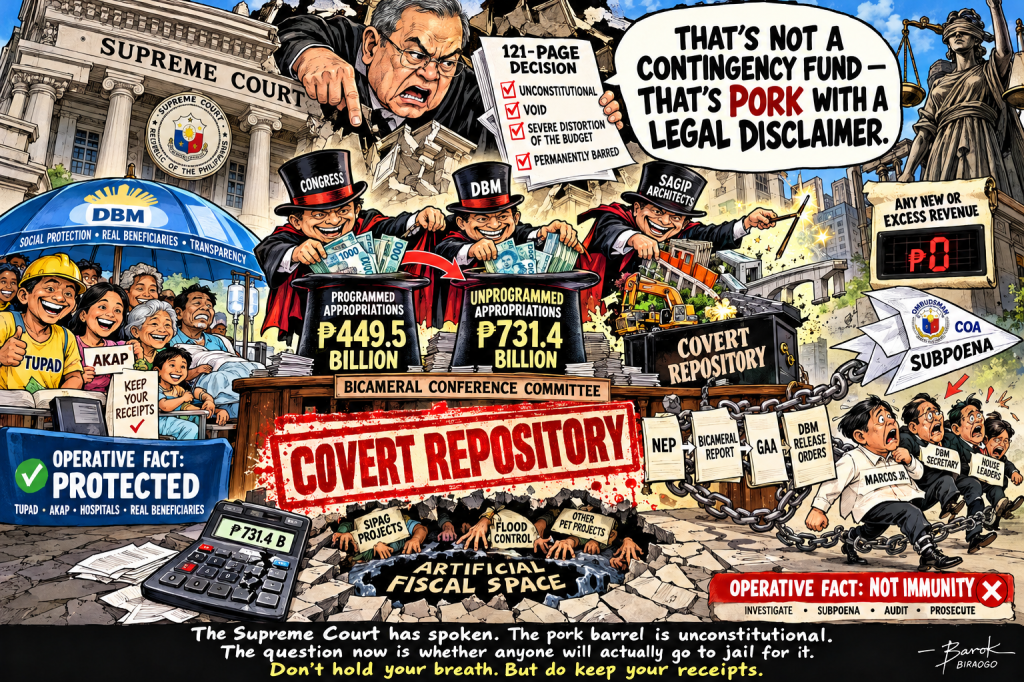
Consider the P243.4-billion Unprogrammed Appropriations (UA), which I dub the Pork Barrel Lazarus Fund. These standby funds can be released post-enactment when revenues exceed targets or when discretionary needs arise. The Supreme Court in Araullo v. Aquino (2014), which struck down parts of the Disbursement Acceleration Program (DAP), warned against unauthorized realignments that bypass congressional intent. Large unprogrammed funds risk the same constitutional defects if deployed for projects never originally approved.
Then there is the Medical Assistance to Indigent and Financially Incapacitated Patients (MAIFIP) program and the parallel Assistance to Individuals in Crisis Situations (AICS) scheme. Ungab correctly identifies these as fragmented and prone to patronage—patients forced to secure “guarantee letters” from politicians like supplicants in a feudal court. The Universal Health Care (UHC) Law was meant to streamline automatic coverage through the Philippine Health Insurance Corporation (PhilHealth). Instead, we preserve parallel pipelines that keep lawmakers central to healthcare delivery. This echoes the spirit of Belgica v. Ochoa (2013), which declared the Priority Development Assistance Fund (PDAF) unconstitutional for enabling post-enactment legislator control.
Finally, the P33-billion farm-to-market roads program now channeled through the Department of Public Works and Highways (DPWH)—an agency long criticized for creative “project placement.” Senator Francis Pangilinan expressed serious reservations about implementation. Routing agricultural infrastructure through DPWH is less about efficiency than creating new avenues for district-level favors.
Pork Barrel 2.0: sleeker, digital, and still hungry.
3. Executive Usurpation or Sloppy Governance? The Bicam Fiasco
Ungab’s sharpest charge: the Department of Public Works and Highways (DPWH) Secretary was permitted to intervene in the Bicameral Conference Committee (Bicam)—a process that should be a “purely legislative exercise.” Article VI, Section 24 of the 1987 Constitution vests the power of the purse exclusively in Congress. Executive consultation is routine; active participation in reconciliation raises separation-of-powers concerns.
The true scandal, however, lies in the “revised matrix” fiasco. DPWH admitted errors in Construction Materials Price Data (CMPD), prompting a 75-percent slash to Foreign-Assisted Projects (FAPs)—including massive cuts to the Metro Manila Subway and North-South Commuter Railway. The recomputed list was never properly projected or debated. Ungab’s question lingers: What if more errors emerge later?
This episode reveals either executive overreach or breathtaking incompetence. I suspect the latter—if you’re orchestrating a budget coup, at least proofread the spreadsheet.
4. The Davao Bloc’s Motivations: A Four-Cornered Analysis
Let us dispense with naïveté. Four motives overlap:
- Principle: A legitimate, if theatrical, push for transparency and accountability—points they raise that many colleagues ignore.
- Power: A deliberate move to undermine the Marcos administration’s momentum and reassert Duterte narrative dominance.
- Pork (Protection): A defensive posture against perceived reductions in Davao Region’s traditional allocations, especially after DPWH “recomputations” stripped billions from certain districts.
- Posturing: Laying groundwork for a “we told you so” campaign in 2028.
Politicians are complex creatures; all four can coexist comfortably.
5. The Fallout: From Reenacted Budgets to Political Rupture
Both chambers ratified the GAB, and it now awaits presidential signature on January 5, 2026. Yet the dissent—joined by senators who refused to sign the Bicam report—carries weight.
Delay risks a reenacted 2025 budget: no new programs, stalled initiatives, bureaucratic paralysis. Sharp FAP cuts threaten contractual breaches with foreign lenders like JICA and ADB, jeopardizing investor confidence.
Politically, the UniTeam is dead—bury it with full military honors. This marks the first major legislative rupture of the Marcos-Duterte partnership, waged through line items and matrices. It is the opening shot of the 2028 war, with ordinary Filipinos as collateral: delayed trains, politicized medicine, classrooms that remain blueprints.
6. Verdict & Recommendations: Beyond the Blog Post
The Davao bloc’s substantive concerns are valid, though diluted by electoral calculus. The 2026 GAB is neither immaculate nor catastrophic—typical Philippine compromise: real public goods wrapped in patronage and opacity.
We deserve better. My prescriptions, delivered with requisite sarcasm:
- Order an immediate, fully transparent audit of the 2025–2026 budget pipeline by the Commission on Audit (COA) and Office of the Ombudsman before presidential signing.
- Establish a Bicameral Blackout Rule: bar executive department heads from conference committee rooms. Consultation yes—intrusion no.
- Phase out Unprogrammed Appropriations in their current form; require explicit programming or locked contingency mechanisms.
- Route all medical assistance directly through PhilHealth and healthcare facilities, ending guarantee-letter patronage as Ungab proposed.
To lawmakers on both sides: if you genuinely believe this budget is unconstitutional plunder, file a proper Supreme Court petition. Otherwise, spare us the privilege-speech theatrics. The Filipino people can see the puppet strings—and we are weary of funding the marionette show.
Hanggang sa susunod na kwebanata, mga kaibigan.
–Barok
Key Citations
- The 1987 Constitution of the Republic of the Philippines. Official Gazette of the Republic of the Philippines. Accessed 1 Jan. 2026.
- Belgica et al. v. Executive Secretary Paquito N. Ochoa, Jr. et al., G.R. No. 208566, Supreme Court of the Philippines, 19 Nov. 2013, LawPhil Project. Accessed 1 Jan. 2026.
- Araullo et al. v. Benigno Simeon C. Aquino III et al., G.R. No. 209287, Supreme Court of the Philippines, 1 July 2014, LawPhil Project. Accessed 1 Jan. 2026.
- Francisquete, David Ezra M. “Davao Solons Oppose Ratification of P6.793-T 2026 Nat’l Budget.” SunStar Davao, 30 Dec. 2025.



Leave a Reply