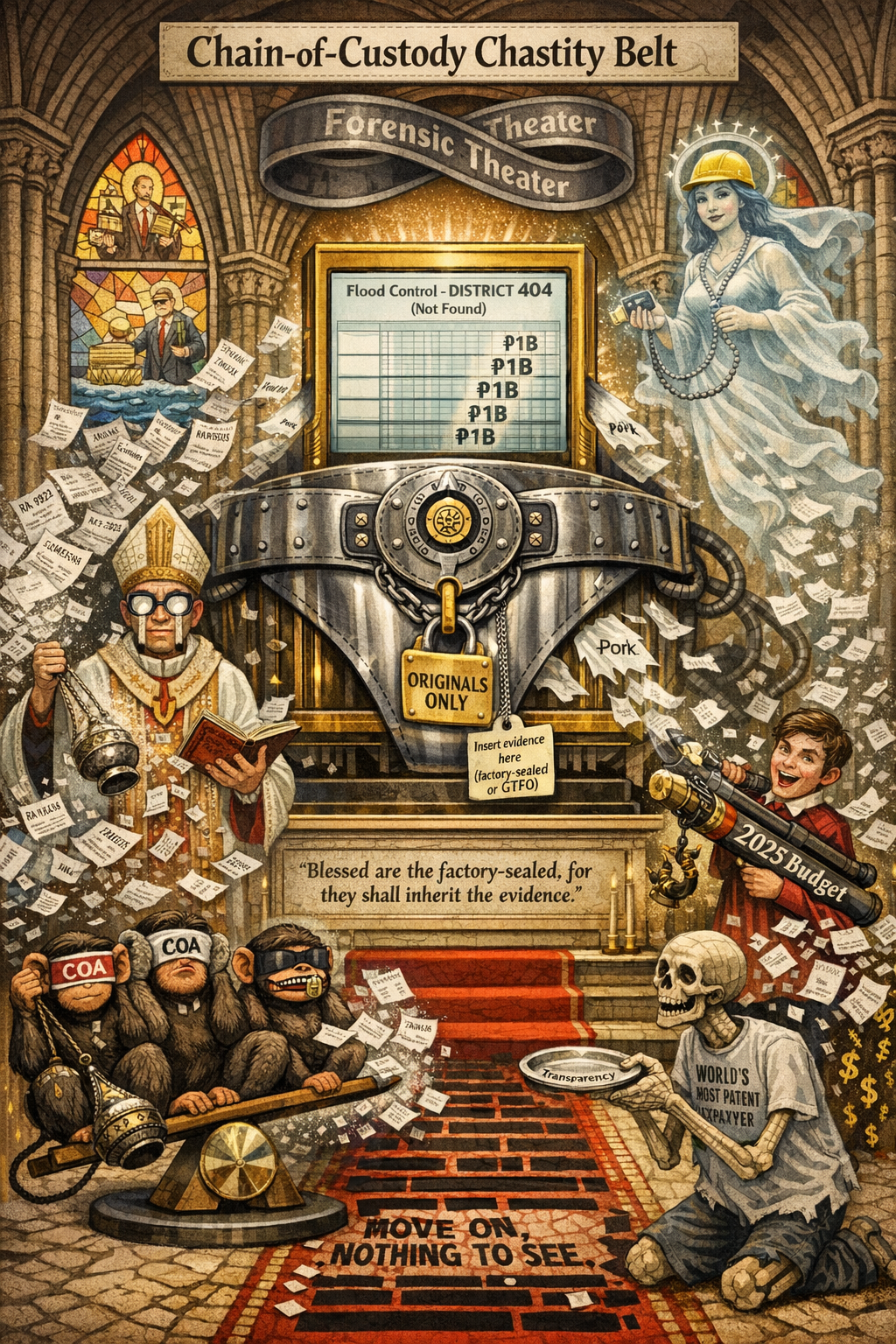
How the Ombudsman Turned Chain of Custody into a Chastity Belt for Truth
By Louis “Barok” C. Biraogo — January 1, 2026
HMMNN, the sweet smell of procedural formaldehyde. The Office of the Ombudsman has spoken, and its verdict on the Cabral Files is clear: originals only, please. Copies are for peasants and Telegram gossip mills. Assistant Ombudsman Mico Clavano, with the solemnity of a priest refusing communion to the unwashed, reminds us that soft copies in Word or Excel are “inherently” unreliable—alterable, manipulable, contextually orphaned. Better to wait for the pristine central processing unit (CPU) of the late Undersecretary Maria Catalina Cabral, now safely in the Ombudsman’s loving embrace, to be forensically caressed by the dream team of the Commission on Audit (COA), the Department of Public Works and Highways (DPWH), and the Philippine National Police Anti-Cybercrime Group (PNP-ACG).
Legally? Unimpeachable—grounded in the Rules on Electronic Evidence (A.M. No. 01-7-01-SC) and Republic Act No. 8792 (Electronic Commerce Act of 2000). Politically? A masterclass in how to turn a live grenade into a paperweight.
Let us call this the Clavano Doctrine: when faced with explosive allegations of budget insertions linking Cabinet secretaries to ghost flood control projects, the correct response is to lecture the nation on chain of custody. Never mind that in this country, originals have a curious habit of evaporating, getting “sanitized,” or simply vanishing into the same black hole that swallows COA disallowances. The Supreme Court itself has warned against letting technicalities become the grave of substantial justice. Yet here we are, watching the Ombudsman treat evidentiary rigor like a chastity belt for inconvenient truths.
When does legal prudence cross into political paralysis? When the same institution that moves at glacial speed against the powerful suddenly discovers the virtues of forensic perfection the moment a dead woman’s files threaten the living.
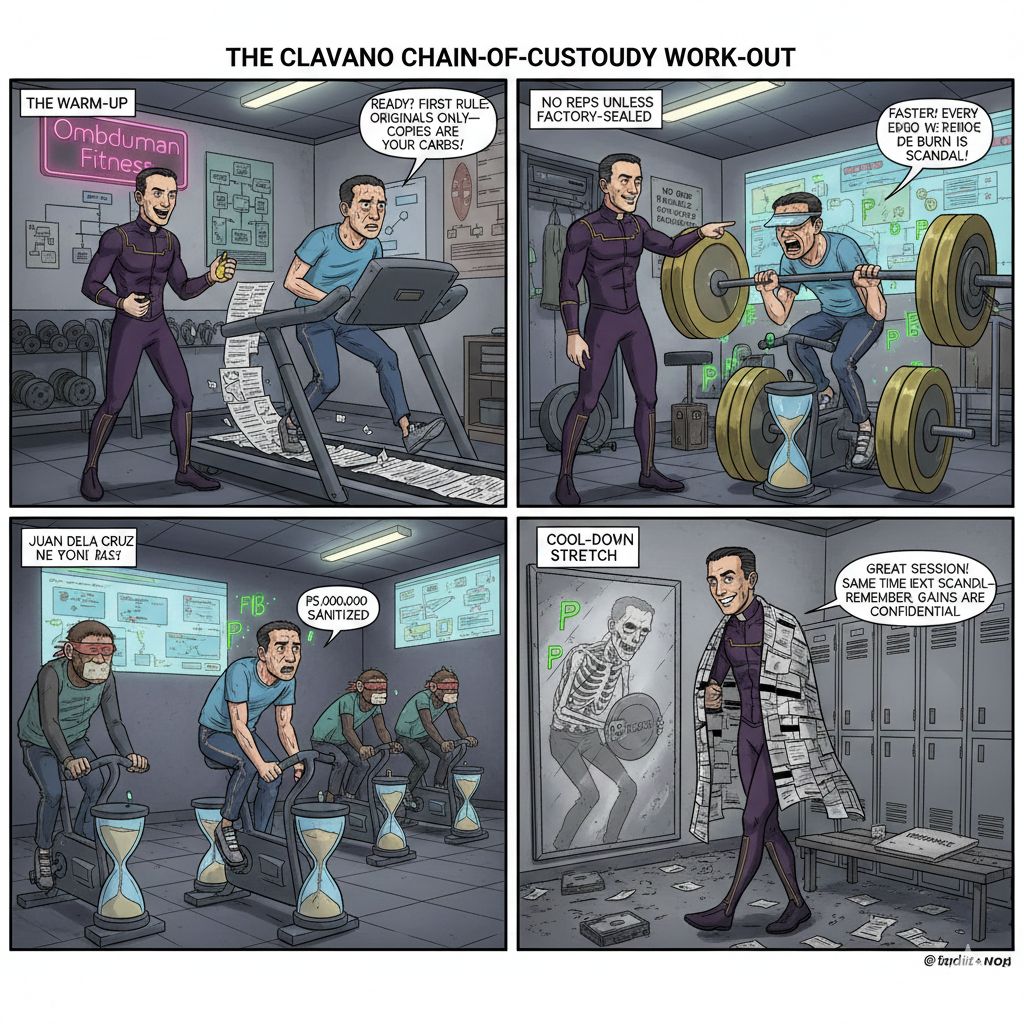
The Files Themselves: Not Just Insertions, But a Confession
Forget the euphemisms. These are not mere “budget insertions.” They are, by all accounts, a shadow ledger: parked allocations, flood control projects that exist only on spreadsheets, billions tucked into districts without the knowledge of local representatives, ready to be released to favored contractors at the nod of higher powers. The national cardiac arrest was not caused by the leak—it was caused by the recognition. We have seen this movie before: Priority Development Assistance Fund, Disbursement Acceleration Program, the endless parade of “infrastructure” that enriches everyone except the taxpayer.
An insertion is not automatically illegal, Clavano helpfully reminds us. True. But when the pattern is systematic, when the beneficiaries are politically connected, when the projects are either grossly overpriced or never built, the law stops being neutral. Republic Act No. 3019 (Anti-Graft and Corrupt Practices Act), particularly Section 3(e), does not require a smoking gun labeled “kickback.” It requires manifest partiality, evident bad faith, or gross inexcusable negligence causing undue injury. Malversation under Article 217 of the Revised Penal Code does not care whether the money was “parked” elegantly or crudely siphoned. And Republic Act No. 9184 (Government Procurement Reform Act) was not written to accommodate shadow budgets. Republic Act No. 6713 (Code of Conduct and Ethical Standards for Public Officials and Employees) demands transparency that these files, by their very existence, mock.
The Ombudsman promises to check if these projects were “actually implemented” or merely “gross.” How reassuring. One pictures a committee solemnly debating whether a billion-peso flood control project that controls zero floods is merely “gross” or outright criminal.
The Forensic Theater: A Committee Designed for Delay
The digital forensic examination of Cabral’s CPU is now underway—transparently, we are assured, in coordination with COA, DPWH, and PNP-ACG. A collaboration so inclusive it feels less like an investigation and more like a family reunion where everyone has something to hide.
Who had custody of that CPU first? How many hands touched it before the Ombudsman finally claimed it? Was it powered on? Files deleted? Metadata scrubbed? We are not told. Instead we are treated to lectures about how third-party copies lack credibility. Yet if the “original” has been in the hands of interested parties for weeks, the third-party copies—however editable—might be the only surviving witnesses to the truth.
This is not forensics. This is theater. A state-sponsored autopsy where the cause of death has already been pre-written as “natural causes.”
The Cast: Whistleblower, Gatekeepers, and Ghosts
Congressman Leandro Leviste plays the chaotic whistleblower—hero to some, political opportunist to others. He claims authorization from Secretary Vince Dizon himself, says he showed the files to investigative bodies before Cabral’s death, and insists DPWH staff confirmed authenticity. Against him: whispers from DPWH personnel that he accessed Cabral’s office in questionable fashion. Rumors, yes. But in a system allergic to paper trails, rumors are often the only oxygen truth gets.
The implicated Cabinet secretaries have options: pre-emptive resignation (unlikely), aggressive libel suits to intimidate circulators (probable), or the classic Filipino strategy—weather the storm in silence while friendly institutions do the heavy lifting of discrediting the evidence.
And the Ombudsman as institution? This is its crucible. An office that has shown vigor against small fish now faces the ultimate test: will it build a case against the powerful, or build a tomb for the scandal? Its credibility hangs not on legal correctness, but on whether the public believes the forensic process is a search for truth or a burial of evidence.
The Grand Narrative: The System That Needs Leaks to Breathe
The real scandal is not the leak. The real scandal is the opacity that makes leaks necessary.
We outlawed the Pork Barrel in Belgica v. Ochoa. We congratulated ourselves. And then we simply dispersed the ghosts into a thousand flood control projects—unbundled, opaque, perfect vehicles for patronage. The “neutral insertion” is not a legal doctrine; it is a beautiful fiction in a swamp of kickbacks.
Why do we still have shadow budgets in 2025? Why does infrastructure planning remain a black box guarded by secretaries and congressmen? Because transparency is the enemy of the system. And the system fights back with the most powerful weapon in its arsenal: procedure.
The Reckoning
This case will write precedents. It will decide whether digital whistleblowing can ever be treated as evidence, or whether only “official” hardware—controlled by the very institutions under scrutiny—will be deemed worthy. It will stain the 2025 budget permanently. It will either restore some faith in the Ombudsman, COA, and DPWH, or confirm that impunity is not merely tolerated but institutionalized.
And for the Filipino people? Another chapter in the long, corrosive saga of watching billions vanish while being lectured about chain of custody.
Enough.
I demand—not request, demand—the following:
- A swift, time-bound digital forensic examination with live, public updates on methodology and findings. No more black-box “coordination.”
- Immediate grant of immunity to any holder of copies willing to submit their files for metadata comparison against the “original” CPU.
- A full, line-by-line public accounting of every flood control project in the 2025 budget—proponent, contractor, status, disbursement.
- If the files are fake, name the fabricators and prosecute them relentlessly. If they are real, name the beneficiaries and prosecute them without fear or favor.
The powerful are squirming. Good. Let them squirm harder.
Because in the space between the “original” file and the sanitized copy lies the truth about where power truly resides in this country.
And we, the people, are done waiting for permission to see it.
–Barok
Key Citations
- “Ombudsman: Multiple sources claiming to have copies of ‘Cabral files’.” Inquirer.net, Philippine Daily Inquirer. Accessed 1 Jan. 2026.
- Belgica v. Ochoa. Supreme Court of the Philippines, G.R. No. 208566, 19 Nov. 2013, LawPhil Project. Accessed 1 Jan. 2026.
- Philippines. Congress. Republic Act No. 3019. Anti-Graft and Corrupt Practices Act. 17 Aug. 1960, LawPhil Project. Accessed 1 Jan. 2026.
- Philippines. Congress. Republic Act No. 6713. Code of Conduct and Ethical Standards for Public Officials and Employees. 20 Feb. 1989, LawPhil Project. Accessed 1 Jan. 2026.
- Philippines. Congress. Republic Act No. 8792. Electronic Commerce Act of 2000. 14 June 2000, Official Gazette of the Republic of the Philippines, LawPhil Project. Accessed 1 Jan. 2026.
- Philippines. Congress. Republic Act No. 9184. Government Procurement Reform Act. 10 Jan. 2003, Official Gazette of the Republic of the Philippines. Accessed 1 Jan. 2026.
- Philippines. Act No. 3815: The Revised Penal Code. 8 Dec. 1930. Official Gazette of the Republic of the Philippines. Accessed 1 Jan. 2026.
- Supreme Court of the Philippines. A.M. No. 01-7-01-SC. Rules on Electronic Evidence. 17 July 2001. Accessed 1 Jan. 2026.
- ₱9 Billion in ‘Savings’? DILG’s Fire Truck Deal Smells Like Smoke

- ₱8B BBM Pork: CCTV for Every Captain’s Kumpare?

- ₱8.9 Billion, 331 Ghost Police Stations: The TIKAS Scandal Explained

- ₱8.4 Billion, 42,000 Barangays, 1 Election: The “Bawat Barangay Makikinabang” Vote-Buying Masterclass

- ₱75 Million Heist: Cops Gone Full Bandit

- ₱63 to the Dollar: The Only Thing Falling Faster Than the Peso Is the Government’s Credibility

- ₱6.77B Ghost Haunts Duterte: RTC Dismisses Mans Carpio’s Desperate Plea
- ₱6.77 Billion and Zero Cash: The Sara Duterte SALN Math That Doesn’t Add Up

- ₱6.7-Trillion Temptation: The Great Pork Zombie Revival and the “Collegial” Vote-Buying Circus

- ₱58.53B, Zero Receipts: The LGSF Pork Barrel Nobody Wants to Name
- ₱53 Million Man Tells ₱695-a-Day Workers to Stop Being ‘Mayabang’: The Audacity of BSP’s Remolona

- ₱4.4 Billion and a Witness Who Can’t Explain It: The Duterte Impeachment’s Most Expensive Non-Answer




Leave a Reply