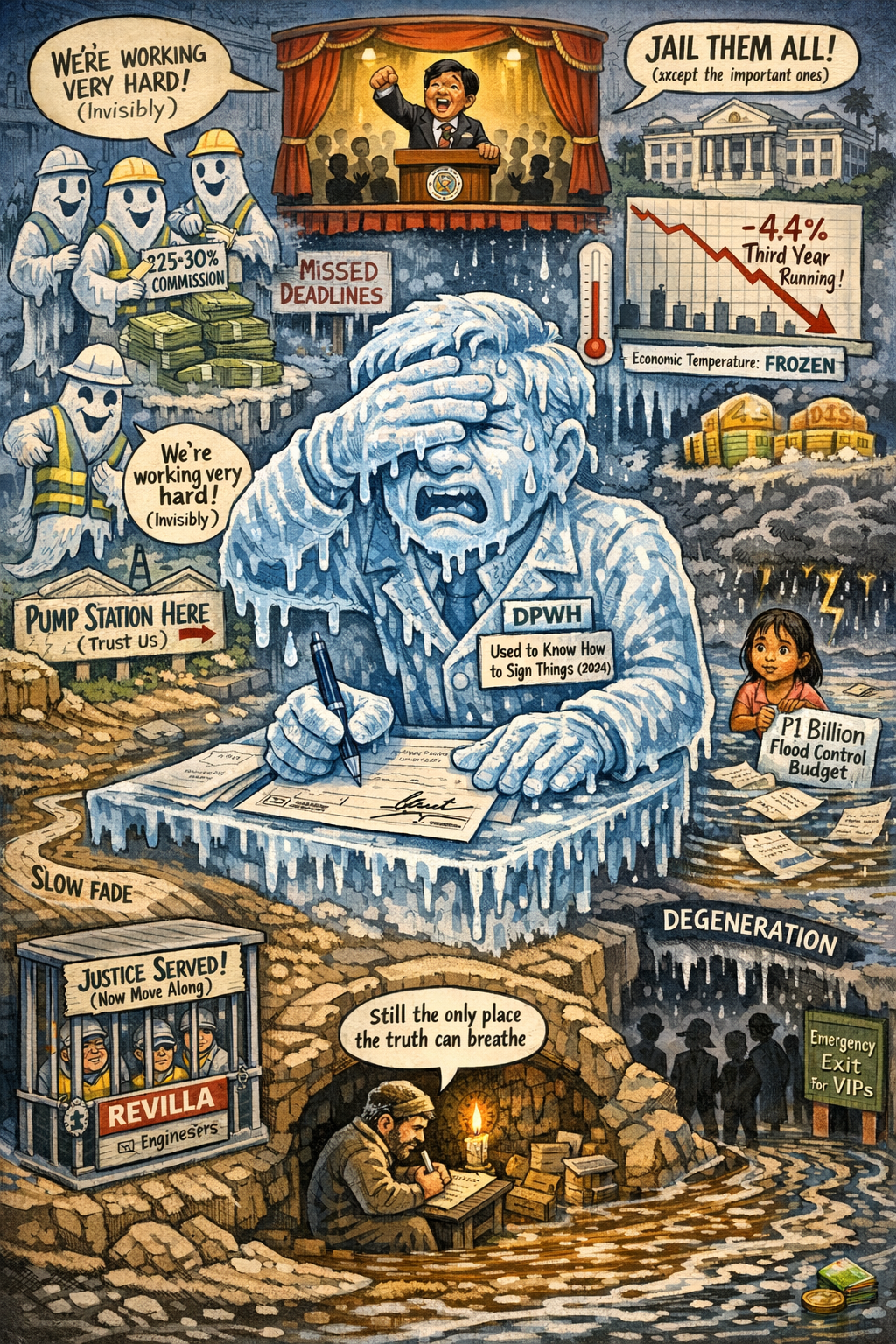
Monsod’s Diagnosis: The Bureaucracy Didn’t Freeze from Corruption—It Froze from the Sudden Threat of Actually Doing Its Job
By Louis “Barok” C. Biraogo –– February 3, 2026
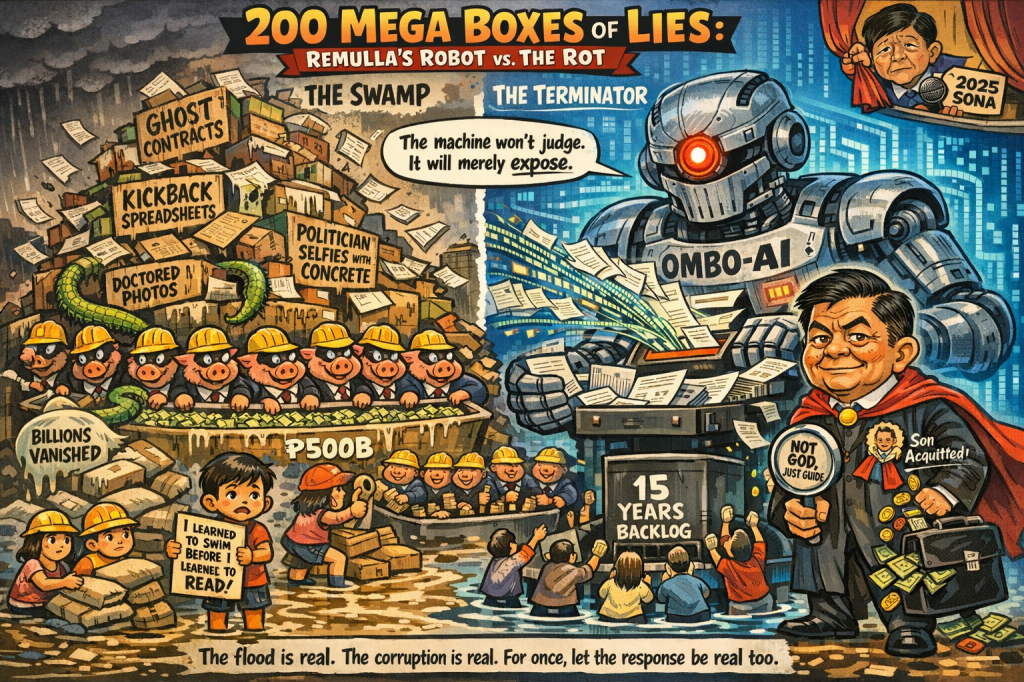
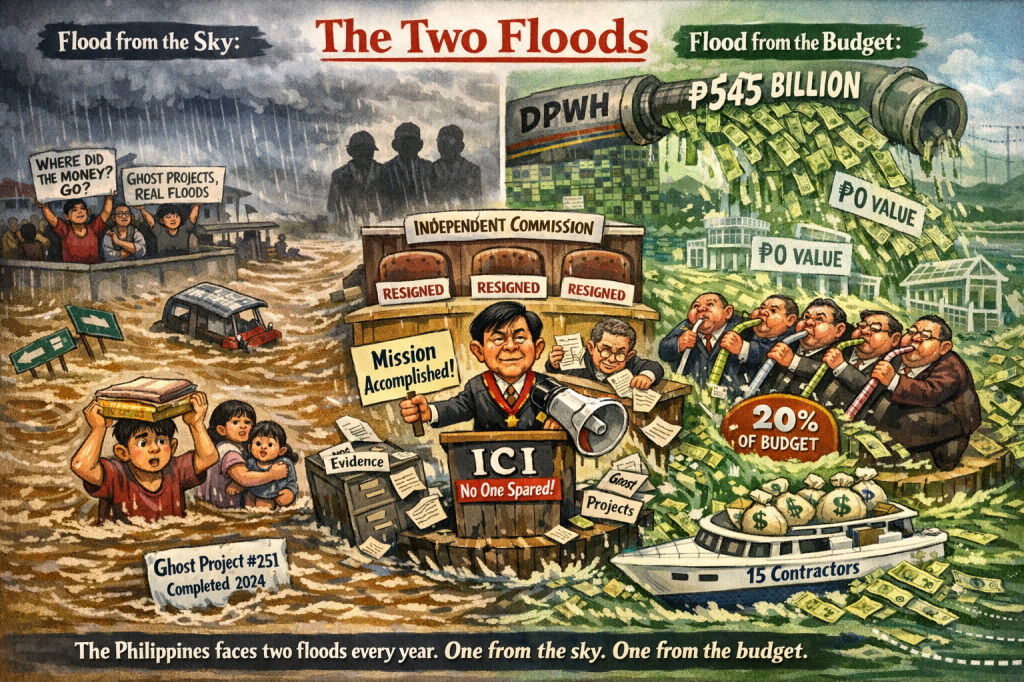
LET US begin with a simple image: a child in a flooded Manila barangay, waist-deep in filthy water, clutching a plastic basin that serves as both toy and life raft. Behind her, a billion-peso “flood control project” that exists only on paper and in some contractor’s offshore account. This is not an accident. This is the Philippine state at work.

The False Dichotomy and the Bureaucratic Abyss
Professor Solita “Winnie” Monsod, professor emeritus at the University of the Philippines School of Economics, recently argued in a video podcast that the economic slowdown in the second half of 2025 resulted from bureaucratic paralysis rather than the corruption scandal itself. She is technically correct: the Department of Public Works and Highways (DPWH) and other agencies froze like rabbits in headlights, terrified to sign vouchers lest they be dragged into investigations. Public construction spending collapsed, the country’s Gross Domestic Product (GDP) growth limped to a humiliating 4.4%, and the growth target was missed for the third straight year.
Monsod’s verdict is blunt: inefficiency, not the scandal, caused the damage. If investigating corruption necessarily paralyzes government, she warns, perhaps we should stop investigating altogether.
Yet this is where the professor’s analysis stops short. She treats paralysis as a managerial failure that could have been prevented with clearer guidelines. I contend that the paralysis is the most honest symptom of a system so thoroughly corrupted that the mere prospect of scrutiny triggers institutional catatonia.
In a bureaucracy where routine compliance has long carried an implicit 25–30% surcharge for patrons, the sudden demand for actual accountability does not produce efficiency—it produces panic. Officials did not freeze because they feared being caught doing their jobs properly. They froze because they had forgotten how.
The Pantomime of Accountability
President Ferdinand Marcos Jr., in his 2025 State of the Nation Address (SONA), performed righteous fury with practiced conviction. He brandished evidence of non-existent pump stations, denounced ghost projects, and vowed to jail everyone implicated. The public applauded. Then, quietly, the script changed.
Today, only a handful of mid-level DPWH engineers and one conveniently pre-vilified former senator—Ramon “Bong” Revilla Jr.—face incarceration. The lawmakers who allegedly inserted the projects, the contractors who allegedly paid commissions, and the higher officials who allegedly approved payments remain untouched. The Department of Justice (DOJ) files cases that crawl through the courts, while the Office of the Ombudsman moves with glacial deliberation.
This is not mere failure. This is calculated theater—sacrificial scapegoats offered to quiet public anger while the larger network endures.
The Methodology of a Captured State
Consider the lifecycle of a typical ghost project:
- A lawmaker inserts a vague line item into the budget—no feasibility study, no climate-risk assessment required.
- The DPWH regional office, often staffed by political appointees, inflates costs to accommodate the standard 25–30% commission.
- Pre-selected contractors submit billings for work never performed, using recycled photographs as “proof.”
- Engineers sign off on accomplishments they never inspected.
- Commissions are paid in cash or layered transactions.
Every stage depends on silent complicity across legislators, bureaucrats, contractors, and auditors. When the President demands accountability without first providing clear safe-harbor guidelines for honest implementers, the entire machinery seizes—not from sudden virtue, but from fear of unpredictable rules.
Ambiguity, in this system, is not an oversight. It is a control mechanism.
The Human Cost
While economists debate GDP percentages, families lose everything.
Stolen billions mean absent retention walls, undredged esteros, and pump stations that exist only in presentations. When typhoons arrive—and they always do—the water rises higher, lingers longer, and claims more lives. Climate change is not merely a risk multiplier here; it has become a profit center. More frequent floods justify larger budgets—and larger commissions.
The contrast is obscene: kickback-fueled luxury alongside the destitution of repeatedly submerged barangays.
The Systemic Prognosis
Three paths lie ahead:
- Most likely: A slow fade. Protests subside, a few convictions are secured, spending resumes under marginally stricter rules, and the big fish retire untouched.
- Reform fantasy: Independent prosecution, transparent budgeting, an end to congressional insertions, real-time project geo-tagging. Fantastical, because it requires the powerful to vote against their own interests.
- Degeneration: The next super-typhoon strikes an even more neglected metropolis. Deaths mount. Public cynicism hardens into contempt. State legitimacy erodes further.
A Reckoning Overdue
This is not a “scandal.” Scandals imply exception. This is the operating system of Philippine infrastructure politics: a predatory state that feeds on its citizens’ vulnerability.
The Marcos administration’s response reveals a state that cannot investigate itself without freezing, cannot punish the powerful without threatening its foundations, and cannot escape the false choice between corruption and stagnation.
There is a third way—but it will not come from Malacañang or Congress. It must come from citizens who refuse to forget, journalists who keep digging, honest officials who choose integrity, and a civil society that sustains pressure long after the cameras leave.
We need relentless, intelligent demand for governance rooted in competence and integrity—not polite requests, but a sustained civic awakening. The state, as currently constituted, will not heal itself.
— Barok, still writing from the cave, because apparently the only place the truth can breathe is underground while the palaces stay dry.
Key Citations
- Cabalza, Dexter. “Inefficiency, not Corruption Scandal, Caused Slowdown.” Philippine Daily Inquirer, February 2026.
- “Department of Public Works and Highways.” Department of Public Works and Highways, Republic of the Philippines. Accessed 2 Feb. 2026.
- “Department of Justice.” Department of Justice, Republic of the Philippines. Accessed 2 Feb. 2026.
- “Office of the Ombudsman.” Office of the Ombudsman, Republic of the Philippines. Accessed 2 Feb. 2026.
- “President Ferdinand R. Marcos Jr.’s State of the Nation Addresses.” Official Gazette of the Republic of the Philippines. Accessed 2 Feb. 2026.
- ₱75 Million Heist: Cops Gone Full Bandit

- ₱6.7-Trillion Temptation: The Great Pork Zombie Revival and the “Collegial” Vote-Buying Circus

- ₱1.9 Billion for 382 Units and a Rooftop Pool: Poverty Solved, Next Problem Please

- ₱1.35 Trillion for Education: Bigger Budget, Same Old Thieves’ Banquet

- ₱1 Billion Congressional Seat? Sorry, Sold Out Na Raw — Si Bello Raw Ang Hindi Bumili

- “We Will Take Care of It”: Bersamin’s P52-Billion Love Letter to Corruption
- “Skewed Narrative”? More Like Skewered Taxpayers!

- “Scared to Sign Vouchers” Is Now Official GDP Policy – Welcome to the Philippines’ Permanent Paralysis Economy
- “Robbed by Restitution?” Curlee Discaya’s Tears Over Returning What He Never Earned

- “My Brother the President Is a Junkie”: A Marcos Family Reunion Special

- “Mapipilitan Akong Gawing Zero”: The Day Senator Rodante Marcoleta Confessed to Perjury on National Television and Thought We’d Clap for the Creativity

- “Just Following Orders” Is Dead: How the Hague Just Turned Tokhang’s Finest Into International Fugitives

 KWEBA ni BAROK
Leave a comment