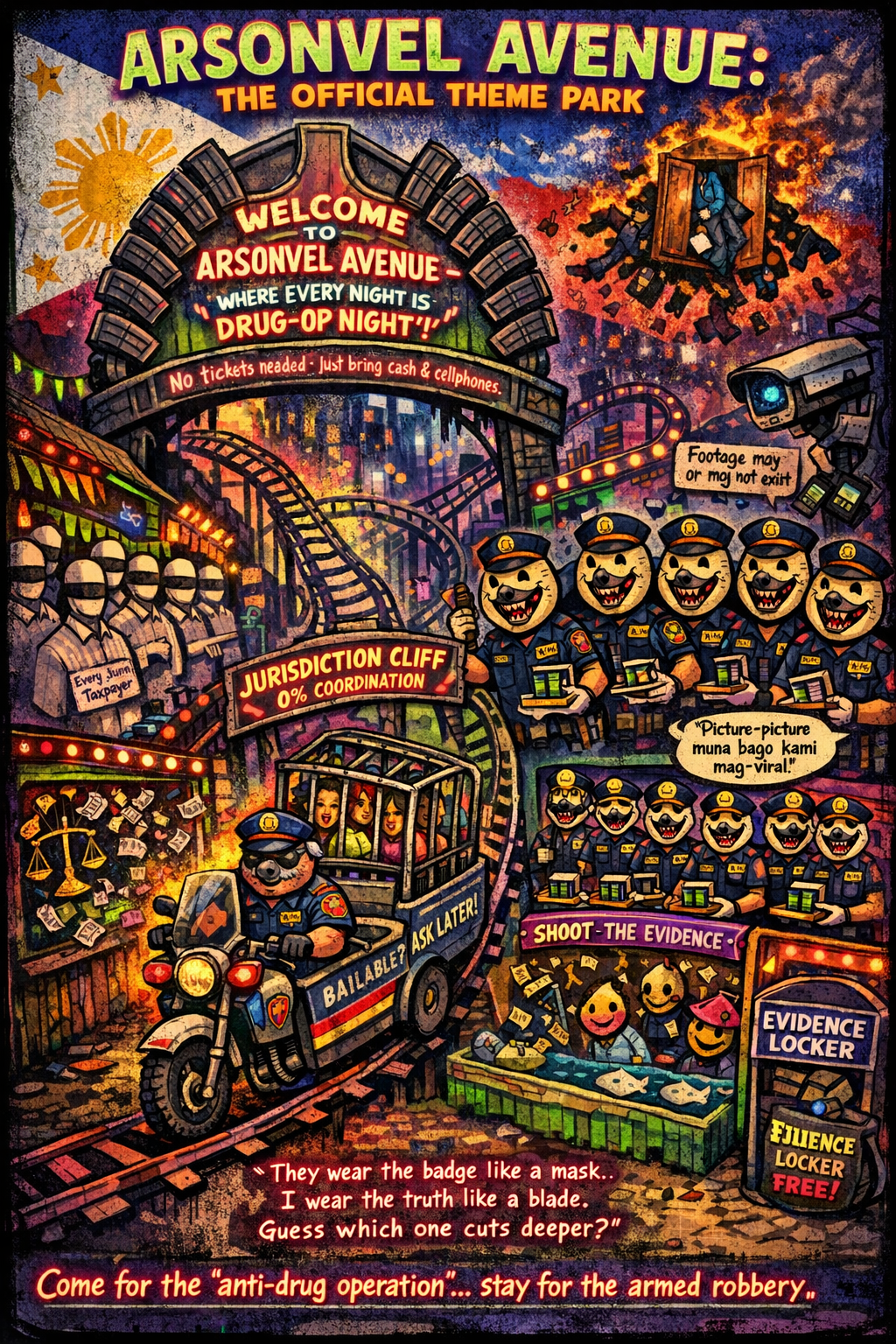
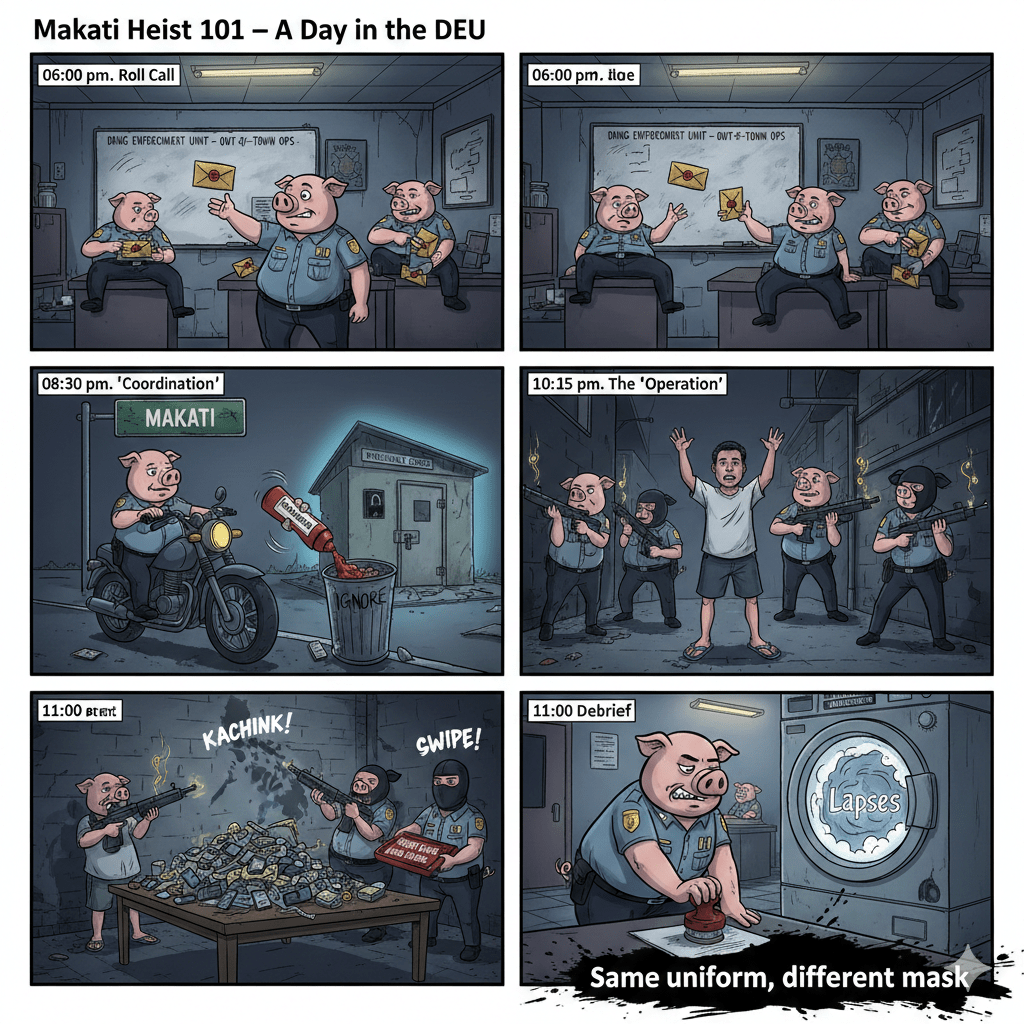
Makati Heist 101 – Enrolled by MPD’s Finest, Funded by Every Juan Taxpayer
By Louis ‘Barok‘ C. Biraogo — February 2, 2026
ONE night on Arsonvel Street, Makati—not a movie scene, not a tabloid tale, but real life captured on video. Six police officers from the Station Drug Enforcement Unit of the Manila Police District (MPD), either in uniform or carrying government-issued firearms, waylaid victims they had lured from Malate. They dragged them into a dark alley, held them at gunpoint, forced them to the ground, kicked them, tied their hands, and robbed them of cellphones and cash. Then they fled on motorcycles like ordinary hold-up men—no masks, no attempt to conceal their identities—because they knew the most effective disguise in the Philippines is the PNP uniform itself.
These were not “rogue cops.” They were criminals who happened to have government jobs. A bonus package: taxpayer-funded guns, badges that confer authority, and a license to terrorize fellow citizens. The audacity—striking in Makati, far outside their jurisdiction—was not merely a crime. It was an insult. It was a slap in the face of every Filipino who still hopes the police will protect rather than prey upon them.
The Gutting: From Protectors to Predators
First, the six so-called “erring” policemen—one police staff sergeant and five patrolmen, now detained in Makati City. Let us not call them “misguided officers.” They are thieves who happened to draw salaries from the state. Master tacticians who apparently believed the highest form of police work was robbing innocent people while armed with service firearms. They did not “fall into temptation.” They planned it, repeated it—additional victims have since come forward identifying the same group in earlier robberies. And the most galling part: they used the pretext of an “anti-drug operation” to slip into Makati without coordination. Bravo. Truly world-class criminality.
Second, the systemic rot that nurtured them. The Station Drug Enforcement Unit—mini-warlords with operational autonomy, minimal oversight, and the perfect “war on drugs” cover. Corruption thrives here: no logs, no witnesses, no questions asked. Only when a video goes viral does the so-called “internal cleansing” begin. Perfect timing. As if they were waiting for public outrage before bothering to act. How many times have we heard this script? How many more “isolated incidents” must we endure before admitting the entire culture is rotten?
Third, the betrayal of trust. NAPOLCOM Commissioner Rafael Vicente R. Calinisan stated: “When the uniform is used to intimidate, abuse, and commit crime, it is a clear betrayal of the people’s trust.” He is correct—but the irony cuts deep. Those words are repeated every time a scandal breaks, only for everything to return to normal after the press release fades. The uniform and service firearm—symbols of public safety—were turned into weapons against the public. Most tragic of all: the victims were ordinary Filipinos with no means to defend themselves against six armed “protectors of the law.”
The Legal Autopsy: From Crime to Institutional Failure
First, the criminal farce. This was not simple robbery. It constitutes robbery under Article 293 of the Revised Penal Code, qualified by violence and intimidation against persons, committed by a band (six perpetrators, hence aggravated), and involving state-issued firearms—a direct violation also of Republic Act No. 10591, the Comprehensive Firearms and Ammunition Regulation Act. Physical injuries were inflicted, elements of illegal detention present. Recall the Supreme Court precedent in PO2 Ireneo M. Sosas, Jr. v. People—when a police officer abuses authority to extort or intimidate, it is robbery, not mere “extortion.” This is no anomaly in the PNP; it is a recurring pattern.
Second, the prosecution theater. Credit is due to the Makati City Police for the swift arrest—commendation-worthy indeed. But what follows? Parallel investigations by NAPOLCOM’s Inspection, Monitoring, and Investigation Service (IMIS) and the PNP Internal Affairs Service (IAS), preventive suspension, relief of the entire unit. Excellent for press releases, but a predictable circus. How many months or years before the “thorough investigation” concludes? How many “command responsibility” inquiries will end in whitewash? This is crisis management, not genuine accountability—designed to quiet public anger until the news cycle moves on.
Third, the command responsibility charade. IAS Inspector General Brigido J. Dulay announced that “lapses in supervision” would be examined. How massive must those “lapses” be for an entire drug unit to leave Manila, enter Makati, and commit armed robbery without anyone noticing? In a functional system, the station commander and immediate superiors would already face charges for criminal negligence. Yet here? Mere relief and investigation. No names above station level are mentioned. Why? Because once the probe climbs higher, far more heads might roll.
The Architecture of Impunity: Why This Was Inevitable
The “unauthorized operation” was not a bug—it was a feature of the system. Lax coordination requirements make it easy to disguise any crime as a “drug operation.” The overlapping mandates of IAS and NAPOLCOM? Not redundant oversight, but a deliberate maze where accountability gets lost. And the “war on drugs” pretext? It has become the Swiss Army knife of corrupt police: justification for illegal searches, arrests, shakedowns, and now outright robbery.
The Demands: Beyond Empty Platitudes
The usual “full force of the law” rhetoric is insufficient. The following must happen:
- Immediate: Not just dismissal—fast-tracked criminal trials with public docket tracking. Immediate asset forfeiture proceedings against the officers and their families. No bail where warranted.
- Structural: Dissolve all station-level drug enforcement units. All anti-drug operations must be regional, multi-agency, with mandatory body cameras and real-time, publicly accessible coordination logs.
- Accountability: File charges under Republic Act No. 3019 (Anti-Graft and Corrupt Practices Act), Sections 3(a) and 3(b)—they clearly received “gifts” (stolen cash and phones) in connection with their official functions. This is plunder of public trust.
- Transparency: Establish a public, real-time online dashboard listing all police officers facing administrative and criminal charges. No exceptions, no secrecy.
The Verdict: The Nation’s Choice
This is a litmus test. Will this be buried as another “isolated incident” in procedural molasses, or will it become the final straw that forces a reckoning with the PNP’s poisoned culture? The public’s trust is not merely cracked—it has been held at gunpoint, robbed, and kicked while down. The question is stark: Will the system once again protect its own, or will it finally, truly, cleanse itself?
As long as police officers can commit armed robbery while wearing the uniform of the state, every “internal cleansing” press conference is meaningless. As long as officials deliver beautiful speeches without concrete action, the system remains criminal.
The uniform has been defiled. It may be time to burn the entire wardrobe.
They wear the badge like a mask. I wear the truth like a blade. Guess which one cuts deeper.
— Barok
Key Citations
A. Legal & Official Sources
- Act No. 3815: The Revised Penal Code of the Philippines. 8 Dec. 1930. Official Gazette of the Republic of the Philippines.
- Republic Act No. 10591. An Act Providing for a Comprehensive Law on Firearms and Ammunition and Providing Penalties for Violations Thereof. Official Gazette of the Republic of the Philippines, 29 May 2013.
- Republic Act No. 3019: Anti-Graft and Corrupt Practices Act. 17 Aug. 1960. Official Gazette of the Republic of the Philippines.
- Republic Act No. 6975. An Act Establishing the Philippine National Police under a Reorganized Department of the Interior and Local Government, and for Other Purposes. LawPhil Project.
- Sosas v. People. G.R. No. 249400, Supreme Court of the Philippines, 15 Mar. 2023. Supreme Court E-Library.
B. News Reports
- “Six MPD cops face criminal, admin raps over viral Makati robbery.” Daily Tribune, 31 Jan. 2026, tribune.net.ph/2026/01/31/six-mpd-cops-face-criminal-admin-raps-over-viral-makati-robbery.

- “Far-Off” My Axx: Malacañang’s Claire Castro Drowns in Her Own Legal Gaslighting
- “Forthwith” to Farce: How the Senate is Killing Impeachment—And Why Enrile’s Right (Even If You Can’t Trust Him)
- “HINDI AKO NAG-RESIGN!”

- “I’m calling you from my new Globe SIM. Send load!”

- “Mahiya Naman Kayo!” Marcos’ Anti-Corruption Vow Faces a Flood of Doubt

- “Manageable” Debt, Unmanageable Lies: DBM’s ₱21 Trillion Fairy Tale
- “Meow, I’m calling you from my new Globe SIM!”

- “Natrabaho”: One Word, One Ombudsman, and a Judiciary on Trial
- “No Special Jail for Crooks!” Boying Remulla Slams VIP Perks for Flood Scammers
- “Philippine-Controlled” or Yankee Gas Station? The Davao Fuel Depot Farce Exposed
- “PLUNDER IS OVERRATED”? TRY AGAIN — IT’S A CALCULATED KILL SHOT

- “Several Lifetimes,” Said Fajardo — Translation: “I’m Not Spending Even One More Day on This Circus”




 KWEBA ni BAROK
Leave a comment