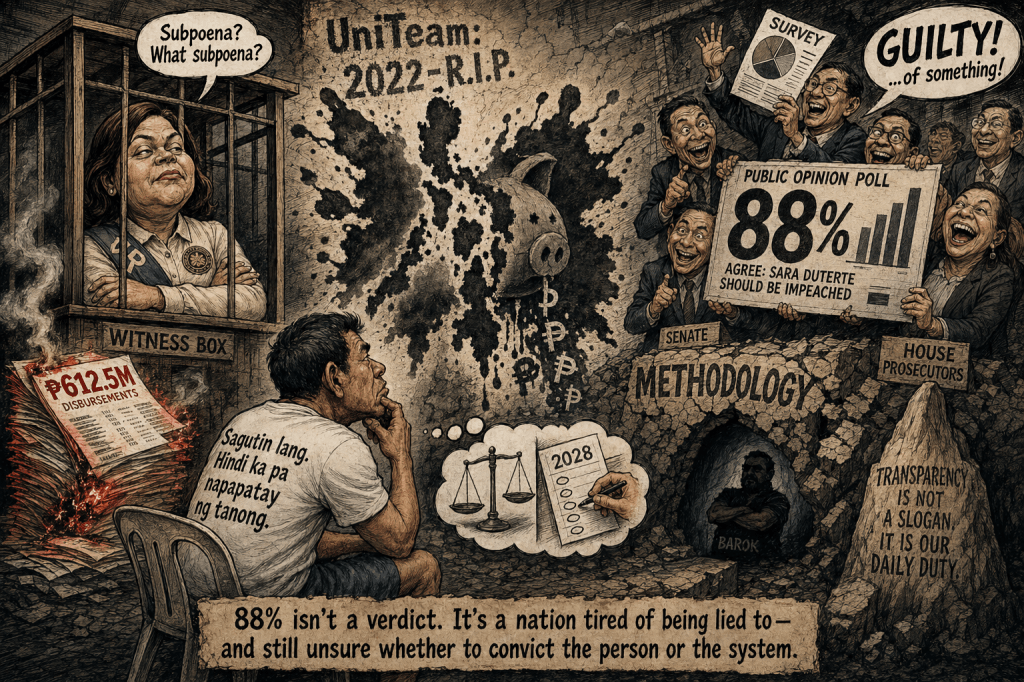
A Nation Demands Answers, Not Blood: The Poll That Exposed Drama Fatigue
By Louis ‘Barok‘ C. Biraogo — April 26, 2026
LISTEN. Close your eyes for a second and picture it: an 88 percent scream echoing across the archipelago.
Not a lynching party, not a digital mob with pitchforks and hashtags. No.
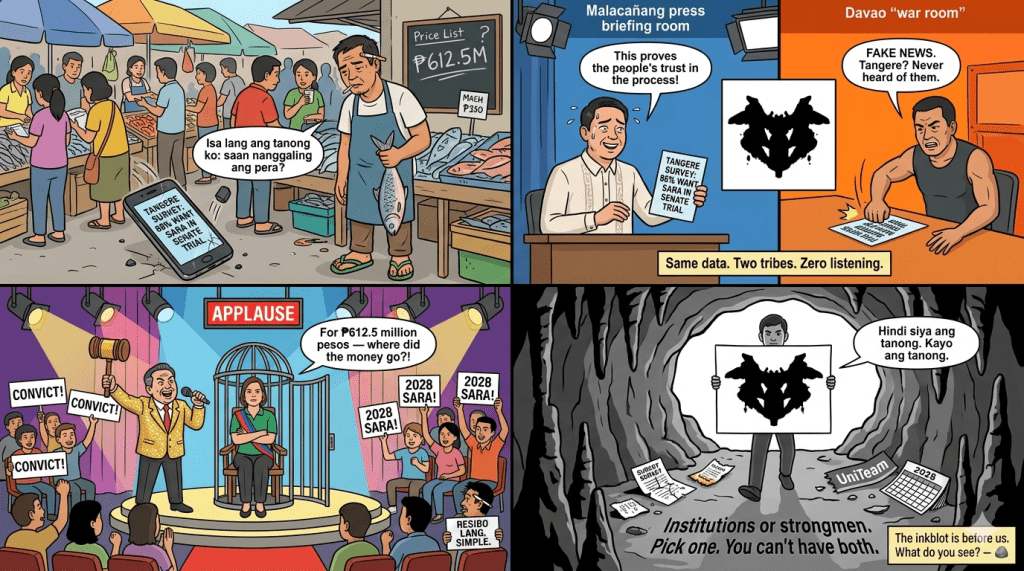
This Tangere survey—dropped like a grenade on April 23—isn’t a monolithic war cry of “anti-Sara” rage. It is a fractured prism, a political Rorschach blot where every inkblot reveals something rawer than partisan fury.
To the comfortable in Malacañang’s echo chambers and the Duterte war rooms in Davao, the lazy binary is irresistible: “They hate her! It’s Marcos revenge!” Rubbish.
Peel back the ink. That 88 percent is a desperate plea for transparency from a people exhausted by smoke and mirrors. It is a raw demand that institutions—those creaky, compromised pillars we pretend still stand—actually function.
It is a burning curiosity about those unresolved allegations swirling around confidential funds, those ₱612.5 million ghosts that vanished into thin air while children sat in classrooms without books.
And yes, for the undecided voters—the quiet middle who still remember the UniTeam fairy tale—it is a cold-eyed test: let’s see the Vice President sweat under oath, not behind press releases or proxy tirades.
The news report from PNA and the echo chamber of lawmakers waving this poll like a moral cudgel? They missed the nuance entirely.
This isn’t hatred. It’s the electorate, bloodied by years of drama fatigue, saying: “Enough evasion. Show us the books. Let the Senate do its damn job.” The binary comforts the powerful. Reality indicts us all.
I. Dissecting the 88%: Genuine Outcry or Skewed Selfie?
The best case for the 88 percent is damningly simple. It captures a public conscience fed up with evasion.
Filipinos aren’t demanding her head on a platter; the poll itself frames the trial as a defense venue, not punishment.
Seventy percent want her to testify personally. Fifty-one percent want the financial records laid bare.
This is not “guilty until proven innocent.” This is “institutions must work, or why bother calling ourselves a democracy?”
It fits the trend: OCTA’s face-to-face poll weeks earlier clocked 69 percent support for a trial. Directionally consistent.
Salient events—House hearings, the confidential funds scandal—have shifted sentiment. Even in Mindanao, OCTA found majority backing. The people are saying: let evidence speak, let her answer under oath. If she’s clean, she walks taller. If not, accountability isn’t optional.
The harshest case against it is equally damning. Eighty-eight percent? In a polarized nation where Sara Duterte remains a 2028 frontrunner in multiple trackers?
That number smells like statistical perfume sprayed on a digital divide.
Tangere’s mobile-app poll—1,200 respondents, April 22-23—inevitably amplifies the connected, the urban, the young, the smartphone-owning classes who scroll past the DDS memes and into the outrage cycle.
The offline poor, the rural heartlands, the Mindanao base that still sees her as Inday Sara? They’re ghosts in this data.
Contrast that with OCTA’s boots-on-the-ground interviews or the more modest (and historically lower) numbers from Pulse Asia and SWS in prior cycles—26-32 percent support for outright impeachment moves.
Leading questions matter: “Should she face a trial to defend herself?” sounds noble and procedural. “Should she be removed?” invites tribal defense. Who is being amplified here? The echo chamber of the already-convinced, or the silent majority still weighing loyalty against evidence?
The survey isn’t gospel. It’s a flare gun. It illuminates hunger for process. But methodology is the fine print that the grandstanding lawmakers conveniently ignored.
II. The Roots of the Outcome: From Confidential Funds to Drama Fatigue
This moment didn’t materialize in a vacuum.
The toxic residue of the confidential funds scandal—₱612.5 million for the OVP and DepEd, ₱125 million allegedly burned in 11 days in 2022—has festered like an open wound.
Theatrical non-appearances at House hearings didn’t help; they looked like legal chess to lawyers and political cowardice to everyone else.
The shattered UniTeam alliance? That fairy tale exploded into elite civil war, turning former bedfellows into investigators with subpoena power.
Add the psychological “drama fatigue”: years of press releases, victim cards, and social-media salvos have left even loyalists sighing, “Just answer the questions already.”
Demographics sharpen the blade. Urban Luzon and NCR—connected, scrolling, skeptical—drive the numbers higher.
Rural Mindanao still leans loyal but even there, OCTA found 61 percent open to a trial. Younger voters, wired to institutionalist ideals, want the process.
Offline elders and the poor? They remember the strongman romance and wonder why the powerful always evade the same scrutiny they demand of the weak.
The roots are not conspiracy. They are accumulated distrust, unresolved shadows, and a nation that has watched too many powerful people treat public money like personal loot.
III. The Key Actors Under the Knife: No Saints, Just Calculated Survivors
Sara Duterte. Her strategic silence and performative defiance are a masterclass in legal preservation—and a catastrophic forfeiture of public trust.
Skipping hearings while her team files jurisdiction challenges may be smart lawyering. To the 88 percent, it reads like a woman who wants the presidency but not the accountability that comes with it.
Is she preserving options or eroding the very legitimacy she’ll need in 2028? The clock is ticking on that answer.
The House Prosecutors. They risk turning a solemn constitutional process into a ratings-driven circus.
Waving a survey as a cudgel instead of building an airtight money trail? That’s not justice; that’s performance art.
If this becomes grandstanding and selective outrage, sympathy will bleed toward Sara faster than any confidential fund ever disappeared.
The Supreme Court and the Senate. Will they be impartial arbiters or 2028 calculators?
The Supreme Court already struck down the 2025 attempt on the one-year bar.
The Senate—peopled with ambitious souls eyeing the same throne—will weigh evidence against electoral math. Impartiality is a luxury few can afford when the next presidency is the prize.
The Public. Ah, the body politic. We demand accountability while still flirting with populist strongmen.
We want the public hanging and the reelection rally. We cheer “due process” until it threatens our tribe.
That hidden contradiction—support the trial, yet keep her high in presidential preferences—isn’t hypocrisy. It’s pragmatic exhaustion: “Let her answer. If she survives clean, maybe she’s steel.”
IV. The Options, Resolutions, and Repercussions: The Cliffhanger That Will Define 2028
The choices are stark. Sara can testify aggressively—project confidence, rebut specifics, frame herself as victim of political persecution—and turn the Senate into her vindication stage.
Or she can double down on jurisdictional stonewalling and risk the “evasive” brand sticking like tar. Hybrid? Legal challenges plus public engagement.
Or mobilize the base into martyrdom: “This is anti-Mindanao persecution.”
House options: evidence-based or circus? Speed or thoroughness? The Senate will choose between conviction (historically rare without ironclad proof), acquittal (even amid polls), procedural collapse, or political damage without removal.
The seismic impacts? A conviction craters her 2028 path and disqualifies her. An acquittal could forge her into a martyr stronger than before.
Procedural death breeds cynicism. Either way, institutional credibility hangs by a thread.
The post-Marcos/Duterte democratic project—already battered—could fracture further if this becomes another chapter in elite score-settling rather than truth-seeking.
Here is the question that will haunt every barangay, every dinner table, every 2028 strategy session: Can Sara Duterte convert this deafening demand for accountability into an electrifying opportunity for vindication—or will this survey mark the precise moment the tide of her credibility washed out for good?
A Galvanizing Call: Transparency Is Not a Slogan—It Is Our Daily Duty
Fellow Filipinos, the jury is not only in the Senate. It is in every living room, every street corner, every scrolling thumb.
Demand transparency not as a hashtag but as a daily practice. Vigilance is not against one person named Sara—it is against the machinery of impunity that has ground down administrations for decades, regardless of surname or color.
To the media: stop the circus framing. Report the money trails, the documents, the sworn words.
To civil society: organize town halls, not echo chambers. Demand evidence, not vibes.
To voters: participate discerningly. Read beyond the headlines. Weigh the contradiction of wanting both process and strong leadership.
In a democracy, the most powerful verdict is cast not in 2028 but in the informed choices we make today.
Sara Duterte faces a trial for political survival while still leading the presidential pack. The nation faces a mirror. Will we choose the hard road of institutions that work—or the easy slide back into the comfort of strongmen who don’t have to?
The inkblot is before us. What do you see?
—Barok
Key Citations
A. News Articles
- Reganit, Jose Cielito. “Lawmakers: New Survey Shows 88% of Filipinos Want VP in Senate Trial.” Philippine News Agency, 24 Apr. 2026.
- Rita, Joviland “69% of Filipinos Support Impeachment Trial vs VP Sara Duterte — OCTA Survey.” GMA News Online, 15 Apr. 2026.
- Mateo, Janvic. “45 Percent Against, 26 Percent for VP Sara Impeachment – Pulse Asia.” Philstar.com, 15 Mar. 2025.
- Peralta-Malonzo, Third Anne andFlores, Claudine. “Duterte Declares 2028 Bid, Shatters ‘UniTeam’ Alliance.” SunStar, 18 Feb. 2026.
B. Official & Reference Sources
- “SC: House Impeachment Complaint vs VP Duterte Barred by 1-Year Rule, Due Process or Fairness Applies During All Stages of Impeachment Process.” Supreme Court of the Philippines, 25 July 2025.
- “Sara Duterte Confidential Funds Controversy.” Wikipedia, Wikimedia Foundation, 23 Apr. 2026.
- “Ang Hirap Maging Mahirap”: The PAO Scandal That Proves Government Contempt Is Nothing New

- “Far-Off” My Axx: Malacañang’s Claire Castro Drowns in Her Own Legal Gaslighting
- “Forthwith” to Farce: How the Senate is Killing Impeachment—And Why Enrile’s Right (Even If You Can’t Trust Him)
- “HINDI AKO NAG-RESIGN!”

- “I Know Nothing”: Baste Duterte’s Amnesia Defense Meets ₱33M in GenCorp Contracts

- “I’m calling you from my new Globe SIM. Send load!”

- “Mahiya Naman Kayo!” Marcos’ Anti-Corruption Vow Faces a Flood of Doubt

- “Manageable” Debt, Unmanageable Lies: DBM’s ₱21 Trillion Fairy Tale

- “Meow, I’m calling you from my new Globe SIM!”

- “Natrabaho”: One Word, One Ombudsman, and a Judiciary on Trial

- “No Special Jail for Crooks!” Boying Remulla Slams VIP Perks for Flood Scammers

- “Philippine-Controlled” or Yankee Gas Station? The Davao Fuel Depot Farce Exposed




Leave a Reply