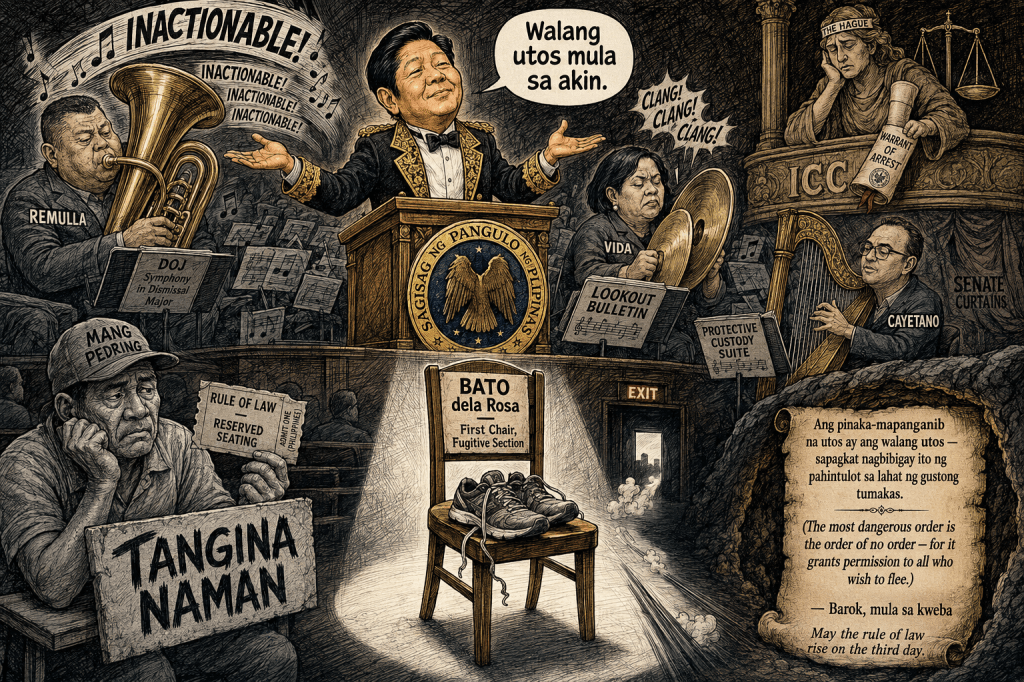
Golden Ticket to Impunity: Marcos Clears Path for Duterte Ally
By Louis ‘Barok‘ C. Biraogo — May 17, 2026
BUCKLE up, mga ka-kweba, because what we are about to dissect is not just a scandal. It is a masterclass in performative governance, a telenovela of institutional collapse where the only thing more absent than the suspect is the political will of the man ostensibly in charge. This is the story of the failed arrest of Senator Ronald “Bato” dela Rosa, an episode so rich in farce and constitutional sacrilege that it makes the average banana republic look like a bastion of efficiency.
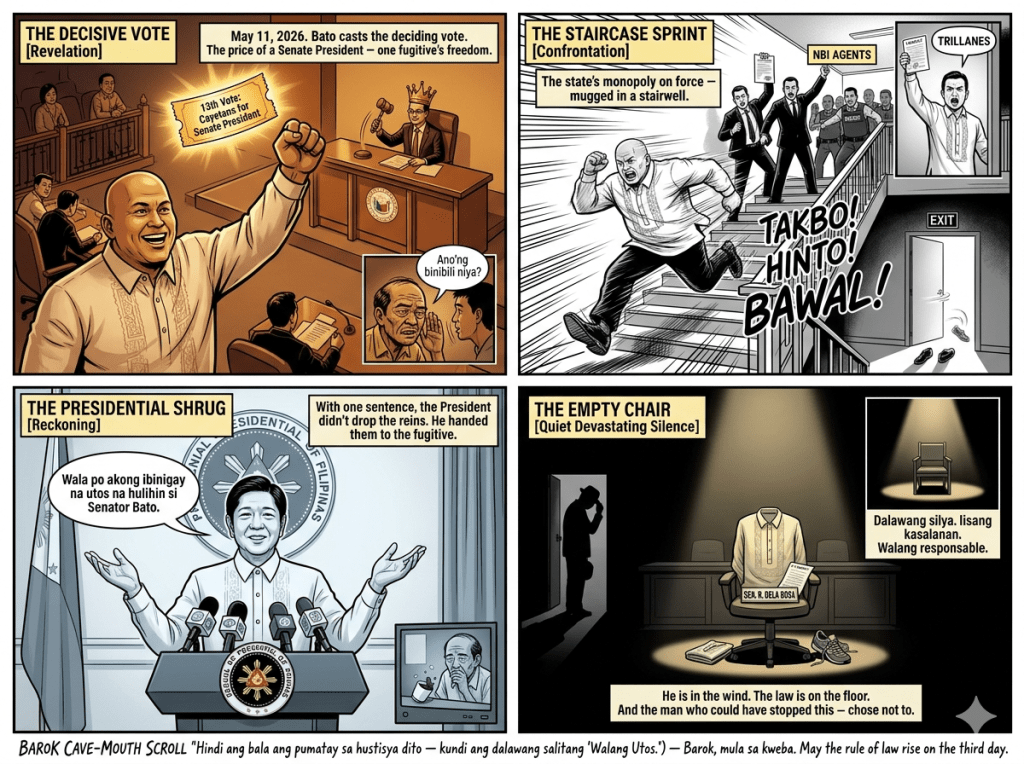
Staircase Farce: Bato’s Senate Sprint to Freedom
Let us trace the geometry of this fiasco. On May 11, 2026, Senator Dela Rosa—a man who has spent six months treating an International Criminal Court (ICC) warrant like a parking ticket—materializes on the Senate floor. His purpose is not to face justice, but to play kingmaker. He delivers the decisive 13th vote to oust Senate President Vicente “Tito” Sotto III, crowning Alan Peter Cayetano in a coup so brazen it would make Julius Caesar blush. The timing is, of course, purely coincidental. As a reward, the newly minted Senate President extends to Dela Rosa the ancient and constitutionally dubious gift of “Senate protective custody.”
What follows is a sequence that would be rejected by a screenwriter for being too on-the-nose. Agents of the National Bureau of Investigation (NBI), operating under the Department of Justice (DOJ), attempt an arrest. They are met with a scene that can only be described as a komedya: a chase down a staircase, a Senate lockdown, and the theatrical appearance of former Senator Antonio Trillanes IV brandishing a copy of the warrant like a prophet descending with a tablet. The arrest fails. Dela Rosa scampers. The state’s monopoly on force is mugged in a stairwell.
Then, the pièce de résistance: a shooting incident on May 13, shrouded in the fog of war and political spin, followed by Dela Rosa’s silent slip from the compound with Senator Robin Padilla at 2:30 AM. He is now in the wind, a fugitive from the law he once swore to enforce. The entire sequence is a living monument to executive atrophy.
Legal Labyrinth: Phantom Custody and Hollow Excuses
Let us be surgically precise about the law, because the law, in this case, is not ambiguous. It is being deliberately obfuscated by a government whose right hand refuses to know what the left hand is doing, while the head nods off in the corner.
The Department of the Interior and Local Government (DILG) Secretary, Juanito Victor “Jonvic” Remulla, publicly vacillated, first preparing a 10,000-person dragnet, then declaring the warrant “inactionable” because it didn’t come gift-wrapped by Interpol. This is legal sophistry of the highest order. The operative domestic law is Republic Act No. 9851 (Philippine Act on Crimes Against International Humanitarian Law, Genocide, and Other Crimes Against Humanity). Section 17 of RA 9851 is a wrecking ball to the administration’s prevarication. It explicitly allows the Philippine government to surrender a suspect to an “appropriate international court.” It does not mention Interpol as a gatekeeper. It does not require a supplementary treaty with a court the Philippines has left. It is a domestic, self-executing commitment to international accountability. The Marcos administration itself weaponized this very law to bundle Rodrigo Duterte onto a plane to The Hague in March 2025. To now claim it is suddenly insufficient for Dela Rosa is not a legal argument; it is a political confession.
The constitutional framework is even more damning. Senator Cayetano’s offer of “protective custody” is a phantom. Article VI, Section 11 of the 1987 Constitution is ruthlessly clear: senatorial privilege from arrest exists only for offenses punishable by not more than six years of imprisonment. Crimes against humanity are not a petty misdemeanor. They are an affront to the species. The Senate is not an embassy, and Dela Rosa is not a political refugee. By attempting to transform the upper chamber into a sanctuary for a man accused of mass murder, Cayetano and his allies have not exercised legislative independence; they have engaged in obstruction of justice, a common crime under Article 151 of the Revised Penal Code.
And then there is the Supreme Court’s non-intervention. On May 13, the Court did not issue a Temporary Restraining Order (TRO) against the arrest. In Philippine jurisprudence, the absence of a TRO is a green light, not a yellow one. Under Rule 58 of the Rules of Court, the executive is free to act. The DOJ’s claim that it must wait for the Court to “resolve all legal issues” is a self-imposed paralysis, a convenient excuse to run out the clock while their quarry fled.
Core Malignancy: Marcos’ Catastrophic Lack of Will
This brings us to the unavoidable, central indictment of President Ferdinand Marcos Jr. The core issue was never a lack of power; it was a catastrophic, calculated lack of will. The narrative of “operational mishap” is a lie. This was a political choice, streaming live for the world to see.
What did the President do as his government became a global punchline? He spoke, and in doing so, signed the capitulation order. “There’s no instruction from anyone to arrest Senator Bato,” he declared. With that single sentence, Marcos didn’t just drop the reins of power; he handed them to the fugitive. He signaled to every law enforcement agent in the land that the rule of law was subordinate to the political convenience of the Palace. This is not weakness; it is a deliberate refusal to enforce the mandate. It is the President, as the country’s Chief Executive under Article VII, formally announcing that he will not execute the laws.
The evidence of his government’s bad faith is in its own forked tongue. Acting DOJ Secretary Fredderick Vida announced a Lookout Bulletin Order and threatened arrest should Dela Rosa “mock justice” by trying to leave the country. This is an absurdity within a catastrophe. The DOJ is saying it will arrest a fugitive for trying to do what fugitives do, but it lacked the “legal clarity” to arrest him when he was lounging in the Senate, casting votes, and staging political coups. This selective paralysis proves that the administration’s goal is not justice, but managed optics. It wants to appear strong to the international community while signaling its de facto protection of a Duterte ally to avert a full-blown political war.
Hall of Shame: Trophies for the Impunity All-Stars
Let us dispense with the pleasantries and assign the trophies of shame.
Ferdinand Marcos Jr. is the architect of impunity. He stands as a hollow man in the storm, his “unity” mantra now buried under the rubble of an open political civil war. His chronic indecision created the very conditions for Dela Rosa’s evasion. He has proven that for him, the law is not an impartial sword but a switchblade to be drawn only against his political enemies and sheathed for his uneasy allies. He is not a leader; he is a weather vane, spinning in the gale of Duterte loyalist threats and his own dynastic insecurities.
Ronald “Bato” Dela Rosa is not a man seeking due process; he is a fugitive engaged in a pantomime of persecution. A former police chief, he of all people understands the mechanics of an arrest warrant. His flight is not an act of defiance; it is a consciousness of guilt expressed through his sprinting feet. His pleas to “men in uniform” are the most cynical form of sedition, an attempt to fracture the chain of command for personal safety. He has completed his transformation from the Republic’s top cop to its most infamous rabbit.
Alan Peter Cayetano, the new Senate President, has debased his chamber into a safehouse. His act of offering “protective custody” is a declaration of war on the Constitution. In a single day, he did more to shatter the Senate’s institutional credibility than any opposition could in a century. He is not a legislative leader; he is an accomplice after the fact.
The Cabinet Secretaries are a chorus of confusion, hired for loyalty rather than competence. Remulla’s “inactionable” dance and Vida’s logic-defying offer of “protective custody” to a fugitive are the death rattles of an executive branch that has forgotten the meaning of the word “serve.” Their contradictory statements are not evidence of a complex plan but of a leadership vacuum sucking all coherence from the state.
Dire Consequences: Impunity’s Terrifying Legacy
The implications are terrifyingly clear. This scandal establishes a new, refined doctrine of impunity in the Philippines: political power now comes with an invisible, bulletproof vest, instantly effective against international tribunals. The stark, obscene contrast will haunt this nation: thousands of anonymous Filipinos were shot dead in alleys during the drug war on mere suspicion, while the campaign’s architect is afforded the luxury of a Senate refuge, a theatrical escape, and a government that squints so hard at his crimes it gives itself a migraine.
This is the institutional failure Marcos has midwifed. The ICC’s complementarity principle is now powerfully triggered—not because Philippine courts are unable, but because the highest political echelons are demonstrably unwilling. The “war on drugs” victims’ calls for justice are answered only by the deafening silence of a state that protects its butchers.
Call for Justice: Enforcing the Rule of Law Now
Here in the Kweba ni Barok, we demand the supremacy of the rule of law, not just its rhetorical performance. We demand justice, not a two-tiered system where the powerful stage coups while the powerless fill graves. We call for a leadership that delivers tangible results, not the empty, lawyerly sophistry that now drips from the Palace.
Recommendations:
- Immediate Rearrest: President Marcos must issue a direct, written, and public order to the Philippine National Police (PNP) and NBI to arrest Dela Rosa on sight, based on the existing and valid ICC warrant, under the clear authority of RA 9851. End the ambiguity. Command the state.
- Constitutional Reckoning: The Senate must lift its legally void “protective custody” and censure Senator Cayetano for a flagrant overreach of legislative authority, an act that undermines the equal protection clause of the Bill of Rights.
- Obstruction Investigation: The Ombudsman must suo motu initiate an investigation into all public officials, from Cabinet secretaries to Senate staff, for obstruction of justice, rendering aid to a fugitive, and violating Republic Act No. 3019 (Anti-Graft and Corrupt Practices Act), for giving unwarranted benefits to a private party—in this case, a fleeing suspect.
- Surrender to The Hague: Upon arrest, Dela Rosa must be surrendered to the ICC without further delay, consistent with the Duterte precedent. This is the only act that can begin to suture the wound this farce has torn in the nation’s commitment to international law.
- Accountability for False Statements: The contradictions between Remulla’s, Vida’s, and Castro’s statements constitute a breach of Republic Act No. 6713 (The Code of Conduct and Ethical Standards for Public Officials and Employees), which demands commitment to public interest and honesty. Those who deliberately misled the public to facilitate an escape must be sacked and prosecuted.
The Dela Rosa affair is not a procedural hiccup. It is a defining snapshot of a nation where the state is not absent but has been actively repurposed to protect the powerful from the law. Marcos has chosen political expediency over constitutional duty. In doing so, he has proven that the most dangerous fugitive from justice is not the man who fled the Senate, but the truth that fled the Palace.
Key Citations
A. Legal & Official Sources
- The 1987 Constitution of the Republic of the Philippines. Official Gazette of the Republic of the Philippines, 1987.
- Republic Act No. 9851. Philippine Act on Crimes Against International Humanitarian Law, Genocide, and Other Crimes Against Humanity. Official Gazette of the Republic of the Philippines, 2009.
- The Revised Penal Code of the Philippines (Act No. 3815). Official Gazette of the Republic of the Philippines, 1930.
- The 1997 Rules of Civil Procedure (Rule 58). Supreme Court of the Philippines.
- Republic Act No. 3019. An Act to Prevent and Suppress Graft and Corruption. Official Gazette of the Republic of the Philippines, 1960.
- Republic Act No. 6713. An Act Establishing a Code of Conduct and Ethical Standards for Public Officials and Employees. Official Gazette of the Republic of the Philippines, 1989.
B. News Reports

- “Ang Hirap Maging Mahirap”: The PAO Scandal That Proves Government Contempt Is Nothing New
- “Far-Off” My Axx: Malacañang’s Claire Castro Drowns in Her Own Legal Gaslighting
- “Forthwith” to Farce: How the Senate is Killing Impeachment—And Why Enrile’s Right (Even If You Can’t Trust Him)

- “HINDI AKO NAG-RESIGN!”

- “I Know Nothing”: Baste Duterte’s Amnesia Defense Meets ₱33M in GenCorp Contracts
- “I’m calling you from my new Globe SIM. Send load!”

- “Mahiya Naman Kayo!” Marcos’ Anti-Corruption Vow Faces a Flood of Doubt

- “Manageable” Debt, Unmanageable Lies: DBM’s ₱21 Trillion Fairy Tale
- “Meow, I’m calling you from my new Globe SIM!”

- “Natrabaho”: One Word, One Ombudsman, and a Judiciary on Trial
- “No Special Jail for Crooks!” Boying Remulla Slams VIP Perks for Flood Scammers

- “Philippine-Controlled” or Yankee Gas Station? The Davao Fuel Depot Farce Exposed







Leave a Reply