By Louis ‘Barok‘ C. Biraogo
IN A world where truth is often the first casualty, the territorial disputes between the Philippines and China in the South China Sea serve as a sobering reminder of how narratives can be twisted to serve nationalistic or geopolitical agendas. In his recent commentary, Rigoberto Tiglao asserts that a collision between Philippine and Chinese vessels near Sabina (Escoda) Shoal was orchestrated by the Philippine Coast Guard (PCG) to portray China as the aggressor. Yet, upon closer inspection, Tiglao’s narrative unravels under the weight of logical fallacies, selective evidence, and geopolitical bias.
The Knotty History of the Territorial Dispute
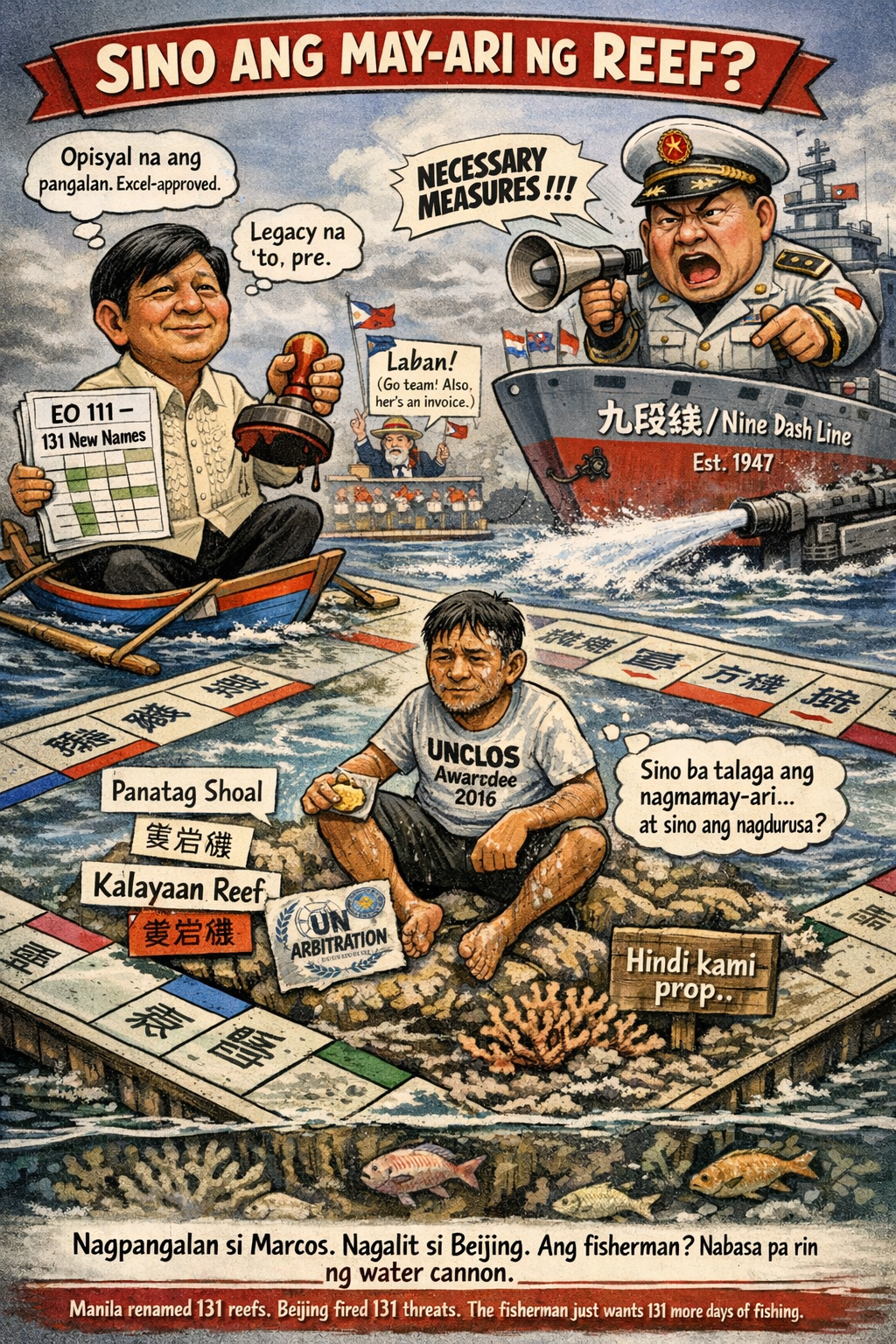
The roots of the Philippine-China territorial dispute run deep, entwined with centuries of historical claims, evolving international laws, and shifting geopolitical alliances. The Spratly Islands, a contested region in the South China Sea, have long been a flashpoint for tension between the two nations. The Philippines, backed by a 2016 arbitral ruling under the United Nations Convention on the Law of the Sea (UNCLOS), asserts its rights over parts of this region, including areas within its Exclusive Economic Zone (EEZ). China, however, claims historical sovereignty over the entire South China Sea, often justified by the so-called “nine-dash line” map, which has been widely disputed.
Tiglao’s commentary, steeped in an apparent pro-China bias, dismisses these historical complexities and instead focuses on a singular event: the recent collision between vessels from the Philippine Coast Guard (PCG) and the China Coast Guard (CCG). He accuses the PCG of deliberately provoking the incident to cast China as the bully—a narrative that is not only misleading but dangerously simplistic.
The Fallacies in Tiglao’s Assertions
- Ad Hominem Attacks: Tiglao’s critique relies heavily on ad hominem attacks, particularly against Commodore Jay Tarriela of the PCG and Jonathan Malaya of the National Security Council. By attacking their credibility rather than engaging with their arguments, Tiglao undermines the objectivity of his own analysis. This tactic distracts from the core issue and instead focuses on discrediting individuals based on perceived biases rather than on the merits of their statements.
- Straw Man Argument: Tiglao constructs a straw man by suggesting that the entire Philippine government is united in a conspiracy to provoke China, driven by orders from the U.S. Deep State. This exaggeration of the Philippine position ignores the diversity of views within the government and oversimplifies the complex dynamics at play. It’s a convenient narrative that serves to paint the Philippines as a mere pawn of the U.S., thus diverting attention from China’s actions.
- Appeal to Authority: Tiglao repeatedly references the CCG’s video footage as incontrovertible evidence of the PCG’s culpability. However, his reliance on this single source—one that is, unsurprisingly, produced by China—raises questions about the selective use of evidence. An appeal to authority, in this case, the Chinese government, fails to account for the broader context of the dispute and the possibility of manipulation or bias in the presented evidence.
- False Dilemma: By framing the incident as a binary choice between accepting China’s version of events or being complicit in anti-China propaganda, Tiglao presents a false dilemma. This ignores the reality that multiple perspectives can coexist, and the truth is often found in the gray areas between competing narratives.
The Importance of Evidence and Context
While Tiglao leans heavily on video footage from the CCG to support his claims, the reliability and interpretation of this evidence must be scrutinized. Video clips, particularly those released by state actors, can be edited or taken out of context to serve specific agendas. The absence of independent verification or corroborating evidence from neutral parties should prompt caution, not conviction.
Furthermore, Tiglao’s dismissal of the 2016 arbitral ruling as irrelevant to the current dispute is not only misleading but factually incorrect. While it is true that the ruling did not explicitly mention Sabina Shoal, it set important precedents regarding the Philippines’ rights within its EEZ, which are directly relevant to the ongoing tensions. By omitting this context, Tiglao’s narrative becomes skewed, conveniently aligning with China’s broader strategy to undermine the legitimacy of the arbitral ruling.
Geopolitical and Domestic Entanglements
Tiglao’s commentary is not just a critique of the PCG’s actions; it is a broader reflection of the geopolitical entanglements that color the South China Sea dispute. His alignment with a pro-China perspective can be seen as part of a larger narrative that seeks to delegitimize the Philippines’ claims and downplay the significance of U.S. involvement in the region. This narrative, however, fails to acknowledge the complexities of Philippine domestic politics, where different factions have varying views on how to handle relations with China.
By accusing the Marcos Jr. government of being a puppet of the U.S. Deep State, Tiglao ignores the nuanced and often conflicting positions within the Philippine leadership. While some officials advocate for a more assertive stance against China, others seek to balance this with diplomatic engagement—a strategy that reflects the Philippines’ precarious position between two global powers.
The Logical Implications and Consequences
If we were to accept Tiglao’s assertions at face value, the logical implications would be troubling. It would suggest that the Philippines is actively seeking to provoke a conflict with China, a move that would be both reckless and counterproductive given the significant power disparity between the two nations. It would also imply that the Philippine government is willing to jeopardize the safety of its own personnel to further a geopolitical agenda—a claim that lacks credible evidence and defies logic.
Moreover, Tiglao’s narrative conveniently shifts the blame for the collision away from China, ignoring the broader pattern of aggressive behavior by the CCG in the South China Sea. By focusing narrowly on this incident, he overlooks the numerous reports of harassment and intimidation faced by Filipino fishermen and the repeated incursions by Chinese vessels into Philippine waters.
Unbiased Assessment
When we objectively evaluate the situation, it becomes clear that Tiglao’s narrative is deeply flawed. His reliance on selective evidence, logical fallacies, and geopolitical bias undermines the credibility of his assertions. In contrast, the Philippine government, despite its imperfections, has a stronger case based on international law, particularly the 2016 arbitral ruling, and the consistent reports of Chinese aggression in the region.
Recommendations
For Tiglao and those who share his perspective, a more balanced approach is necessary. Engaging with the full spectrum of evidence, acknowledging the complexities of the dispute, and avoiding the pitfalls of logical fallacies would lead to a more credible and constructive discourse.
For the Philippine government, it is crucial to continue asserting its rights under international law while avoiding unnecessary provocations that could escalate tensions. At the same time, strengthening alliances with other nations in the region and beyond can help counterbalance China’s growing influence.
Conclusion
In the opaque waters of the South China Sea, where truth is often obscured by the fog of geopolitics, it is essential to navigate carefully. Rigoberto Tiglao’s commentary, while compelling to some, ultimately falls short of providing a truthful and balanced account of the recent collision between Philippine and Chinese vessels. By dissecting his assertions with the tools of logic, evidence, and context, we can see through the deception and better understand the complex dynamics at play in this critical region.

- ₱75 Million Heist: Cops Gone Full Bandit

- ₱6.7-Trillion Temptation: The Great Pork Zombie Revival and the “Collegial” Vote-Buying Circus

- ₱1.9 Billion for 382 Units and a Rooftop Pool: Poverty Solved, Next Problem Please

- ₱1.35 Trillion for Education: Bigger Budget, Same Old Thieves’ Banquet
- ₱1 Billion Congressional Seat? Sorry, Sold Out Na Raw — Si Bello Raw Ang Hindi Bumili

- “We Will Take Care of It”: Bersamin’s P52-Billion Love Letter to Corruption
- “Skewed Narrative”? More Like Skewered Taxpayers!

- “Scared to Sign Vouchers” Is Now Official GDP Policy – Welcome to the Philippines’ Permanent Paralysis Economy
- “Robbed by Restitution?” Curlee Discaya’s Tears Over Returning What He Never Earned
- “No Pressure” Luistro? The House Pork Bazaar Exposed

 KWEBA ni BAROK
Leave a comment