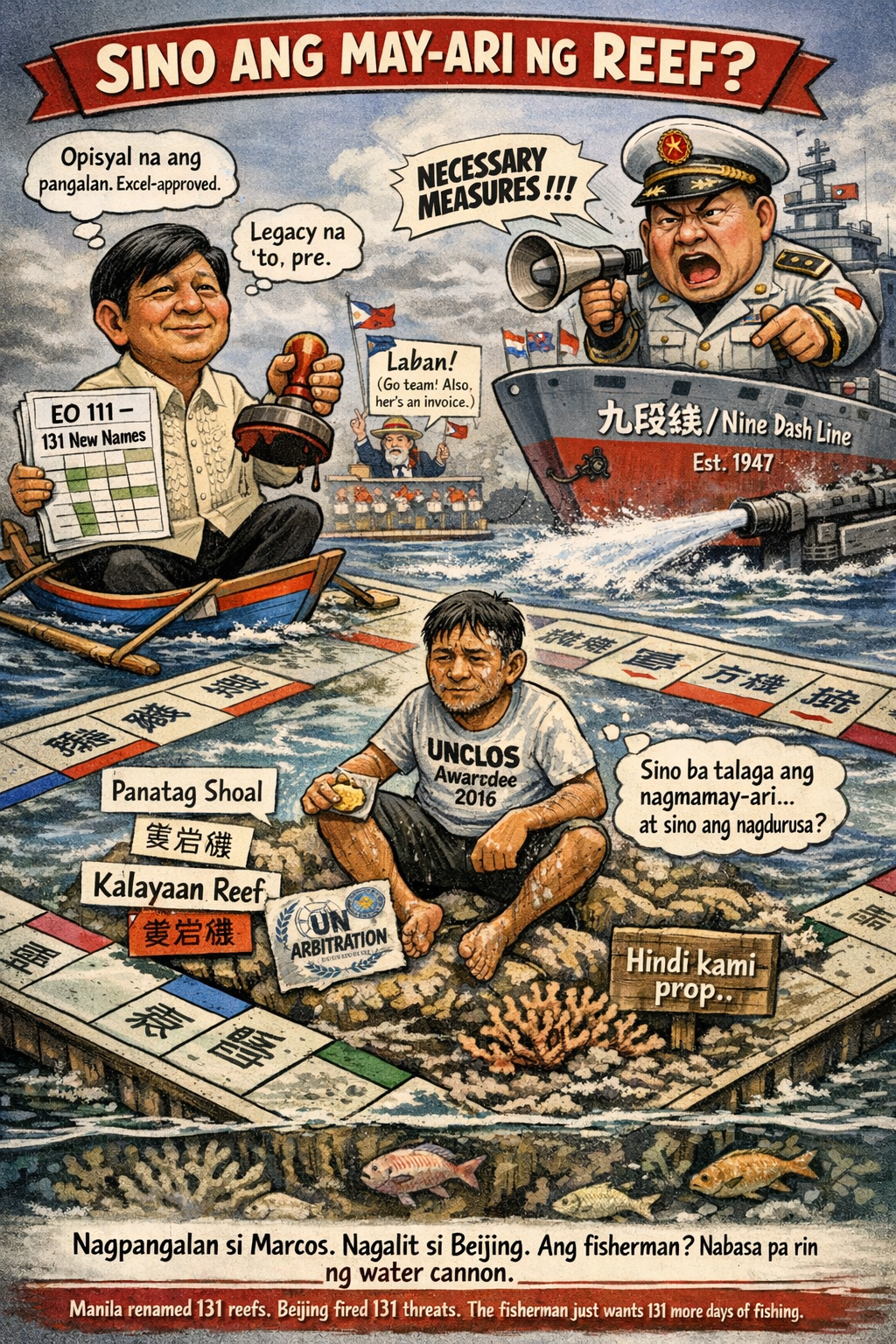
Manila’s soft assertion meets Beijing’s hard occupation – a masterclass in diplomatic theater that fools no one but the domestic crowd.
By Louis ‘Barok‘ C. Biraogo — April 4, 2026
LISTEN up, mga ka-kweba. While the rest of the world was busy with whatever April 2026 nonsense it was peddling, President Marcos Jr. dropped Executive Order No. 111 (or 57), quietly renaming 131 reefs, shoals, atolls, and sand spits in the Kalayaan Island Group.
Standard bureaucratic housekeeping, the National Maritime Council called it. Just tidying up the maps for “efficient administration and governance.”
Beijing’s response? The usual Mao Ning special: “This infringes on China’s sovereignty! We will take necessary measures!” Translation: We own the whole damn sea because our ancestors drew a dotted line on a map in 1947, and your little name swap is basically an act of war.
Welcome to the Theater of the Absurd, South China Sea edition. Names versus “measures.” Law on paper versus gunboats on water. Two governments treating the Spratlys like rival TikTok influencers fighting over who gets to caption the same reef. And the only people who actually pay are the Filipino fishermen getting water-cannoned, the Vietnamese and Malaysian crews getting rammed, the reefs turned into parking lots for Chinese dredgers, and the marine life that used to feed millions.
I’ve had enough of the posturing. Both sides. Let’s eviscerate this mess without mercy.
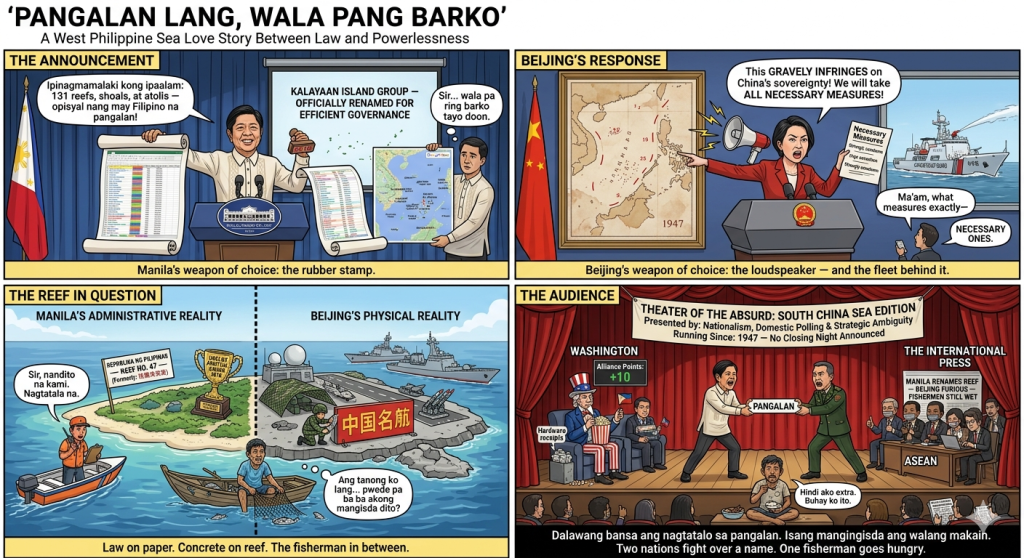
(How Do You Fight for a Reef With an Excel File Against a Coast Guard Fleet?)
Name Game Bullshit Exposed
Both sides weaponize victimhood like pros. Manila: “We’re the brave David fighting Goliath with UNCLOS!” Beijing: “We’re the humiliated giant reclaiming what’s ours after a century of shame!” Spare me. Nationalism is the cheapest applause line in both capitals.
Law vs. Power Farce
UNCLOS is clear. The 2016 arbitration is final, binding, and devastating for China’s historic-rights fairy tale. Features in the Spratlys are rocks or low-tide elevations. No EEZ. Philippine sovereign rights in its own EEZ are real. Renaming is, on paper, a domestic act.
China’s response? “UNCLOS doesn’t cover sovereignty!” Convenient, since they ratified the damn thing. They treat international law like an à la carte menu: take the EEZ when it benefits them in the East China Sea, reject it when it cramps their style here.
And Manila? Let’s not pretend perfection. The Philippines screams “rule of law” in the West Philippine Sea while its own indigenous peoples have fought decades for land rights under the IPRA law—rights that sometimes get steamrolled by mining or logging interests. Selective memory is a national sport on both sides of the sea.
The real gap? Law on paper versus power on the water. Beijing has built islands, installed missiles, and turned reefs into bases. Manila has… new Excel files. UNCLOS without enforcement is poetry. China knows this. So does the rest of the world.
Motives Laid Bare
Marcos Jr.: Needs to look tough after Duterte’s China-friendly pragmatism. Legacy play: “I stood up where my predecessor knelt.” Also useful for signaling to Washington that the alliance is alive and well. Domestic polls love sovereignty theater.
Beijing: Domestic legitimacy. Xi Jinping’s China cannot be seen losing face to a smaller neighbor. Gray-zone strategy 101: keep the pressure, normalize occupation, scare everyone else. Fear of precedent—if Manila’s naming sticks, Vietnam and Malaysia might get ideas.
Washington: Happy to cheer from the bleachers, sell missiles, run joint exercises, and let Filipinos take the first water-cannon blast. Principle? Sure. Self-interest dressed as principle? Obviously.
ASEAN (Vietnam, Malaysia, etc.): Quietly supportive of Manila’s legal high ground but terrified of economic retaliation. Grow a spine? Only when it doesn’t cost export dollars.
Everyone is playing for the crowd back home while the sea burns.
Options That Suck
Philippines options: Double down on names? Performative. Legal escalation? China will just ignore it. Alliance deepening with the us? Risky if Washington decides the treaty is “ambiguous” when the shooting starts. De-escalation? Politically toxic.
China options: Symbolic retaliation? Already doing it. Gray-zone harassment? Working too well. Economic coercion? Hurts everyone, including their own exporters. Negotiation? They prefer it on their terms.
US options: FONOPs and statements. Great optics, zero teeth when reefs are being paved.
Every “option” is either a headline grab or a slow-motion trap. Face-saving retreats are the only adult choices nobody wants.
Resolution Delusions
Code of Conduct? ASEAN-China talks have been “progressing” since the Mesozoic era. Pure lullaby.
Joint development? Delusion. Who gets the oil? Who controls security? Who writes the map?
Status quo entropy? Most likely. Slow bleeding of fishermen’s livelihoods, more reef destruction, occasional collisions.
The only real resolutions are ugly compromises: mutual restraint zones, third-party monitoring, binding incident protocols. Everything else is diplomatic Ambien.
Impacts Nobody Admits
Short-term: Headlines, chest-thumping, more viral videos of water cannons.
Medium-term: Mapping wars. More “renaming” by everyone. Alliances shift. Fishermen stay poor.
Long-term: Erosion of rule of law. Regional arms race. Trade disruption when someone finally miscalculates. Environmental catastrophe. And the human cost—widows in Palawan, orphaned reefs, poisoned fishing grounds—never makes the nightly news.
Soft Assertion Scam
This is the cruelest joke. “Soft assertion” is just a fancy term for name bombing while lacking the ships, planes, or political will to back it up. Manila renames a shoal. China parks a coast guard fleet on it. Who governs? The one with the gray hulls.
Contrast that with China’s hard occupation—dredgers, runways, missile batteries. One side is playing SimCity with maps. The other is playing Risk with concrete. Both are absurd. Neither is sustainable.
Enough With the Circus
This isn’t naive idealism. It’s the only sane path before the slow-motion escalation turns hot. Stop treating international law like a buffet. Stop using fishermen as props in your nationalist circus. The South China Sea is not a stage for legacy projects or domestic applause. It is home to real people trying to feed their families while you two play map Monopoly.
What They Should Actually Do
To the Philippines: Stop performative symbolism without capability. Invest in real maritime diplomacy, ASEAN unity, and coast-guard modernization—not just PowerPoint names. Talk to China quietly. The 2016 award is your shield, not a sword.
To China: Accept that bullying names off a map doesn’t erase legal reality or make you look strong. It makes you look scared. Historic rights are dead. Move on.
To the United States: Stop cheering from the sidelines while arming both deterrence and delusion. Push real de-escalation mechanisms instead of just selling hardware.
To ASEAN: Grow a collective spine. A united front is the only thing Beijing respects.
Enough. The reefs are dying. The fishermen are starving. The politicians are preening. Time to choose law, diplomacy, and shared prosperity over flags, names, and slow-motion tragedy.
The sea belongs to all of us—or to none. Let’s act like it.
— Louis “Barok” C. Biraogo
Kweba ni Barok
Key Citations
A. News Articles
- Agence France-Presse. “China threatens ‘measures’ vs. PH renaming Kalayaan features in West PH Sea.” GMA News Online, 2 Apr. 2026.
- Beech, Hannah. “South China Sea: Where Did China Get Its Nine-Dash Line?” TIME, 18 July 2016.
B. Official Documents and Awards
- Permanent Court of Arbitration. “South China Sea Arbitration.” PCA Case No. 2013-19.
- United Nations. United Nations Convention on the Law of the Sea.
- Philippines. Republic Act No. 8371: An Act to Recognize, Protect and Promote the Rights of Indigenous Cultural Communities/Indigenous Peoples, Creating a National Commission on Indigenous Peoples, Establishing Implementing Mechanisms, Appropriating Funds Therefor, and for Other Purposes. 29 Oct. 1997, Official Gazette.
C. Regional Agreements
- “Ang Hirap Maging Mahirap”: The PAO Scandal That Proves Government Contempt Is Nothing New

- “Far-Off” My Axx: Malacañang’s Claire Castro Drowns in Her Own Legal Gaslighting
- “Forthwith” to Farce: How the Senate is Killing Impeachment—And Why Enrile’s Right (Even If You Can’t Trust Him)

- “HINDI AKO NAG-RESIGN!”

- “I Know Nothing”: Baste Duterte’s Amnesia Defense Meets ₱33M in GenCorp Contracts

- “I’m calling you from my new Globe SIM. Send load!”

- “Mahiya Naman Kayo!” Marcos’ Anti-Corruption Vow Faces a Flood of Doubt

- “Manageable” Debt, Unmanageable Lies: DBM’s ₱21 Trillion Fairy Tale
- “Meow, I’m calling you from my new Globe SIM!”

- “Natrabaho”: One Word, One Ombudsman, and a Judiciary on Trial

- “No Special Jail for Crooks!” Boying Remulla Slams VIP Perks for Flood Scammers

- “Philippine-Controlled” or Yankee Gas Station? The Davao Fuel Depot Farce Exposed







Leave a Reply