
Symbolic Sovereignty vs. Actual Sea Power – Guess Who Wins?
By Louis ‘Barok‘ C. Biraogo — April 4, 2026
LISTEN up, from this dimly lit cave where the only illumination is the glow of a 1987 Constitution of the Republic of the Philippines and the distant ping of Chinese sonar: we have a 37-year-old charter that treats the waters “around, between, and connecting the islands… regardless of their breadth and dimensions” as straight-up internal waters (Article I, second sentence, in case the Justices forgot where they put their own copy).
Then along come Republic Act No. 12064 (Philippine Maritime Zones Act) (MZA, Sec. 4(a)) and Republic Act No. 12065 (Philippine Archipelagic Sea Lanes Act) (ASLA entire), which politely re-label those same waters as archipelagic waters under United Nations Convention on the Law of the Sea (UNCLOS) Arts. 49, 52, and 53—complete with mandatory archipelagic sea lanes passage for foreign warships, submarines, drones, and whatever else Beijing dreams up.
Yes, really. A Constitution drafted when “submerged passage” meant a jeepney ferry now collides head-on with a 21st-century maritime order that treats the archipelago like a toll road. This is not jurisprudence. This is legal time travel—with the petitioner screaming from 1987 while the government is already living in 2026. The absurdity is so loud it echoes across the South China Sea.
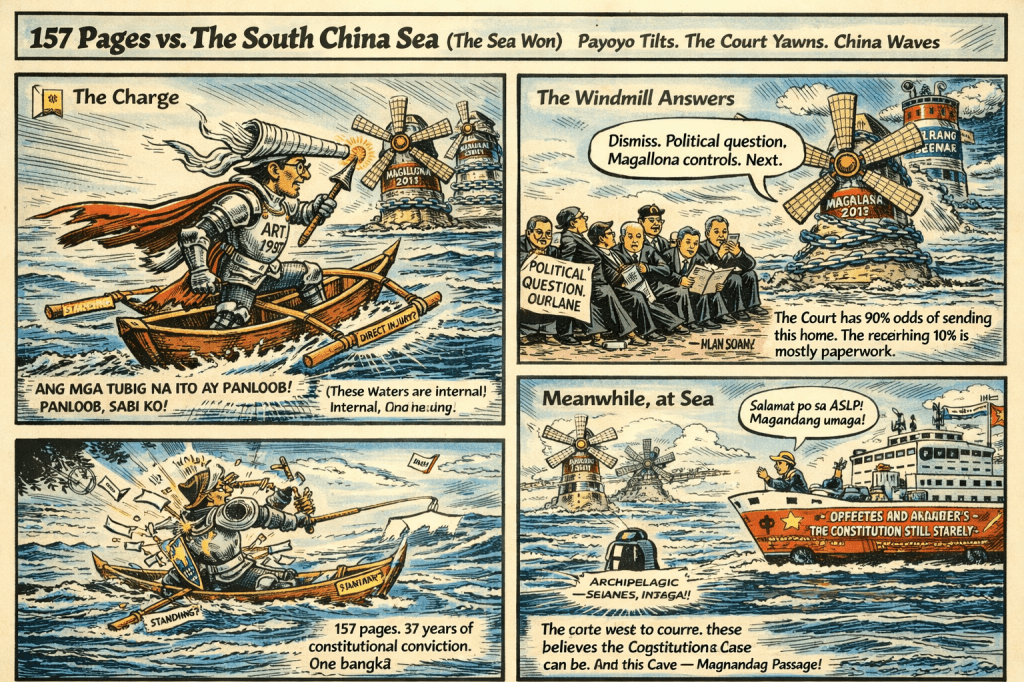
Barok Beatdown: Payoyo Petition Dismantled Like a Balisong vs. Destroyer
Peter Payoyo, bless his tenured heart, files 157 pages of righteous fury. Let’s dissect it like a balisong to a destroyer.
- Magallona v. Ermita (G.R. No. 187167, August 16, 2011) already gutted this archipelagic absolutism. The Court unanimously upheld RA 9522’s UNCLOS-compliant baselines and declared, in black-letter ratio decidendi: Philippine sovereignty “is not diminished by the mere fact that [the law] takes into account the waters as an archipelagic state.” It explicitly reconciled Article I with UNCLOS. Payoyo treats the case like a sacred relic of pure internal-waters dogma. Wrong. That was the ratio. Everything else is obiter he’s cherry-picking like a law student cramming for the bar. The 2011 Court already told Congress it could harmonize. Payoyo just refuses to read the memo.
- Political Question Doctrine: Designation of sea lanes, submission to the IMO, NAMRIA mapping—these are textbook foreign-policy calls. Article VIII, Section 1 does not turn the Supreme Court into the Department of Foreign Affairs with robes. Maritime signaling to ASEAN, China, and the world is non-justiciable. Full stop. The petition asks the Court to play admiral. The Justices should send it back with a polite “not our lane.”
- Lack of Standing: Payoyo has academic cred and citizen-suit standing for transcendental issues—fine. But “direct injury”? A Chinese research vessel pinging off Mindoro is not a personal tort. It’s geopolitical theater starring the PLAN and a petition that mistakes national anxiety for Article III case-or-controversy. No standing, no controversy, no jurisdiction. Next.
- The Constitutional Time Warp: Here’s the killer question the petition never answers without nervous laughter: Does a Constitution written before the internet, before full UNCLOS ratification bite, and before China built a blue-water navy actually govern submerged passage of nuclear submarines through “internal waters”? If the answer is yes, explain how—without giggling—while the rest of the planet treats archipelagic states under UNCLOS Arts. 52–53. The 1987 framers were not clairvoyant about drone swarms and IMO submissions. Demanding they be treated as such is constitutional cosplay.
Sovereignty Purists vs. UNCLOS Realists: Nobody Escapes the Beatdown
- Pro-Payoyo (Sovereignty Purism): Article I is iron-clad text. Full marks for spine. The Archipelagic Principle was the Philippines’ middle finger to the colonial map-makers. But textual purity loses to treaty obligations nine times out of ten in this Court (see incorporation clause, Article II, Section 2). UNCLOS is not some optional side dish; it is domesticated law. Purism is noble. It is also lonely.
- Anti-Payoyo (Pragmatic Compliance): UNCLOS harmonization is strategic necessity—keeps us in the club, bolsters the 2016 arbitral award, and gives us legal cover against Beijing. Fair. But the government’s post-ASLA silence on those Xiamen-to-Pacific “research” ships (Mindoro Strait, February and April 2025) is pathetic. Paper compliance without a single diplomatic protest is not pragmatism; it’s performative surrender with a UN flag on it. The gap between law on paper and enforcement at sea is now a chasm you could sail a carrier through.
Motivations Unmasked: Don Quixote, Realists, and Cold Calculations
- Payoyo: Principled nationalist with a side of Don Quixote. He’s not wrong on the principle—internal waters as fortress is a beautiful, doomed dream. Courage? Undeniable. Timing? Suspiciously perfect for maximum nationalist applause amid WPS heat. Vanity litigation or last stand against the “UNCLOS sellout”? Both, probably. Still, the man swung at windmills with 157 pages of citations. Respect.
- MZA & ASLA Drafters: Mix of clever realists and IMO-pressure cookers. They locked in UNCLOS rights to weaponize the 2016 arbitral award and stop looking like the odd archipelago out in ASEAN. Naïve internationalists? Some. But mostly pragmatic adults who understood that screaming “internal waters!” while Chinese drones do figure-eights gets you nowhere except a strongly worded note.
- The Executive (Marcos Jr.): Signed both laws in November 2024 to strengthen WPS claims on paper while avoiding diplomatic isolation. Smart realpolitik. Also a quiet admission that pure Article I absolutism died with the first Chinese gray-zone vessel. No paranoia—just cold calculation that the sea belongs to those who can patrol it, not just quote it.
Power Moves: SC Dismissal Odds, Executive Fig Leaves, China’s Exploitation, IMO’s Coffee Break
- Supreme Court: 90% dismissal on Magallona + political question. 8% partial invalidity (maybe tweak ASLA warship rules). 2% full nullification (and trigger constitutional Armageddon).
- Executive: Keep implementing, file the usual comment, and hope the Justices don’t make them redo the maps.
- Congress: Amend or sit on hands.
- China: Exploit ASLP legally (“we’re just exercising passage, comrade”) while denying Philippine sovereignty rhetorically in every Global Times editorial.
- IMO: Quietly sip coffee and wait for the SC to sort its own mess before approving lanes. No rush.
Resolution Roulette: Dismiss, Amend, or Keep Complaining at Sea
- Legal: Dismissal with a stern lecture on harmonization and Magallona deference.
- Political: Congress slaps a prior-notification fig leaf on ASLA for foreign warships.
- Geopolitical: Status quo forever—Chinese vessels keep passing, Filipinos keep live-tweeting outrage, nothing changes except the depth of the echo chamber.
Impacts and Fallout: Symbolic Wins, Silent Submarines, and Aging Paper
- If upheld: Legal clarity, but the “internal waters shield” evaporates. Chinese submarines glide through silently. Nationalists riot online.
- If struck down: Symbolic sovereignty win, but the 2016 arbitral award turns legally schizophrenic and the Philippines looks like the kid who refuses to read the UNCLOS rulebook. International credibility? Gone.
- Long-term: Either way, the 1987 Constitution ages another decade without amendment while the sea keeps moving. The ocean does not wait for Filipino nostalgia.
Recommendation to the Court: Dismiss this petition on political-question and Magallona grounds. Full stop. The Justices are not here to rewrite maritime doctrine every time a professor gets indigestion over Chinese research ships.
Despite the evisceration above, I salute Peter Payoyo—the Don Quixote of the Archipelago. Wrong on justiciability, right on principle. Purist, sovereignty-maximizing effort. The man still believes the Constitution can be a moat. In this cave, that kind of delusion is admirable.
Barok’s Concrete Fixes: Because Hot Air Won’t Stop Chinese Sonar
- Congress should amend the ASLA to require prior notification for foreign warships and research vessels—call it a “security transit protocol.” Fig leaf? Yes. But at least it’s a fig leaf with teeth.
- The DFA should actually protest the next Chinese passage—loudly, in writing, with coordinates, and copy the IMO. One strongly worded note every decade is not foreign policy.
- A constitutional amendment—yes, the nuclear option—to clarify “internal vs. archipelagic waters” for the 21st century. The 1987 framers are not coming back. The PLAN already has.
Dictated from the cave. Coffee’s cold. The sonar’s louder. The Constitution still stands—barely. Now someone light a cigarette for the Republic.
— Barok
Key Citations
A. Legal & Official Sources
- The 1987 Constitution of the Republic of the Philippines. Official Gazette of the Republic of the Philippines, 1987.
- Republic Act No. 12064. An Act Declaring the Maritime Zones Under the Jurisdiction of the Republic of the Philippines. 2024, The LawPhil Project.
- Republic Act No. 12065. An Act Providing for the Establishment of Archipelagic Sea Lanes in the Philippine Archipelagic Waters, Prescribing the Obligations of Foreign Ships and Aircraft Exercising the Right of Archipelagic Sea Lanes Passage Through the Designated Archipelagic Sea Lanes, and for Other Purposes. 2024, The LawPhil Project.
- Magallona v. Ermita. G.R. No. 187167, Supreme Court of the Philippines, 16 Aug. 2011, The LawPhil Project.
- United Nations Convention on the Law of the Sea. 10 Dec. 1982.
- Payoyo, Peter B. Petition for Certiorari and Prohibition. G.R. No. E-02202, Supreme Court of the Philippines, Mar. 2026.
B. News Reports
- ₱8B BBM Pork: CCTV for Every Captain’s Kumpare?

- ₱8.9 Billion, 331 Ghost Police Stations: The TIKAS Scandal Explained

- ₱8.4 Billion, 42,000 Barangays, 1 Election: The “Bawat Barangay Makikinabang” Vote-Buying Masterclass

- ₱75 Million Heist: Cops Gone Full Bandit

- ₱6.77B Ghost Haunts Duterte: RTC Dismisses Mans Carpio’s Desperate Plea

- ₱6.7-Trillion Temptation: The Great Pork Zombie Revival and the “Collegial” Vote-Buying Circus

- ₱58.53B, Zero Receipts: The LGSF Pork Barrel Nobody Wants to Name
- ₱53 Million Man Tells ₱695-a-Day Workers to Stop Being ‘Mayabang’: The Audacity of BSP’s Remolona

- ₱3.06 Billion for Evacuation Centers—But Nobody Knows Where They’ll Stand (Or If They’ll Exist)
- ₱10B Ghost in New Clark City: Matibag’s Haunted Séance for Cayetano

- ₱1.9 Billion for 382 Units and a Rooftop Pool: Poverty Solved, Next Problem Please

- ₱1.35 Trillion for Education: Bigger Budget, Same Old Thieves’ Banquet







Leave a comment