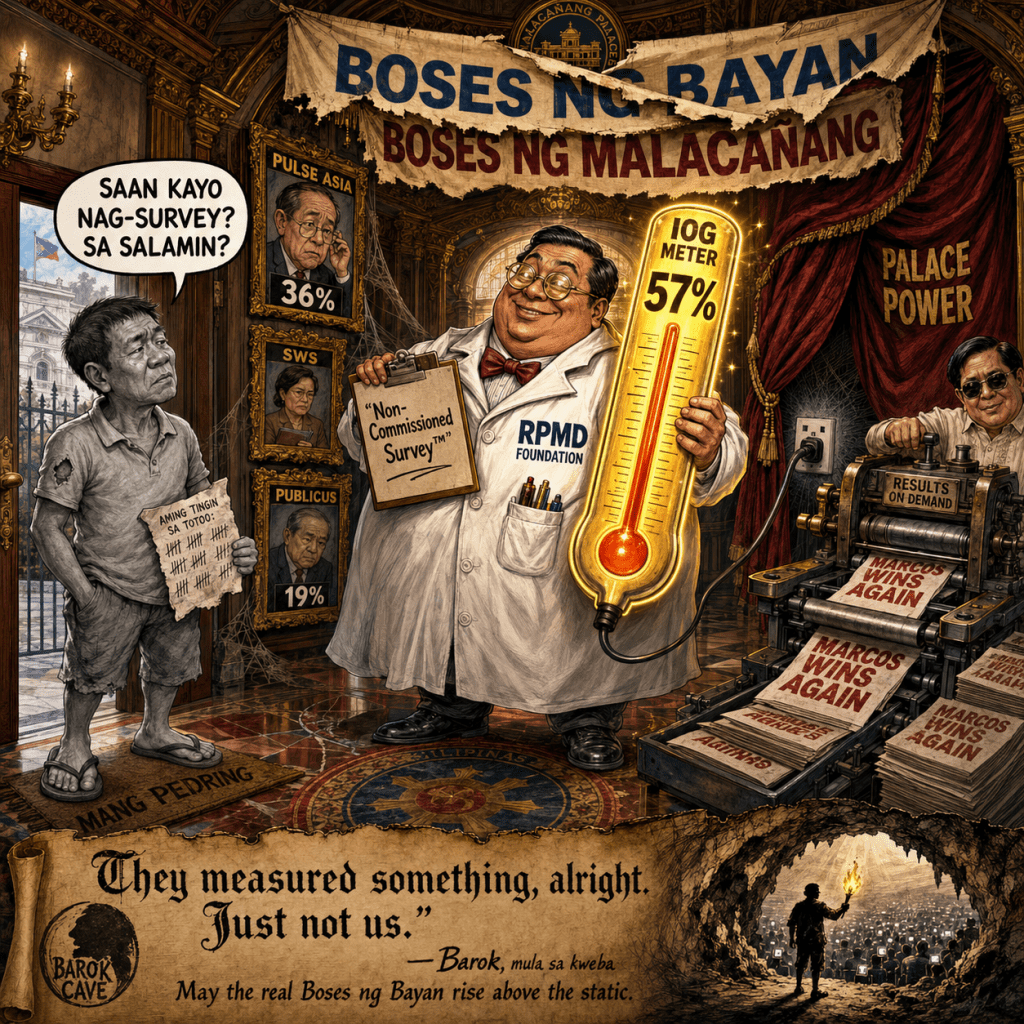
Why This “Boses ng Bayan” Is Actually Just Boses ng Malacañang
By Louis “Barok” C. Biraogo — May 18, 2026
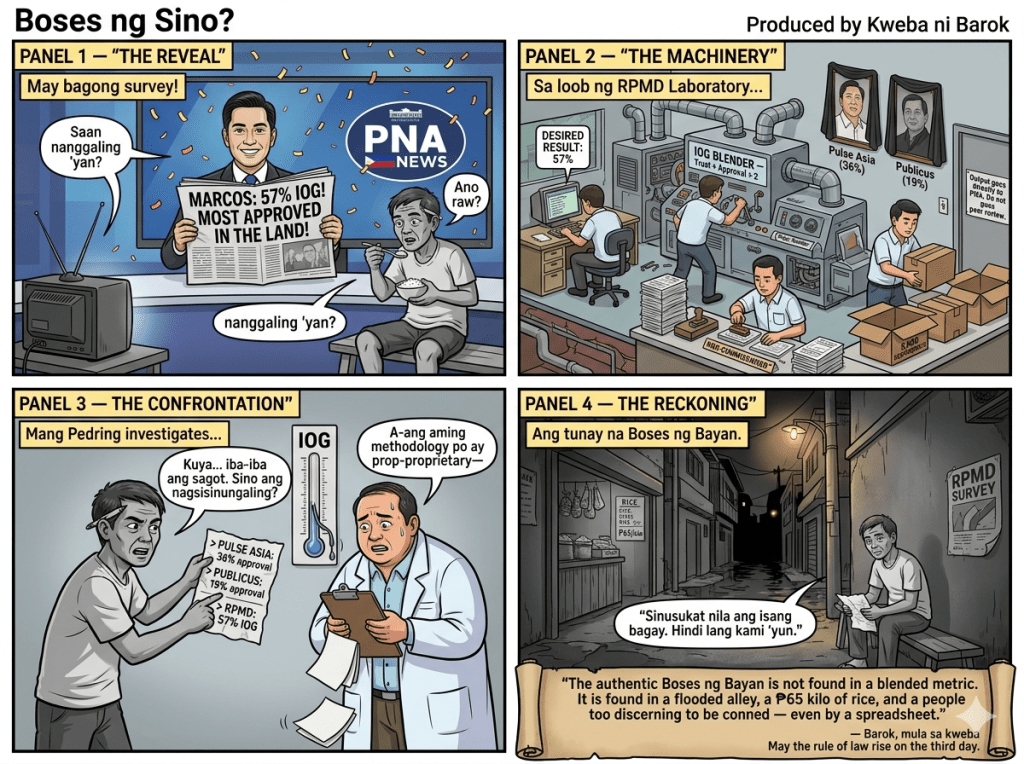
LET us begin with the obvious question that the Philippine News Agency—that faithful stenographer of power—chose not to ask: Who, exactly, is RPMD Foundation Inc., and why do its numbers always, always, always make Ferdinand Marcos Jr. look like the second coming of Ramon Magsaysay?
The “Boses ng Bayan” survey, conducted April 1 to 8, 2026, presents us with a comforting fairy tale. In this enchanted kingdom, President Marcos enjoys a 57 percent Index of Governance (IOG) score, buoyed by 56 percent trust and 58 percent approval.
The margin of error is a tidy ±1 percent. The sample size is an impressive 5,000 respondents. Everything gleams with the veneer of statistical respectability—until you hold it up to the light and watch the cracks spiderweb across the surface.
I. The Phantom Pollster: A Genealogy of Convenience
The RP-Mission and Development Foundation is not Pulse Asia. It is not Social Weather Stations. It is not even Publicus Asia, which, for all its methodological quirks, at least publishes detailed technical documentation.
RPMD occupies that twilight zone of Philippine survey research where “foundation” serves as a euphemism for “political messaging apparatus with a veneer of academic legitimacy.”
Observe the pattern. In 2023, RPMD’s “Boses ng Bayan” showed Marcos at 80 percent performance and Sara Duterte at 78 percent—a convenient double-boost for the then-intact UniTeam. In early 2024, both topped the charts again. By September 2025, with the Marcos-Duterte alliance in shambles, RPMD still showed Marcos at a robust 71 percent IOG.
Now, with impeachment proceedings against Vice President Duterte reaching their crescendo, RPMD once again materializes like clockwork to certify that the President remains beloved, resilient, and—crucially—democratically vindicated.
This is not a polling firm. This is a narrative maintenance operation.
The survey is described as “non-commissioned”—a phrase that, in the Philippine context, carries roughly the same evidentiary weight as a politician’s claim to have “no ambitions” for higher office. Who funded the fieldwork? Who paid the enumerators? Who financed the data processing? RPMD does not say. The PNA does not ask.
And so we are left to take on faith that a survey conveniently favorable to the administration, released through a state-run wire service, timed to coincide with impeachment proceedings, is simply a disinterested act of public scholarship.
Forgive me if I do not genuflect before this altar of coincidence.
II. The Canyon Between RPMD and Reality
Here is where the numbers become not merely suspect but laughable.
Consider the data landscape in which this survey drops. Pulse Asia’s Q1 2026 survey—conducted just weeks before RPMD’s fieldwork, with 1,200 face-to-face interviews and fully disclosed methodology—found that 44 percent of Filipinos distrusted Marcos, while only 35 percent trusted him.
His disapproval rating stood at 45 percent versus 36 percent approval. Publicus Asia’s Pahayag Q1-2026 survey was even more brutal: 19 percent approval and 13 percent trust.
The gap between RPMD’s 57 percent IOG and Pulse Asia’s 36 percent approval is not a methodological quirk. It is a chasm. It is the difference between saying a man is slightly overweight and saying he requires a forklift to leave his bedroom.
Twenty-one percentage points do not evaporate because of different sampling frames or questionnaire wording. They indicate that someone is either catastrophically wrong or deliberately lying.
And here is the diagnostic clue: RPMD’s errors always, exclusively, unidirectionally favor the Marcos administration. Never once has RPMD published a survey showing the President with numbers worse than the industry average.
This is not the behavior of a polling firm. This is the behavior of a press release.
III. The IOG Shell Game
Let us examine RPMD’s methodological innovation: the Index of Governance, or IOG. This proprietary metric combines trust and approval scores and divides them equally to produce a single blended number. It is, to put it charitably, a creative exercise in data obfuscation.
Why average trust and approval? Because it allows RPMD to present a single, higher-looking headline number that is impossible to compare directly with any other pollster’s output. Pulse Asia reports trust and approval separately. SWS uses net trust ratings. Publicus has its own framework.
RPMD’s IOG exists in a methodological vacuum, immunized against apples-to-apples scrutiny.
More importantly, the IOG conceals internal contradictions that would otherwise be analytically devastating. Sara Duterte, for instance, registered 57 percent trust but only 51 percent approval in the same survey. Under standard reporting, this six-point gap would be a story: “Duterte trusted but not approved.”
RPMD’s blended IOG buries that nuance beneath a tidy 54 percent number. The metric serves not clarity but concealment.
This is not survey research. This is public relations with a spreadsheet.
IV. The Timing Is Everything
The survey was conducted April 1 to 8, 2026. The House of Representatives, dominated by Marcos allies, had already voted overwhelmingly—257 of 318 members—to impeach Vice President Sara Duterte for the second time.
Charges included misuse of confidential funds, unexplained wealth exceeding $110 million flagged by the Anti-Money Laundering Council, and threats against the President, First Lady, and former Speaker.
Into this volatile moment drops RPMD with a survey certifying that the President remains the “most approved” official in the land. The subtext is unmistakable: the impeachment is not an act of political aggression but a reflection of the popular will.
The people, we are told, stand with Marcos. The numbers prove it. Never mind that three other independent pollsters show a deeply divided, skeptical, and disapproving public. RPMD has spoken, and PNA has amplified.
This is the classic two-step of authoritarian communication: manufacture the evidence, then cite the evidence as proof. The survey justifies the impeachment; the impeachment validates the survey.
The circular logic is impenetrable to those inside the information loop and invisible to those too busy surviving inflation to cross-reference polling methodologies.
V. The Cabinet Ratings: A Comedy of Statistical Incontinence
And then we arrive at the Cabinet ratings, which deserve their own special place in the museum of propaganda artifacts.
Public Works Secretary Vince Dizon: 80 percent IOG. Let that sink in. The Department of Public Works and Highways—ground zero for the Zaldy Co ghost infrastructure scandal, the agency where an undersecretary apparently died under circumstances still unexplained, the department that has become synonymous with flood control projects that do not control floods—earns its chief an 80 percent governance rating.
I invite you to conduct your own survey. Visit Bulacan. Walk through neighborhoods where residents are still bailing silt out of their living rooms. Ask them about the DPWH. Ask them about Vince Dizon. Then come back and tell me with a straight face that 80 percent of Filipinos approve of his governance.
Social Welfare Secretary Rex Gatchalian at 87 percent is at least explainable: DSWD distributes cash, and cash recipients express gratitude. This is not governance; this is transaction.
But Dizon at 80 percent, Jonvic Remulla at DILG with 82 percent despite his central role in enforcement actions against Duterte allies—these numbers strain credulity past its breaking point.
And note the clever distribution: economic managers Frederick Go (54 percent) and Arsenio Balisacan (52.5 percent) receive lower scores, providing a patina of internal differentiation. A propaganda exercise sophisticated enough to include some “losers” is harder to dismiss as pure fabrication.
But the overall architecture remains unmistakable: the administration’s service-delivery and political-enforcement arms are celebrated; its economic managers, who preside over inflation and hardship that cannot be spun, are allowed to absorb some dissatisfaction. This is not data. This is dramaturgy.
VI. The Mindanao Mirage
Perhaps the most politically significant claim in RPMD’s survey is that Marcos is “gaining ground in Mindanao,” a region traditionally considered a Duterte stronghold. This assertion is central to the administration’s narrative that the impeachment of Sara Duterte and the ICC arrest of Rodrigo Duterte have not provoked a regional backlash.
Pulse Asia’s Q1 2026 survey tells a radically different story. It found that distrust of Marcos among Mindanawons stood at 77 percent—more than three-quarters of the population. Trust was negligible.
These are not the numbers of a President “gaining ground.” These are the numbers of a President viewed as an occupying force.
How does RPMD reconcile its Mindanao findings with Pulse Asia’s? It doesn’t. It simply asserts its version and relies on PNA to broadcast it without critical interrogation. The state wire service, true to form, obliges.
And so a fiction—Marcos making inroads in Duterte country—enters the public record, to be cited by Palace spokespersons and social media operatives as established fact.
VII. What the Survey Actually Reveals
Strip away the IOG obfuscation, the non-commissioned pretense, the PNA amplification, and the impeachment-convenient timing, and what remains is a document that inadvertently reveals the administration’s deepest anxieties.
The Marcos government is not surveying the public; it is projecting an image of public support that independent evidence does not corroborate. It is not measuring opinion; it is attempting to manufacture it.
The survey is not a window into Filipino political sentiment but a mirror of Malacañang’s desired self-image—a President beloved, a Vice President fading, a nation coalescing around stability.
The reality, as Pulse Asia, Social Weather Stations (SWS), and Publicus consistently demonstrate, is far messier.
The Filipino public is deeply divided, economically anxious, and unconvinced by either the Marcos administration’s performance or the Duterte camp’s defiance.
Trust in institutions is fragmenting. Approval is conditional, soft, and easily reversed. The electorate is not rallying to Marcos; it is waiting, watching, and surviving.
VIII. The Propaganda Function
Let us be precise about what this survey accomplishes in the information ecosystem:
- First, it provides a counter-narrative to independent polls. When journalists cite Pulse Asia’s 36 percent approval, Palace communications can counter with RPMD’s 57 percent IOG. The contradiction itself creates confusion, and in confusion, propaganda thrives.
- Second, it furnishes “democratic” cover for the impeachment proceedings. The House can claim it is acting on the people’s will, as certified by a “nationwide survey.”
- Third, it demoralizes the opposition by suggesting that despite impeachment, despite the ICC, despite economic hardship, the President remains popular—and resistance is therefore futile.
- Fourth, it creates a bandwagon effect: undecided voters, local politicians, and business elites, seeing “momentum” toward Marcos, may calculate that alignment is safer than opposition.
This is not polling. This is psychological operations conducted through the medium of statistical language.
IX. A Call for Transparency
The RPMD Foundation must answer basic questions that any credible polling organization would answer as a matter of course:
- Who funds your operations? Disclose all donors, sponsors, and financial backers for the past five years.
- Who commissioned this survey? If it was truly “non-commissioned,” explain how the fieldwork, which for 5,000 respondents nationwide costs millions of pesos, was financed.
- Publish the full methodology. Release the sampling frame, the questionnaire wording in all languages used, the enumerator training protocols, the refusal and replacement rates, the raw regional and demographic cross-tabulations, and the weighting procedures.
- Explain the IOG metric. Why was it developed? What peer review has it undergone? Why does it diverge so consistently from standard trust and approval measures?
- Disclose your principals. Who sits on the RPMD board? What are their political affiliations, past and present? What relationships do they maintain with administration officials?
Until these questions are answered, the “Boses ng Bayan” survey deserves to be treated not as social science but as political communication—and not particularly sophisticated political communication at that.
X. To the Filipino Public
My countrymen: You are being managed.
The coordinated release of administration-favorable surveys through state media is not an accident. It is a strategy—one refined over decades by governments that understand that in the age of information saturation, perception often precedes reality, and a lie repeated frequently enough acquires the weight of truth.
When you encounter a survey showing the President at 57 percent governance approval, ask yourself: Does this reflect the Philippines I live in? The Philippines where electricity costs devour wages, where floodwaters rise annually, where the West Philippine Sea shrinks by the month, where confidential funds vanish into auditing black holes, where an impeachment process consumes the nation’s attention while rice prices climb?
If the answer is no, trust that intuition. You are not mistaken. The survey is.
Exercise the critical thinking that the framers of our democracy assumed would always accompany the right of suffrage. Cross-reference. Demand sources. Reject the passive consumption of prepackaged narratives.
The authentic “boses ng bayan”—the true voice of the people—is not found in any single survey, least of all one amplified by the Presidential Communications Office through its wire service. It is found in the aggregate of independent evidence, in the texture of lived experience, in the stubborn refusal to be told what to think.
XI. Recommendations
For media organizations: Treat RPMD surveys with the skepticism appropriate to an entity that refuses to disclose its funding, methodology, or principals. Always report RPMD numbers alongside Pulse Asia, SWS, and Publicus data. The story is not the numbers; the story is the discrepancy.
For civil society: Demand the establishment of an independent survey standards body with the authority to audit polling firms, require methodological transparency, and sanction entities that function as political propaganda operations under the guise of research.
For the Commission on Elections: The proliferation of partisan polling firms filling the information space with favorable data during election cycles represents a structural threat to democratic integrity. COMELEC must develop regulatory frameworks for survey publication and amplification.
For the diplomatic community: When international partners cite public opinion data on Philippine governance, ensure that sources are triangulated. An RPMD number cited without its Pulse Asia counterpart is not information; it is disinformation.
For the Marcos administration: If your governance is genuinely popular, the data will converge. You will not need RPMD. You will not need PNA. You will not need the “non-commissioned” pretense. You will have Pulse Asia, SWS, and Publicus confirming your mandate.
The fact that you rely on a friendly pollster to manufacture what independent pollsters cannot confirm is, in itself, the most damning indictment of your standing.
Epilogue: The Philippines RPMD Cannot See
There is a Philippines beyond the survey samples, beyond the carefully weighted demographics, beyond the proprietary metrics.
It is the Philippines of the jeepney driver calculating whether a day’s boundary will cover his family’s meals. It is the Philippines of the teacher spending her own salary on classroom supplies. It is the Philippines of the farmer watching Chinese vessels on the horizon and wondering why the Coast Guard seems always too late.
It is the Philippines of flood victims who have heard promises about infrastructure for a decade and seen only silt. It is the Philippines of young people scrolling through political chaos on their phones, trying to decide whether any of these warring elites deserve their faith.
That Philippines does not fit neatly into an IOG score. It cannot be captured by a blended metric that averages trust and approval and calls the result governance. It is messy, contradictory, skeptical, resilient, and far more discerning than the political class gives it credit for.
Mang Pedring—my everyman, my moral compass, my reminder that politics must ultimately answer to the lived experience of ordinary Filipinos—looked at this survey and said: “They are measuring something. But it is not us.”
He is right. RPMD is measuring the administration’s wishful thinking and presenting it as public opinion. The rest of us are under no obligation to accept the substitution.
Let our judgments be guided not by manipulation or fleeting trends, but by what is right, just, and best for the nation and its people. The real “boses ng bayan” speaks not through a single survey but through the accumulated evidence of independent inquiry, the testimony of lived experience, and the stubborn refusal of a free people to be conditioned, controlled, or conned.
That voice, I submit, is saying something quite different from what RPMD would have you believe.
— Barok
Key Citations
A. Reports & Studies
- Pulse Asia Research, Inc. “1st Quarter 2026 Nationwide Survey on Reasons for Trusting or Distrusting the President and the Vice-President.” Pulse Asia, 16 Mar. 2026.
- Publicus Asia, Inc. “Pahayag 2026 First Quarter Executive Summary.” Publicus Asia, Apr. 2026.
- Social Weather Stations. SWS Website.
B. News Articles
C. Encyclopedic Sources
- Wikipedia Contributors. “Second Impeachment of Sara Duterte.” Wikipedia, The Free Encyclopedia, 17 May 2026.
- “Ang Hirap Maging Mahirap”: The PAO Scandal That Proves Government Contempt Is Nothing New

- “Far-Off” My Axx: Malacañang’s Claire Castro Drowns in Her Own Legal Gaslighting
- “Forthwith” to Farce: How the Senate is Killing Impeachment—And Why Enrile’s Right (Even If You Can’t Trust Him)

- “HINDI AKO NAG-RESIGN!”

- “I Know Nothing”: Baste Duterte’s Amnesia Defense Meets ₱33M in GenCorp Contracts

- “I’m calling you from my new Globe SIM. Send load!”

- “Mahiya Naman Kayo!” Marcos’ Anti-Corruption Vow Faces a Flood of Doubt

- “Manageable” Debt, Unmanageable Lies: DBM’s ₱21 Trillion Fairy Tale

- “Meow, I’m calling you from my new Globe SIM!”

- “Natrabaho”: One Word, One Ombudsman, and a Judiciary on Trial

- “No Special Jail for Crooks!” Boying Remulla Slams VIP Perks for Flood Scammers

- “Philippine-Controlled” or Yankee Gas Station? The Davao Fuel Depot Farce Exposed









Leave a Reply