
Fugitive Senator’s Great Escape Backfires as OSG Drops Constitutional Hammer
By Louis ‘Barok‘ C. Biraogo – May 18, 2026
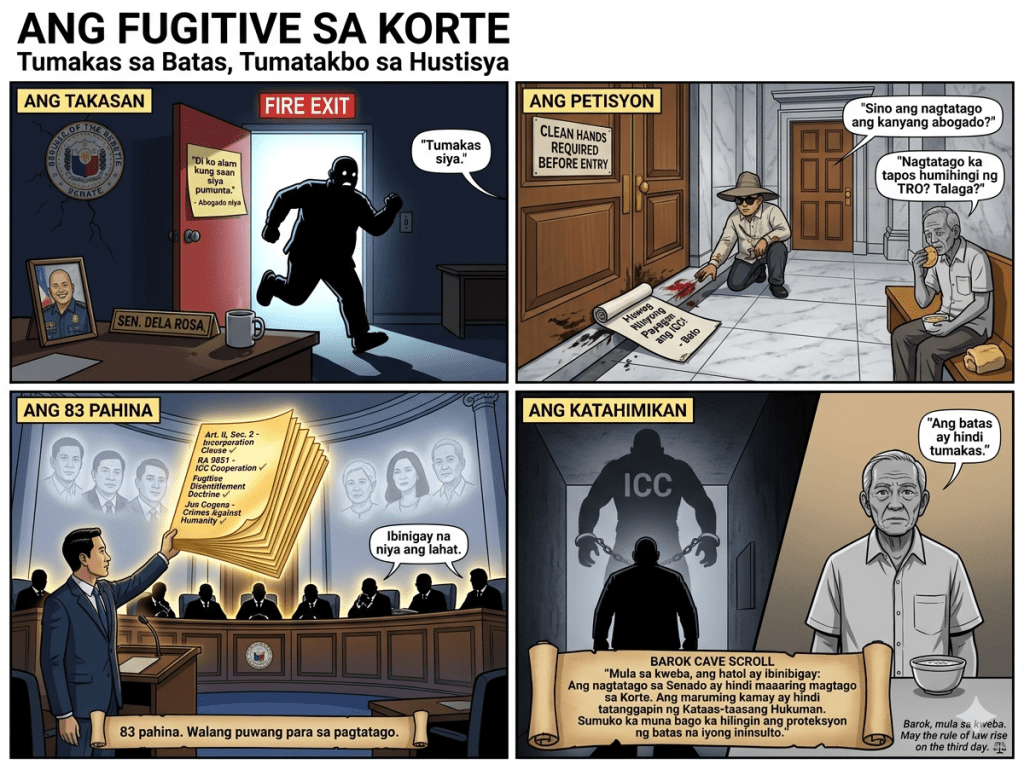
FROM the dim glow of the cave, I emerge once more, poison pen sharpened, to carve open this constitutional carcass. The Rappler report of May 17, 2026, is not mere journalism; it is the autopsy report of a political farce that has metastasized into a full-blown assault on the rule of law. Senator Ronald “Bato” dela Rosa—former Philippine National Police (PNP) chief, Duterte’s most loyal attack dog, and now a walking embodiment of elite impunity—has filed for a TRO to block an International Criminal Court (ICC) arrest warrant for crimes against humanity. The Office of the Solicitor General has responded with an 83-page legal howitzer. And the nation watches a senator who “escaped” the Senate’s own “protective custody,” his wife’s own words sealing his fate.
Let us dissect this with the cold precision it deserves.
OSG’s Legal Masterstroke: Unassailable, Ruthless, and Utterly Devastating
The Office of the Solicitor General has not merely filed a comment; it has delivered a constitutional symphony, a masterstroke so airtight it should be taught in every law school as Exhibit A of how to defend the Republic without flinching. Grounded squarely in Article II, Section 2 of the 1987 Constitution of the Republic of the Philippines—
“the Philippines adopts the generally accepted principles of international law as part of the law of the land”
—the OSG reminds us that the Rome Statute of the International Criminal Court’s obligations did not evaporate when the Philippines withdrew in 2019. Crimes against humanity are jus cogens norms; jurisdiction over acts committed between 2011 and 2019 survives withdrawal under Article 127(2) of the Rome Statute itself. The ICC Pre-Trial Chamber ruled exactly that in 2021. The Supreme Court, in Pangilinan v. Cayetano, has already signaled that accrued liabilities do not vanish with a treaty exit.
But the OSG’s true brilliance lies in Republic Act No. 9851—the Philippine Act on Crimes Against International Humanitarian Law, Genocide, and Other Crimes Against Humanity. Section 17 and 18 explicitly authorize cooperation with the ICC, including surrender arrangements, and expressly state that enforcement of an ICC warrant does not require a separate Philippine court warrant. RA 9851 is the domestic bridge that makes international accountability enforceable on Philippine soil. The OSG wields it like a scalpel, slicing through the sovereignty myth peddled by the anti-ICC crowd.
And then comes the coup de grâce: the invocation of the fugitive disentitlement doctrine. The OSG’s 83-page comment is merciless. Dela Rosa’s “public pronouncements resisting submission,” his “continued refusal to surrender,” his “suspicious exit from the Senate premises” after the gunfire incident on May 13-14, his counsel’s refusal to disclose his whereabouts, and—most damning—his own wife’s admission that he “escaped.” These are not the acts of a man seeking justice; they are the textbook definition of a fugitive. As the OSG puts it: “His conduct clearly places him within the definition of a fugitive from justice… Senator Dela Rosa did not come to court with clean hands. His attempts to evade and obfuscate the Warrant of Arrest… show a deliberate intent to mock the judicial process.”
Brilliant. A man who mocks the courthouse cannot then knock on its door begging for protection. The doctrine—recognized in Philippine jurisprudence through People v. Mapalao (G.R. No. 92415) and the clean-hands principle of Rule 1, Section 6—slams the doors shut. The OSG has turned Dela Rosa’s own flight into his legal noose. Unassailable. Constitutionally grounded. Politically fearless.
Dela Rosa’s Fatal Flight: Due Process Farce and Sovereignty Relic Exposed
Dela Rosa’s petition is a sinking ship, and the OSG has torpedoed it below the waterline. His due-process argument? A farce. He has invoked the Supreme Court’s jurisdiction multiple times, filed pleadings, and demanded a hearing—yet he refuses to submit to the very process he claims was denied him. The OSG is right: due process has been afforded. Estrada v. Desierto long ago settled that one cannot demand a hearing while evading arrest. His “escape” and hidden whereabouts make his cry of due process ring as hollow as a politician’s promise.
His sovereignty argument? A legal relic, extinguished by RA 9851 and Article II, Section 2. The Philippines ratified the Rome Statute in 2011; the drug-war killings at issue occurred while we were full members. Withdrawal does not erase prior liabilities. The ICC’s jurisdiction is not “foreign coercion”—it is a binding obligation the Republic itself accepted. Dela Rosa’s camp clings to Article II, Section 1 like a drowning man to driftwood, but the Constitution’s own incorporation clause drowns that argument.
And his bid for judicial relief? Cynical theater. He emerges from hiding to cast a vote in the Senate leadership coup, enjoys Cayetano’s legally nonexistent “protective custody,” then slips away under cover of night—only to run to the Supreme Court while his whereabouts remain a state secret. The OSG’s scalpel cuts deepest here: “It is deeply regrettable that as a sitting senator he has perpetrated the idea that it is his interpretation of the law that governs.” He mocks the judicial process and then begs it for sanctuary. The fugitive disentitlement doctrine was invented for precisely this man.
The Morbid Anatomy of Marcos’ Leadership: A Spine-Less Spectator Presidency
Here is the rotting core of this national embarrassment: a President whose spine has been surgically removed. Ferdinand Marcos Jr. presides over this circus not because he lacks power, but because he lacks the will to wield it. The OSG is forced to act as the state’s backbone precisely because the man in Malacañang has none. Chronic weakness, dangerous indecision, and a pathetic vacuum of authority define this administration’s handling of the Dela Rosa debacle.
Where is Marcos while a sitting senator plays hide-and-seek with an ICC arrest warrant? Spectating. Where is he while Senate President Alan Peter Cayetano invents a constitutionally baseless “protective custody” to shield a man wanted for crimes against humanity? Silent. The Executive Branch fractures before our eyes—OSG filing an aggressive, pro-ICC comment—yet the President himself utters not one word of resolve. He allows immigration lookout orders and passive coordination, but never the decisive enforcement the law demands. Why? Because confronting the Duterte bloc head-on requires the political courage he has never possessed. Marcos is not leading; he is managing perceptions, hoping the ICC does his dirty work while he maintains plausible deniability.
This is leadership by absence—a gaping void where resolve should be. The entire spectacle exists because the President is too timid to assert the supremacy of law over loyalty, too frightened of Mindanao blowback, too addicted to political triangulation. A strong executive would have ended this soap opera days ago. Instead, we get a spectator President watching his own administration’s legal officers do the heavy lifting he refuses to touch. Pathetic. Contemptible. And, in the end, dangerous for the Republic.
Clarion Call: Supreme Court Must Deny the TRO — Rule of Law or Elite Circus?
Enough. The Supreme Court must deny the TRO without delay. The Executive Branch must act decisively. This distracting national embarrassment must end. The nation cannot afford another week of this elite impunity circus while the poor and the marginalized—those who cannot flee into Senate “protective custody” or hide behind lawyers—suffer the crushing weight of poverty, crime, and broken governance.
The rule of law is not a slogan to be trotted out for photo-ops; it is a concrete, bloody-minded reality. It demands that no man, not even a senator with a badge and a body count, stands above the law. The OSG has shown the way. The Court must follow. Anything less is an open invitation to anarchy dressed in robes and barong.
Barok’s Scalding Recommendations: No More Sanctuaries for Fugitives
- The Supreme Court must dismiss the petition outright and deny the TRO without hesitation. Judicial relief is a privilege, not a shield for fugitives. A senator who “escapes” Senate premises, hides his whereabouts, and refuses to submit to lawful process cannot invoke the very courts he has chosen to mock. The fugitive disentitlement doctrine and the clean-hands principle demand nothing less: Dela Rosa must first surrender to the jurisdiction of the law before he can demand its protection.
- Dela Rosa’s counsel faces an immediate ethical reckoning before the Integrated Bar of the Philippines. Refusing to disclose a client’s whereabouts while filing pleadings on his behalf is not zealous advocacy; it is professional misconduct bordering on obstruction.
- The Senate must be reminded, in the bluntest terms, that it is not a sanctuary for fugitives. “Protective custody” is constitutional nullity; Cayetano’s declaration has no force of law. The Senate is a co-equal branch, not a safe house.
- The Executive must enforce the immigration lookout order and coordinate surrender protocols under RA 9851 without further delay. No more half-measures.
- And to the victims’ families: the cave watches. Justice, however delayed, is coming—because the law, unlike certain senators, does not run.
The verdict from the cave is rendered. The Republic deserves better than fugitive senators and spectator presidents. The rule of law must prevail. Now.
Key Citations
A. Legal & Official Sources
- The 1987 Constitution of the Republic of the Philippines. Official Gazette of the Republic of the Philippines, 1987.
- Republic Act No. 9851. An Act Defining and Penalizing Crimes Against International Humanitarian Law, Genocide and Other Crimes Against Humanity, Organizing Jurisdiction, Designating Special Courts, and for Related Purposes. 2009, The LawPhil Project.
- Rome Statute of the International Criminal Court. International Criminal Court, 17 July 1998. — PDF
- Pre-Trial Chamber I. Decision on the Prosecutor’s Request for Authorisation of an Investigation Pursuant to Article 15(3) of the Statute. ICC-01/21-12, International Criminal Court, 15 Sept. 2021.
- People v. Mapalao. G.R. No. 92415, Supreme Court of the Philippines, 14 May 1991, The LawPhil Project.
- Pangilinan, Francis “Kiko” N., et al. v. Cayetano, Alan Peter S., et al. G.R. No. 238875, Supreme Court of the Philippines, 16 Mar. 2021, The LawPhil Project.
- Estrada v. Desierto. G.R. Nos. 146710-15, Supreme Court of the Philippines, 2 March 2001, The LawPhil Project.
B. New Reports

- ₱8B BBM Pork: CCTV for Every Captain’s Kumpare?

- ₱8.9 Billion, 331 Ghost Police Stations: The TIKAS Scandal Explained

- ₱8.4 Billion, 42,000 Barangays, 1 Election: The “Bawat Barangay Makikinabang” Vote-Buying Masterclass

- ₱75 Million Heist: Cops Gone Full Bandit

- ₱6.77B Ghost Haunts Duterte: RTC Dismisses Mans Carpio’s Desperate Plea

- ₱6.77 Billion and Zero Cash: The Sara Duterte SALN Math That Doesn’t Add Up

- ₱6.7-Trillion Temptation: The Great Pork Zombie Revival and the “Collegial” Vote-Buying Circus

- ₱58.53B, Zero Receipts: The LGSF Pork Barrel Nobody Wants to Name

- ₱53 Million Man Tells ₱695-a-Day Workers to Stop Being ‘Mayabang’: The Audacity of BSP’s Remolona

- ₱4.4 Billion and a Witness Who Can’t Explain It: The Duterte Impeachment’s Most Expensive Non-Answer
- ₱3.06 Billion for Evacuation Centers—But Nobody Knows Where They’ll Stand (Or If They’ll Exist)

- ₱16 Billion, 280 Accounts, 8 Helicopters: Boying Remulla’s Case Against the Yaps Is Not a Drill









Leave a comment