Innocence Presumed, Impunity Guaranteed
By Louis ‘Barok‘ C. Biraogo — May 26, 2026
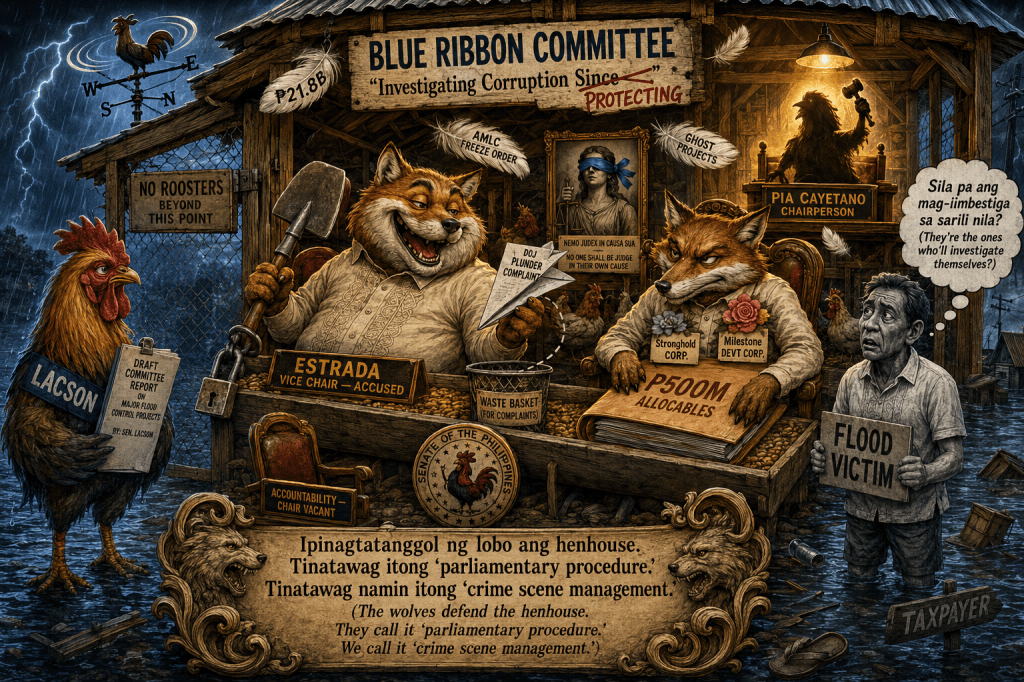
LET us not be coy. What happened on May 25, 2026 was not a routine committee reorganization. It was not parliamentary procedure dutifully observed. It was a coronation. A validation. A syndicated money-laundering of political power disguised as Senate housekeeping.
Jinggoy Estrada and Rodante Marcoleta are now vice chairpersons of the Senate Blue Ribbon Committee—the chamber’s premier anti-corruption body, the very panel investigating the multibillion-peso flood control scandal. Read that sentence again. Let it curdle in your stomach. Two men whose names are practically tattooed onto the scandal’s corpus delicti have just been handed the scalpels and asked to perform the autopsy.
The Philippine Senate has abandoned even the pretense of accountability. And it expects you to applaud the efficiency.
The Anatomy of a Cover-Up in Three Acts
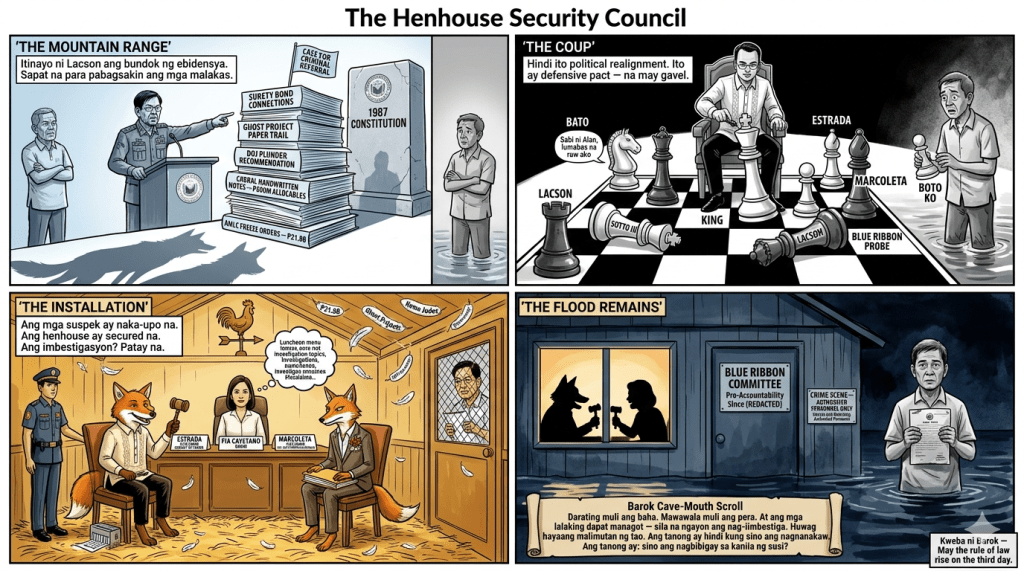
To understand this farce, one must appreciate its choreography. This was no improvisation. It was a three-act political opera, composed in the key of impunity.
Act One: The Probe Tightens
Senator Panfilo Lacson, then chair of the Blue Ribbon Committee, was doing something radical: his job. His draft committee report was metastasizing into a genuine threat. It named names. It compiled a “menu” of possible charges. It dared to suggest that senators—actual sitting members of that gilded chamber—might be criminally liable for the flood control anomalies that had literally and figuratively sunk the nation.
The walls were closing in. Senator Jinggoy Estrada faced a Department of Justice (DOJ) resolution recommending plunder and graft charges—plunder, the crime of those who steal on an industrial scale. Senator Rodante Marcoleta was drowning in revelations: P500 million in alleged “allocables” traced through handwritten notes of a deceased undersecretary, a previous chairmanship suspiciously dedicated to placing ghost-project contractors under the Witness Protection Program (WPP), and a wife whose corporate directorships conveniently intersected with the surety bonds of the very contractors being investigated. The evidence wasn’t just mounting; it was forming a mountain range.
Act Two: The Coup
On May 11, the dam broke—not the flood control dam, of course, those remained fictional. The Senate dam broke. Alan Peter Cayetano, with a coalition of Duterte allies and the imperiled, executed a swift decapitation of Tito Sotto III’s leadership. The official narrative spoke of political realignment. The honest narrative spoke of a defensive pact.
Senator Ronald “Bato” dela Rosa later admitted that Cayetano personally urged him to surface from months of hiding to vote in the leadership change. Four senators who backed Cayetano’s coup had ties to the flood control investigation. This was not a vote of no confidence in Sotto; it was a vote of confidence in self-preservation. Cayetano ascended to the Senate presidency not on a wave of reformist zeal, but on the shoulders of men who desperately needed the investigation to die.
Act Three: The Installation
With the gavel secured, the spoils were distributed. Pia Cayetano—sister of the new Senate President—was named chair of the Blue Ribbon Committee. And as her vice chairs? Estrada and Marcoleta. The subjects of the investigation are now its leaders. The suspects now control the evidence room. The foxes, having devoured the previous guard, have been formally appointed to the Henhouse Security Council.
The Estrada Paradox: The Accused as Prosecutor
Let us dissect the Estrada problem with clinical precision, for it is here that the Senate’s rot is most gangrenous.
The DOJ has recommended plunder and graft charges against this man, alongside former Department of Public Works and Highways (DPWH) Secretary Manuel Bonoan and others. Plunder is not a parking ticket. It is the legal term for a crime so massive, so audacious, that it constitutes a direct assault on the body politic. The Ombudsman is now reviewing this recommendation, and Estrada is already barred from leaving the country—a precautionary measure for those deemed flight risks.
And yet, this man—this potential flight risk, this soon-to-be-respondent in a plunder case—will now help decide the Blue Ribbon Committee’s investigative priorities. He will have a voice in which witnesses are called. He will sit in judgment over a report that quite literally names him as a subject for criminal referral.
Estrada’s defense, shouted from every friendly microphone, is the presumption of innocence. In response to the DOJ recommendation, he called it “baffling and unjust,” citing a Senate Legislative Budget Research and Monitoring Office (LBRMO) report he claims clears him of budget insertions. “Not yet convicted,” his allies bleat, as if this were a talisman against all criticism. This is a deliberate, sophistical confusion of legal standards and ethical imperatives. No one is arguing Estrada should be thrown in jail without trial. The argument is that he should not be the judge in his own cause—a principle so ancient and foundational that it is captured in the Latin maxim nemo judex in causa sua.
The Senate is not a court of law. It is a political institution whose investigative power derives not from Article III of the Constitution but from its credibility. When Estrada takes his seat as vice chair, he does not merely bring his experience. He brings a metastasizing conflict of interest that renders every subpoena he signs, every hearing he schedules, and every question he poses an act of grotesque self-dealing. The Blue Ribbon Committee’s report on the flood control scandal—the one that requires nine signatures for sponsorship—now has an unspoken co-author: the man it seeks to indict.
The Marcoleta Entanglement: A Deeper, More Insidious Rot
If Estrada’s conflict is a blazing neon sign, Marcoleta’s is a labyrinth of shadows—and arguably more dangerous for it.
Marcoleta has already had his turn at the wheel. During his previous chairmanship of this very committee, he was publicly accused by Lacson of attempting to place Pacifico and Sarah Discaya—the contractors at the epicenter of the ghost project allegations—under the Witness Protection Program. Let that sink in. The head of the investigation tried to give the central suspects a legal shield. This was not oversight. This was obstruction dressed in a barong.
Then came the P500 million “allocables” allegation, emerging from the late Undersecretary Catalina Cabral’s handwritten notes like a message from the grave. Lacson noted that Marcoleta, in his lengthy privilege speech responding to the allegations, had “deliberately missed the most important reaction: deny or refute the handwritten note”. Marcoleta denies wrongdoing, of course. They always do. But coupled with his prior conduct as chair, the allegation forms a coherent narrative: a senator using his institutional power not to expose corruption, but to manage it.
And then there is the matter of his wife, Edna, who serves as an independent director of Stronghold Insurance and Milestone Guaranty and Assurance—firms that issued surety bonds to Discaya-owned contractors. Marcoleta denies wife’s links to Discaya flood control scandal. Marcoleta will insist on the word “independent” as if it were a magic incantation. He has dismissed the allegations as a smear campaign, arguing that an independent director’s role is limited to protecting minority shareholders. But in a country where “independent directors” are often just well-dressed relatives, and where surety bonds are the financial ligaments connecting contractors to their political patrons, this is a conflict so glaring it should be visible from space. The paper trail of the flood control scam runs directly through the firms where Mrs. Marcoleta holds board seats. Her husband now helps oversee the investigation of that paper trail.
Marcoleta’s defenders portray him as a persecuted anti-establishment crusader. This is a remarkable act of political jujitsu: transform the man accused of shielding contractors and sitting on a half-billion-peso allocables mountain into a victim of elite persecution. It is, however, a narrative that collapses under the weight of its own absurdity. The persecuted reformer does not typically attempt to place the prime suspects in the Witness Protection Program. The persecuted reformer’s wife does not typically collect director’s fees from firms entangled in the scandal.
The Cayetano Equation: The Architect’s Fee
No analysis is complete without examining the man who made this possible. Alan Peter Cayetano’s fingerprints are all over this crime scene, and they deserve to be dusted for prints.
His sister, Pia, now chairs the committee. In her first public statement, she declared she would “determine what matters will be prioritized by the Blue Ribbon Committee,” pointedly refusing to mention the flood control probe. This is the verbal equivalent of hiding an elephant behind a cocktail napkin. The flood control scandal is the most significant corruption investigation to hit the Senate in a decade, and the new chair is musing about priorities as if she’s planning a luncheon menu.
Cayetano has denied the coup was related to the Sara Duterte impeachment. He has not, tellingly, denied it was related to the flood control probe. The denial is itself a confession by omission. When you install the accused as vice chairs of the committee investigating them, you are not reorganizing; you are sanitizing. Pia Cayetano now faces an impossible political geometry: can she credibly lead an investigation when her vice chairs are its primary targets and her brother’s political survival depends on their protection?
The committee’s majority membership reads like a casting call for a satirical play titled The Suspects Convene. Bong Go. Robin Padilla. Francis Escudero. Imee Marcos. Mark Villar. Camille Villar. Several of these names have surfaced in connection with the flood control probe. Their presence on the committee is not oversight. It is a mutual defense pact with gavels. It is a board meeting of the Flood Control Contractors’ Appreciation Society.
The Post-Truth Labyrinth: Defenses That Defraud the Public
The defenders of this travesty have constructed a rhetorical fortress of bad faith. It is time to storm it.
“Presumption of innocence!” This is the shibboleth of the corrupt, a constitutional principle twisted into a moral shield. The presumption of innocence is a legal standard that governs the burden of proof in a criminal trial. It is not an ethical immunity card that entitles the accused to positions of power over their own investigation. By this logic, an accused embezzler should be allowed to audit his own company’s books, and a suspected arsonist should lead the fire investigation. The Senate is free to seat its members. It is not free to install them as their own inquisitors without inviting the contempt of every thinking citizen.
“Experience matters!” This is the argument that a bank robber’s familiarity with vaults makes him an ideal security consultant. Marcoleta’s “experience” chairing the committee consisted, by all credible accounts, of attempting to neuter its investigation. Estrada’s “experience” is in being the subject of corruption probes—he was convicted of plunder before, in the pork barrel scam, only to be acquitted by the Supreme Court on technical grounds. These are not qualifications. They are rap sheets.
“This is political retaliation!” Marcoleta’s camp, in particular, seeks to cast this as elite persecution of a populist crusader. This is the final refuge of the cornered scoundrel: when the evidence implicates you, accuse your accusers of a conspiracy. It is a narrative that works on those who prefer their politics as simplified morality plays. But the facts are stubborn things: the WPP controversy, the P500 million allocables, the surety bond connections. These are not the fabrications of Lacson or the liberal elite. They are documented threads in a tapestry of corruption that Marcoleta would rather you not examine too closely.
The Unseen War: What They Don’t Want You to Discuss
Beneath the parliamentary theater, a more sinister reality is unfolding. The Blue Ribbon Committee is not merely being neutralized; it is being weaponized.
Under the new leadership, the committee can pursue selective accountability—aggressively investigating low-level bureaucrats and convenient political targets while meticulously steering clear of the senators, dynasties, and financiers who form the Cayetano coalition’s backbone. This is the Philippine corruption playbook in its most refined form: sacrifice a few pawns to protect the kings. The hearings will continue. Cameras will roll. Senators will grandstand. And at the end of it all, the powerful will remain untouched, their impunity freshly lacquered with the veneer of due process.
The public, meanwhile, is expected to swallow this spectacle. As Lacson himself noted in his privilege speech, the Anti-Money Laundering Council has already secured freeze orders covering more than PHP21.8 billion in assets linked to the flood control irregularities. Real money. Real frozen accounts. Yet the men at the center of the controversy are now in charge of the congressional investigation. Flood control projects remain ghostly, the floods themselves remain all too real, and the architects of this disaster are now officially in charge of explaining what went wrong. The gap between the Senate’s self-image as an august deliberative body and its reality as a self-dealing protection racket has never been wider.
The Verdict and the Summons
The implications of this moment are staggering. The Senate has institutionalized a new principle: those under investigation for corruption are uniquely qualified to oversee that investigation. The Blue Ribbon Committee is no longer an anti-corruption body. It is an anti-accountability body, a formalized mechanism for burying inconvenient truths.
This is not democracy. It is oligarchy with parliamentary pretensions. When a committee tasked with investigating plunder is led by a man facing plunder charges, the institution has ceased to function as a check on power. It has become an extension of power.
What is to be done? The recommendations are clear, even if the political will to enact them is conspicuously absent:
- Immediate Recusal. Estrada and Marcoleta must recuse themselves from all proceedings related to the flood control investigation. Not because they are guilty, but because their continued involvement renders the investigation a laughingstock. To refuse recusal is to announce, unequivocally, that one’s priority is not public service but personal survival.
- Senate Ethics Committee Intervention. The Senate Ethics Committee must immediately investigate the conflicts of interest in the new Blue Ribbon composition. If the Ethics Committee itself has been similarly captured, then the Senate has no functioning ethical mechanism—a revelation the public deserves.
- Ombudsman Independence. The Ombudsman must proceed with its independent review of the DOJ’s plunder recommendation against Estrada with all deliberate speed. The Senate’s internal corruption of its investigative processes must not be allowed to infect the criminal justice track. The Ombudsman is now the last institutional firewall.
- Citizen Vigilance. If the institutions have been captured, the people must serve as the last line of defense. Civil society must document every hearing, expose every delay, and name every act of obstruction. The Senate may have forgotten it serves the public, but the public must not forget it has the power to remember.
- Senatorial Conscience. To those senators who have not yet sold their souls—and surely there must be a few—this is your moment. Rise above the petty power struggles. Refuse to participate in this charade. The judgment of history, and of the electorate, awaits your choice.
The rule of law in the Philippine Senate did not die on May 25, 2026. It had been dying for years, weakened by a thousand small betrayals, eroded by a culture that treats accountability as a weapon to be used against enemies and a shield to protect friends. But on this day, the mask came off entirely. The subjects of the investigation now run the investigation. The arsonists have been promoted to fire chief. The vampires have been given control of the blood bank.
There is a Filipino tradition of venerating the senado as a hallowed chamber of statesmen. This Blue Ribbon Committee composition is the final, definitive refutation of that myth. It is a gathering of the implicated, a convocation of the conflicted, presided over by a chair whose brother orchestrated the coup that made it all possible.
The floods will come again. The money will have disappeared. And the men now charged with investigating that disappearance will look the nation in the eye and express their profound concern—before quietly burying the report, shielding their allies, and waiting for the public’s famously short memory to fade.
Do not let them. The foxes are in the henhouse. The only question remaining is whether the chickens will finally organize.
May the rule of law rise on the third day. But let us be clear: it has been crucified by the very men who swore to uphold it.
Key Citations
A. News Articles
- “DOJ Recommends Plunder Raps vs Jinggoy, Bonoan.” The Philippine Star, 19 May 2026, www.philstar.com/headlines/2026/05/19/2528925/doj-recommends-plunder-raps-vs-jinggoy-bonoan.
- Lacson, Panfilo. “Lacson: Marcoleta Said a Lot, but Didn’t Deny Seeking P500-M Allocables.” Inquirer.net, 7 May 2026, newsinfo.inquirer.net/2225390/lacson-marcoleta-said-a-lot-but-didnt-deny-seeking-p500-m-allocables.
- “Marcoleta Denies Wife’s Links to Discaya Flood Control Scandal.” The Philippine Star, 30 Sept. 2025, www.philstar.com/headlines/2025/09/30/2476411/marcoleta-denies-wifes-links-discaya-flood-control-scandal.
- “Bato Admits Alan Cayetano Urged Him to Appear for Coup.” Philstar.com, 18 May 2026, www.philstar.com/headlines/2026/05/18/2528828/dela-rosa-admits-cayetano-urged-him-appear-coup.
- “Senate Names New Blue Ribbon Vice Chairpersons, Members.” Daily Tribune, 25 May 2026, tribune.net.ph/2026/05/25/senate-names-new-blue-ribbon-vice-chairpersons-members.
- “Lacson Defends Flood Probe as Cases, Asset Freezes Mount.” Philippine News Agency, 5 May 2026, www.pna.gov.ph/articles/1274370.
- Ong, Ghio. “DOJ Recommends Plunder Raps vs Jinggoy, Bonoan.” The Philippine Star, 19 May 2026, https://www.philstar.com/headlines/2026/05/19/2528925/doj-recommends-plunder-raps-vs-jinggoy-bonoan.
- “Jinggoy Calls DOJ Plunder Raps ‘Baffling, Unjust.’” Daily Tribune, 19 May 2026, tribune.net.ph/2026/05/19/jinggoy-calls-doj-plunder-raps-baffling-unjust.
- Lacson, Panfilo. “Lacson: Cabral’s Handwritten Note Shows P500M ‘Allocables’ for Marcoleta.” Inquirer.net, 6 May 2026, newsinfo.inquirer.net/2224436/lacson-cabrals-handwritten-note-shows-p500m-allocables-for-marcoleta.
- “Ang Hirap Maging Mahirap”: The PAO Scandal That Proves Government Contempt Is Nothing New
- “Far-Off” My Axx: Malacañang’s Claire Castro Drowns in Her Own Legal Gaslighting
- “Forthwith” to Farce: How the Senate is Killing Impeachment—And Why Enrile’s Right (Even If You Can’t Trust Him)
- “HINDI AKO NAG-RESIGN!”

- “I Know Nothing”: Baste Duterte’s Amnesia Defense Meets ₱33M in GenCorp Contracts
- “I’m calling you from my new Globe SIM. Send load!”

- “Mahiya Naman Kayo!” Marcos’ Anti-Corruption Vow Faces a Flood of Doubt

- “Manageable” Debt, Unmanageable Lies: DBM’s ₱21 Trillion Fairy Tale
- “Meow, I’m calling you from my new Globe SIM!”

- “Natrabaho”: One Word, One Ombudsman, and a Judiciary on Trial
- “No Special Jail for Crooks!” Boying Remulla Slams VIP Perks for Flood Scammers
- “Philippine-Controlled” or Yankee Gas Station? The Davao Fuel Depot Farce Exposed



Leave a Reply