Duterte Appointees Split 5-4 — Majority Says No to Impunity and Sanctuary Games
By Louis ‘Barok’ C Biraogo — May 26, 2026
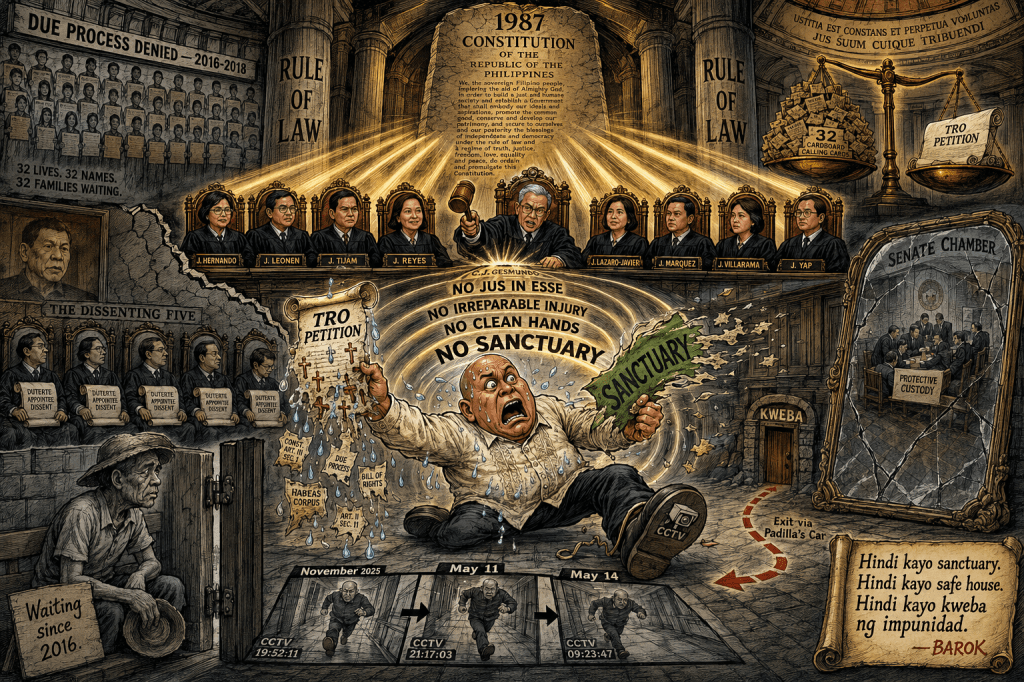
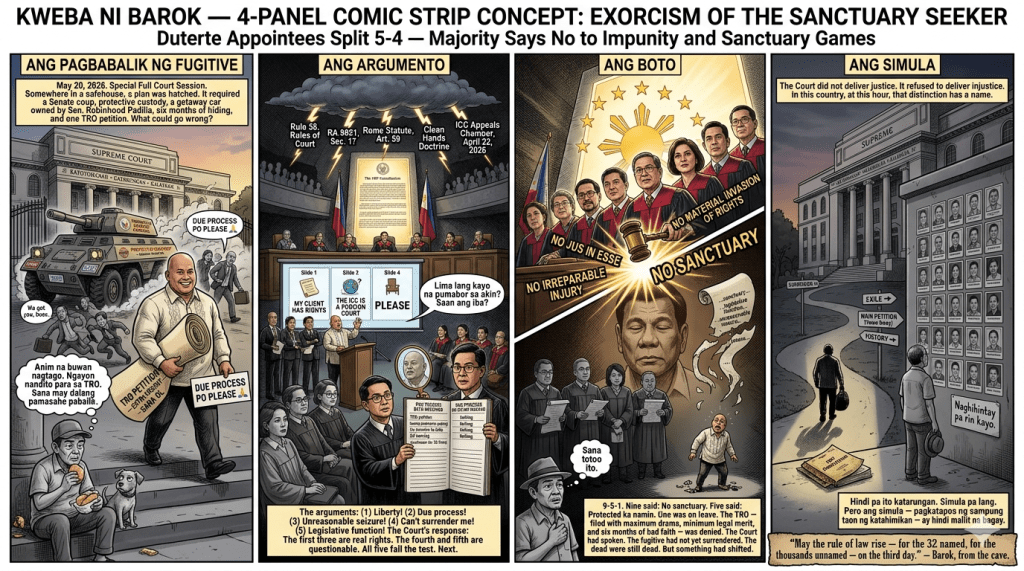
THEY say the Supreme Court moves in mysterious ways. But on May 20, 2026, during a special full court session, nine justices moved with a clarity that must have felt like a thunderclap inside whatever safehouse currently shelters Senator Ronald “Bato” dela Rosa. The 9-5-1 vote denying his plea for a Temporary Restraining Order wasn’t just a procedural setback for a man who has turned evasion into an art form. It was an institutional exorcism—the Court declaring, in its characteristically understated legalese, that it will not become a sanctuary for the architects of mass death who suddenly discover the Constitution when the handcuffs are within reach.
The question now isn’t whether Bato will surrender. He won’t. The question is whether the institutions of this republic can survive his determination to make a mockery of them. So far, the Senate has failed that test. The Executive has equivocated. The Supreme Court, at least provisionally, has not.
Let us deconstruct this masterpiece of judicial housekeeping.
Framing Wars: Media Battle for Control of the Narrative
Read the two news reports side by side, and you are witnessing not journalism but a framing war—two narratives wrestling for control of public memory.
The Inquirer report, penned by Tetch Torres-Tupas, frames the denial as a moral reckoning. Its headline screams “No Sanctuary,” immediately casting the Court not as a neutral arbiter but as an institution that actively refused complicity in impunity. The article leads with Justice Caguioa’s devastating concurrence—”The Court should not come to the rescue of an individual, a public officer no less, who is charged with mass murder”—and Justice Singh’s clean hands doctrine, which effectively calls Bato a bad-faith litigant who treats legal process like a convenience store: enter when needed, exit when threatened.
The Manila Bulletin report, by contrast, frames the story as political arithmetic. Its headline asks “Who voted to grant?” before “Who voted against?”—a subtle but significant editorial choice that centers the dissenters as the primary subjects of interest. It leads with the Duterte-appointee angle, emphasizing that five of the twelve justices who are Duterte appointees voted to grant the TRO. The implicit narrative: this is about loyalty and betrayal within a political family, not about law or justice at all.
Neither framing is entirely wrong. Both are incomplete without the other. The truth, as usual, lives in the tension between them—a tension the Manila Bulletin inadvertently captures by burying Caguioa’s morally serious concurrence deep in its report while foregrounding vote arithmetic that reads like election returns.
But let us not pretend the arithmetic is irrelevant. It is devastatingly relevant. When five Duterte appointees vote as a perfect bloc to protect a Duterte loyalist, and zero cross over, the 2025 Code of Judicial Conduct and Accountability (A.M. No. 25-04-04-SC)‘s requirement that judges avoid impropriety and the appearance of impropriety in all their activities ceases to be an abstraction and becomes an accusation. The dissenting opinions, when published in full, must explain why this perfect alignment is jurisprudential coincidence rather than political destiny. I am not holding my breath.
Majority’s Procedural Precision: Elegant Legal Jiu-Jitsu
The nine justices who denied the TRO did not need to reach the explosive constitutional questions about ICC jurisdiction. They did something more elegant: they applied Rule 58 of the Rules of Court, the four-part test for injunctive relief, and found that Bato failed at every single turn.
This is legal jiu-jitsu of the highest order. The majority didn’t need to declare that the ICC has jurisdiction. They didn’t need to rule on whether Republic Act No. 9851 (RA 9851), Section 17 independently authorizes surrender to international tribunals. They simply asked: Does this fugitive have a clear and unmistakable right? And the answer, delivered with surgical precision, was no.
The right to liberty is not absolute. Seizure pursuant to a lawful court order is not unlawful. Due process is satisfied when proceedings comply with the law of the land. These are black-letter principles so basic that first-year law students recite them in their sleep. That a senator needed nine Supreme Court justices to remind him of this is an indictment not of the Court but of the legal strategy that thought “hiding for six months then filing a TRO” constituted a good-faith invocation of equity.
Justice Singh’s clean hands concurrence deserves special attention. The maxim ‘he who comes into equity must come with clean hands’ is not a technicality. It is a foundational principle of equity jurisprudence, affirmed in Willem Beumer v. Avelina Amores (G.R. No. 195670, 2012), and it exists precisely to prevent courts from becoming instruments of bad faith. Bato hid for six months. He surfaced to vote in a Senate leadership coup—installing Alan Peter Cayetano, who would promptly grant him “protective custody.” Then he vanished again. This is not litigation strategy. This is a man playing the legal system like a slot machine, pulling the lever of due process only when the jackpot of impunity is within reach.
Singh called it what it is: “inequitable conduct which should bar the grant of the relief he seeks.” In the clinical language of jurisprudence, she called him a cheat.
Caguioa went further. His concurrence framed Bato’s TRO plea not merely as legally deficient but as morally obscene—”a severe insult to the deceased” who were denied the very due process Bato now demands. This is not typical Supreme Court language. It is the language of a justice who has watched impunity strut through Philippine institutions for decades and has decided, on this day, not to be part of its victory parade.
The majority’s procedural restraint is strategic genius. By confining the ruling to TRO requisites, they denied Bato relief without prejudging the main petition’s constitutional questions. They left the door open for a future ruling on ICC jurisdiction while slamming this door—the emergency door, the “protect me now” door—firmly in his face. It is judicial minimalism in service of maximal impact.
Dissent’s Robed Loyalty: Perfect Appointee Bloc in Action
Five justices dissented: Hernando, Lazaro-Javier, Inting, Rosario, and Kho Jr. All are Duterte appointees. All voted to protect a Duterte loyalist. Not one broke ranks.
The dissenting opinions have not been fully published as of this writing. But the arguments available—from Bato’s pleadings and the known positions of sovereignty advocates—center on two claims: first, that the ICC lacks jurisdiction because the Philippines withdrew from the Rome Statute of the International Criminal Court in 2019; second, that Article III, Section 2 of the Constitution requires a Philippine judicial warrant before any arrest can occur on Philippine soil.
These are not frivolous arguments. They are serious constitutional positions that deserve serious engagement. The problem is not that the dissenters advanced them. The problem is the perfect, unbroken alignment of all five Duterte appointees in a case that directly implicates the legacy of their appointing authority’s signature policy.
Let us be precise. The ICC Appeals Chamber ruled on April 22, 2026, that the Court has jurisdiction over crimes committed in the Philippines from November 1, 2011 to March 16, 2019. Bato’s alleged crimes fall squarely within this window. Article 127(2) of the Rome Statute explicitly states that withdrawal “shall not affect any cooperation with the Court in connection with criminal investigations and proceedings” commenced before withdrawal took effect. RA 9851, Section 17, independently authorizes Philippine authorities to “surrender or extradite suspected perpetrators to an international court.” The Solicitor General herself opined that ICC warrants do not require Philippine judicial validation.
The dissenters had to ignore or distinguish all of this to reach their conclusion. They may have done so with brilliant legal reasoning that will be vindicated when the main petition is decided. Or they may have done what the optics scream: protected their patron’s police chief because that is what appointees do in a system where judicial appointments function as political investments.
Until their full opinions are published and can be evaluated on their merits, the five dissenters live under a cloud of appearance—and in judicial ethics, as the Code of Judicial Conduct reminds us, appearance matters. The judiciary must be “free from any appearance of impropriety.” A 5-0 Duterte-appointee bloc voting to shield a Duterte loyalist from an ICC arrest warrant is, at minimum, an appearance that demands an explanation.
Impunity’s Architecture: The Forgotten Mountain of the Dead
The Manila Bulletin report, with its focus on vote arithmetic and political alignments, omits what the Inquirer report centers: the reason this case exists at all.
The Philippine drug war killed thousands. The 32 named in the ICC warrant are the visible tip of an invisible mountain of dead. For nearly a decade, not a single senior official faced criminal accountability in a Philippine court. The Philippine National Police (PNP) investigated itself and found itself innocent. The Department of Justice (DOJ) declined to prosecute. Congress held hearings that produced television drama but zero indictments. The previous Ombudsman, Duterte appointee Samuel Martires, that perennial paper tiger, shuffled documents and looked away.
This is the context the dissenters’ due process arguments conveniently forget. Due process was denied to the dead at 2 a.m. when police kicked down doors and didn’t wait for answers. Due process was denied to the families who received cardboard signs—”Pusher, ‘Wag Tularan”—instead of autopsy reports. Due process was denied to the communities that watched their sons and brothers and fathers become statistics in a policy that treated human lives as acceptable collateral damage.
Now the man who served as the operational architect of this system—who stood beside Duterte and promised that the killings would continue until the last drug user was dead—invokes due process to escape accountability. And five Supreme Court justices are willing to help him.
This is not a legal argument. It is the continuation of the crime by other means.
Calls to Action: Surrender, Rise, and Reform
To Bato dela Rosa: Surrender. Now. Not when it is convenient. Not when the political winds shift. Not after another six months of hiding while your lawyers file successive motions designed to run out the clock. The clean hands doctrine is not a legal technicality you can wash off with procedural soap. You have made a mockery of the Senate, of the Constitution, and of the 32 dead named in the warrant who never got to file a single motion in their defense. Submit yourself to the law you once swore to uphold as the nation’s top cop. The cave-dweller is not holding his breath—but the demand stands.
To the Rule of Law: Rise. The Senate’s “protective custody” resolution has no basis in the 1987 Constitution of the Republic of the Philippines. Article VI, Section 11 grants parliamentary immunity only for offenses punishable by not more than six years imprisonment—a threshold that crimes against humanity, defined under RA 9851, exceed by several orders of magnitude. The Senate cannot create sanctuary out of thin air. Senatorial privilege is not a bunker. The rule of law does not stop at the Senate gate. It must be declared the supreme foundation of governance—above political alliances, above institutional solidarity, above the convenience of the powerful.
To the Reformers: Fix this broken system. The Senate must repeal its “protective custody” fiction before it becomes precedent for every future fugitive with legislative allies. The Judicial and Bar Council appointment process must be insulated from presidential influence so that the Supreme Court never again faces the spectacle of a perfect appointer-bloc alignment that invites charges of political loyalty over judicial independence. The mechanisms that allowed the drug war to proceed without domestic accountability—the PNP’s self-investigations, the DOJ’s prosecutorial discretion abused into prosecutorial inaction—must be dismantled and rebuilt.
To Democratic Institutions: Be worthy of the name. The Supreme Court’s majority demonstrated that institutional integrity can survive political pressure. The Senate’s leadership demonstrated the opposite. A Senate that becomes a sanctuary for a fugitive is not a democratic institution; it is a criminal conspiracy with stationery. The NBI and PNP must enforce the law without fear of Senate reprisal. The Executive must stop its two-step of formal compliance and informal sabotage. Institutions that cannot check power are not institutions at all—they are decorations on a dictatorship that hasn’t finished forming.
Recommendations: Fixing the System for the Main Petition
For the Supreme Court in the main petition (G.R. No. 278747): Rule that RA 9851 provides an independent domestic basis for ICC warrant enforcement. The Philippines enacted this law as its own; it is not merely a treaty-implementation statute that died with Rome Statute withdrawal. Section 17’s authorization to surrender accused persons to international courts is plain text. Honor it. If the Court requires a domestic judicial process before ICC warrant enforcement, create a summary procedure that satisfies due process without becoming the obstruction mechanism that the dissenters appear to desire.
For Congress: Pass legislation defining the precise procedures for ICC cooperation, eliminating the ambiguity that allowed the Senate to invent “protective custody” as a constitutional category. While you’re at it, amend the JBC’s composition to reduce presidential influence over judicial appointments. The 9-5 vote split—with its perfect appointee alignment on both sides—is a structural problem, not a personal failing.
For the Executive Branch: Stop hiding behind Facebook Live declarations that you haven’t “ordered” Bato’s arrest. The DOJ, NBI, and PNP are under your authority. If they are enforcing an ICC warrant, you have ordered it—either directly or through deliberate non-interference with lawful enforcement. Choose the rule of law openly, or choose political expediency openly. This two-track ambiguity insults the intelligence of the Filipino people and the dignity of the 32 named dead.
Cave-Dweller’s Closing Scroll: A Crack in the Edifice of Impunity
From the cave mouth, where the echo of Senate gunfire still reverberates and the families of the dead still wait for the word that their loved ones mattered:
Nine justices did not deliver justice on May 20, 2026. They delivered something smaller but still precious: a refusal to participate in the machinery of impunity.
Six of those nine were appointed by the very man whose drug war is the subject of the ICC prosecution. They voted against his police chief anyway. This is not nothing. In a country where appointment has historically been destiny on the bench, this crossover vote is a crack in the edifice of political loyalty—a crack through which the rule of law might, eventually, enter.
The five dissenters have explaining to do. Their full opinions, when published, will either vindicate them with serious constitutional argument or confirm the worst suspicions of a public that has watched the powerful protect the powerful for far too long. The cave-dweller will read those opinions with the scrutiny they deserve.
The Senate’s protective custody farce is a constitutional obscenity that should be formally repudiated by every member who swore an oath to defend the 1987 Constitution. The senators who filed Resolution No. 395—Pangilinan, Sotto, Lacson, Hontiveros, Bam Aquino—read the Constitution correctly: there is no sanctuary clause. There is no protective custody provision. There is only the law, and the law does not stop at the Senate door.
Bato dela Rosa is still at large. The drug war dead are still dead. The main constitutional questions are still unanswered. But for one day, on one motion, the Supreme Court of the Republic of the Philippines refused to be what the Senate briefly became: a sanctuary where accountability goes to die.
That is not justice. It is a beginning.
May the rule of law rise—for the 32 named, for the thousands unnamed, for every family that received a cardboard sign instead of a day in court—on the third day.
It must rise.
— Barok, from the cave.
Key Citations
A. Legal & Official Sources
- Philippines. The 1987 Constitution of the Republic of the Philippines. 1987. Official Gazette of the Republic of the Philippines, www.officialgazette.gov.ph/constitutions/1987-constitution/.
- Philippines. Republic Act No. 9851: An Act Defining and Penalizing Crimes Against International Humanitarian Law, Genocide and Other Crimes Against Humanity. 11 Dec. 2009. Official Gazette of the Republic of the Philippines, www.officialgazette.gov.ph/2009/12/11/republic-act-no-9851/.
- United Nations. General Assembly. Rome Statute of the International Criminal Court. 17 July 1998. International Criminal Court, www.icc-cpi.int/sites/default/files/2024-05/Rome-Statute-eng.pdf.
- Philippines. Supreme Court. A.M. No. 25-04-04-SC: Re: The 2025 Code of Judicial Conduct and Accountability. 11 Nov. 2025, elibrary.judiciary.gov.ph/thebookshelf/showdocs/11/100836.
- Appeals Chamber. The Prosecutor v. Rodrigo Roa Duterte. Judgment on the Appeal of the Defence Against the Pre-Trial Chamber I’s Decision on Jurisdiction. 22 Apr. 2026. ICC-01/21-01/25, http://www.icc-cpi.int/news/icc-appeals-chamber-confirms-jurisdiction-duterte-case.
- Philippines. Supreme Court. Rules of Court, Rule 58 (Preliminary Injunction). The LawPhil Project, https://lawphil.net/courts/rules/rc_1-71_civil.html#r58.
- Senate of the Philippines. Senate Resolution No. 395. Resolution Expressing the Sense of the Senate Urging Senator Ronald “Bato” M. Dela Rosa to Voluntarily Surrender to the Proper Authorities and Seek Judicial Remedies in Accordance with the Constitution and Applicable Laws and Rules. 12 May 2026, senate.gov.ph/legislative-documents/resolutions.
- Philippines. Supreme Court. People of the Philippines v. Romeo G. Jalosjos. G.R. Nos. 132875-76, 3 Feb. 2000. The LawPhil Project, lawphil.net/judjuris/juri2000/feb2000/gr_132875_2000.html.
- Philippines. Supreme Court. Beumer v. Amores. G.R. No. 195670, Supreme Court of the Philippines, 3 Dec. 2012, lawphil.net/judjuris/juri2012/dec2012/gr_195670_2012.html.
B. News Reports
- Torres-Tupas, Tetch. “No Sanctuary: Why SC Denies Sen. Dela Rosa’s TRO Bid.” Inquirer.net, 25 May 2026, globalnation.inquirer.net/324521/no-sanctuary-why-sc-denies-bato-dela-rosas-tro-bid.
- Panaligan, Rey G. “Who Voted to Grant Bato Dela Rosa’s Plea for TRO vs ICC’s Arrest Order? Who Voted Against?” Manila Bulletin, 25 May 2026, mb.com.ph/2026/05/25/who-voted-to-grant-bato-dela-rosas-plea-for-tro-vs-iccs-arrest-order-who-voted-against.
- ₱9 Billion in ‘Savings’? DILG’s Fire Truck Deal Smells Like Smoke

- ₱8B BBM Pork: CCTV for Every Captain’s Kumpare?

- ₱8.9 Billion, 331 Ghost Police Stations: The TIKAS Scandal Explained

- ₱8.4 Billion, 42,000 Barangays, 1 Election: The “Bawat Barangay Makikinabang” Vote-Buying Masterclass

- ₱75 Million Heist: Cops Gone Full Bandit

- ₱63 to the Dollar: The Only Thing Falling Faster Than the Peso Is the Government’s Credibility

- ₱6.77B Ghost Haunts Duterte: RTC Dismisses Mans Carpio’s Desperate Plea
- ₱6.77 Billion and Zero Cash: The Sara Duterte SALN Math That Doesn’t Add Up

- ₱6.7-Trillion Temptation: The Great Pork Zombie Revival and the “Collegial” Vote-Buying Circus

- ₱58.53B, Zero Receipts: The LGSF Pork Barrel Nobody Wants to Name

- ₱53 Million Man Tells ₱695-a-Day Workers to Stop Being ‘Mayabang’: The Audacity of BSP’s Remolona
- ₱4.4 Billion and a Witness Who Can’t Explain It: The Duterte Impeachment’s Most Expensive Non-Answer








Leave a Reply