Walkout Drama Exposes the Real Agenda: Online Impunity for Duterte’s Loyalists
By Louis “Barok” C. Biraogo — May 27, 2026
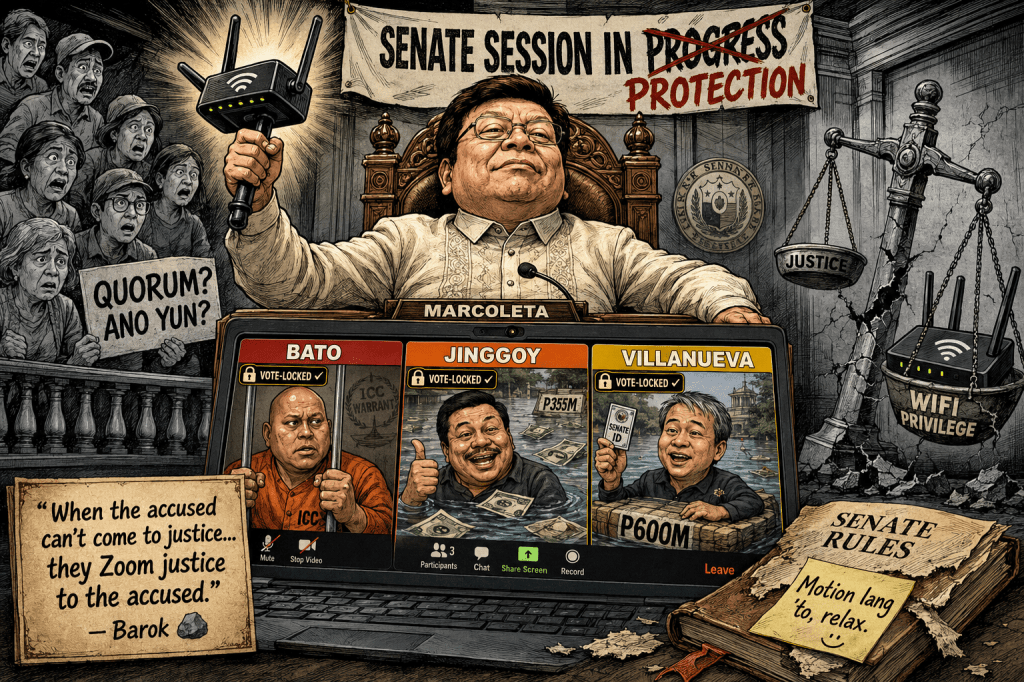
WELL, well, well, mga ka-kweba, pull up a chair. The Philippine Senate has once again transformed itself into a high-stakes thriller where the real plot is never on the order of business. On May 26, 2026, the minority bloc walked out after a tense clash over Senator Rodante Marcoleta’s motion to allow online voting “for justifiable reasons.” The Rappler report frames it as a simple procedural tiff: majority wants modernization, minority cries railroading. But scratch the veneer and you smell the unmistakable stench of transactional politics.
The timing is surgical. On May 11, the International Criminal Court (ICC) unsealed an arrest warrant against Senator Ronald “Bato” dela Rosa for crimes against humanity tied to the drug war. That same day, dela Rosa materializes long enough to cast the decisive vote making Alan Peter Cayetano Senate President, then vanishes again. Marcoleta drops his online-voting proposal on the very same day. Fast-forward to May 26: the Ombudsman announces imminent plunder charges against majority senators Jinggoy Estrada and Joel Villanueva in the flood-control scandal—P355 million and P600 million insertions, 30% kickbacks alleged. Suddenly, Cayetano is in a tearing hurry to vote on remote participation. Coincidence? In Philippine politics, coincidence is just another word for choreography.
Procedural Railroading 101: Motion Over Resolution?
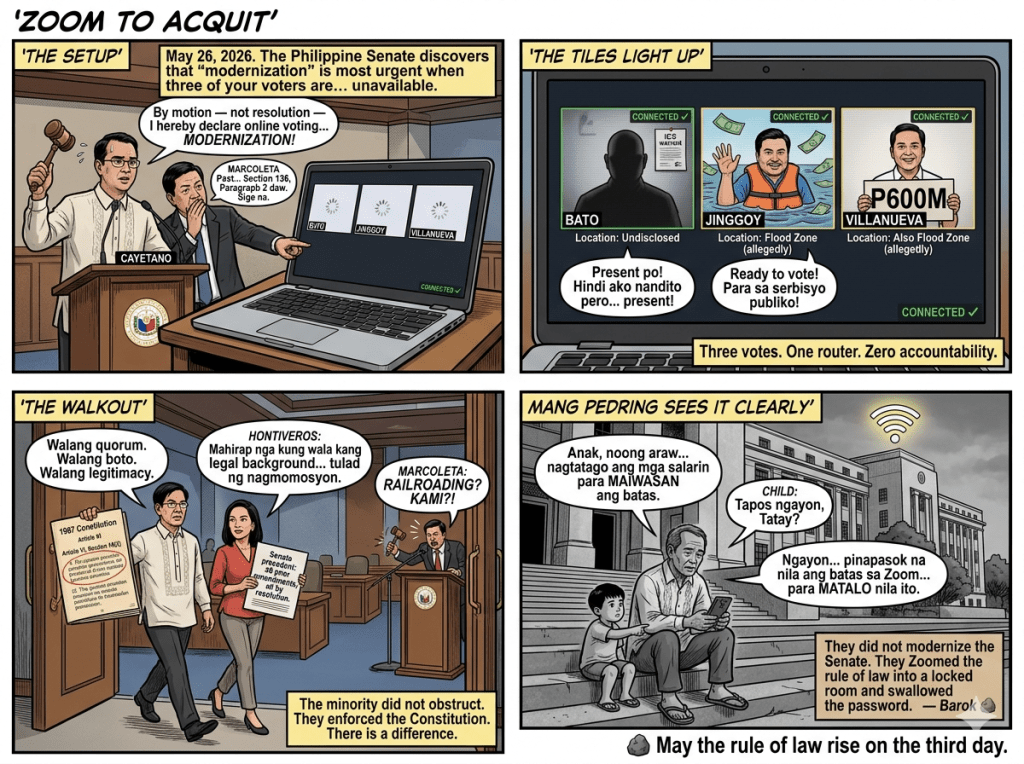
Let us dissect the majority’s central contention with the cold scalpel it deserves: that this rule change is benign modernization, unrelated to locking in acquittal votes for Vice President Sara Duterte’s impeachment. The logical endpoint of their argument is revealing. If the Senate can amend its rules by simple motion under Section 136, Paragraph 2, then any future majority can rewrite the game mid-contest to protect its endangered members. Historical practice demolishes this. All 48 previous amendments to the Senate Rules went through formal resolutions and committee review. Under contemporanea expositio, long-standing practice is the best interpreter of an ambiguous rule (Rizal Light & Ice Co. v. PSC). Marcoleta’s “motion-not-resolution” theory is not interpretation; it is ex post facto convenience.
Worse, the Committee on Rules has not even been reconstituted after the May 11 leadership coup. A non-existent committee cannot validly endorse anything. Avelino v. Cuenco reminds us that internal rules must be followed for proceedings to have legal effect. The minority’s walkout was not obstruction; it enforced the constitutional quorum under Article VI, Section 16(2) of the 1987 Constitution: a majority of 13 senators “shall constitute a quorum to do business.” No quorum, no railroading. Elegant, constitutional, and devastating.
Substantive Law: The Real Stakes
Now layer in the substantive law. Plunder under Republic Act No. 7080 (Plunder Law) requires a combination of overt acts amassing at least P50 million in ill-gotten wealth. The flood-control insertions fit the template perfectly; Estrada v. Sandiganbayan upheld the law’s constitutionality precisely for such schemes. The Anti-Graft and Corrupt Practices Act (Republic Act No. 3019) Section 3(e) covers the manifest partiality and bad faith alleged. Republic Act No. 6713 (Code of Conduct and Ethical Standards for Public Officials and Employees) demands ethical conduct and avoidance of impropriety. Legislative immunity under Article VI, Section 11 of the 1987 Constitution provides only for offenses punishable by six years or less. Plunder carries reclusion perpetua; ICC crimes against humanity are beyond it entirely. These senators are not shielded; they are simply trying to vote while evading the consequences of their alleged acts.
Impeachment: The Prize They Can’t Lose
The impeachment context makes the cynicism breathtaking. Conviction of Sara Duterte requires 16 of 24 votes. Nine suffice for acquittal. Dela Rosa is a guaranteed “not guilty.” Estrada and Villanueva, if detained pending Sandiganbayan arraignment, would normally lose their physical presence. The online rule is not about Zoom convenience; it is vote-insurance for a fugitive and two accused plunderers whose ballots may decide whether the Vice President escapes accountability. Senator Lacson correctly notes that impeachment proceedings follow separate rules under Article XI, Section 3(6) of the 1987 Constitution. A plenary amendment does not automatically govern the Senate sitting as an impeachment court.
Marcoleta’s ad hominem jab at Senator Risa Hontiveros—“mahirap kasi kung wala tayong legal background”—was not merely rude; it was a procedural own-goal that exposed the majority’s arrogance. The irony drips: the man pushing a legally threadbare motion questions the competence of a colleague who actually studied law.
A Scathing Call to Duty
To the Senators reading this: Enough. Discharge your duties with integrity, dignity, and fairness. Rest your decisions solely on evidence, not on the political survival of allies. The public is not stupid. When you weaponize internal rules to protect fugitives and accused plunderers, you hollow out the very institution the 1987 Constitution of the Republic of the Philippines entrusted to you under Article VI and Article XI.
Strategic Calculations for the Power Players
Strategic realities: The majority’s options are limited.
- Forcing the vote on June 1 invites another quorum walkout and public backlash.
- Routing it properly through a reconstituted Committee on Rules buys time but risks losing momentum before the July 6 impeachment trial.
- Abandoning the motion admits the obvious.
The minority bloc, on the other hand, can:
- Sustain quorum pressure as a holding action.
- File a proper resolution exposing the majority’s bad faith.
- Escalate to the Supreme Court under the narrow Arroyo v. De Venecia exception where constitutional rights are impaired.
Possible future scenarios:
- (A) Rule passes — remote votes in the impeachment trial → Sara Duterte acquitted → institutional legitimacy cratered.
- (B) Minority holds — proper process followed → delay moots the immediate threat.
- (C) Supreme Court intervenes — on the fugitive-voting paradox.
- (D) Dela Rosa arrested — entire debate becomes academic.
- (E) Narrow compromise — excluding fugitives and accused plunderers.
Barok’s Verdict
What we are witnessing is not a debate over teleconferencing. It is an attempt to convert the Senate into a remote-control shield for a fugitive from international justice and senators facing plunder raps, all to shield a Vice President from the constitutional reckoning her office demands. The walkout was not drama; it was the last honest quorum left standing.
The rule of law is not optional equipment for the powerful. When senators rewrite the rules to let the accused legislate from the shadows, they declare that accountability is for the little people only. The Republic cannot survive that declaration.
Kapag pinabayaan natin ang proseso, pinabayaan natin ang lahat.
— Barok
🪨 May the rule of law rise on the third day.
Key Citations
A. Legal & Official Sources
- The 1987 Constitution of the Republic of the Philippines. Official Gazette of the Republic of the Philippines, 1987, http://www.officialgazette.gov.ph/constitutions/1987-constitution/.
- Philippines. Republic Act No. 7080: An Act Defining the Crime of Plunder and Prescribing its Penalties. 1991. LawPhil Project, lawphil.net/statutes/repacts/ra1991/ra_7080_1991.html.
- Philippines. Republic Act No. 3019: The Anti-Graft and Corrupt Practices Act. 1960. LawPhil Project, lawphil.net/statutes/repacts/ra1960/ra_3019_1960.html.
- Philippines. Republic Act No. 6713: An Act Establishing a Code of Conduct and Ethical Standards for Public Officials and Employees. 1989. LawPhil Project, lawphil.net/statutes/repacts/ra1989/ra_6713_1989.html.
- Rules of the Senate. Senate of the Philippines, March 2025, legacy.senate.gov.ph/rules%20of%20the%20senate-final.pdf.
- Supreme Court of the Philippines. Estrada v. Sandiganbayan. G.R. No. 148560, 19 Nov. 2001. LawPhil Project, lawphil.net/judjuris/juri2001/nov2001/gr_148560_2001.html.
- Supreme Court of the Philippines. Rizal Light & Ice Co., Inc. v. Public Service Commission, G.R. No. L-20993, 28 Sept. 1968, LawPhil Project, lawphil.net/judjuris/juri1968/sep1968/gr_l-20993_1968.html.
- Supreme Court of the Philippines. Avelino v. Cuenco. G.R. No. L-2821, 4 Mar. 1949. LawPhil Project, lawphil.net/judjuris/juri1949/mar1949/gr_l-2821_1949.html.
- Supreme Court of the Philippines. Arroyo v. De Venecia. G.R. No. 127255, 26 June 1998. LawPhil Project, lawphil.net/judjuris/juri1998/jun1998/gr_127255_1998.html.
B. News Reports
- “Senate Minority Walks Out Over Virtual Voting Proposal.” Rappler, 26 May 2026, http://www.rappler.com/philippines/senate-minority-walkout-motion-virtual-participation-session-may-26-2026/.
- “Senators Clash Over Rule to Allow Online Voting in Chamber.” INQUIRER.net, 26 May 2026, newsinfo.inquirer.net/2234894/senators-clash-over-rule-to-allow-online-voting-in-chamber.
- “Philippine Senator Flees ICC Arrest Over Role in Duterte’s Drug War.” Al Jazeera, 11 May 2026, http://www.aljazeera.com/news/2026/5/11/philippine-senator-flees-icc-arrest-over-role-in-dutertes-drug-war.
- “Senate Minority-Majority Rushing Rule Change for Members With Raps.” INQUIRER.net, 26 May 2026, newsinfo.inquirer.net/2234933/senate-minority-majority-rushing-rule-change-for-members-with-raps.
- “Senate Minority-Majority Rushing Rule Change for Members With Raps.” INQUIRER.net, 26 May 2026, newsinfo.inquirer.net/2234933/senate-minority-majority-rushing-rule-change-for-members-with-raps.

- “Ang Hirap Maging Mahirap”: The PAO Scandal That Proves Government Contempt Is Nothing New
- “Far-Off” My Axx: Malacañang’s Claire Castro Drowns in Her Own Legal Gaslighting
- “Forthwith” to Farce: How the Senate is Killing Impeachment—And Why Enrile’s Right (Even If You Can’t Trust Him)

- “HINDI AKO NAG-RESIGN!”

- “I Know Nothing”: Baste Duterte’s Amnesia Defense Meets ₱33M in GenCorp Contracts

- “I’m calling you from my new Globe SIM. Send load!”

- “Mahiya Naman Kayo!” Marcos’ Anti-Corruption Vow Faces a Flood of Doubt

- “Manageable” Debt, Unmanageable Lies: DBM’s ₱21 Trillion Fairy Tale
- “Meow, I’m calling you from my new Globe SIM!”

- “Natrabaho”: One Word, One Ombudsman, and a Judiciary on Trial

- “No Special Jail for Crooks!” Boying Remulla Slams VIP Perks for Flood Scammers

- “Philippine-Controlled” or Yankee Gas Station? The Davao Fuel Depot Farce Exposed




Leave a comment