Elites vs. King of Comedy: Why the National Artist Process Is Broken
By Louis ‘Barok‘ C. Biraogo — June 14, 2026
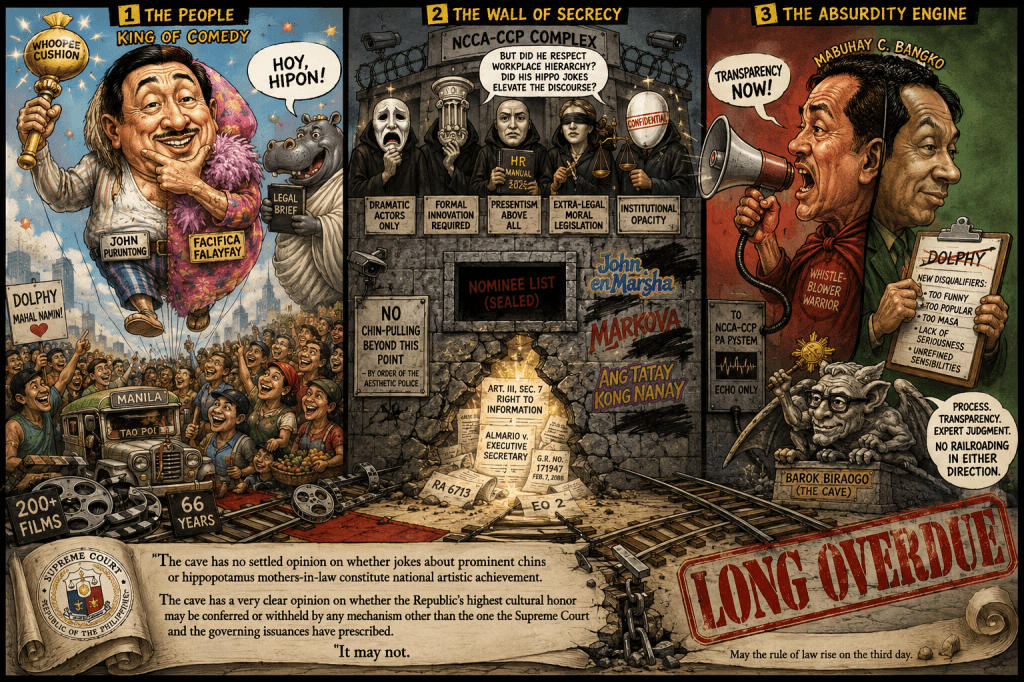
THE opinion piece signed Mabuhay C. Bangko that demands the National Commission for Culture and the Arts (NCCA) and the Cultural Center of the Philippines (CCP) “Do Not Railroad Dolphy as National Artist” performs a neat trick: it fires a legally devastating broadside at institutional secrecy while simultaneously revealing why that secrecy exists in the first place.
The article correctly notes that a lifetime stipend drawn from public funds cannot be awarded through a process the public is forbidden to examine. It then ruins the point by attempting to disqualify Rodolfo “Dolphy” Quizon Sr. on aesthetic and moral grounds that appear nowhere in Proclamation No. 1001, Executive Order No. 236 (Honors Code of the Philippines), or the Order of National Artists (ONA) guidelines.
The piece hands its opponents the perfect weapon — its own transparency argument — and then proceeds to demonstrate why the weapon must be turned against the institutions, not merely against one dead comedian’s legacy of chin-pulling and hippo jokes.
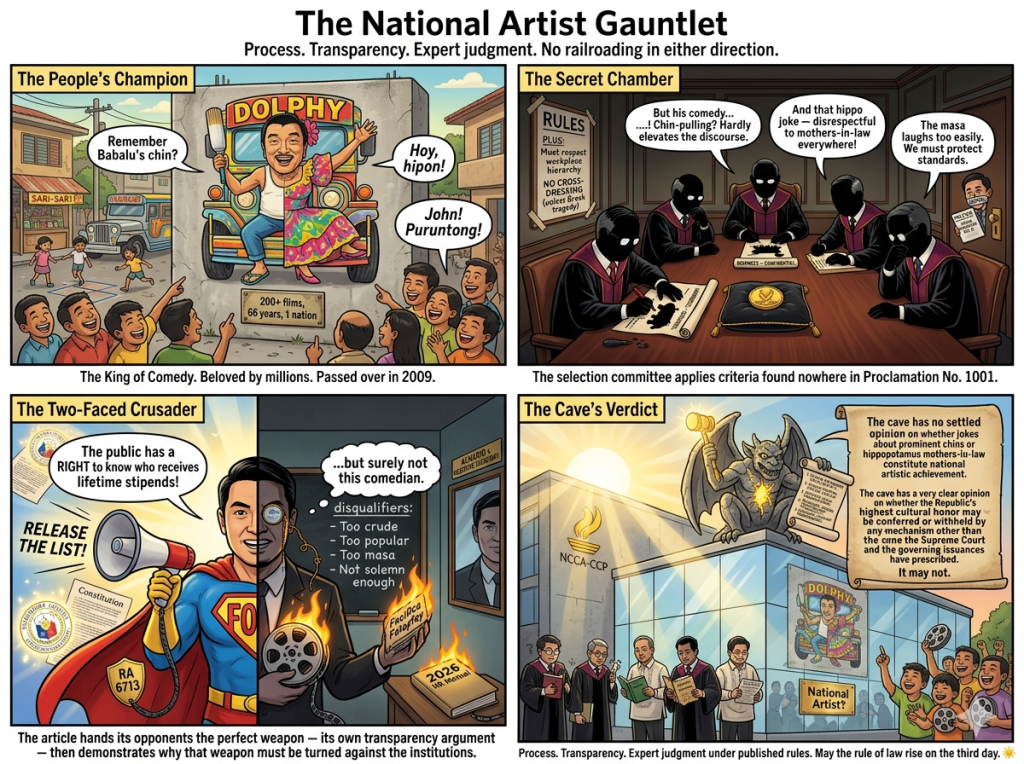
The factual predicate is uncontested. Dolphy made more than two hundred films across sixty-six years. He was the dominant comedic presence on Philippine screens and television from the 1950s through the 2000s.
His signature characters — from the long-suffering Dario in the John & Marsha franchise to the gender-bending Facifica Falayfay — were watched by generations who found in them a recognizable portrait of underclass resilience, family chaos, and the small victories of the powerless. In 2009 he was considered and passed over. In July 2025, Manila Third District Representative Joel Chua filed House Resolution No. 41 urging his posthumous conferment. Vandolph Quizon has expressed the family’s hope. The NCCA-CCP nomination list remains, by institutional habit, confidential. That is the entire matrix.
The article’s aesthetic case collapses under elementary legal scrutiny. It complains that Dolphy’s comedy relied on physical mockery (the famous Babalu chin-pulling scenes), on equating a hippopotamus with his mother-in-law, and on plots that celebrated insubordination at the workplace. These observations are factually accurate for much of the oeuvre. They are also irrelevant to the governing criteria.
The ONA guidelines speak of “vision, unusual insight, creativity and imagination, technical proficiency of the highest order” in expressing Filipino culture, traditions, history, way of life, and aspirations. They do not contain a footnote requiring solemnity, forbidding physical comedy, or demanding that characters respect managerial authority. To disqualify a lifetime body of work because it fails a test the Republic never wrote into law is not criticism; it is extra-legal moral legislation dressed in cultural concern.
The deeper fallacy is presentism. Comedy that played to audiences navigating martial law, economic crisis, and authoritarian pomp looks crude when judged by 2026 human-resources manuals. The same charge could be leveled at Aristophanes, at Chaplin’s treatment of the powerful, or at any popular art form that encodes resistance in laughter rather than manifestos.
The article’s horror at “disrespect for persons in authority” would, if consistently applied, disqualify large stretches of Philippine protest literature and cinema. Laughter has always been one of the few weapons available to people who cannot afford to be solemn in the face of power. That Dolphy wielded it in Tagalog, on commercial television, for the masa rather than the seminar room does not diminish the achievement; it defines its cultural location.
The counter-case is equally imperfect but legally more coherent. Comedy is not a lesser art; it is a technically ferocious one. Sustained timing, physical control, and the ability to make millions laugh through dictatorship and poverty require craft of a high order. Jose Javier Reyes has noted that it is considerably harder to make an audience laugh than to make it cry. Lea Salonga has argued that Dolphy must be judged on his body of work, not on contemporary sensitivities retrofitted to 1970s material.
The influence on subsequent comedians — Vic Sotto, Joey de Leon, Michael V., the long-form sitcom structure itself — is measurable. Whether that influence “elevated” comedy according to university standards or simply consolidated a popular tradition that spoke authentically to Filipino experience is a question of aesthetic ideology, not statutory disqualification.
The legal framework that actually governs the dispute is settled. In Almario v. Executive Secretary, G.R. No. 189028 (July 16, 2013), the Supreme Court voided presidential proclamations that bypassed the NCCA-CCP expert process and conferred the title on persons not on the shortlist. The Court held that the multi-level deliberation by cultural experts is constitutionally indispensable. It also held that the President retains discretion to proclaim all, some, or none of the recommendees.
The ruling cuts both ways: political pressure to force Dolphy onto the list violates Almario; bureaucratic or ideological resistance that substitutes personal taste for the published criteria is equally vulnerable to challenge as grave abuse if it can be shown to be pretextual. Representative Chua’s resolution is political signaling, not legal compulsion. It cannot bind the boards.
The transparency argument advanced by the article is its only durable contribution. Article III, Section 7 of the 1987 Constitution guarantees the right to information on matters of public concern. Article XI, Section 1 of the 1987 Constitution declares that public office is a public trust. Republic Act No. 6713 (The Code of Conduct and Ethical Standards for Public Officials and Employees) requires officials to respond to requests for information within fifteen working days and imposes liability for willful refusal. Executive Order No. 2, s. 2016, operationalizes freedom of information for the executive branch.
The Supreme Court has repeatedly held, in Legaspi v. Civil Service Commission (G.R. No. 72119, May 29, 1987) and Chavez v. Presidential Commission on Good Government (G.R. No. 130716, September 22, 1998), pursuant to Article III, Section 7 of the 1987 Constitution, that government records are presumptively public and that the burden of justifying secrecy rests on the agency. A list of persons who may receive lifetime stipends from the national treasury does not fall within any recognized exception for deliberative process privilege. The NCCA and CCP’s continued treatment of the nominee list as confidential is an institutional reflex, not a legal shield. Refusal to disclose upon proper request exposes the heads of both agencies to administrative and potentially criminal liability under RA 6713 and Republic Act No. 6770 (The Ombudsman Act of 1989). On this point the article is not merely correct; it is operationally useful.
The motivations of the key stakeholders are transparent once the legal stakes are clear. The Quizon family seeks posthumous validation of a patriarch’s dominance and the commercial value that may attach to an elevated brand. Representative Chua seeks populist credit in a district where Dolphy’s everyman persona still resonates. The cultural-academic elite that has historically opposed Dolphy seeks to preserve a definition of artistic excellence that privileges formal innovation and intellectual seriousness over mass commercial endurance. The NCCA and CCP boards, scarred by the 2009 Almario litigation, default to opacity to protect whatever remains of their deliberative autonomy. The Mabuhay C. Bangko piece appears to combine genuine procedural concern with an aesthetic conservatism that views popular comedy as a threat to standards. All of these positions are human; none of them overrides the requirement that the Republic follow its own published rules.
The possible resolutions are few and stark. If the NCCA-CCP boards conduct their review under the Almario constraints, apply only the published criteria, and either recommend or decline to recommend Dolphy, the outcome — whatever it is — carries institutional legitimacy. If a president proclaims him without a processed list, or if Congress attempts to legislate the title, the act repeats the 2009 error and invites certiorari. If the boards reject him on grounds the guidelines do not contain, the decision is vulnerable to the same legal attack the article levels at secrecy. The only scenario that strengthens the Order rather than further damaging it is sunlight: publication of the nominee list, publication of the criteria actually applied, and a decision rendered by the expert panels the law created for that purpose.
The broader damage is already visible. Every politicized or opaque episode further erodes public confidence that the highest cultural honor is awarded on merit rather than connections, noise, or ideological veto. It tells the majority of Filipinos whose daily experience Dolphy chronicled that their laughter does not count as culture unless certified by people whose credentials are academic rather than box-office. It tells future artists that longevity and audience connection are secondary virtues. The Order of National Artists was created to honor those who shaped the nation’s cultural heritage. It was not created to ratify the aesthetic preferences of any single class or generation.
The demands are therefore narrow and non-negotiable.
- The NCCA and the CCP must cease treating the nominee list as a state secret and release it upon request under EO No. 2 and RA 6713.
- They must publish the names under consideration, the criteria applied at each stage, and a summary of the expert deliberations once a shortlist is formed.
- The boards must apply only the criteria the Republic has published and must not invent additional disqualifiers about “elevating” comedy or respecting workplace hierarchy.
- The President must respect the Almario boundary: choose from a properly processed list or choose none.
- Congress must stop the performative resolutions that function as political pressure on an expert body.
- Those who believe Dolphy’s work fails the statutory test must make that case inside the process, with evidence, rather than from newspaper columns that substitute taste for law.
The cave has no settled opinion on whether jokes about prominent chins or hippopotamus mothers-in-law constitute national artistic achievement. The cave has a very clear opinion on whether the Republic’s highest cultural honor may be conferred or withheld by any mechanism other than the one the Supreme Court and the governing issuances have prescribed. It may not.
Process. Transparency. Expert judgment under published rules. No railroading in either direction.
From the depths where truth drips like stalactites: No railroading. No hiding. Only judgment. 🪨
— Barok
Key Citations
A. Legal & Official Sources
- The 1987 Constitution of the Republic of the Philippines. Official Gazette of the Republic of the Philippines, 1987, www.officialgazette.gov.ph/constitutions/1987-constitution/.
- Proclamation No. 1001. Establishing the Order of National Artists. Official Gazette of the Republic of the Philippines, 27 Apr. 1972, www.officialgazette.gov.ph/1972/04/27/proclamation-no-1001/.
- Executive Order No. 236, s. 2003 (Honors Code of the Philippines). Official Gazette of the Republic of the Philippines, 19 Sept. 2003, lawphil.net/executive/execord/eo2003/eo_236_2003.html.
- Republic Act No. 6713 (The Code of Conduct and Ethical Standards for Public Officials and Employees). Eighth Congress, 20 Feb. 1989, lawphil.net/statutes/repacts/ra1989/ra_6713_1989.html.
- Republic Act No. 6770. An Act Providing for the Functional and Structural Organization of the Office of the Ombudsman, and for Other Purposes. Eighth Congress, 17 Nov. 1989. The Lawphil Project, Arellano Law Foundation, lawphil.net/statutes/repacts/ra1989/ra_6770_1989a.html.
- Executive Order No. 2, s. 2016. Operationalizing in the Executive Branch the People’s Constitutional Right to Information and the State Policies to Full Public Disclosure and Transparency in the Public Service and Providing Guidelines Therefor. Official Gazette of the Republic of the Philippines, 23 July 2016, lawphil.net/executive/execord/eo2016/eo_2_2016.html.
- Almario v. Executive Secretary. G.R. No. 189028, Supreme Court of the Philippines, 16 July 2013, lawphil.net/judjuris/juri2013/jul2013/gr_189028_2013.html.
- Legaspi v. Civil Service Commission. G.R. No. L-72119, vol. 150, 29 May 1987, p. 530. The Lawphil Project, Arellano Law Foundation, lawphil.net/judjuris/juri1987/may1987/gr_l-72119_1987.html.
- Chavez v. Presidential Commission on Good Government. G.R. No. 130716, vol. 299, 9 Dec. 1998, p. 744. The Lawphil Project, Arellano Law Foundation, lawphil.net/judjuris/juri1998/dec1998/gr_130716_1998.html.
B. News Reports
- Mabuhay C. Bangko. “Attention NCCA and CCP! Do Not Railroad Dolphy as National Artist.” Kweba ni Barok, 12 June 2026, https://kwebanibarok.com/wp-content/uploads/2026/06/wp-1781320846948.pdf. PDF.
- Rolling Stone Philippines. “Is Dolphy Finally About to Become A National Artist?” Rolling Stone Philippines, 10 July 2025, https://rollingstonephilippines.com/culture/news-culture/dolphy-national-artist-nomination/.
- Cruz, Marinel. “FDCP campaigns for Dolphy’s national artist title, pays tribute to comedians.” Inquirer.net, 31 Aug. 2023, https://entertainment.inquirer.net/516535/fdcp-campaigns-for-dolphys-national-artist-title-pays-tribute-to-comedians.
- Mallorca, Hannah. “Lea Salonga thinks Dolphy is more worthy of National Artist title than her.” Inquirer.net, 22 Sept. 2024, https://entertainment.inquirer.net/577826/lea-salonga-thinks-dolphy-is-more-worthy-of-national-artist-title-than-her.
- ₱9 Billion in ‘Savings’? DILG’s Fire Truck Deal Smells Like Smoke
- ₱8B BBM Pork: CCTV for Every Captain’s Kumpare?
- ₱8.9 Billion, 331 Ghost Police Stations: The TIKAS Scandal Explained

- ₱8.4 Billion, 42,000 Barangays, 1 Election: The “Bawat Barangay Makikinabang” Vote-Buying Masterclass
- ₱75 Million Heist: Cops Gone Full Bandit

- ₱6.77B Ghost Haunts Duterte: RTC Dismisses Mans Carpio’s Desperate Plea
- ₱6.77 Billion and Zero Cash: The Sara Duterte SALN Math That Doesn’t Add Up
- ₱6.7-Trillion Temptation: The Great Pork Zombie Revival and the “Collegial” Vote-Buying Circus

- ₱58.53B, Zero Receipts: The LGSF Pork Barrel Nobody Wants to Name
- ₱53 Million Man Tells ₱695-a-Day Workers to Stop Being ‘Mayabang’: The Audacity of BSP’s Remolona
- ₱4.4 Billion and a Witness Who Can’t Explain It: The Duterte Impeachment’s Most Expensive Non-Answer
- ₱3.06 Billion for Evacuation Centers—But Nobody Knows Where They’ll Stand (Or If They’ll Exist)



Leave a Reply