From Regional Greasing to National Bottleneck: The Cure That Poisoned Housing
By Louis “Barok” C. Biraogo — June 13, 2026
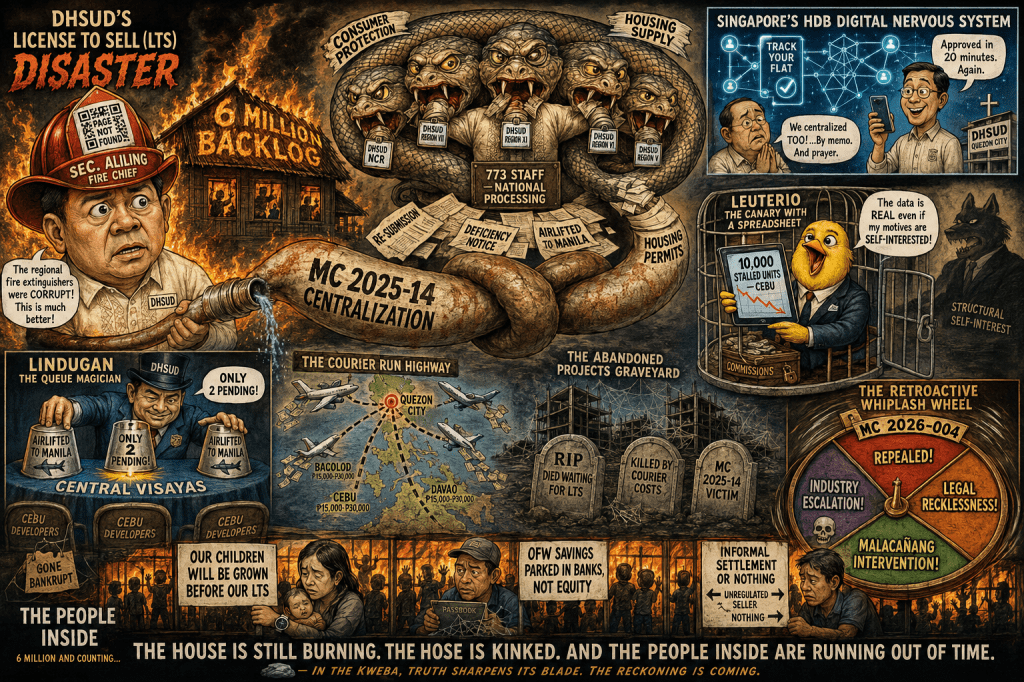
HERE’S the irony in full bloom: a government that declares war on the 6-million-unit housing backlog, trumpets its Pambansang Pabahay program, then funnels all License to Sell applications into one understaffed Quezon City office — only to act bewildered as the pre-selling pipeline seizes up like a cheap engine drowning in seawater.
This is not policy. This is institutional self-sabotage dressed in anti-corruption drag.
The scandal is not merely delay. It is a Greek tragedy in bureaucratic form: the very machinery built to protect homebuyers and enforce standards has become the primary obstacle to delivering the homes the nation was promised.
Call it the regulatory ouroboros — the snake that began by eating regional graft and ended by devouring its own tail, the housing supply.
The Central Contradiction: The Ouroboros Bites Back
Memorandum Circular 2025-14 did not emerge from thin air. It was sold as the cure for documented rot in regional offices — inconsistent interpretations, local political influence, the old HLURB-era vulnerabilities.
Centralize, the theory went, and you standardize, you monitor, you reduce opportunities for grease.
The theory collapsed on contact with reality. Processing times ballooned by 60 to 90 days. Small developers in Cebu, Davao, Bacolod, and Bicol now hemorrhage ₱15,000–₱30,000 per application on courier runs and Manila trips.
At least three Bicol projects have already been abandoned. Leuterio’s claim of more than 10,000 stalled units in Cebu alone may be disputed in its precise number, but the pattern is corroborated by REBAP, CREBA, and multiple national dailies.
The bottleneck did not disappear; it simply migrated to a single choke point with 773 people and no modern digital workflow.
Worse, the same department that centralized authority then attempted retroactive financial punishment via MC 2026-004 on Balanced Housing Development obligations — a circular so legally reckless it had to be repealed after industry escalation to Malacañang.
That whiplash is not a footnote. It is proof of policymaking by panic, not principle. You cannot preach regulatory predictability while changing the rules mid-project and then act surprised when capital flees or prices rise.
Leuterio: The Canary Who Also Sells the Coal
Anthony Gerard O. Leuterio is not a disinterested saint. He is the president of ABREP, founder of Filipino Homes and Rent.ph, a marketing network whose commissions depend on a steady flow of LTS-cleared projects ready for pre-selling.
His outrage is therefore structurally self-interested. When he demands public LTS statistics broken down by region and project type, he is also demanding market intelligence that benefits his own ecosystem.
Yet the data he and allied groups present is not fabricated. OFW families lose affordable options. Supply compression drives prices upward — the most regressive tax on the very demographic the 4PH program claims to serve.
Stalled launches mean stalled construction jobs, stalled bank lending, and a quiet migration of buyers toward informal or unregulated sellers — the precise outcome consumer-protection rules were meant to prevent.
Leuterio is therefore both symptom and signal. He is the market participant who correctly identified that the regulatory “cure” has become more expensive than the original disease.
His advocacy may be laced with commercial motive, but the motive does not invalidate the evidence. In Philippine regulatory politics, sometimes the only people loud enough to be heard are those whose livelihoods are also on the line.
DHSUD’s Defense: Semantic Victory, Strategic Defeat
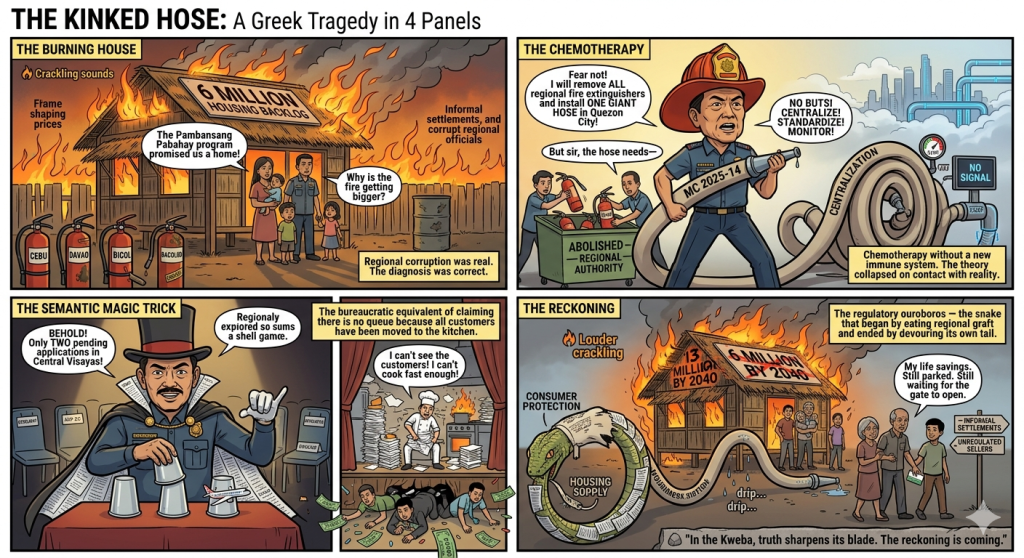
Regional Director Mark Anthony Lindugan’s flat denial — “only two pending applications in Central Visayas” — is technically defensible only if one ignores that the applications have been airlifted to the national office.
It is the bureaucratic equivalent of claiming there is no queue at the restaurant because all the customers have been moved to the kitchen where the single overworked chef cannot see them.
Secretary Jose Ramon Aliling inherited a department already scarred by the Acuzar-era controversies and COA flags. Centralization was his attempt at chemotherapy.
The problem is that the patient also needed a new immune system — digital tracking, real-time dashboards, published service-level agreements, and enough trained evaluators to handle volume. None of that infrastructure arrived with the memo.
What arrived was concentrated discretion without concentrated capacity.
The result is the classic administrative reform failure: the diagnosis (regional corruption and inconsistency) was real; the prescribed remedy (centralization without digitalization or staffing) was catastrophic.
The Root Cause Is Not Graft Alone — It Is Analog Capacity in a Digital Crisis
Under the old Weberian model, strict hierarchy and documentation feel like accountability. In practice they produce exactly what we see: repeat submissions, opaque status, and no public metrics on average processing time, deficiency rates, or approval ratios.
New Public Management and good regulatory governance demand the opposite — measurable outputs, citizen-facing transparency, proportionate burdens, and predictable timelines.
DHSUD currently fails on predictability and timeliness while claiming necessity. That is not a sustainable position. A regulator that cannot publish its own performance data has forfeited the moral high ground in any debate about “consumer protection.”
Singapore centralized because it first built the digital nervous system and the performance culture. Singapore did not centralize by memo and prayer.
The Only Non-Stupid Path Forward
Full re-decentralization would simply revive the old regional capture risks. The status quo guarantees the backlog climbs toward 13 million by 2040 and the President’s housing narrative collapses into a national punchline.
The only intellectually serious option is the hybrid model already sketched in serious policy circles: restore regional evaluation authority for routine projects while retaining national-level quality audit for high-risk or large-scale developments; mandate a public-private partnership with DICT to deliver a real-time “Track Your LTS” portal within six months; publish monthly approval statistics by region, category, and processing stage; and impose a hard 20–30 day service standard with automatic escalation to ARTA and presidential oversight.
Anything less is theater. Anything more ideological — either pure deregulation or pure central command without capacity — is malpractice.
The Reckoning
DHSUD must immediately publish the last six months of LTS data, region by region, with reasons for delay or deficiency. It must publish a credible digitalization roadmap with milestones and a named implementing team.
It must stop treating transparency as a threat and start treating it as the only remaining source of institutional legitimacy.
If it does not, the consequences will not be abstract. They will be measured in OFW families whose life savings remain parked in banks instead of equity. In construction workers idled. In rising prices that push the next generation of buyers into informal settlements.
In the slow, corrosive realization that the state’s loudest promise — decent housing — is being strangled by its own regulatory architecture.
The six million families waiting do not care which circular or which director is technically correct. They care whether the gate to a legal, LTS-cleared home still opens before their children are grown.
Secretary Aliling walked into a burning house and tried to solve regional arson by removing all the regional fire extinguishers and installing one giant, slow hose in Quezon City. The house is still burning. The hose is kinked. And the people inside are running out of time.
— barok
🪨 In the Kweba, truth sharpens its blade. The reckoning is coming.
Key Citations
News Articles
- Cordova, Calvin. “DHSUD Urged to Fast-Track OK of Housing Projects.” Manila Bulletin, 11 June 2026, mb.com.ph/2026/06/11/dhsud-urged-to-fast-track-ok-of-housing-projects.
- Cordova, Calvin. “DHSUD Urged to Fast-Track Release of License to Sell.” Manila Bulletin, 16 April 2026, mb.com.ph/2026/04/16/dhsud-urged-to-fast-track-release-of-license-to-sell.
- Cabato, Luisa “DHSUD-7 Rejects Claim of 10,000 Housing Units Awaiting Permits.” Daily Tribune, 3 June 2026, https://tribune.net.ph/2026/06/03/dhsud-7-rejects-claim-of-10000-housing-units-awaiting-permits.
- Rappler. “Housing Czar Jerry Acuzar Lost Cabinet Post Due to ‘Internal Conflicts’ – Source.” Rappler, 23 May 2025, https://www.rappler.com/philippines/marcos-accepts-resignation-housing-czar-jerry-acuzar/.
Official Websites and Laws
- Anti-Red Tape Authority. ARTA Official Website, arta.gov.ph/.
- Department of Human Settlements and Urban Development. DHSUD Official Website, dhsud.gov.ph/.
- Department of Information and Communications Technology. DICT Official Website, dict.gov.ph/.
- Housing & Development Board (HDB). e-Services and Digital Transformation. Housing & Development Board, 2026, https://www.hdb.gov.sg/eservices/.
- Republic of the Philippines. Republic Act No. 7279, Urban Development and Housing Act of 1992. Official Gazette, 24 Mar. 1992, www.officialgazette.gov.ph/1992/03/24/republic-act-no-7279/.
- Republic of the Philippines. Republic Act No. 11201, An Act Creating the Department of Human Settlements and Urban Development. Official Gazette, 14 Feb. 2019, www.officialgazette.gov.ph/2019/02/14/republic-act-no-11201/.
- Department of Human Settlements and Urban Development. Memorandum Circular No. 2025-14. Feb. 2026. CREBA, https://creba.ph/wp-content/uploads/2026/02/DHSUD.MC_.2025-014.pdf.
- Department of Human Settlements and Urban Development. Memorandum Circular No. 2026-004. Mar. 2026. CREBA, https://creba.ph/wp-content/uploads/2026/03/DHSUD.MC_.2026-004.Incentvized.New-Guidelines1.pdf.
- Chamber of Real Estate and Builders’ Associations, Inc. (CREBA). Letter to President Ferdinand R. Marcos Jr. re: Appeal for Relief and Recalibration of DHSUD MC 2026-004 Implementing RA 7279. 4 Mar. 2026. CREBA, https://creba.ph/wp-content/uploads/2026/03/Letter-to-PBBM-re-MC-2026-004.pdf.

- “Forthwith” to Farce: How the Senate is Killing Impeachment—And Why Enrile’s Right (Even If You Can’t Trust Him)
- “HINDI AKO NAG-RESIGN!”

- “I’m calling you from my new Globe SIM. Send load!”

- “Mahiya Naman Kayo!” Marcos’ Anti-Corruption Vow Faces a Flood of Doubt

- “Manageable” Debt, Unmanageable Lies: DBM’s ₱21 Trillion Fairy Tale
- “Meow, I’m calling you from my new Globe SIM!”

- “Natrabaho”: One Word, One Ombudsman, and a Judiciary on Trial
- “No Special Jail for Crooks!” Boying Remulla Slams VIP Perks for Flood Scammers

- “Philippine-Controlled” or Yankee Gas Station? The Davao Fuel Depot Farce Exposed

- “PLUNDER IS OVERRATED”? TRY AGAIN — IT’S A CALCULATED KILL SHOT

- “Several Lifetimes,” Said Fajardo — Translation: “I’m Not Spending Even One More Day on This Circus”

- “Shimenet”: The Term That Broke the Internet and the Budget


 KWEBA ni BAROK
Leave a comment