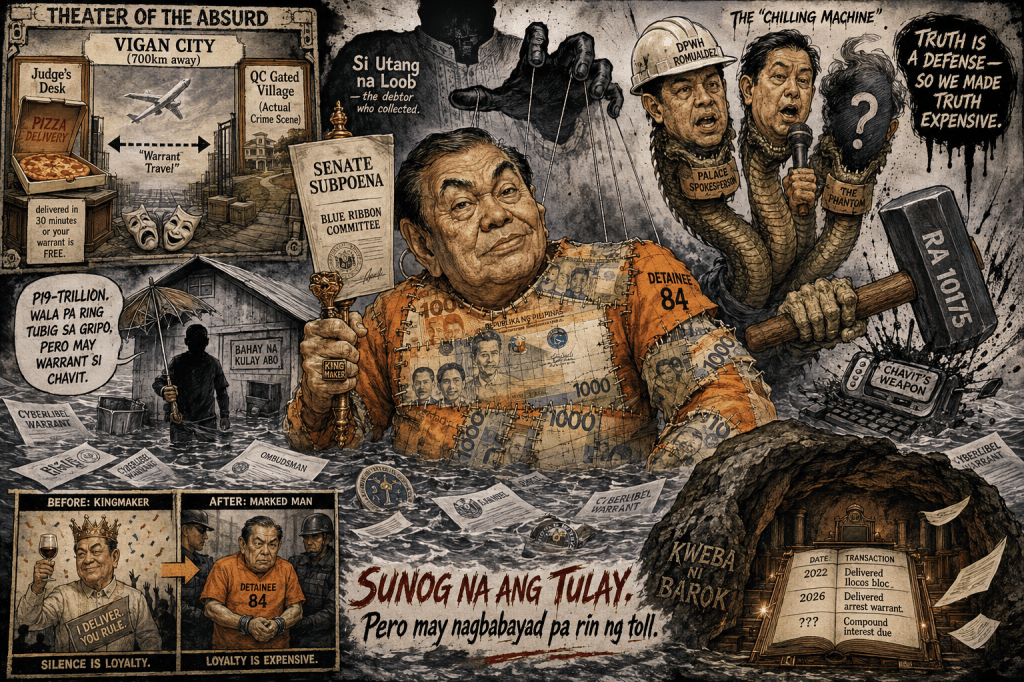
From Kingmaker to Marked Man: The Flood Control Prophet’s “Badge of Honor” Arrest
By Louis ‘Barok‘ C. Biraogo — June 13, 2026
I. The Perp-Walk Premiere: Chavit’s June 11 Booking Spectacle
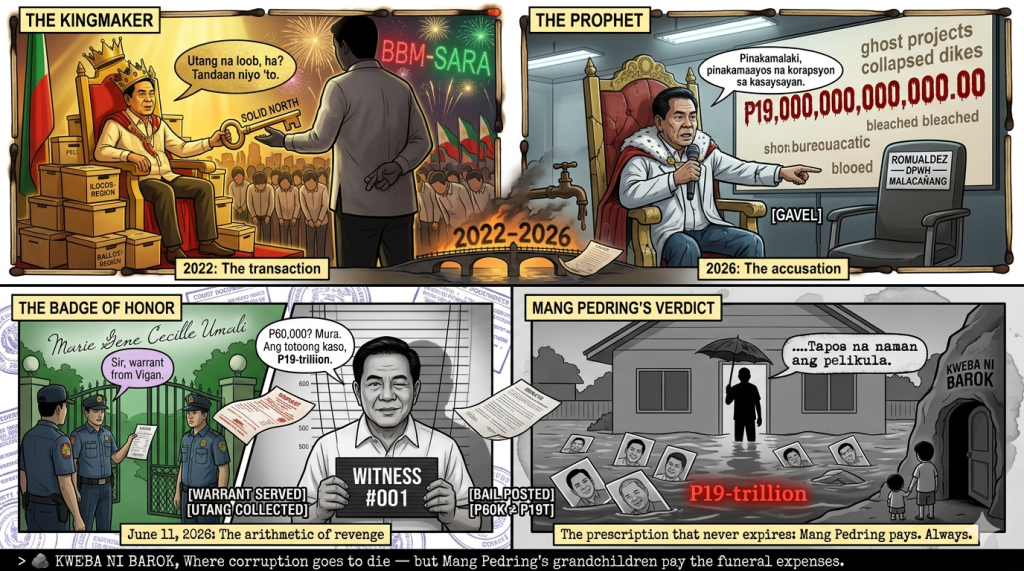
Roll the tape on this classic patronage betrayal: June 11, 2026, late afternoon in a gated village in Barangay Ugong Norte, Quezon City. An 84-year-old former governor, once a kingmaker who delivered the Ilocos bloc to the 2022 Marcos campaign, finds himself at the receiving end of a warrant issued the previous day by Judge Marie Gene Cecille Umali of RTC Vigan City, Branch 21. The charge: violation of Section 4(c)(4) in relation to Section 6 of Republic Act No. 10175 (Cybercrime Prevention Act of 2012) — cyberlibel, upgraded by the penalty enhancer. Quezon City Police District (QCPD) officers serve it at his residence. A booking photo circulates. Bail is fixed at a curiously modest P60,000. By evening he is free, posting bond and immediately framing the episode as a “badge of honor” and political harassment.
The choreography is almost theatrical in its precision. The warrant originates from Vigan — jurisdictionally convenient for a complainant whose identity remains deliberately opaque — while the arrest unfolds in the national capital where Singson actually resides and posts. No public disclosure of the exact online statements that supposedly crossed into defamation. No named complainant. Just the indelible image of an old man processed like a common criminal at the precise moment he was positioning himself as a Senate Blue Ribbon Committee witness in the flood-control plunder narrative. Singson’s own Bombo Radyo interview that same day only thickened the plot: he refused to name the complainant, called him “a bad person” who once sought his help and then “turned against me,” and directly linked the case to his accusations that former Speaker Martin Romualdez, DPWH, and even the Executive itself were partners in the “biggest and well-orchestrated corruption scheme” involving ghost or substandard flood-control projects. The P19-trillion national debt, he thundered, is borrowed money that was simply stolen.
This is not a routine criminal proceeding. This is the inciting incident of a political thriller whose central mystery is not whether Singson uttered defamatory words online, but who is using the criminal process to shut him up and why now.
II. The Legal Stiletto Called Cyberlibel: RA 10175’s Built-in Chilling Machine
Cyberlibel is not a new crime; Causing v. People (G.R. No. 258524, October 11, 2023) made that clear. It is simply the old Revised Penal Code of the Philippines (Act No. 3815) Article 353 libel — public and malicious imputation of a crime, vice, or defect tending to dishonor — committed through a computer system and punished one degree higher under Republic Act No. 10175 (Cybercrime Prevention Act of 2012). The alchemy is elegant and lethal: what used to be prision correccional becomes prision mayor (six years and one day to eight years). A judge finds probable cause on the basis of a private complaint, issues a warrant, and the machinery of the State — arrest, booking, public humiliation — does the rest long before any trial.
Disini v. Secretary of Justice (G.R. No. 203335, February 11, 2014) upheld the provision’s facial constitutionality for the original author, but left the as-applied challenge wide open precisely for cases like this. The law’s design is SLAPP perfection: criminal penalty + immediate coercive power of arrest + reputational damage via booking photo that no acquittal can fully erase. It requires no state prosecutor to initiate; a private complainant suffices. And when that complainant’s identity is shielded while the accused is paraded, the chilling signal radiates outward with maximum efficiency and minimum political cost to the real powers behind the curtain.
III. The Mastermind and the Passive Referee: Romualdez’s Flame War with the Palace
Singson did not invent the flood-control scandal; the Ombudsman’s own public statements and the Senate Blue Ribbon Committee’s partial report did that work. Assistant Ombudsman Mico Clavano’s April 16, 2026, characterization of Romualdez as “master plunderer” was already a political bomb. Romualdez responded with a sophisticated inhibition motion against Ombudsman Jesus Crispin Remulla, arguing prejudgment and violation of due-process appearance standards. The Marcos administration has played the role of curiously passive referee — watching its former House Speaker and a former ally tear at each other in public while corruption allegations engulf both camps.
The endgame is not legal victory for either side. It is survival and narrative control. Every day the plunder cases remain unfiled while a cyberlibel warrant against a vocal accuser is served with alacrity tells its own story. Singson’s arrest is simply the latest scene in a flame war that threatens to consume the administration’s remaining credibility on accountability.
IV. Patron to Pariah: How Chavit Burned His Own Bridge and Became the Prophet
Singson’s political biography is pure Philippine komiks. He was the transactional kingmaker who helped install the current dispensation. Now he is the pariah-prophet crying plunder in the wilderness, his own earlier graft cases (dismissed by the Sandiganbayan partly on delay grounds) thrown back at him as proof of selective moral outrage. Critics call it hypocrisy. A colder analysis sees survival instinct in a political ecosystem where yesterday’s patron becomes today’s target the moment utang na loob is deemed settled and the bridge is burned (sunog na ang tulay). Once you have publicly accused the powerful of systematic looting, there is no going back. You become feral, unpredictable, and therefore dangerous. That is exactly why the machinery moved against him.
V. The Phantom’s Power: Anonymity as the Ultimate Political Weapon
The most damning piece of evidence in this entire affair is the continuing anonymity of the complainant. In a jurisdiction where private complainants in libel cases are ordinarily named in the Information, the refusal to disclose identity functions as a deliberate political feature, not a bug. It allows the State to maintain the fiction of a purely private grievance while achieving the exact chilling effect it could not secure through overt sedition threats floated earlier by Palace spokespersons. The phantom complainant is the perfect proxy: he (or she) does the dirty work, absorbs none of the political blowback, and insulates the real powers from direct accusations of persecution. Singson’s refusal to name him while branding him a betrayer of utang na loob is itself a cultural verdict more devastating in Ilocano political culture than any court ruling.
VI. Borjal’s Shield and Truth’s Sword: Can the Prosecution Pierce the Defenses?
Singson’s two primary shields are formidable. Under Article 361 of the Revised Penal Code (RPC), when the imputation concerns a public officer’s official duties, truth is a complete defense — and the ongoing Ombudsman investigations, Senate hearings, ICI recommendations, and arrests of other officials in the same scandal supply powerful corroboration. More critically, Borjal v. Court of Appeals (G.R. No. 126466, January 14, 1999) imported the New York Times v. Sullivan actual-malice standard: for public officials on matters of public concern, the complainant must prove with clear and convincing evidence that the statement was made with knowledge of its falsity or reckless disregard of truth. Political speech accusing high officials of plundering the treasury in the middle of active legislative and administrative probes sits at the apex of constitutional protection. The prosecution’s burden is not merely steep; under these facts it is nearly insurmountable.
VII. Silencing the Witnesses: Why This Arrest Was Always About Mang Pedring
This arrest was never primarily about punishing one 84-year-old man for online statements. It was a calibrated message to every other prospective witness in the flood-control cases — the ordinary Mang Pedring in his grayscale house who saw substandard projects or ghost deliveries. If Chavit Singson, with his resources, counsel, and national profile, can be subjected to warrant service and booking spectacle while actively signaling readiness to testify before the Senate, what chance does the barangay-level whistleblower have? The irony is constitutional: the State is using criminal process against a potential witness in a legislative investigation protected by Article VI, Section 21 of the 1987 Constitution of the Republic of the Philippines, raising the specter of obstruction under Presidential Decree No. 1829 (Obstruction of Justice). The chilling effect is not a regrettable side effect. It is the operational objective.
VIII. When the Sword Turns Inward: Institutional Corrosion and the Rule of Law’s Slow Death
The Philippines still lacks a comprehensive anti-SLAPP statute. That legislative vacuum has been weaponized. Every time a critic is arrested on cyberlibel while billion-peso corruption complaints languish, the Ombudsman, the Senate Blue Ribbon Committee, and the entire anti-corruption infrastructure suffer reputational corrosion. The public sees a justice system that moves with alacrity against the accuser and glacial slowness against the accused powerful. That perception is not merely damaging; it is institutionally lethal. It accelerates the very delegitimization of legal processes that the powerful claim to fear.
IX. Possible Teleserye Endings: Quash, Supreme Court Glory, or the Bleeding Appeal
The cleanest legal exit is a Motion to Quash on prescription under Causing v. People (G.R. No. 258524, October 11, 2023) — one year from discovery. If the complained-of posts predate the complaint by more than twelve months, the case dies at the threshold. The most institutionally cathartic resolution is a Supreme Court acquittal that becomes the digital-age Borjal — explicitly extending actual-malice and qualified-privilege doctrines to social-media political commentary on government corruption and declaring that Republic Act No. 10175 (Cybercrime Prevention Act of 2012) cannot be deployed to silence witnesses in active legislative probes. A quiet withdrawal by the phantom complainant would confirm the political character of the prosecution but leave the chilling precedent intact. The most dangerous path is conviction followed by years of appeals — a slow-bleeding constitutional wound that further erodes public trust in the rule of law.
X. The Cave Speaks Its Verdict: This Case Was Never About Libel
This case was never about cyberlibel. It is about who controls the narrative of the flood-control scandal at the exact moment the Ombudsman is preparing plunder charges and the Senate has already rendered a partial report. The law, on every threshold question that matters, favors dismissal: prescription, truth as defense, actual-malice burden, qualified privilege for political speech on public corruption, and the constitutional impropriety of using criminal process to intimidate a legislative witness. The immediate dismissal of this case is not leniency toward Singson. It is a constitutional necessity.
Mang Pedring stands in the doorway of his gray house and watches the same script he has seen performed across seven administrations. The powerful file cases. The booking photos circulate. The warrants issue at politically convenient moments. And then, with the stubborn regularity that has outlasted every strongman, greed does what it always does: it consumes its own. The P19-trillion debt is not an abstraction. It is the compound interest on decades of systematic looting — the bill Mang Pedring’s grandchildren will pay for projects never built and flood control that never controlled any flood.
That truth — unlike the phantom complaint, unlike the booking photograph, unlike the June 10, 2026 warrant — cannot be prescribed, quashed, or bailed out.
🪨
May the rule of law rise on the third day.
Kweba ni Barok — Where corruption goes to die. This dispatch constitutes protected political expression and satirical commentary under Article III, Section 4 of the 1987 Philippine Constitution and Article 19 of the International Covenant on Civil and Political Rights. All legal citations are for analytical and commentary purposes and do not constitute legal advice. The cave watermark is non-negotiable.
Key Citations
A. Legal & Official Sources
- Philippines, Congress. The 1987 Constitution of the Republic of the Philippines. Official Gazette of the Republic of the Philippines, 1987, www.officialgazette.gov.ph/constitutions/1987-constitution/.
- Philippines, Congress. Republic Act No. 10175: An Act Defining Cybercrime, Providing for the Prevention, Investigation, Suppression and the Imposition of Penalties Therefor and for Other Purposes. 12 Sept. 2012, www.officialgazette.gov.ph/2012/09/12/republic-act-no-10175/.
- Philippines, Office of the President. Presidential Decree No. 1829: Penalizing Obstruction of Apprehension and Prosecution of Criminal Offenders. 16 Jan. 1978, https://lawphil.net/statutes/presdecs/pd1981/pd_1829_1981.html.
- Philippines, National Assembly. “Act No. 3815, s. 1930.” Official Gazette of the Republic of the Philippines, 8 Dec. 1930, http://www.officialgazette.gov.ph/1930/12/08/act-no-3815-s-1930/.
- Philippines, Supreme Court. Causing v. People. G.R. No. 258524, 11 Oct. 2023, https://lawphil.net/judjuris/juri2023/oct2023/gr_258524_2023.html.
- Philippines, Supreme Court. Disini v. Secretary of Justice. G.R. No. 203335, 11 Feb. 2014, https://lawphil.net/judjuris/juri2014/feb2014/gr_203335_2014.html.
- Philippines, Supreme Court. Borjal v. Court of Appeals. G.R. No. 126466, 14 Jan. 1999, https://lawphil.net/judjuris/juri1999/jan1999/gr_126466_1999.html.
B. News Reports
- Sigales, Jason. “Chavit Singson Arrested, Released on Bail over Cyberlibel.” Inquirer.net, 12 June 2026, newsinfo.inquirer.net/2245068/chavit-singson-arrested-released-on-bail-over-cyberlibel.
- “Chavit Singson Cries Political Harassment in Arrest for Cyberlibel.” Inquirer.net, 12 June 2026, newsinfo.inquirer.net/2245105/chavit-singson-cries-political-harassment-in-arrest-for-cyberlibel.
- Cua, Aric John Sy and Abanilla, Izel. “Chavit Singson Arrested for Cyberlibel but Posts Bail.” Manila Times, 12 June 2026, www.manilatimes.net/2026/06/11/news/chavit-singson-arrested-for-cyberlibel-but-posts-bail/2363460.
- “Ang Hirap Maging Mahirap”: The PAO Scandal That Proves Government Contempt Is Nothing New
- “Far-Off” My Axx: Malacañang’s Claire Castro Drowns in Her Own Legal Gaslighting
- “Forthwith” to Farce: How the Senate is Killing Impeachment—And Why Enrile’s Right (Even If You Can’t Trust Him)

- “HINDI AKO NAG-RESIGN!”

- “I Know Nothing”: Baste Duterte’s Amnesia Defense Meets ₱33M in GenCorp Contracts

- “I’m calling you from my new Globe SIM. Send load!”

- “Mahiya Naman Kayo!” Marcos’ Anti-Corruption Vow Faces a Flood of Doubt

- “Manageable” Debt, Unmanageable Lies: DBM’s ₱21 Trillion Fairy Tale
- “Meow, I’m calling you from my new Globe SIM!”

- “Natrabaho”: One Word, One Ombudsman, and a Judiciary on Trial
- “No Special Jail for Crooks!” Boying Remulla Slams VIP Perks for Flood Scammers

- “Philippine-Controlled” or Yankee Gas Station? The Davao Fuel Depot Farce Exposed




Leave a comment