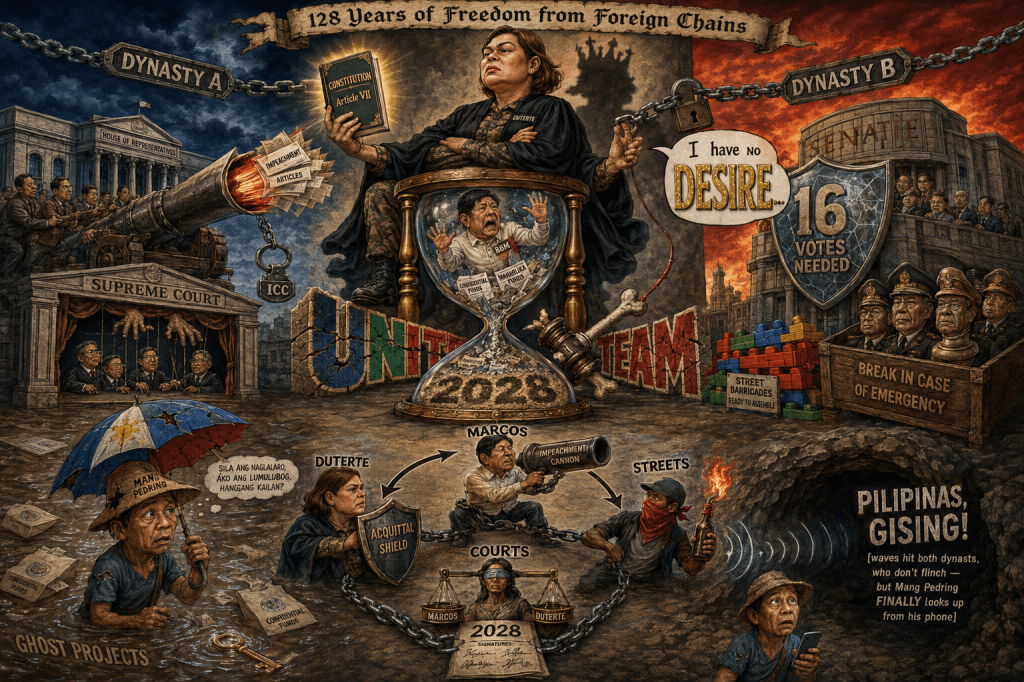
Rejecting the Grab Today, Positioning for the Throne Tomorrow
By Louis “Barok” C. Biraogo — June 14, 2026
ON the 128th anniversary of Philippine independence, as the nation sang of freedom from foreign chains, Vice President Sara Zimmerman Duterte stood in Davao City and declared she had no desire to grab Bongbong Marcos’s position. She wanted Filipinos to witness, “until the very end,” just how shameless the President is. It was a statement of constitutional restraint delivered with the precision of a political assassin.
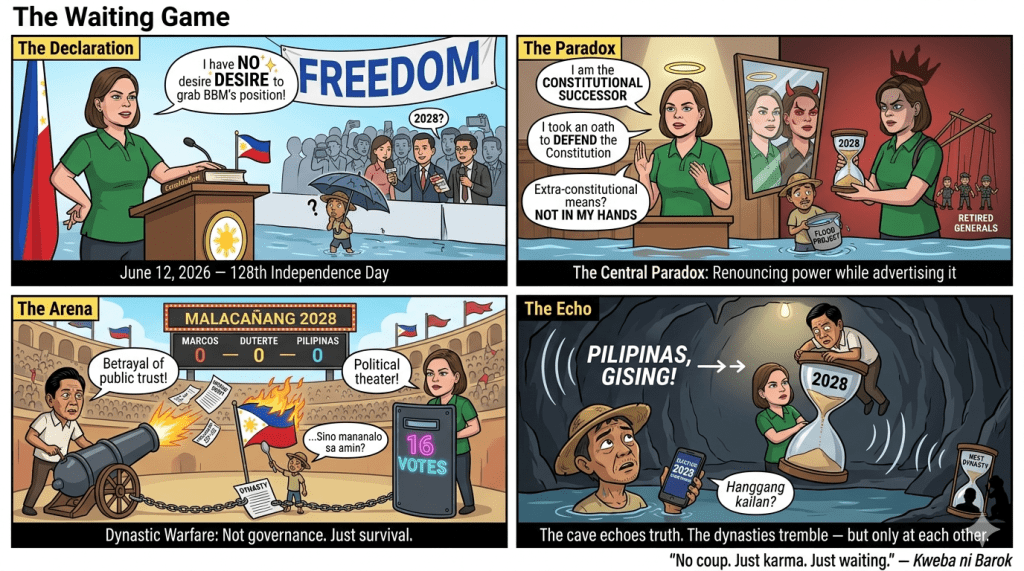
The Central Paradox of Restraint and Reminder
She simultaneously rejected extra-constitutional shortcuts urged by retired officers while reminding the nation she remains the constitutional successor under Article VII, Section 8 of the 1987 Constitution. In one breath she repudiated a coup and in the next she brandished the very succession she claims to forswear.
This is the central paradox of the moment: a public renunciation of illegitimate power that functions as its most sophisticated advertisement. Sara Duterte has executed a masterclass in strategic ambiguity—she will not seize the throne unconstitutionally, yet she will ensure the people see the incumbent’s failures until the throne becomes hers by default in 2028.
Dynastic Warfare, Not Governance
This is not governance. This is dynastic warfare between two families whose rivalry has already consumed the UniTeam alliance, the confidential funds controversy, the ICC surrender of Rodrigo Duterte, and now the second impeachment of the sitting Vice President. The Marcos camp fires the House impeachment cannon—257-25 on May 11, 2026—on charges of betrayal of public trust, graft, and alleged plots against the First Family (see detailed coverage). The Duterte camp holds the Senate acquittal shield, its allied majority making the 16-vote conviction threshold a steep climb. The courts remain, for now, an administration asset. The streets and the latent loyalty of retired officers remain a Duterte reserve. Neither side fights for the Republic; each fights to annihilate the other’s capacity to control Malacañang after 2028.
Advance Maneuvering for 2028
Every maneuver is calibrated for that election. Sara Duterte’s February 18, 2026 declaration of presidential candidacy made the timeline explicit. The Marcos machinery’s rush to disqualify her through impeachment is the logical counter. The retired officers’ recruitment within the AFP—confirmed by Senator Lacson yet assessed as unlikely to succeed because the institution remains professional—is not abstract patriotism; it is insurance for a Duterte restoration. The “shameless BBM” formulation on Independence Day is not spontaneous moral outrage; it is the opening argument of the 2028 campaign: let the incumbent finish his term so the electorate can judge him guilty by acclamation. This is not statesmanship. This is sophisticated posturing conducted through the captured instruments of the state.
The Mutual Destruction Pact and National Tragedy
This is the mutual destruction pact at its rawest: Marcos holds the House and its impeachment cannon. Duterte commands the Senate and its acquittal shield. He controls the courts—for now. She holds the streets—if she chooses. Neither can finish the other without finishing themselves. And caught in the middle is the Filipino people watching two dynasties turn the Republic into their personal arena.
A Senate conviction would manufacture a martyr whose narrative power could dominate 2028 through surrogates or direct resurrection. An acquittal by the Senate or a Supreme Court intervention—invoking its expanded judicial review under Article VIII, Section 1 and the Francisco v. House of Representatives precedent—would confirm that impeachment has degenerated into mere political theater.
An actual People Power escalation would expose participants to rebellion under Articles 134–136 of the Revised Penal Code (rebellion, insurrection, and related offenses) and Republic Act 6968 (RA 6968) on coup d’état, while triggering the very state-of-rebellion powers Marcos could invoke under Article VII, Section 18. Between these two dynasties, si Mang Pedring—the taxpayer funding ghost flood projects, the citizen whose institutions erode daily—watches the gladiatorial spectacle and wonders why, on Philippine Independence Day, the greatest threat to liberty is not a colonial master but two families fighting over whose hands will hold the keys to Malacañang in 2028.
Legal Framework and Ethical Obligations
Legally, Sara Duterte’s constitutional analysis is correct but incomplete. Article XI, Section 2 permits removal of the President only through impeachment for culpable violation of the Constitution, treason, bribery, graft and corruption, other high crimes, or betrayal of public trust. The Vice President has no unilateral authority to precipitate succession. Her oath under Article VII, Section 5—to preserve and defend the Constitution—prohibits both active destabilization and studied acquiescence that invites it. Retired officers recruiting active personnel violate the Articles of War and civilian supremacy under Article II, Section 3.
The Marcos camp’s second impeachment, filed after the Supreme Court’s July 25, 2025 one-year bar ruling, tests whether Article XI remains an accountability mechanism or has become a dynastic elimination tool. Both sides strain Republic Act No. 6713 (RA 6713), the Code of Conduct and Ethical Standards for Public Officials and Employees’s ethical command of loyalty to the Republic above personal political survival.
Impacts on Institutions and the People
The consequences are already visible. Civil-military relations absorb new stress as the AFP leadership navigates recruitment in silence. The rule of law erodes as every proceeding—impeachment, confidential funds, flood control, ICC cooperation—is perceived as politically instrumentalized. Economic confidence frays under sustained uncertainty. Mindanao’s regional loyalties risk further alienation from a Manila-centric power struggle. The 2028 election itself inherits a legitimacy minefield manufactured today.
The Path Forward: Ending the Cycle
From this searing indictment emerges a single, non-negotiable demand: an immediate end to the widespread, systemic, and institutionalized corruption that treats public funds and institutions as family weapons. All competing political camps—Marcos, Duterte, and any force that would challenge both—must abandon the battlefield and compete through honest, issue-based debate on platforms that confront corruption, deliver real flood infrastructure, and secure genuine accountability for every dynasty without exception.
They must uphold the rule of law not when it protects their succession but as the covenant that shields every citizen from the powerful. Each must check the other’s excesses—the House its impeachment cannon, the Senate its acquittal reflex, the executive its selective prosecutions, the streets its extra-constitutional temptations—with institutional maturity rather than dynastic vendetta. Above all, they must deliver genuine public service and pro-people governance: leaders who treat office as public trust, not inherited arsenal, and who place the welfare of Mang Pedring above the next rotation of power in Malacañang.
The Constitution is not a tightrope for political acrobats calculating 2028 angles. It is the last line of defense a people bled for in 1986. To treat it as dynastic artillery is to betray the independence we celebrated three days ago.
Let the cave echo the truth — and the dynasties tremble.
🪨 Pilipinas, gising!
— Barok
Key Citations
A. News Articles
- “VP Sara Duterte: ‘I Have No Desire to Take Marcos Position’.” Inquirer.net, 12 June 2026, https://newsinfo.inquirer.net/2245291/vp-sara-duterte-i-have-no-desire-to-take-marcos-position.
- “Retired Officers Planning to Grab Power – Lacson.” The Manila Times, 27 Apr. 2026, https://www.manilatimes.net/2026/04/27/news/retired-officers-planning-to-grab-power-lacson/2328747.
- Gomez, Jim. “Philippine Vice President Sara Duterte Announces 2028 Presidential Bid.” Associated Press, 18 Feb. 2026, https://apnews.com/article/philippines-sara-duterte-ferdinand-marcos-jr-4b0cf78be1715e57de67520f9a1b2e7a.
B. Legal and Constitutional Sources
- Republic of the Philippines. The 1987 Constitution of the Republic of the Philippines. Official Gazette, https://www.officialgazette.gov.ph/constitutions/1987-constitution/.
- Supreme Court of the Philippines. Francisco v. House of Representatives. G.R. No. 160261, 10 Nov. 2003. Lawphil Project, https://lawphil.net/judjuris/juri2003/nov2003/gr_160261_2003.html.
- Republic of the Philippines. Republic Act No. 6713: Code of Conduct and Ethical Standards for Public Officials and Employees. Official Gazette, 20 Feb. 1989, https://www.officialgazette.gov.ph/1989/02/20/republic-act-no-06713/.
- Philippines. Republic Act No. 3815: The Revised Penal Code of the Philippines. 8 Dec. 1930. Lawphil Project, https://lawphil.net/statutes/acts/act1930/act_3815_1930b.html.
- Republic of the Philippines. Republic Act No. 6968: An Act Punishing the Crime of Coup d’Etat. Lawphil Project, https://lawphil.net/statutes/repacts/ra1990/ra_6968_1990.html.
C. Reference Works
- Wikipedia contributors. “Second impeachment of Sara Duterte.” Wikipedia, The Free Encyclopedia, https://en.wikipedia.org/wiki/Second_impeachment_of_Sara_Duterte.
- Wikipedia contributors. “2026 efforts to impeach Sara Duterte.” Wikipedia, The Free Encyclopedia, https://en.wikipedia.org/wiki/2026_efforts_to_impeach_Sara_Duterte.
- ₱9 Billion in ‘Savings’? DILG’s Fire Truck Deal Smells Like Smoke

- ₱8B BBM Pork: CCTV for Every Captain’s Kumpare?
- ₱8.9 Billion, 331 Ghost Police Stations: The TIKAS Scandal Explained

- ₱8.4 Billion, 42,000 Barangays, 1 Election: The “Bawat Barangay Makikinabang” Vote-Buying Masterclass

- ₱75 Million Heist: Cops Gone Full Bandit

- ₱6.77B Ghost Haunts Duterte: RTC Dismisses Mans Carpio’s Desperate Plea
- ₱6.77 Billion and Zero Cash: The Sara Duterte SALN Math That Doesn’t Add Up

- ₱6.7-Trillion Temptation: The Great Pork Zombie Revival and the “Collegial” Vote-Buying Circus

- ₱58.53B, Zero Receipts: The LGSF Pork Barrel Nobody Wants to Name
- ₱53 Million Man Tells ₱695-a-Day Workers to Stop Being ‘Mayabang’: The Audacity of BSP’s Remolona
- ₱4.4 Billion and a Witness Who Can’t Explain It: The Duterte Impeachment’s Most Expensive Non-Answer
- ₱3.06 Billion for Evacuation Centers—But Nobody Knows Where They’ll Stand (Or If They’ll Exist)







Leave a Reply