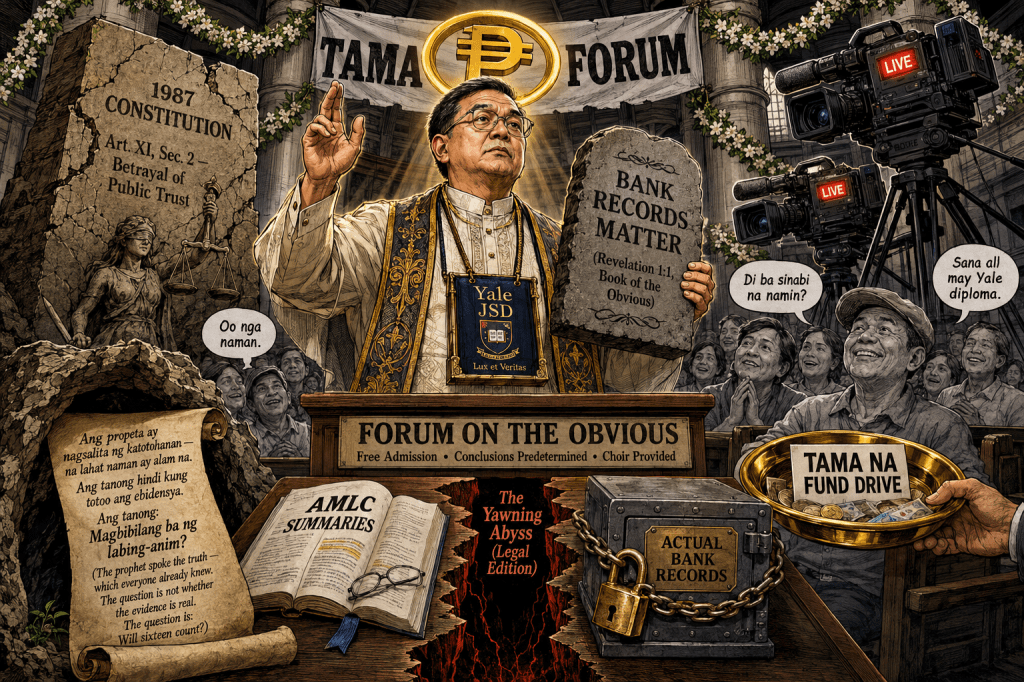
Tony La Viña Preaches the Gospel of Bank Records – But Will It Work?
By Louis ‘Barok‘ C. Biraogo — May 25, 2026
GATHER ’round, children of the republic, for we have been blessed with a prophet. He descended not from Sinai but from Ateneo, clutching not stone tablets but a Yale JSD diploma, and he has come to deliver unto us The Word: It might be fatal to the case if we do not see the official bank accounts of Sara Duterte.
And lo, the people did murmur: “Thank you, Captain Obvious.”
But let us not be too hasty with our mockery. For Tony La Viña—third-place Bar placer, former DENR undersecretary, climate activist, and now apparently the oracle of impeachment Delphi—has done something remarkable. He has stated, with the gravitas of a man who knows exactly which cameras are rolling, that evidence might matter in a trial. Stop the presses. Alert the Vatican. We have a candidate for sainthood.
Here at the Kweba, however, we do not genuflect at the altar of credentials. We ask the impolite questions. When a legal scholar speaks at a forum organized by Taumbayan Ayaw sa Magnanakaw at Abusado Network Alliance (Tama Na) — a group whose name literally translates to “People Against Thieves and Abusers”—is he delivering dispassionate analysis, or is he preaching to the choir while the collection plate makes its rounds? The answer, as with all things in Philippine politics, is: Yes. Both. Neither. It depends who’s asking.
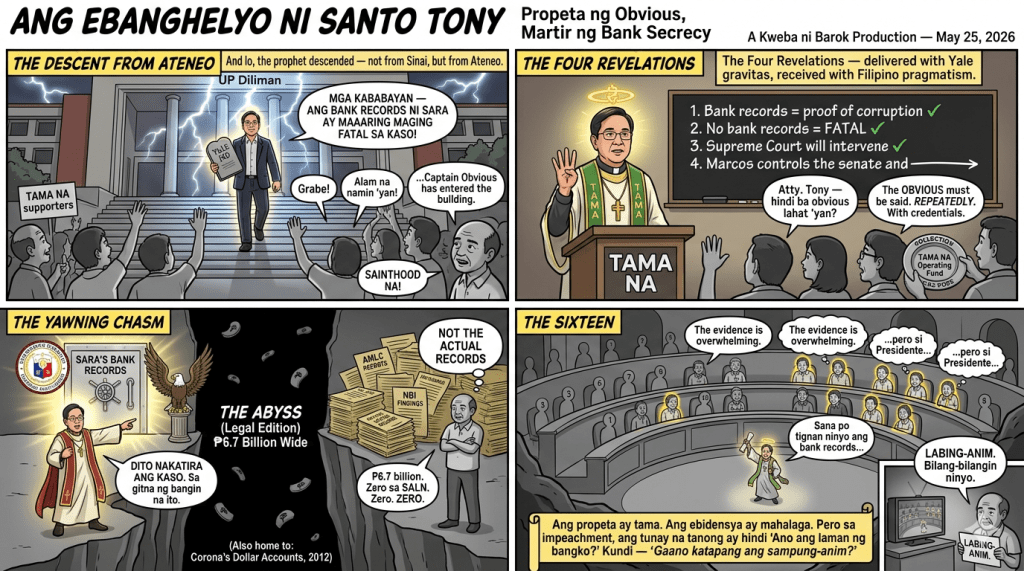
Saint Tony’s Four Revelations: Obvious Truths Served with Yale Flair
La Viña’s sermon, delivered at the University of the Philippines no less—because where else would one announce the obvious with revolutionary fervor?—contains four core assertions. Let us examine each with the seriousness it deserves, which is to say, with the same seriousness one accords a telenovela plot twist.
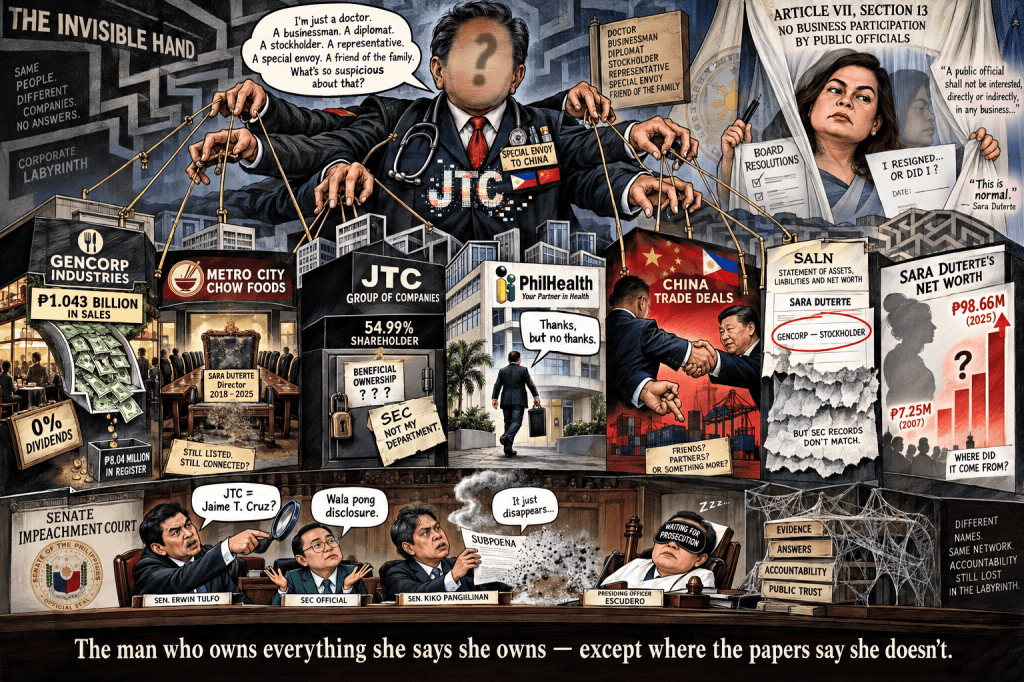
- First: Bank records could “prove corruption.” This is legally plausible and rhetorically safe. The theory rests on unexplained wealth, discrepancies between SALNs and financial flows, and the Anti-Money Laundering Council (AMLC)’s tantalizing spread of numbers: 33 suspicious transactions, 630 covered dealings, P6.7 billion in aggregate flows linked to the Vice President and her husband spanning from 2006 to 2025. That is a lot of zeros—and zero of those zeros appear in Duterte’s Statements of Assets, Liabilities and Net Worth (SALNs). This is what lawyers call a “yawning chasm of unexplained wealth that screams for explanation like a banshee at a funeral.”
- Second: Failure to access the bank accounts may be “fatal” to the prosecution. This is controversial but not unreasonable. Impeachment cases are partly legal and partly political. Direct documentary evidence matters enormously. Without bank records, prosecutors rely on AMLC summaries, COA findings, and whistleblower testimony. But sixteen senator-judges do not vote to perpetually disqualify a sitting Vice President based on PowerPoint presentations alone. They need the documents. The signatures. The opening balances and closing balances and every damned transaction in between. La Viña is effectively arguing: Political cases require politically devastating evidence. The Corona precedent haunts this analysis like a ghost.
- Third: The Supreme Court could intervene. This is not prediction; this is spoiler. The Court has already demonstrated its willingness to wade into this saga, having nullified the first impeachment complaint in 2025 on one-year-bar grounds. Duterte’s legal camp would almost certainly elevate any subpoena dispute involving dollar accounts under Republic Act No. 6426 (Foreign Currency Deposit Act). The constitutional crisis that nearly collapsed the Corona trial in 2012 would replay, same script, different cast.
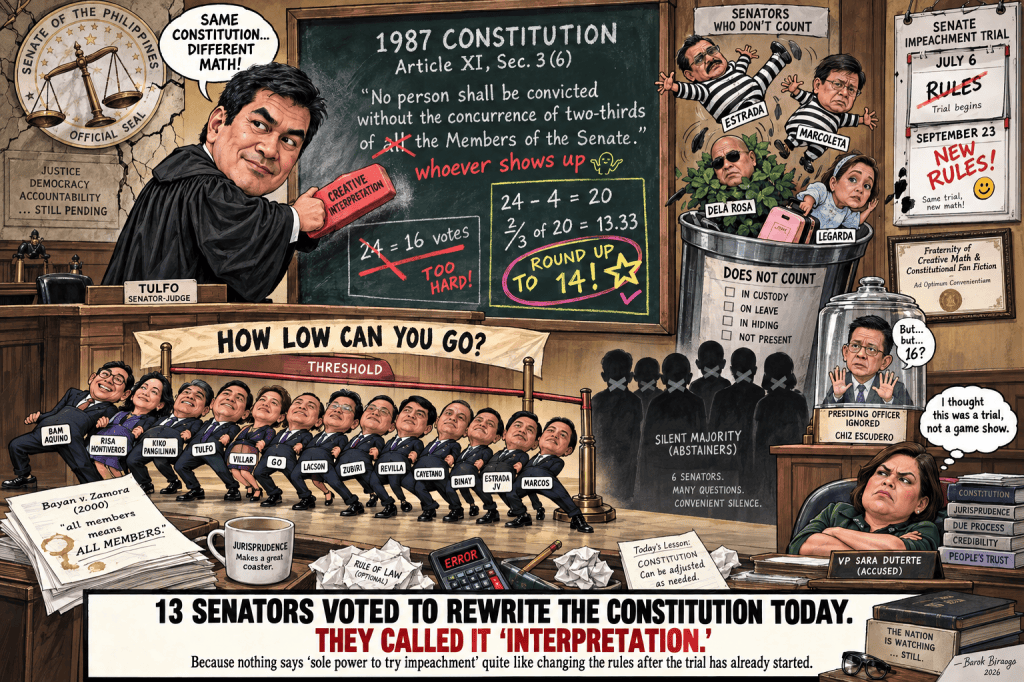
- Fourth: Marcos’ influence may affect senators. This is where La Viña abandons legal analysis for political candor. He notes that during the Corona trial, “there were initially just 12 to 14 votes in favor of convicting,” before President Aquino “persuaded” senators to reach the required 16. The scare quotes around “persuade” are doing extraordinary heavy lifting, carrying the weight of unspoken implications about executive pressure, pending cases against senators, and the dark arts of Philippine presidential politics.
The Case FOR: Bank Records as the Holy Grail
La Viña is substantially correct on the legal architecture. The AMLC-SALN gap is not merely a discrepancy; it is an independently impeachable offense. P230.87 million in flagged transactions between 2019 and 2024—years when Duterte reportedly declared zero cash or cash deposits in her SALNs. Zero. Not “insufficient.” Not “approximate.” Zero. This is a falsification problem under Republic Act No. 6713 (The Code of Conduct and Ethical Standards for Public Officials and Employees), punishable by imprisonment and perpetual disqualification. It is also “betrayal of public trust” under Article XI, Section 2 of the 1987 Constitution of the Republic of the Philippines.
The Commission on Audit (COA) corroboration strengthens the narrative. COA has disallowed P73.28 million in confidential funds spent in eleven days in December 2022—a spending rate of roughly P6.66 million per day, which is either impressively efficient or impressively brazen. A second disallowance of P375 million has been issued. The National Bureau of Investigation (NBI) has found identical signatures appearing under different names on acknowledgment receipts. The Philippine Statistics Authority (PSA) cannot match many of those names to any person in the civil registry. Ghost recipients. Phantom signatures. Real money, vanished.
The Corona precedent is both sword and shield. In 2012, it was the direct confrontation of bank records against SALN declarations that became the smoking gun—not AMLC summaries, not whispers, not “trust me, bro” from a congressman. The Senate Impeachment Court voted to subpoena those records. The political earth moved. La Viña argues: no subpoena, no smoking gun, no conviction.
The Case AGAINST: Why the Gospel Develops a Limp
But the professor’s syllogism develops a limp upon closer inspection.
- First: the AMLC data, standing alone, is not nothing. It is a regulatory compilation generated under Republic Act No. 9160 (Anti-Money Laundering Act), where covered institutions are required to report suspicious transactions and are expressly immunized from bank secrecy violations for doing so. As former Justice Secretary Leila de Lima correctly noted, what AMLC disclosed was not bank records but AMLC’s own reports—regulatorily distinct and legally separate. The prosecution already has substantial corroboration even without the underlying accounts.
- Second: Duterte’s lawyer, Michael Poa, has fired his warning shot across the methodology bow. “I have P1,000 that I deposited then withdrew. The total transaction will be P2,000 even though I have no cash in the bank.” Former Finance Undersecretary Cielo Magno has countered that the reports only capture transactions of P500,000 and above, making the P1,000 hypothetical irrelevant. But the attack line has been drawn. Without the actual account records, the defense will hammer this drum until it drowns out every other sound in the chamber.
- Third: the Foreign Currency Deposit Act is the legal fortress that nearly collapsed the Corona trial. Republic Act No. 6426 (Foreign Currency Deposit Act) provides no impeachment exception. If Duterte holds foreign currency accounts—and given her family’s operational scale, this is not speculative—any subpoena will trigger exactly the constitutional crisis that La Viña claims to want to avoid. The professor’s analysis conveniently elides that the most crucial records may be legally unreachable.
Marcos: The Invisible Puppet Master Pulling Strings
La Viña’s most politically explosive statement is his observation that “the signs coming from President Marcos toward the possible votes are important.” This is legally irrelevant but politically operative—the brutal honesty of Philippine constitutional realism.
Marcos has the most complex calculus in this drama. A convicted and disqualified Sara Duterte removes his most dangerous 2028 rival. But a conviction visibly orchestrated by Malacañang transforms Duterte from alleged corrupter to political martyr. The Duterte base—concentrated in Mindanao, substantial among overseas Filipino workers, fiercely loyal—would not disappear. It would radicalize.
Marcos must therefore achieve conviction without appearing to achieve it. He must persuade without being seen to persuade. He must pressure without leaving fingerprints. This is the art of Philippine presidential politics at its most refined, and if anyone inherited the instinct for it, it is the son and namesake of the man who perfected the form.
La Viña’s call for “pressure on the President to actually take steps” is, in this light, either naive or disingenuous. The President is already taking steps. He simply cannot be seen taking them.
Evisceration of Tony’s Central Thesis: Misdirection Masterclass
Now we arrive at the ritual disembowelment.
La Viña asserts that “the nature and disclosure of financial records serve as the determining factor in whether an impeachment devolves into a symbolic political spectacle or evolves into a credible effort to hold power to account for corruption.”
This is elegant. It is quotable. It is also a magnificent evasion of the actual problem.
The problem is not whether bank records determine the outcome. The problem is that the outcome may be determined regardless of bank records—by political pressure, executive influence, and senatorial self-interest dressed in legal language. La Viña’s formulation implies a binary: either we get the records and achieve credible accountability, or we don’t and suffer symbolic spectacle. But Philippine experience suggests a third possibility: we get the records, they are devastating, and the Senate acquits anyway because sixteen votes cannot be assembled in a political environment where conviction carries unacceptable costs.
By framing the bank records as the determinant, La Viña directs public attention toward a legal evidentiary question and away from the political question that will actually decide the case:
Will sixteen senators vote to destroy a political dynasty that can still hurt them?
This is not analysis. This is misdirection—sophisticated, Yale-trained, but misdirection nonetheless.
The actual determinant is whether the political cost of acquittal exceeds the political cost of conviction for at least sixteen senators. The bank records matter only insofar as they affect that calculus.
Rule of Law: Sacred Incantation or Empty Prayer?
And now, let us speak of the rule of law—invoked in Philippine political discourse with the same frequency that saints are invoked in novenas: repetitively, fervently, and with the quiet understanding that the invocation itself may be the only thing standing between order and chaos.
Calling on senator-judges to ignore politics is like calling on fish to ignore water. It is their element. It is what they are. The Constitution creates an impeachment court composed of politicians and then demands that they behave like judges. This is not a bug; it is a feature. Impeachment is meant to be a political-legal hybrid—a mechanism for removing officials whose conduct has become intolerable to the political community, not merely those who have violated criminal statutes.
The call should not be for senators to ignore politics. The call should be for senators to fear the political consequences of ignoring evidence. This is what La Viña actually means when he urges public “vigilance” and “pressure.” He knows that the rule of law in impeachment is enforced not by judicial review but by the judgment of an angry electorate.
Wisdom from the Cave: Practical Advice for the Impeachment Circus
For the Senate: Subpoena the peso accounts—Republic Act No. 1405 (Bank Secrecy Law) explicitly permits it. Subpoena the dollar accounts and let the Supreme Court stop you; make the Court own the intervention. Reject any motion to dismiss not grounded in clear constitutional defect. Conduct the trial as though the public is watching, because they are.
For the Prosecution: Build the case on what you have, not what you hope to get. Focus on the SALN falsification angle—it does not require proving the source of funds, only that funds existed and were not disclosed. Prepare for trial without dollar accounts; the case must still be winnable on the evidence already in hand.
For Civil Society: Pressure the senators, not just the President. Document everything—every question, objection, and ruling preserved for the next election. Do not make Tony La Viña the face of this movement; he is a credible scholar but also a political actor with a history of aligned advocacy.
For the Public: Watch the trial—not the commentary about the trial, not the social media hot takes, but the actual proceedings. Reject the binary of conviction-as-victory and acquittal-as-defeat. The trial itself serves an accountability function regardless of outcome. A Senate that acquits in the face of overwhelming evidence has revealed itself, and that revelation has political value.
Epilogue: On the Third Day – Public Will vs. Palace Power
Barok, your cave-dwelling chronicler, has long maintained that the rule of law is only as strong as the political will to enforce it. Let me add a corollary: The political will to enforce the rule of law is only as strong as the public’s refusal to accept its violation.
The bankers will guard their vaults. The politicians will guard their prerogatives. The dynasties will guard their survival. The only force that can counterbalance all of them is a public that watches, remembers, and votes accordingly. This is not a satisfying answer. It is not a clean legal doctrine. It is the messy, exhausting, unglamorous work of democratic citizenship.
May the senator-judges fear the people more than they fear the palace. May the evidence matter more than the politics. May the rule of law rise not on the third day but on every day that citizens demand it.
And may Tony La Viña continue to provide excellent legal analysis, even when—perhaps especially when—it serves his political objectives. We can hold both thoughts in our heads simultaneously. We are, after all, complicated creatures here in the cave.
Key Citations
A. Legal & Official Sources
- The 1987 Constitution of the Republic of the Philippines. Official Gazette of the Republic of the Philippines, 1987, http://www.officialgazette.gov.ph/constitutions/1987-constitution/.
- Republic Act No. 1405. An Act Prohibiting Disclosure of or Inquiry into, Deposits with any Banking Institution and Providing Penalty Therefor. 1955, https://lawphil.net/statutes/repacts/ra1955/ra_1405_1955.html.
- Republic Act No. 6426. An Act Instituting a Foreign Currency Deposit System in the Philippines, and for Other Purposes. 1972, https://lawphil.net/statutes/repacts/ra1974/ra_6426_1974.html.
- Republic Act No. 6713. An Act Establishing a Code of Conduct and Ethical Standards for Public Officials and Employees. 1989, https://lawphil.net/statutes/repacts/ra1989/ra_6713_1989.html.
- Republic Act No. 9160. An Act Defining the Crime of Money Laundering, Providing Penalties Therefor and for Other Purposes. 2001, https://lawphil.net/statutes/repacts/ra2001/ra_9160_2001.html.
- Republic Act No. 6426. An Act Instituting a Foreign Currency Deposit System in the Philippines, and for Other Purposes. 4 Apr. 1974, lawphil.net/statutes/repacts/ra1974/ra_6426_1974.html.
- Corona v. Senate of the Philippines. G.R. No. 200242, Supreme Court of the Philippines, 17 July 2012, https://lawphil.net/judjuris/juri2012/jul2012/gr_200242_2012.html.
B. News Reports
- Villanueva, Gillian. “Sara Duterte’s Bank Accounts May ‘Prove Corruption.’” Inquirer.net, 24 May 2026, newsinfo.inquirer.net/2233441/saras-bank-accounts-may-prove-corruption-but.
- “Ang Hirap Maging Mahirap”: The PAO Scandal That Proves Government Contempt Is Nothing New
- “Far-Off” My Axx: Malacañang’s Claire Castro Drowns in Her Own Legal Gaslighting
- “Forthwith” to Farce: How the Senate is Killing Impeachment—And Why Enrile’s Right (Even If You Can’t Trust Him)
- “HINDI AKO NAG-RESIGN!”

- “I’m calling you from my new Globe SIM. Send load!”

- “Mahiya Naman Kayo!” Marcos’ Anti-Corruption Vow Faces a Flood of Doubt

- “Manageable” Debt, Unmanageable Lies: DBM’s ₱21 Trillion Fairy Tale
- “Meow, I’m calling you from my new Globe SIM!”

- “Natrabaho”: One Word, One Ombudsman, and a Judiciary on Trial
- “No Special Jail for Crooks!” Boying Remulla Slams VIP Perks for Flood Scammers

- “Philippine-Controlled” or Yankee Gas Station? The Davao Fuel Depot Farce Exposed

- “PLUNDER IS OVERRATED”? TRY AGAIN — IT’S A CALCULATED KILL SHOT





Leave a comment