
Health Issues, Term-Sharing, or Just Smart Timing to Dodge the Flood Probe?
By Louis ‘Barok‘ C Biraogo — May 21, 2026
CUE the trapo smoke and mirrors: two freshly minted party-list congressmen—neophytes who spent eleven frantic months filing bills, sitting on powerful committees, and voting with the Marcos majority to impeach Vice President Sara Duterte—suddenly hand in resignation letters on the same Monday afternoon.
No press conference. No farewell speech. No public explanation from the House floor.
Just a terse announcement by Zamboanga del Sur Rep. Jeyzel Victoria Yu: drop them from the roll.
The Inquirer framed it with clinical detachment as “the latest exit” after Edvic Yap’s scandal-tainted departure.
But the timing, the silence, the pattern—oh, the pattern—screams something far darker than bureaucratic housekeeping.
This is not routine turnover.
This is the Philippine Congress performing its favorite trick: the silent, strategic exit, stage left, while the audience is still blinking at the last scandal.
Let us deconstruct the official narrative with the cold precision it deserves.
The House’s story is studiously neutral: resignation letters received, members stricken off, vacancies to be filled by the next nominees.
Philstar later floated the “term-sharing agreement” alibi—pre-arranged rotation among party-list nominees, all very civilized, nothing to see here.
Oducado himself stepped forward the next day to offer the health-and-family yarn: asthma, family lung history, dizziness from relentless campaigning since October 2024, the need to watch his kids grow up.
He even denied signing any Justice Committee report on the Duterte impeachment (a denial no one had quite asked for).
Legazpi? Radio silence. Not a single quote. Not a peep.
The gaps are cavernous.
No resignation letters were released.
No prior public disclosure of any term-sharing pact.
No medical certificate waved about.
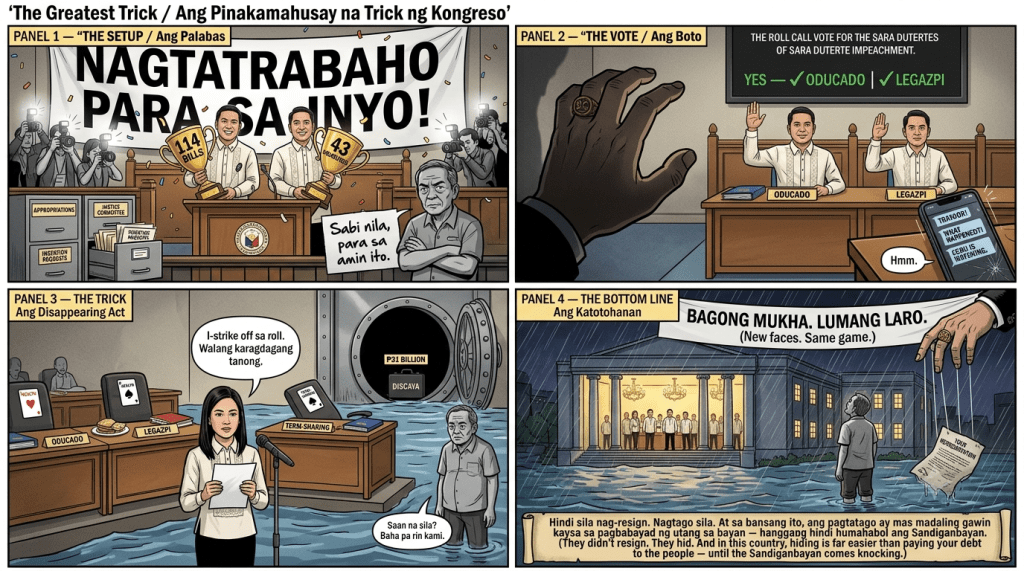
And the timing—mere days after the second Sara Duterte impeachment vote, in the shadow of a multibillion-peso flood-control corruption storm that has already claimed Yap and Elizaldy Co—feels less like coincidence and more like choreography.
The official story asks us to believe two unrelated party-list groups, from two different sectors, executed simultaneous, perfectly legal exits with zero political subtext.
In Philippine politics, that is not an explanation.
That is an insult to the intelligence of every taxi driver, market vendor, and flooded homeowner who has watched this circus for decades.
Now, let us subject every competing theory to the withering scrutiny it demands.
Theory 1: The Institutional Alibi – Genuine Term-Sharing.
It sounds clean. Party-list seats rotate among nominees; Party-List System Act (RA 7941) allows it.
Philstar says it was pre-arranged.
Oducado’s 114 bills and Legazpi’s 43 worker-protection measures had done their symbolic duty.
Next nominee up.
Demolished. Term-sharing may be common, but simultaneous, unannounced resignations by two unrelated groups on the same day—right after a high-stakes impeachment vote—is statistically grotesque.
Real term-sharing is announced upfront like a wedding invitation, not revealed retroactively like an embarrassing receipt.
The legal framework (RA 7941 and COMELEC rules) makes no such rotation mandatory or public.
This alibi is the political equivalent of “the dog ate my homework”—technically possible, but only a fool believes it.
Theory 2: Political Reckoning – Coerced Exit for the Impeachment Vote.
Here the logic bites.
1Tahanan was openly backed by Senator Bong Go, Sara Duterte’s closest ally.
Both men voted Yes on the second impeachment.
Oducado himself admitted supporters in Cebu and Mindanao were flooding him with furious messages: What happened with your vote?
Two weeks later—poof—both are gone.
The case is compelling.
The Duterte machinery does not forgive betrayal lightly.
A Yes vote may have been a temporary bow to the Marcos majority for committee seats (Appropriations! Ways and Means!), but the bill came due.
Oducado’s frantic denials the day after only confirm the pressure.
Legazpi’s silence is the sound of a man who knows the game is over.
If this theory holds, we are witnessing the weaponization of the party-list system as a disposable franchise: use it for a seat, punish it for disloyalty, replace it with a more compliant nominee.
Classic trapo discipline, dressed up as “rotation.”
Theory 3: Scandal Exit – Pre-emptive Flight from the Flood-Control Fire.
This is the one that chills the blood.
The Discaya couple—Pacifico “Curlee” and Cezarah “Sarah” allegedly vacuumed up ₱31 billion in 421 flood-control projects between 2022 and 2025.
Congressional insertions, ghost projects, kickbacks.
Yap resigned in February after the Ombudsman tagged him for ₱70 million in bank transfers from the Discayas.
Co vanished into hiding last September.
Now Oducado (Appropriations, Ways and Means, National Defense) and Legazpi (Justice, Land Use)—committees with ringside seats to budget insertions and procurement—walk out the door together.
No formal charges yet.
No public naming.
But in the Philippine political imagination, resignation amid this storm is never neutral.
It feeds the perception of a legislature in moral freefall.
The pattern is too neat: lawmakers tagged or potentially exposed simply evaporate before subpoenas can bite.
Resignation does not erase liability under the Anti-Graft and Corrupt Practices Act (RA 3019) or the Plunder Law (RA 7080).
It merely buys time to lawyer up, negotiate, or disappear into the private sector.
The public is not stupid.
When smoke billows from the flood-control scandal and two more lawmakers vanish, the reasonable conclusion is not “term-sharing.”
It is “rats leaving a sinking ship.”
The corruption allegations, even unproven, are devastating.
Oducado and Legazpi occupied precisely the panels that greenlight billions in “insertions.”
Their silence in the face of the Discaya revelations, their abrupt departure, their committee placements—all of it feeds the narrative that the party-list system, once meant for the marginalized, has become a patronage laundromat for the connected.
The House has become a place where accountability is not a process but a trapdoor.
You vote the wrong way or see too much, and the floor opens beneath you.
This is not isolated tragedy.
It is systemic decay.
Mid-term flight has become normalized.
The party-list system—constitutional medicine for sectoral representation—has mutated into elite franchises controlled by senators like Bong Go.
Congress treats scandals not as opportunities for justice but as public-relations problems to be managed through quiet exits.
While homeowners in the provinces wade through waist-deep floodwater from substandard projects, their supposed representatives file 114 bills, vote on impeachment, then vanish into the night.
The path forward is brutally simple and politically impossible: an immediate, independent, transparent investigation by the Ombudsman, the Senate Blue Ribbon, and the International Commission of Inquiry—whatever it takes.
Subpoena the bank records.
Freeze assets if necessary.
Publish the full resignation letters.
Demand the next nominees explain, under oath, whether they were installed as political corrections.
Anything less is containment, not accountability.
The rule of law must stop being a suggestion and start being a scalpel.
Barok’s Bottom Line
Two party-list lawmakers who were supposed to speak for workers, the unhoused, and the flood-battered poor have executed the most elegant disappearing act Philippine politics has seen since the last PDAF scandal.
Whether it was health, term-sharing, political punishment, or scandal prophylaxis, the result is the same: the people’s seats are empty, the flood-control billions remain unaccounted for, and the trapos keep perfecting the art of the silent exit.
This is not democracy.
This is a trapo carnival where the clowns change costumes but the rigged game never ends.
The House has become a revolving door for the ambitious and the compromised, while the Filipino taxpayer foots the bill for both the substandard dikes and the convenient resignations.
Until the Sandiganbayan starts handing out non-bailable warrants instead of polite press statements, the only thing that will truly resign is the last shred of public trust.
Welcome to the 20th Congress, folks.
The exits are clearly marked—and the people are always the last to know.
Key Citations
A. News Articles
- “2 Party-List Lawmakers Quit House 2.” Inquirer.net, 2026, https://newsinfo.inquirer.net/2230788/2-party-list-lawmakers-quit-house-2.
- “2 House Lawmakers Resign.” Philstar.com, 20 May 2026, https://www.philstar.com/nation/2026/05/20/2529161/2-house-lawmakers-resign.
- “Nat Oducado Reason Resignation Health Not Impeachment.” Rappler, 2026, https://www.rappler.com/philippines/nat-oducado-reason-resignation-health-not-impeachment/.
- “ACT-CIS Congressman Edvic Yap Resigns.” Rappler, 2026, https://www.rappler.com/philippines/act-cis-congressman-edvic-yap-resigns/.
B. Reports & Studies
- “Insertions in the Storm: When Flood Control Feeds the Corrupt.” Inquirer.net, 2026, https://newsinfo.inquirer.net/2109126/insertions-in-the-storm-when-flood-control-feeds-the-corrupt.
C. Reference Sources
- “Second Impeachment of Sara Duterte.” Wikipedia, 2026, https://en.wikipedia.org/wiki/Second_impeachment_of_Sara_Duterte.
- “Flood Control Projects Scandal in the Philippines.” Wikipedia, 2026, https://en.wikipedia.org/wiki/Flood_control_projects_scandal_in_the_Philippines.
D. Laws and Official Documents
- Republic Act No. 7941. An Act Providing for the Election of Party-List Representatives Through the Party-List System, and Appropriating Funds Therefor, 3 Mar. 1995, https://lawphil.net/statutes/repacts/ra1995/ra_7941_1995.html.
- Commission on Elections. Resolution No. 9366. Rules and Regulations Implementing Republic Act No. 7941, Otherwise Known as the Party-List System Act, sec. 7, https://sites.google.com/view/e-codal/political/omnibus-election-code/other-election-laws/ra-no-7941-party-list-system-act/comelec-res-no-9366.
- Republic Act No. 3019. An Act to Prevent and Suppress Graft and Corrupt Practices by Public Officers and for Other Purposes (Anti-Graft and Corrupt Practices Act), 17 Aug. 1960, https://lawphil.net/statutes/repacts/ra1960/ra_3019_1960.html.
- Republic Act No. 7080. An Act Defining and Penalizing the Crime of Plunder, 12 July 1991, https://lawphil.net/statutes/repacts/ra1991/ra_7080_1991.html.
- ₱8B BBM Pork: CCTV for Every Captain’s Kumpare?

- ₱8.4 Billion, 42,000 Barangays, 1 Election: The “Bawat Barangay Makikinabang” Vote-Buying Masterclass

- ₱75 Million Heist: Cops Gone Full Bandit

- ₱6.77B Ghost Haunts Duterte: RTC Dismisses Mans Carpio’s Desperate Plea
- ₱6.7-Trillion Temptation: The Great Pork Zombie Revival and the “Collegial” Vote-Buying Circus

- ₱53 Million Man Tells ₱695-a-Day Workers to Stop Being ‘Mayabang’: The Audacity of BSP’s Remolona
- ₱3.06 Billion for Evacuation Centers—But Nobody Knows Where They’ll Stand (Or If They’ll Exist)
- ₱10B Ghost in New Clark City: Matibag’s Haunted Séance for Cayetano

- ₱1.9 Billion for 382 Units and a Rooftop Pool: Poverty Solved, Next Problem Please

- ₱1.35 Trillion for Education: Bigger Budget, Same Old Thieves’ Banquet

- ₱1 Billion Congressional Seat? Sorry, Sold Out Na Raw — Si Bello Raw Ang Hindi Bumili

- “Your Paperwork Is Wrong”: Sara Duterte’s Epic Non-Answer Defense





 KWEBA ni BAROK
Leave a comment