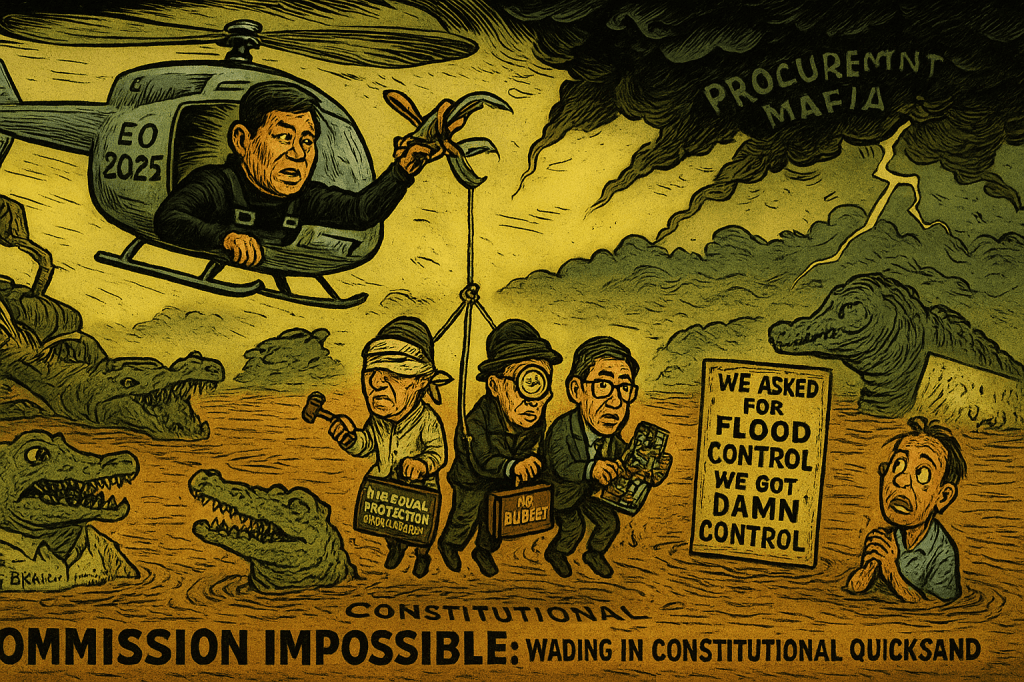
Why three handpicked outsiders, a shaky executive order, and a hostile bureaucracy are a recipe for failure — and another win for corruption.
By Louis “Barok” C. Biraogo — September 9, 2025
I. The Grand Illusion or a Masterstroke?
When a President announces an “independent” commission, my legal nose twitches. I’ve seen this trick before. They roll out a shiny new body, staff it with “outsiders,” and trumpet independence as if credibility can be purchased wholesale. But is this really accountability — or just a Potemkin village built to pacify the mob and the Makati Business Club?
Marcos Jr. whispers of a triumvirate: a justice, an investigator, a forensic accountant. The imagery is cinematic — a dream team cutting through the rot of DPWH flood-control contracts. But pause. Strip away the press releases, and what remains? A three-man squad against a leviathan bureaucracy that eats audits for breakfast. Does anyone really believe they can topple a procurement mafia that has survived five presidents and a dozen Senate hearings?
This, my friends, has all the makings of a political stage play. The sets are lavish, the cast promising, but the ending? Already written.
II. The Ghost of Biraogo v. The Truth Commission
Yes, my ghost lingers still in Padre Faura. When the late President Noynoy Aquino thought he could conjure a Truth Commission, I dragged his handiwork to the Supreme Court — and won. Why? Because no President, however saintly he imagines himself, may create a body that violates the Constitution under the guise of “truth.”
The Court in Biraogo v. Truth Commission taught an iron lesson:
- Target only one administration? That’s unequal protection.
- Usurp powers of the Ombudsman and DOJ? That’s separation of powers suicide.
Now Marcos Jr. flirts with the same abyss. His executive order, still warm in the Palace printer, risks becoming another constitutional stillbirth. Unless he drafts it with surgical precision — neutral scope, fact-finding only, airtight referral to proper agencies — this “independent commission” will collapse under the weight of my very own precedent. Imagine the irony: Marcos Jr., felled not by typhoons or floods, but by the ghost of Biraogo v. Truth Commission.
III. The Dream Team or the Fall Guys?
A justice, an investigator, a forensic accountant. Impressive? Perhaps. But ask yourself: are these hunters or sacrificial lambs?
Three men (or women) against thousands of engineers, contractors, fixers, and bureaucrats — armed only with an executive order and, if lucky, a handful of staff borrowed from the Palace. Without subpoena power, forensic teams, whistleblower protection, and access to COA and DPWH files, they’re not investigators. They’re mascots.
Worse, they risk becoming the fall guys when the commission inevitably stalls. “We tried,” Malacañang will sigh, “but the anomalies were too complex.” The public anger will be absorbed by the commissioners, leaving the administration to dust off its hands and move on. Clever, isn’t it?
IV. The Turf War: Outsiders in the Snake Pit
Make no mistake — this will trigger a bureaucratic knife fight. The Ombudsman, the COA, and the DOJ are constitutionally and statutorily armed to investigate corruption. They don’t take kindly to outsiders stomping on their turf.
Will the Ombudsman open its files? Will COA surrender audit reports that implicate DPWH cronies? Will DPWH bureaucrats hand over blueprints that show ghost projects built on thin air? Don’t hold your breath. More likely, documents will be “missing,” files “reclassified,” and witnesses “transferred.” Bureaucracies are experts at burying truth under mountains of paperwork.
In this snake pit, three outsiders will be strangled by red tape before they even sharpen their pencils.
V. The Budget Question: Who Pays the Piper?
Here lies another landmine. No commission runs on good intentions. It needs staff, offices, fieldwork, and protection. That means money. But Article VI, Section 29 of the Constitution is clear: no money leaves the Treasury without an appropriation by law.
Will Marcos fund this from the Office of the President’s contingent fund? From confidential funds? Or will he dare ask Congress for a supplemental budget? Each path is a trap. Use OP funds, and COA may cry “disallowance.” Ask Congress, and he invites a spectacle where solons can grandstand and clip the commission’s wings. Pay the commissioners hefty honoraria, and the public will howl about fattened outsiders dining while flood victims drown.
Without a transparent, legally sound funding scheme, this commission is dead on arrival — or worse, open to attack as an unconstitutional slush fund.
VI. The Final Reckoning
So what does this mean for us, the flood-battered Filipinos?
- If by miracle it succeeds: DPWH’s rotten procurement system could be cracked open. Corrupt contractors blacklisted. Real flood control projects finally built, saving lives the next time the rains come. A victory not just for the Palace, but for the people.
- If, as history suggests, it fails spectacularly: Public cynicism hardens into granite. The message will be brutal: corruption is untouchable, commissions are for show, and every peso stolen from flood projects is another life washed away. Worse, investors will conclude that the Philippines cannot even police its own dikes, much less its democracy.
This is the hill Marcos’ credibility may die on.
Verdict: Mirage, Masterstroke, or Suicide Mission?
As the man whose case dismantled the Truth Commission, my verdict is clear. Marcos Jr.’s gambit is not a masterstroke. It is a mirage wrapped in legal quicksand. Unless his executive order is drafted with the precision of a scalpel, this commission will share the fate of Aquino’s — struck down, ridiculed, and remembered only as political theater.
Marcos is gambling that three outsiders can slay a dragon. I say they’re being fed to it. And when the floodwaters rise again, it will not be Malacañang that drowns, but the Filipino people.
Key Citations
- Marcos taps 3 gov’t outsiders for flood control project probe — Philippine Daily Inquirer
- 1987 Constitution of the Republic of the Philippines
- Biraogo v. Philippine Truth Commission, G.R. No. 193036 (2010) — Supreme Court of the Philippines

- ₱9 Billion in ‘Savings’? DILG’s Fire Truck Deal Smells Like Smoke
- ₱8B BBM Pork: CCTV for Every Captain’s Kumpare?
- ₱8.9 Billion, 331 Ghost Police Stations: The TIKAS Scandal Explained

- ₱8.4 Billion, 42,000 Barangays, 1 Election: The “Bawat Barangay Makikinabang” Vote-Buying Masterclass
- ₱75 Million Heist: Cops Gone Full Bandit

- ₱63 to the Dollar: The Only Thing Falling Faster Than the Peso Is the Government’s Credibility
- ₱6.77B Ghost Haunts Duterte: RTC Dismisses Mans Carpio’s Desperate Plea
- ₱6.77 Billion and Zero Cash: The Sara Duterte SALN Math That Doesn’t Add Up

- ₱6.7-Trillion Temptation: The Great Pork Zombie Revival and the “Collegial” Vote-Buying Circus

- ₱58.53B, Zero Receipts: The LGSF Pork Barrel Nobody Wants to Name
- ₱53 Million Man Tells ₱695-a-Day Workers to Stop Being ‘Mayabang’: The Audacity of BSP’s Remolona
- ₱4.4 Billion and a Witness Who Can’t Explain It: The Duterte Impeachment’s Most Expensive Non-Answer




Leave a Reply