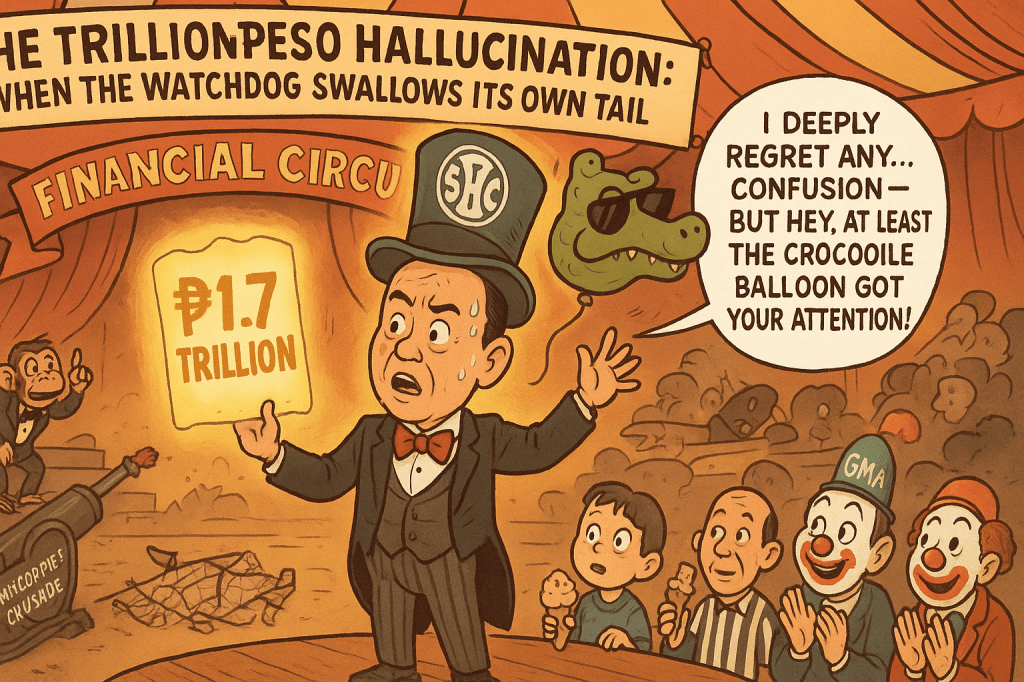
Apocalypse Now? How Lim’s Fake News Flop Betrayed the Market’s Trust
By Louis ‘Barok‘ C. Biraogo — October 11, 2025
The Great Reveal: A Financial Apocalypse That Wasn’t
Imagine the Securities and Exchange Commission (SEC) Chairman Francis Lim, a titan of corporate rectitude, striding to the podium before the Financial Executives Institute of the Philippines (FINEX) on October 7, 2025. With the gravitas of a doomsday prophet, he unveils a cataclysm: a P1.7-trillion market loss, a “weapon of mass wealth destruction” wrought by corruption’s gnarled hand. The room gasps. Portfolios tremble. Here stands the guardian of market integrity, sounding the alarm on a financial Armageddon.
Then, the Philippine Stock Exchange (PSE) clears its throat. The actual loss? A pedestrian P185 billion, a mere 1.2% dip, not the apocalyptic 12% Lim conjured. His trillion-peso bombshell fizzles into a confetti cannon. If this weren’t the nation’s top financial regulator, it’d be a stand-up routine gone wrong. Instead, it’s a tragicomic failure, a masterclass in incompetence that begs the question: what other phantoms lurk in the SEC’s ledger? Dragons guarding GDP? Gnomes juggling the national debt?
The Autopsy of Absurdity: How a Regulator Turned Viral Fiction into Policy Gospel
How does a man like Lim—former PSE president, legal luminary—end up parroting a figure that sounds like it was cooked up in a Reddit thread titled “PhEconomyDoom420”? The answer is a grotesque parade of failures. Lim claimed his P1.7-trillion figure came from a “credible industry report,” which turned out to be as real as a unicorn’s tax return. Was the SEC’s fact-checking team on an extended merienda break? Did a speechwriter mistake a viral X post for a Bloomberg dispatch? Or did Lim’s staff simply shrug and say, “Eh, sounds dramatic enough”?
The root cause is a toxic brew of institutional arrogance and confirmation bias. Lim wanted a number to match his anti-corruption crusade, and P1.7 trillion was a showstopper—never mind that it was nearly ten times the truth. His critical faculties, dazzled by the narrative, took a vacation. This wasn’t a slip; it was a surrender to fiction over fact. The SEC, tasked with safeguarding markets, became a bullhorn for bunk. In a nation where disinformation spreads faster than Manila traffic jams, Lim’s team apparently fell for a fake news post tying a 12% market crash to the so-called Floodgate scandal. No call to the PSE, no glance at official data—just a headlong dive into the digital swamp. If the SEC can’t spot a lie this big, what hope is there for the small investor dodging scams?
The Crocodile Tears: A Non-Apology in Fancy Wrapping
Cue the apology, delivered with all the sincerity of a politician caught with his hand in the cookie jar. “I deeply regret any confusion or concern,” Lim proclaimed, as if the issue were a misfiled memo rather than a P1.5-trillion hallucination. This is the non-apology’s Mona Lisa: regret the reaction, not the recklessness. “My sole intent was to underscore the vital importance of integrity,” he added, as if noble motives could erase a breach of trust wider than Manila Bay.
Apologists call this crisis management done right. Lim owned the error, spared his staff the guillotine, and kept the SEC’s moral banner aloft. PSE President Ramon Monzon tossed him a lifeline, agreeing that corruption indeed harms markets, as if to say, “Points for effort, but maybe try a spreadsheet next time.” Outlets like GMA Network reported the apology factually, including supportive comments from the PSE, amid a bureaucracy often slow to admit fault.”
But hold the applause. This isn’t accountability; it’s damage control in a suit. An apology doesn’t undo the fact that the SEC’s top dog peddled fiction that could’ve spooked markets and scared off investors. Where’s the probe into how this happened? Where’s the pink slip for the staffer who thought “credible report” meant “random X thread”? Without consequences, this is just a press release in disguise. In the gilded halls of power, accountability means a soundbite, not a sacrifice.
Rx for the Ridiculous: A Crash Course for the Factually Challenged
How do we keep the SEC from starring in another episode of “Regulators Gone Wild”? Here are some groundbreaking prescriptions, served with a side of scorn:
- Prescription 1: Discover the Internet. This radical tool, known as a “search engine,” lets you verify claims with actual data.
- Step one: Visit pse.com.ph.
- Step two: Read the numbers.
- Step three: Avoid sounding like you got your stats from a horoscope.
- Prescription 2: Social Media Isn’t a Source. If your data comes from a user named “PinoyEconSlayer_69,” it’s not a report—it’s a cry for attention. Enroll in a crash course on spotting disinformation. Pro tip: Real reports don’t come with emoji storms.
- Prescription 3: Hire a Teenager. Kids can sniff out fake news faster than a regulator can sign a memo. Pay a Gen Z intern to vet your speeches. They’ll save you from mistaking a TikTok rant for a World Bank brief.
But let’s get serious. The SEC needs a mandatory, ironclad verification protocol for all public statements. Every figure must be cross-checked with primary sources—PSE, Bangko Sentral ng Pilipinas (BSP), Department of Finance (DOF)—and backed by an auditable trail. Staff who skip this step should be fired, publicly, to send a message. Create a real-time data-sharing portal with other agencies to prevent these fumbles. And invest in digital literacy training to stop officials from falling for viral lies. The SEC isn’t a tabloid; it’s the bedrock of market trust.
The Aftermath: When the Market’s Watchdog Chases Its Own Tail
The immediate casualty is Lim’s credibility, now lying in a ditch alongside the SEC’s aura of competence. Investors, already jittery in a market battered by scandals like Floodgate, now wonder if their regulator is more clown than cop. But the real damage is deeper. Lim’s blunder hands a megaphone to every corrupt official he aimed to expose. Picture a politico, neck-deep in graft, waving Lim’s apology like a shield: “See? The SEC’s just making it up!” The anti-corruption fight Lim championed is now a laughingstock, sabotaged by his own hand.
The ripple effects are grim. Foreign investors, already wary of the Philippines’ corruption rap sheet, have another reason to park their money in Singapore or Hong Kong. The Makati Business Club has long warned that graft scares off capital; Lim just added “regulatory incompetence” to the list. In the battle for investor confidence, the SEC chairman didn’t just trip—he handed the enemy a bazooka and pulled the trigger on himself.
This isn’t just one man’s misstep. It’s a system that let a trillion-peso fiction slip into a major speech, unchallenged. It’s a regulator meant to fight misinformation, caught spreading it. Lim’s apology is a Band-Aid on a broken leg. The SEC must rebuild trust with rigorous reforms, or the next phantom loss will cost more than embarrassment—it’ll cost the nation’s economic soul.
Key Citations
- Adonis, Meg J. “SEC Chair Apologizes for Citing ‘Fictitious’ Report.” Business Inquirer, 9 Oct. 2025, business.inquirer.net/551836/sec-chair-apologizes-for-citing-fictitious-report.
- Adonis, Meg J., with a report from. “Marcos Aide: SEC Chief Quoted Fake News on Corruption Loss.” Inquirer.net, 10 Oct. 2025, https://newsinfo.inquirer.net/2122479/marcos-aide-sec-chief-quoted-fake-news-on-corruption-loss. Accessed 10 Oct. 2025.
- “SEC Chair Apologizes for Citing Fictitious P1.7-T Market Loss Report.” GMA News Online, 10 Oct. 2025, https://www.gmanetwork.com/news/money/economy/961874/sec-chair-lim-apologizes-says-p1-7-trillion-stock-market-wipeout-report-fictitious/story/.
- “SEC chairman backtracks on market wipeout claim.” Manila Times, 10 Oct. 2025, https://www.manilatimes.net/2025/10/10/business/top-business/sec-chairman-backtracks-on-market-wipeout-claim/2197895.

- ₱9 Billion in ‘Savings’? DILG’s Fire Truck Deal Smells Like Smoke
- ₱8B BBM Pork: CCTV for Every Captain’s Kumpare?
- ₱8.9 Billion, 331 Ghost Police Stations: The TIKAS Scandal Explained

- ₱8.4 Billion, 42,000 Barangays, 1 Election: The “Bawat Barangay Makikinabang” Vote-Buying Masterclass

- ₱75 Million Heist: Cops Gone Full Bandit

- ₱63 to the Dollar: The Only Thing Falling Faster Than the Peso Is the Government’s Credibility

- ₱6.77B Ghost Haunts Duterte: RTC Dismisses Mans Carpio’s Desperate Plea

- ₱6.77 Billion and Zero Cash: The Sara Duterte SALN Math That Doesn’t Add Up

- ₱6.7-Trillion Temptation: The Great Pork Zombie Revival and the “Collegial” Vote-Buying Circus

- ₱58.53B, Zero Receipts: The LGSF Pork Barrel Nobody Wants to Name
- ₱53 Million Man Tells ₱695-a-Day Workers to Stop Being ‘Mayabang’: The Audacity of BSP’s Remolona

- ₱4.4 Billion and a Witness Who Can’t Explain It: The Duterte Impeachment’s Most Expensive Non-Answer




Leave a Reply