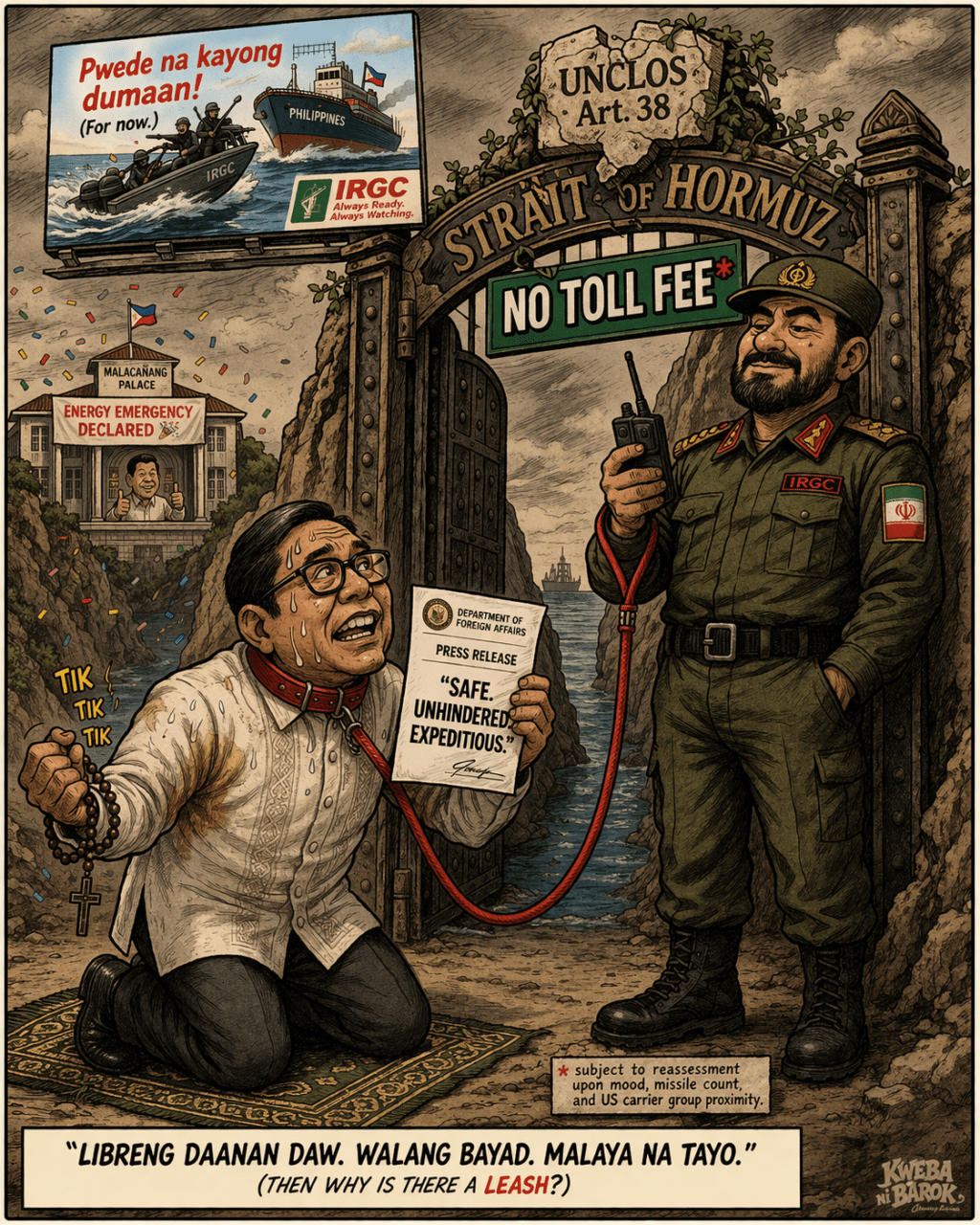
No Toll Fee, Just Hidden Concessions: Why PH’s “Win” Smells Like Capitulation
By Louis ‘Barok‘ C. Biraogo — April 4, 2026
ISIPIN niyo ito, mga ka-kweba: a harried Philippine diplomat in Tehran’s corridors, rosary beads clicking like a Geiger counter, whispering “non-hostile, po” while an IRGC speedboat idles nearby, its crew waving a Philippine-flagged tanker through the Strait of Hormuz the way a barangay tanod waves a tricycle past a flooded intersection—grudging, amused, and fully aware it can revoke the favor with one radio call.
Back in Manila, President Ferdinand R. Marcos Jr. declares a “national energy emergency,” the DFA issues a triumphant press release about “safe, unhindered, and expeditious” passage, and we are all supposed to clap for this masterstroke of statecraft.
As I warned in my last piece, “PH begs Iran: Please call us non-hostile while hugging US bases”. This is not diplomacy. It is the Republic of the Philippines—formal treaty ally of the United States since 1951, host to EDCA bases, quiet cheerleader for the February 28 strikes that killed Khamenei—now on its knees begging the arsonist for a hall pass through the fire it helped ignite.
Iran’s verbal assurance, delivered by Foreign Minister Seyed Abbas Araghchi to Secretary Ma. Theresa Lazaro in a Thursday phone call, is no diplomatic win. It is a leash. A short, fraying one.
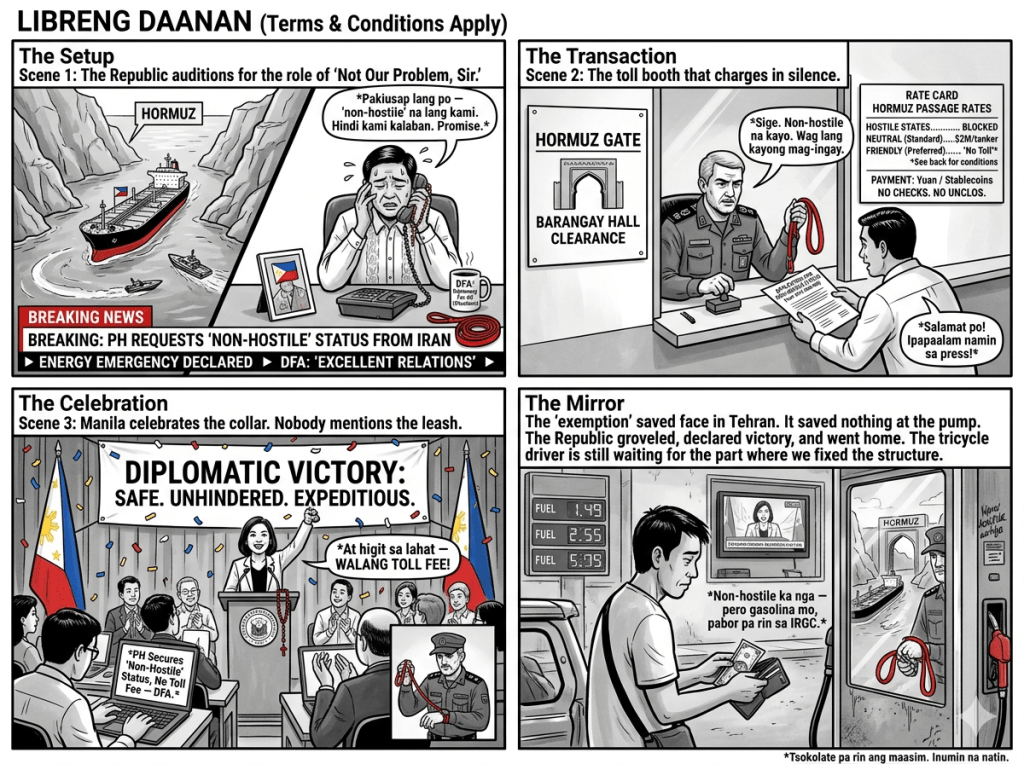
No Toll, Just Soul: The Fine Print of Iranian Charity
The DFA’s crowning boast? “There is no toll fee.” Spokesperson Analyn Ratonel texted it to reporters with the serene certainty of someone who has never paid a barangay clearance in cash under the table.
Come on. This is not charity; this is face-saving fiction. Iran floated the toll as a trial balloon, watched the global markets panic, then offered “exemptions” to select supplicants. The Philippines, desperate enough to request “non-hostile” status while still parked under the American security umbrella, gets the red-carpet waiver.
What hides behind the curtain? Backchannel pledges of neutrality rhetoric? Future payments routed through yuan-denominated fertilizer deals? Intelligence-sharing nods on US movements? Or simply the quiet understanding that Manila will keep its mouth shut about the blockade’s legality?
The research is clear: Iran’s selective passage system is divide-and-rule 101. It rewards “friendly” Global South states, fragments the US-led coalition, and tests Washington’s resolve without firing another missile.
Iran’s $1-per-barrel levy—up to $2 million per supertanker, payable in yuan or stablecoins via IRGC cutouts—has been waved away like an inconvenient rumor. The “no toll” is not generosity; it is the velvet glove over the iron fist of leverage.
Tomorrow, if Marcos so much as hosts one more US carrier group exercise, the IRGC can reimpose the fee or simply “reassess” our non-hostile credentials. And the DFA will issue another text message.
UNCLOS is Dead; Long Live the IRGC
Let us speak plainly about the corpse in the room. The United Nations Convention on the Law of the Sea promises “continuous, expeditious, unimpeded” transit passage through straits used for international navigation.
Iran signed it, never ratified the full package, and now treats Hormuz—the artery carrying 20-30% of global oil—like its private toll road. A de facto blockade after US-Israeli strikes? Selective “non-hostile” screening?
This is not self-defense under Article 51; this is economic coercion with speedboats.
International law has become a suggestion, a polite memo ignored the moment great powers—or mid-tier ones with missiles—decide the rules no longer serve them. The IRGC, not the IMO or the UNCLOS tribunal, now decides who sails.
And smaller states? We clap. We issue statements affirming “excellent relations and lasting peace through continued dialogue.” We pretend the rules-based order still exists while the order is being rewritten in real time by whoever controls the chokepoint.
Who controls global trade arteries? Not some Geneva convention. The IRGC. Does international law constrain power? Only when the powerful feel like it. How do smaller states navigate great-power conflict? Badly, with press releases and prayer beads.
The Philippines just proved it by legitimizing the very precedent Beijing could one day use against us in the West Philippine Sea. Hypocrisy, thy name is DFA talking points.
Marcos Jr.’s Energy Emergency: A Crisis of His Own Making
This “assurance” is not stability. It is a tactical concession, a strategic signal that the United States can be bypassed, and a temporary illusion before the next missile barrage or IRGC mood swing.
The narrow opportunity—short-term fuel and fertilizer delivery—is real. The gaping vulnerability is grotesque. We are a US treaty ally begging “non-hostile” status from the regime our patron just bombed.
This is not strategic hedging; it is diplomatic groveling that exposes the contradictions of EDCA, the Mutual Defense Treaty, and our decade-long failure to build energy independence.
Filipino seafarers get a temporary shield. Oil imports from the Middle East keep flowing for a few weeks. But the price? We have normalized Iran’s right to play God at Hormuz.
We have signaled to every chokepoint controller on the planet that small nations will line up for exemptions rather than fix their own vulnerabilities. And domestically? High oil prices still hit the pump, the tricycle driver, the farmer, the mother stretching the rice budget.
Who benefits? The usual suspects—importers, middlemen, and politicians who treat crisis as photo-op—while the rest of us sip our now-more-expensive tsokolate and wonder why the emergency declaration saves face but not pesos.
This is the mirror I spoke of last week. It reflects our failure to secure energy independence, the death of the rules-based maritime order, and the grotesque theater of small nations applauding the powers that hold their economy hostage.
Recommendations for a Republic That Still Has Some Pride Left
Enough performative diplomacy. The Barok Mandate is simple and ruthless:
- Diversify energy sources yesterday. Nuclear baseload, not endless coal subsidies. Renewables that actually scale, not press-release solar farms. Strategic petroleum reserves that last longer than 45 days.
- Build actual naval escort capacity. Not token patrol boats for photo-ops, but real blue-water capability to protect our flag. Stop treating EDCA as a magical security blanket that somehow covers both China and Iran.
- Demand genuine public service governance. Mock the “expeditious passage” press releases that do nothing for the pump price. Follow the money: who profits from volatility? Which cronies are quietly hedging futures while the public pays? Energy policy must be pro-people, not pro-photo-op.
- And for the love of whatever gods still listen in this flooded republic: stop the groveling. The next time a great power dangles a verbal assurance like a fishhook, remember—hooks have barbs. Iran’s “charity” is temporary. Our dependence is structural. Fix the structure or prepare for the next humiliation.
This assurance is not a solution. It is the symptom. The Philippines did not lose control of its energy future in the Strait of Hormuz. We surrendered it years ago in boardrooms, in Malacañang, in the comfortable illusion that someone else would always keep the lights on. Iran just held up the mirror. The reflection is unflattering, but at least now we can see the truth: performative diplomacy saves nothing but face. And in a republic still pretending to have pride, that is no longer enough.
The tsokolate is extra bitter today. Finish the cup, look in the mirror, and decide if we still deserve to call ourselves a sovereign republic.
— Barok
Key Citations
A. News Articles
- Rocamora, Joyce Ann L. “Iran to allow ‘safe, unhindered’ passage of PH ships thru Hormuz — DFA.” Philippine News Agency, 2026.
- Biraogo, Louis “Barok” C. “PH begs Iran: Please call us non-hostile while hugging US bases.” kwebanibarok.com, 2 Apr. 2026.
B. Reports & Studies
C. Official Documents & Legal Resources
- Philippines. Office of the President. Executive Order No. 110, s. 2026: Declaring a State of National Energy Emergency and Authorizing the Unified Package for Livelihoods, Industry, Food, and Transport. 24 Mar. 2026. Official Gazette of the Republic of the Philippines.
- United Nations. United Nations Convention on the Law of the Sea. https://www.un.org/depts/los/convention_agreements/texts/unclos/unclos_e.pdf.
- UNCLOS Debate. “Iran.” UNCLOSdebate.org, https://www.unclosdebate.org/keywords/iran.
- U.S. Embassy in the Philippines. “Enhanced Defense Cooperation Agreement (EDCA) Fact Sheet.” ph.usembassy.gov, 20 Mar. 2023.
- Avalon Project. “Mutual Defense Treaty Between the United States and the Republic of the Philippines.” Yale Law School, 30 Aug. 1951.

- “Forthwith” to Farce: How the Senate is Killing Impeachment—And Why Enrile’s Right (Even If You Can’t Trust Him)
- “HINDI AKO NAG-RESIGN!”

- “I’m calling you from my new Globe SIM. Send load!”

- “Mahiya Naman Kayo!” Marcos’ Anti-Corruption Vow Faces a Flood of Doubt

- “Meow, I’m calling you from my new Globe SIM!”

- “No Special Jail for Crooks!” Boying Remulla Slams VIP Perks for Flood Scammers
- “PLUNDER IS OVERRATED”? TRY AGAIN — IT’S A CALCULATED KILL SHOT

- “Several Lifetimes,” Said Fajardo — Translation: “I’m Not Spending Even One More Day on This Circus”

- “Shimenet”: The Term That Broke the Internet and the Budget
- “We Did Not Yield”: Marcos’s Stand and the Soul of Filipino Sovereignty

- “We Gather Light to Scatter”: A Tribute to Edgardo Bautista Espiritu

- $150M for Kaufman to Spin a Sinking Narrative


 KWEBA ni BAROK
Leave a comment