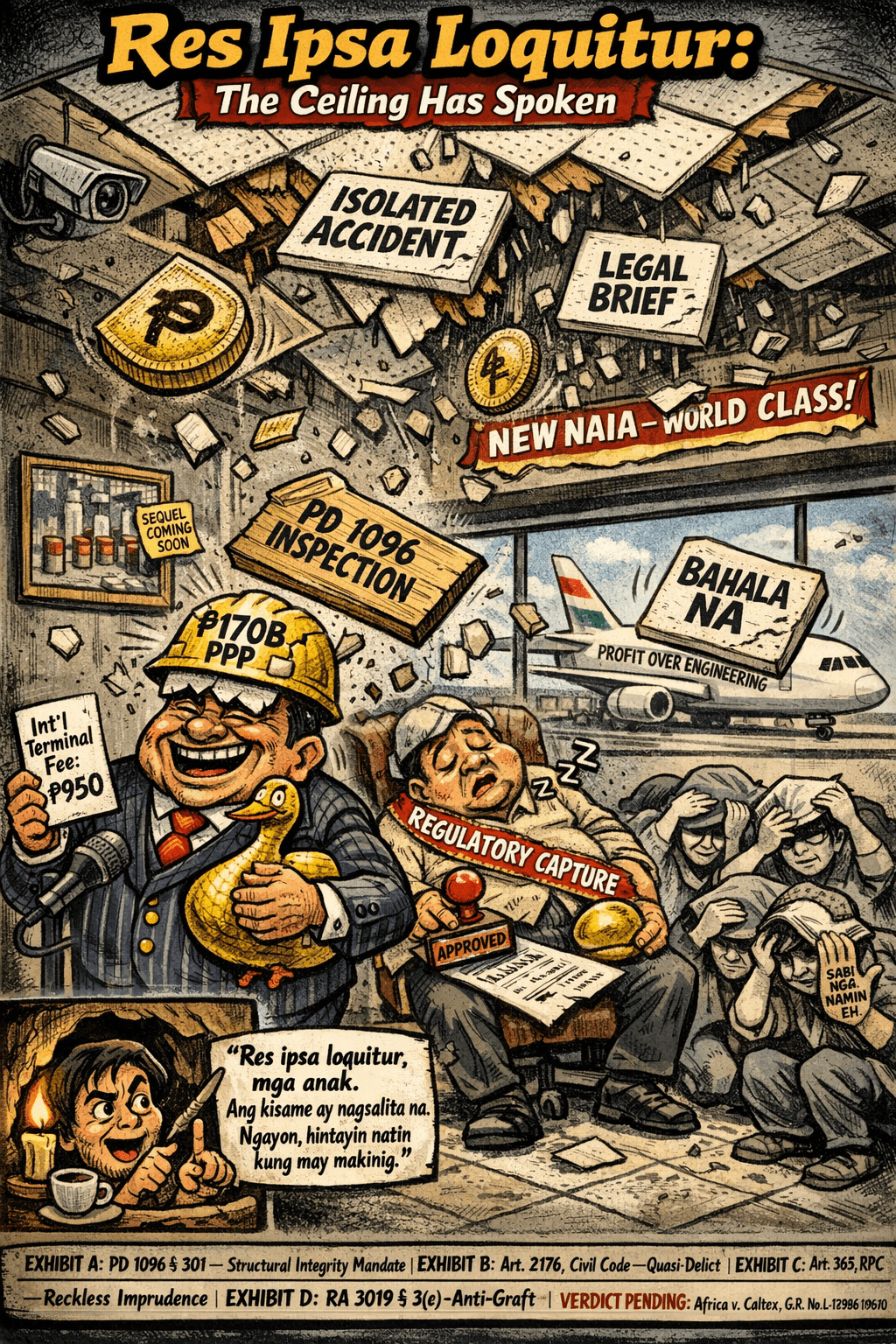
Ceiling panels don’t just fall from the sky on Good Friday. Res Ipsa Loquitur says: someone screwed up big time.
By Louis ‘Barok‘ C. Biraogo — April 5, 2026
LISTEN up, you plywood-peddling propagandists at New NAIA Infra Corp. (NNIC) and your Department of Transportation (DOTr) cheerleaders: a ceiling does not spontaneously detach and rain down on seven innocent Filipinos like some divine piñata on Good Friday. The official script—“isolated accident,” “investigation ongoing,” “safety remains our top priority”—is the same tired karaoke track we’ve heard since the Marcos era. This wasn’t an act of God. This was an act of negligence, plain and simple.
Apply the doctrine of res ipsa loquitur—the thing speaks for itself. As the Supreme Court held in Africa v. Caltex (Philippines), Inc. (G.R. No. L-12986, 1966), when an injury-causing instrumentality is under the exclusive control of the defendant and the accident is one that ordinarily does not occur in the absence of negligence, the burden shifts to the defendant to prove due diligence. Here, the ceiling panel—lightweight plywood and styrofoam in the arrival extension area—was squarely under the control of NNIC, the concessionaire that took over Terminal 1 in September 2024. Ceilings do not just “fall” in a so-called brand-new concession zone unless someone skimped on inspections, used substandard materials, or ignored the National Building Code (Presidential Decree No. 1096). Presidential Decree No. 1096, Section 301 and Rule 3 of its Implementing Rules, mandates structural integrity, proper installation, and regular maintenance for public buildings. A collapse during peak Holy Week traffic screams violation.
And spare me the force majeure defense. Article 1174 of the Civil Code of the Philippines (Republic Act No. 386) requires an unforeseeable, irresistible event like a typhoon or earthquake. “Holy Week traffic” is not a typhoon. It’s predictable human congestion that any competent operator should have anticipated and inspected for. NNIC knew Terminal 1 was handling millions during the holidays; they chose profit over preventive engineering. This is not an isolated accident. It is Exhibit A of systemic rot: inherited MIAA decay plus new-operator corner-cutting.
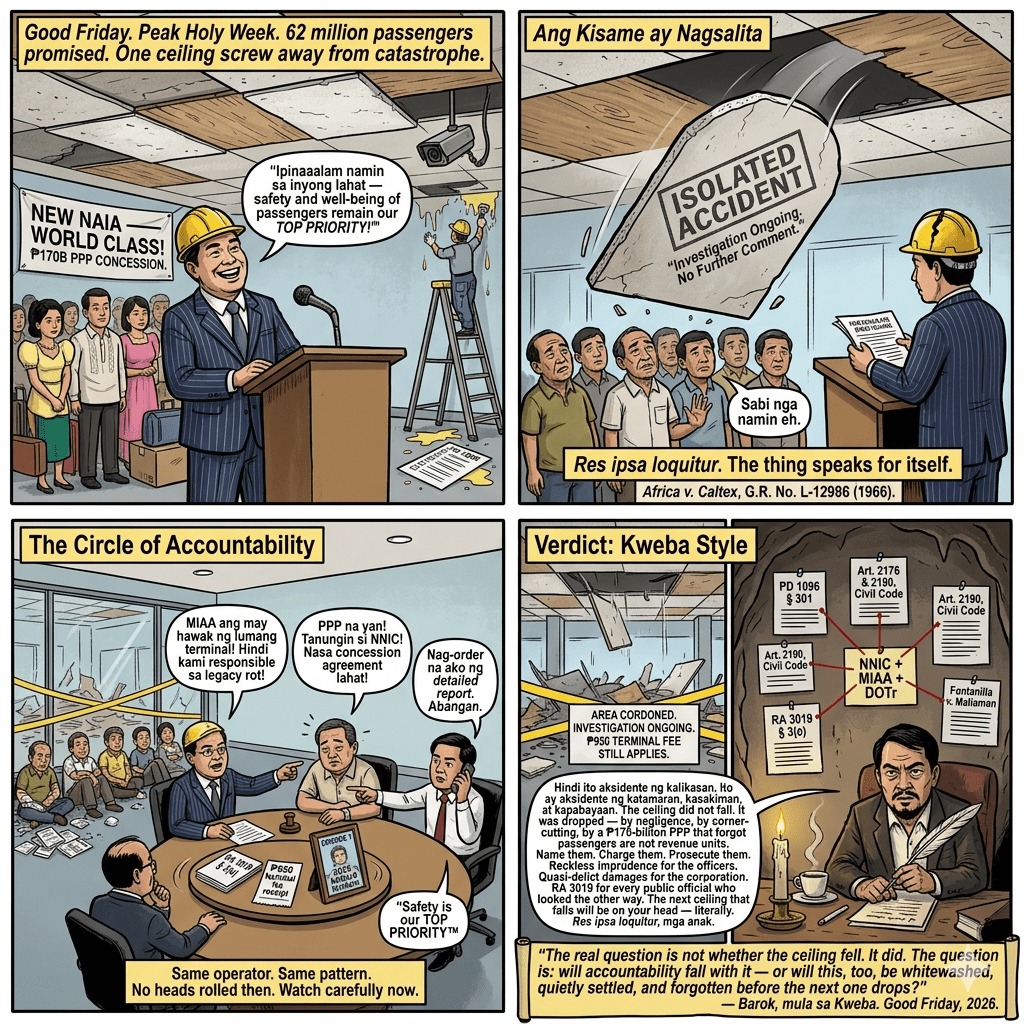
(Hindi ito gawa ng Diyos. Gawa ito ng kapabayaan — at ₱950 na terminal fee.)
Jail Time Memo: Naming the Liable
Time to file the papers, mga ka-kweba. Criminal liability first: Reckless Imprudence Resulting in Physical Injuries under Article 365 of the Revised Penal Code (Act No. 3815). The engineering head, maintenance manager, safety officer of NNIC, and any contractor/project engineer who signed off on that ceiling must answer for voluntary omission coupled with inexcusable lack of precaution. As the Supreme Court held in Cangco v. Manila Railroad Co. (G.R. No. L-12191, October 14, 1918) and People v. Vistan (G.R. No. 17218, September 8, 1921), when a public utility operator fails to exercise the diligence of a good father of a family in the selection and supervision of its personnel, civil liability attaches under Articles 2176 and 2180 of the Civil Code — and where the lack of precaution is gross and inexcusable, reckless imprudence under Article 365 of the Revised Penal Code may also be established.
Civilly, Article 2176 of the Civil Code (quasi-delict) applies with surgical precision: “Whoever by act or omission causes damage to another, there being fault or negligence, is obliged to pay for the damage done.” No contract needed between passenger and operator. Article 2180 imposes vicarious liability on NNIC and Manila International Airport Authority (MIAA) for the negligence of their employees and agents. Add Article 2190 for ruin of structures—owners/operators are liable for partial collapse due to lack of necessary repairs. As the Supreme Court held in Fontanilla v. Maliaman (G.R. No. L-55963, December 1, 1989), stripping government instrumentalities of immunity when performing proprietary functions like operating public facilities, MIAA and DOTr cannot hide behind sovereign cloak.
If the probe reveals substandard materials or kickbacks in procurement, Republic Act No. 3019 (Anti-Graft and Corrupt Practices Act) Section 3(e) kicks in: causing undue injury through manifest partiality, evident bad faith, or gross inexcusable negligence. Public officers in DOTr/MIAA who approved shoddy work or failed to oversee the PPP concession are liable. Demand an immediate, independent investigation—not the cozy in-house NNIC-MIAA circle jerk. Referral to the Ombudsman for criminal and administrative charges. The probe must be transparent, or we call it what it is: another whitewash.
Top Priority Farce: NNIC’s Safety Scam
NNIC’s press release is comedy gold: “Safety and well-being of passengers remain our top priority.” Tell that to the seven people now wearing ceiling tiles as hats while their medical bills pile up. Your “immediate response” and “cordoned-off area” is the bare minimum, not heroism. You took over Terminal 1 promising a 62-million-passenger upgrade, yet a non-structural ceiling fails on Day 1 of Holy Week. Pathetic.
This is classic regulatory capture. MIAA—former operator, now supposed regulator—sits in the same DOTr ecosystem as NNIC. The fox isn’t just guarding the henhouse; it’s sleeping in the same bed with San Miguel’s consortium. DOTr Secretary Banoy Lopez’s “detailed report” order is theater. Everyone’s too cozy because the PPP deal is a ₱170-billion golden goose.
And the profit-vs-safety paradox? Undeniable. NNIC jacked international terminal fees to ₱950 before the paint even dried on the “renovations.” That’s profiteering, not modernization. You squeeze passengers for revenue while skimping on the very infrastructure that keeps them alive. A profit-driven operator will always prioritize the bottom line over a ceiling screw—until bodies hit the floor. Public safety is not a line item; it is a duty under PD 1096 and the Civil Code. Your “top priority” is a punchline.
Bollard to Ceiling: The Rot Runs Deep
We shrug at collapsing ceilings the way we shrug at potholes and power outages—classic “Third World infrastructure” normalization of deviance. Public apathy is the real enabler. Filipinos have been trained to accept death traps as normal. Enough. This is not “bahala na”; this is criminal negligence normalized by weak enforcement.
Rumors are swirling, and Rep. Terry Ridon is right: check the installation date of that plywood panel. Was it MIAA’s ancient rot carried over from the 1980s, or NNIC’s shiny new “upgrade” slapped together by the lowest bidder? The comprehensive analysis confirms the area was under NNIC control post-2024 handover. If it’s new construction, the contractor is on the hook for PD 1096 violations. If old, NNIC failed its maintenance covenant under the ROET agreement.
Connect the dots: this is the sequel to the 2025 bollard failure that killed two people under NNIC watch. Same operator, same pattern—negligence, quick PR spin, no heads roll. Regulatory sleep is the disease: DOTr and MIAA treat PPPs as sacred cash cows instead of public trusts. The deeper rot is privatization without teeth—no real third-party audits, no genuine accountability, just fee hikes and photo-ops.
Verdict Time: Reckoning or Whitewash?
NNIC management (CEO and board), the contractor, the sleeping government inspectors in DOTr/MIAA—name them, charge them, prosecute them all. Reckless imprudence for the officers; quasi-delict damages for the corporation; RA 3019 for any public official who looked the other way.
Demand genuine public service, not this pro-profit farce masquerading as pro-people governance.
Recommendations:
- immediate third-party forensic audit by independent structural engineers;
- criminal referral to the Ombudsman using the sample complaint within 48 hours;
- suspension of all fee hikes (including the ₱950 international gouge) until full safety certification;
- class-action civil suits filed by the victims using the sample complaint already prepared under Articles 2176 and 2180;
- immediate filing of criminal complaints using the sample complaint already prepared for Reckless Imprudence Resulting in Physical Injuries under Article 365 of the Revised Penal Code (Act No. 3815) before the Pasay City Prosecutor’s Office.
The real story? If this is settled quietly with a few medical reimbursements and a slap on the wrist, it sets the precedent for the next 62 million passengers: your safety is optional, your pain is collateral damage, and the next ceiling that falls will be on your head—literally. We cannot let public infrastructure remain a low-budget circus.
This is Barok, signing off from the Kweba. Clean your house, or we will burn it down with the truth.
Key Citations
A. Legal & Official Sources
- The Civil Code of the Philippines (Republic Act No. 386). Official Gazette of the Republic of the Philippines, 1949.
- Presidential Decree No. 1096. National Building Code of the Philippines. Official Gazette of the Republic of the Philippines, 1977.
- Republic Act No. 3019. Anti-Graft and Corrupt Practices Act. Official Gazette of the Republic of the Philippines, 1960.
- Revised Penal Code (Act No. 3815). LawPhil, 1930.
- Africa v. Caltex (Philippines), Inc. G.R. No. L-12986. LawPhil, March 31, 1966.
- Cangco v. Manila Railroad Co. G.R. No. L-12191. LawPhil, October 14, 1918.
- The People of the Philippine Islands vs. Vicente de los Reyes. 20 Sept. 1921. The Lawphil Project, Arellano Law Foundation.
- Spouses Jose Fontanilla and Virginia Fontanilla v. Hon. Inocencio D. Maliaman and National Irrigation Administration (NIA) G.R. No. L-55963, LawPhil December 1, 1989.
B. News Reports
C. Sample Complaint Affidavits
- Criminal Complaint-Affidavit for Reckless Imprudence Resulting in Physical Injuries: Template and Strategic Legal Notes. Kweba ni Barok, Apr. 2026. – Download as pdf file.
- Class Suit Complaint Template: Damages Arising from the NAIA Ceiling Collapse (April 3, 2026). Kweba ni Barok, 3 Apr. 2026. – Download as PDF.
- Complaint-Affidavit Template: Violation of RA 3019, Grave Misconduct, Gross Negligence, and Reckless Imprudence (NAIA Ceiling Collapse, April 3, 2026). Kweba ni Barok, 3 Apr. 2026.

- ₱75 Million Heist: Cops Gone Full Bandit

- ₱6.7-Trillion Temptation: The Great Pork Zombie Revival and the “Collegial” Vote-Buying Circus

- ₱1.9 Billion for 382 Units and a Rooftop Pool: Poverty Solved, Next Problem Please

- ₱1.35 Trillion for Education: Bigger Budget, Same Old Thieves’ Banquet

- ₱1 Billion Congressional Seat? Sorry, Sold Out Na Raw — Si Bello Raw Ang Hindi Bumili

- “We Will Take Care of It”: Bersamin’s P52-Billion Love Letter to Corruption

- “Skewed Narrative”? More Like Skewered Taxpayers!

- “Scared to Sign Vouchers” Is Now Official GDP Policy – Welcome to the Philippines’ Permanent Paralysis Economy

- “Robbed by Restitution?” Curlee Discaya’s Tears Over Returning What He Never Earned

- “No Pressure” Luistro? The House Pork Bazaar Exposed
- “My Brother the President Is a Junkie”: A Marcos Family Reunion Special

- “Mapipilitan Akong Gawing Zero”: The Day Senator Rodante Marcoleta Confessed to Perjury on National Television and Thought We’d Clap for the Creativity




 KWEBA ni BAROK
Leave a comment