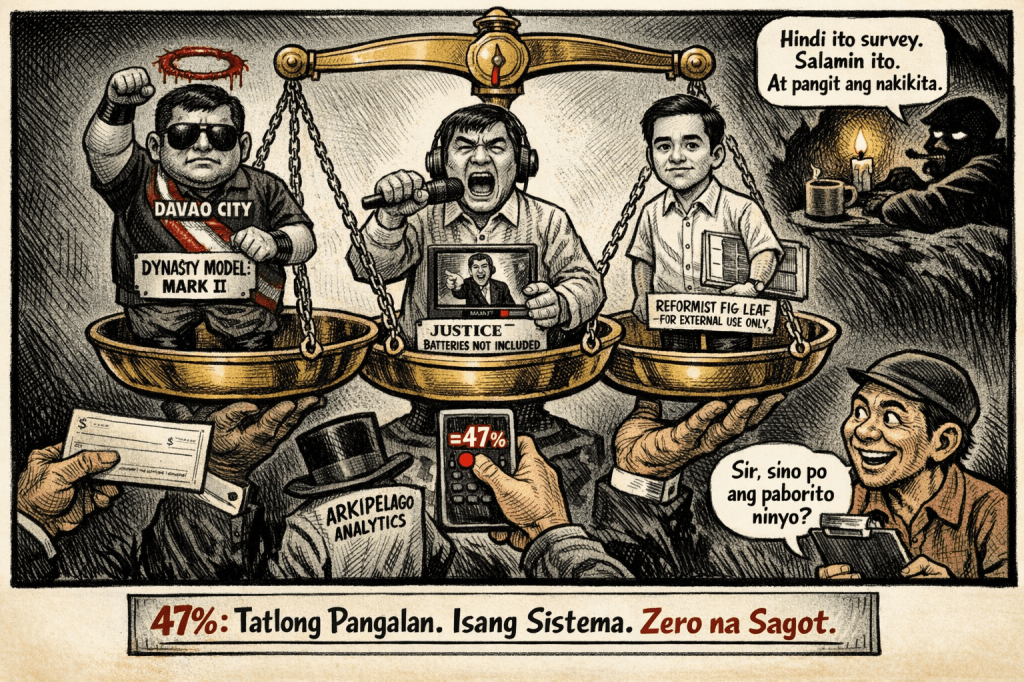
This isn’t a survey. It’s a mirror. And the reflection shows a democracy still addicted to surnames, soundbites, and strongman vibes.
By Louis ‘Barok‘ C. Biraogo — April 6, 2026
DEAR READER,
I am Barok , and I have spent years dissecting the entrails of Philippine politics so you don’t have to. Last Friday, the Manila Times handed us a shiny new survey from Arkipelago Analytics: a “three-way tie” at 47% for Davao Mayor Sebastian “Baste” Duterte, Sen. Raffy Tulfo, and Pasig Mayor Vico Sotto in the 2026 Senate race.
Pause. Let that number sink in. Not 46%. Not 48%. Exactly 47%.
Three separate human beings, three separate political machines, three separate brands of populism—perfectly equal. In a country of 68.6 million registered voters, where every barangay has its own grudge and every radio listener has a different sob story, the gods of statistics smiled and declared a dead heat.
This is not a poll. This is a mirror. And the reflection is ugly.
I. What the Numbers Actually Say (and What They Hide)
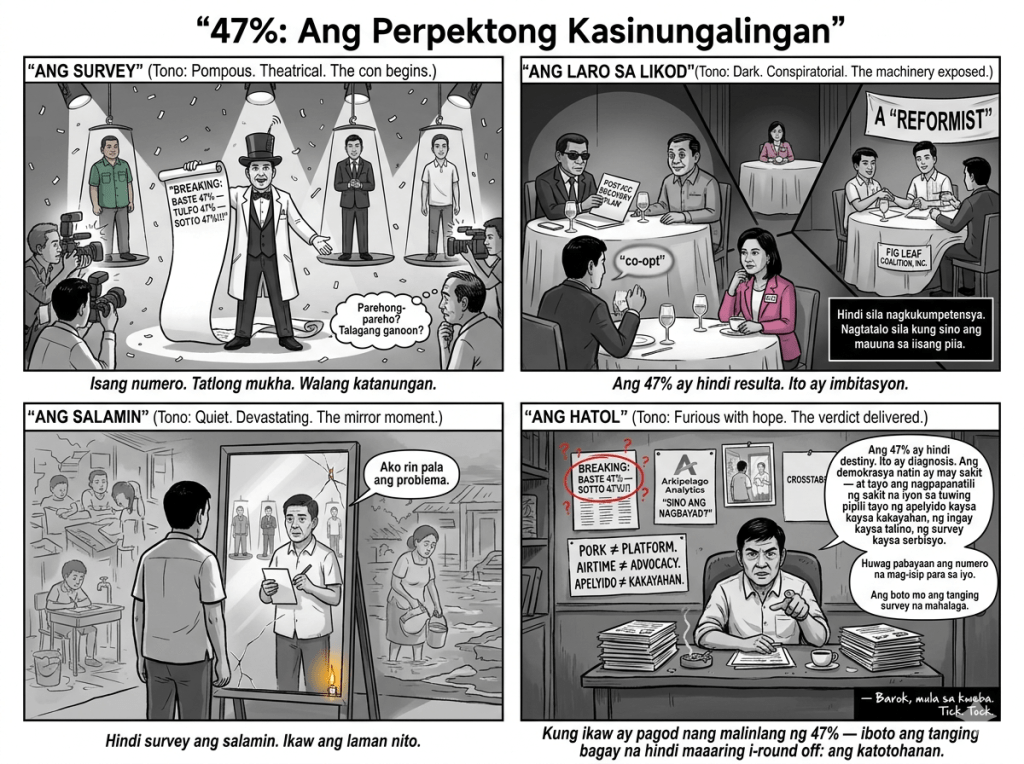
The topline is theater. Baste carries the Duterte dynasty’s bloody halo and Mindanao machinery. Tulfo is the walking embodiment of “justice in real time”—the man who turned grievance into a television empire. Sotto is the clean-face technocrat, the mayor who actually fixes drainage before tweeting about it.
Three archetypes, one score. What it reveals: Philippine voters still worship visibility over vision. What it obscures: this was conducted more than a year before anyone files a certificate of candidacy. These are not “preferences.” These are name-recall scores dressed up as commitments.
Look at the demographics they buried in the fine print: 75% Class D, 18% Class E. The poor are not stupid; they are desperate. They reward the man who yells on TV, the son who inherits the tough-guy brand, and the mayor who at least pretends to deliver. The survey doesn’t measure policy support. It measures pain.
II. Credibility on Trial: Arkipelago Analytics and the 47% Problem
Arkipelago Analytics is not Pulse Asia. It is not SWS. It is a relatively new player that suddenly drops a perfectly symmetrical tie and expects us to genuflect. Sample size 2,637, face-to-face, COMELEC-weighted—yes, those are strengths. But strengths do not immunize against sin.
The 47% problem is statistical malpractice wearing a necktie. Rounding three different raw percentages to the exact same integer is either divine intervention or creative editing. Social-desirability bias in face-to-face interviews is real: respondents tell the pretty enumerator what they think sounds respectable. Add the timing—post-Marcos-Duterte rift, post-Rodrigo’s ICC detention drama—and you have a volatile cocktail no single snapshot can capture.
I am not saying the poll is fake. I am saying it is early, opaque, and weaponized. Unknown funding sources, no longitudinal tracking released, no raw crosstabs for the curious citizen. That is not science. That is marketing.
III. The Soft Launch, the Coalition Games, and the Media Megaphone
Social media is already buzzing with the “soft launch” theory—and for once, the cynics are onto something. These early polls are not neutral measurements; they are trial balloons for donors and kingmakers. Watch who suddenly gets invited to breakfast meetings in Makati and who gets ghosted.
Coalition engineering is already underway. The Duterte camp is testing whether the family brand can survive without Papa’s direct shadow. The administration side is quietly calculating whether to co-opt Tulfo or isolate him. Sotto’s independent streak makes him the perfect “reformist” fig leaf for anyone who needs one. Meanwhile, Leni Robredo sits at 42%—close enough to threaten, far enough to be dismissed as yesterday’s news.
And the media? Oh, the media. Manila Times, Philstar, and every Facebook page with a blue check amplify the “three-way tie” headline because drama sells. Polls become self-fulfilling prophecies: donors chase the 47% names, volunteers flock to them, undecided voters jump on the bandwagon. The survey doesn’t predict the future; it manufactures it.
IV. The Real Culprits: What Everyone Did and Failed to Do
Candidates played the only game they know: cultivate name recall. Baste inherited the machinery; Tulfo built an empire; Sotto fixed streets while others fixed headlines.
Political parties? They did nothing. The weak party system is not a bug—it is the feature. No one builds platforms because platforms don’t win elections; surnames and airtime do.
Media amplified without scrutiny. Pollsters released without full disclosure. Voters? We stayed passive consumers of slogans and soundbites.
The Marcos-Duterte rift, economic pain, governance fatigue, dynastic gravity—these are not excuses. They are symptoms of a system that rewards lineage over leadership and visibility over vision.
V. The Systemic Rot We Refuse to Name
After “people power” restored democracy, we still let dynasties run the Senate like a family business. We still let media personalities bypass institutions. We still let surveys—opaque ones at that—shape reality instead of the other way around.
The failure of party institutionalization is criminal. The entrenchment of political dynasties is immoral. The absence of mandatory voter education is negligence bordering on sabotage. This is why, decades later, we are still choosing between a Duterte son, a TV crusader, and a mayor who at least reads the budget.
VI. What Genuine Public Service Actually Looks Like
It looks like legislators who read the bills instead of signing blank attendance sheets. Mayors who fix drainage before the next flood kills another family. Governance that redistributes power downward—to the barangay health worker, the public-school teacher, the fisherfolk without a boat.
It does not look like 47% name recall.
VII. Concrete, Ruthless Recommendations
- To voters: Stop the bandwagon. Research platforms. Demand candidates post their SALNs, their legislative records, and their drainage-repair statistics. Vote like your children’s future depends on it—because it does.
- To media: Publish methodology, raw data, and funding sources or shut up about “scientific surveys.” Stop turning polls into prophecies.
- To pollsters like Arkipelago: Release crosstabs, longitudinal trends, and client lists. Transparency is not optional.
- To candidates: Unite or differentiate honestly. Stop pretending independence while cutting backroom deals. Withdraw if you have nothing to offer beyond a famous last name.
- To COMELEC and Congress: Pass genuine anti-dynasty legislation. Reform campaign finance so money doesn’t buy airtime. Mandate voter-education modules in every high school. Empower the commission to audit pollsters who play fast and loose with numbers.
- To the administration and opposition: Fight on policy, not personality. Counter-narratives are fine; lies are not.
VIII. Possible Futures and the Moral Choice Before Us
- Scenario one: consolidation. One bloc swallows the others and we get a Senate full of familiar faces.
- Scenario two (most likely): fragmentation. The 47% splits, dark horses surge, and we wake up with a chaotic chamber that still solves nothing.
- Scenario three: a late media-driven upset or scandal that flips the script.
Whatever happens, the real resolution is not in the next poll. It is in us.
- Short-term, this survey juices fundraising for the top three and starves the rest.
- Medium-term, it sets the table for 2028—Sara Duterte or her proxies already licking their chops.
- Long-term, it deepens polarization, weakens institutions, and keeps power in the hands of the visible instead of the visionary.
The Closing Fist
Reader, this 47% charade is not destiny. It is a diagnosis. Our democracy is sick because we keep feeding it the wrong medicine: surveys instead of scrutiny, surnames instead of substance, slogans instead of service.
I am not cynical. I am furious with hope.
Demand polling transparency. Demand anti-dynasty law. Demand voter education that actually educates. Demand legislators who work, not just pose.
And for God’s sake, next time someone waves a 47% poll in your face, ask the only question that matters: “What are they hiding behind the number?”
The system will not fix itself. You have to fix it—at the ballot box, in the barangay hall, and in every conversation where someone tries to sell you another dynasty wrapped in a survey.
This is Barok. See you in the trenches.
Share this if you’re tired of being played. Tag a candidate. Tag a pollster. Tag your congressman. Let’s stop pretending 47% is good enough for the Philippines.
Key Citations
A. Reports & Studies
B. News Articles
- Baroña, Franco Jose C. “Baste Duterte, Raffy Tulfo, Vico Sotto Top Picks in 2026 Senate Race.” The Manila Times, 3 Apr. 2026.
C. Official Websites & Resources
- Commission on Elections. Official Website. COMELEC.
- PinoyMoneyTalk. “Socioeconomic Classes (SEC) ABCDE Explained.” PinoyMoneyTalk, 12 Oct. 2012.
- Pulse Asia Research Inc. Pulse Asia Research Inc. – Opinion Polling. Pulse Asia.
- Social Weather Stations. Social Weather Stations. SWS.
- ₱75 Million Heist: Cops Gone Full Bandit

- ₱6.7-Trillion Temptation: The Great Pork Zombie Revival and the “Collegial” Vote-Buying Circus

- ₱1.9 Billion for 382 Units and a Rooftop Pool: Poverty Solved, Next Problem Please

- ₱1.35 Trillion for Education: Bigger Budget, Same Old Thieves’ Banquet

- ₱1 Billion Congressional Seat? Sorry, Sold Out Na Raw — Si Bello Raw Ang Hindi Bumili

- “We Will Take Care of It”: Bersamin’s P52-Billion Love Letter to Corruption

- “Skewed Narrative”? More Like Skewered Taxpayers!

- “Scared to Sign Vouchers” Is Now Official GDP Policy – Welcome to the Philippines’ Permanent Paralysis Economy

- “Robbed by Restitution?” Curlee Discaya’s Tears Over Returning What He Never Earned

- “No Pressure” Luistro? The House Pork Bazaar Exposed
- “My Brother the President Is a Junkie”: A Marcos Family Reunion Special

- “Mapipilitan Akong Gawing Zero”: The Day Senator Rodante Marcoleta Confessed to Perjury on National Television and Thought We’d Clap for the Creativity



 KWEBA ni BAROK
Leave a comment