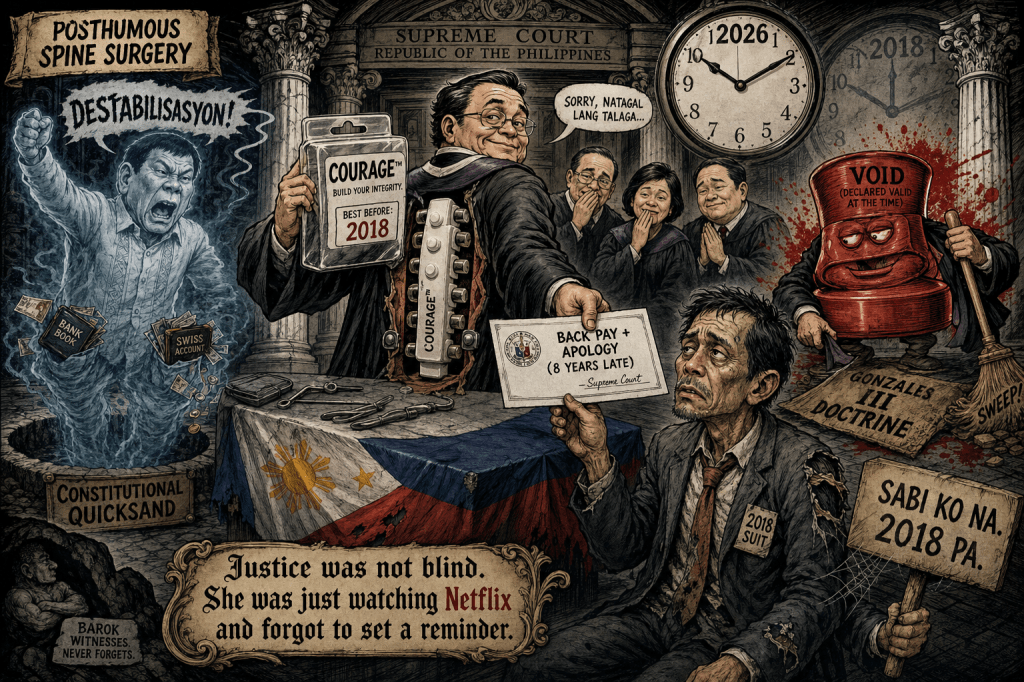
Martires’ Rubber Stamp and the Ombudsman’s Temporary Castration
By Louis ‘Barok‘ C. Biraogo — May 3, 2026
MGA ka-kweba, ladies, gentlemen, and lingering Duterte apologists still refreshing their X feeds for the next “destabilization” conspiracy: grab your popcorn and your 1987 Constitution of the Republic of the Philippines.
Today we autopsy a Supreme Court decision that just handed the ghost of Rodrigo Duterte a middle finger wrapped in judicial robes. Carandang v. Office of the President (G.R. No. 238387, January, 29, 2026), is not merely a labor case about back pay. It is a constitutional crime scene. And I, Barok, am the medical examiner with the sharpest scalpel in the archipelago.
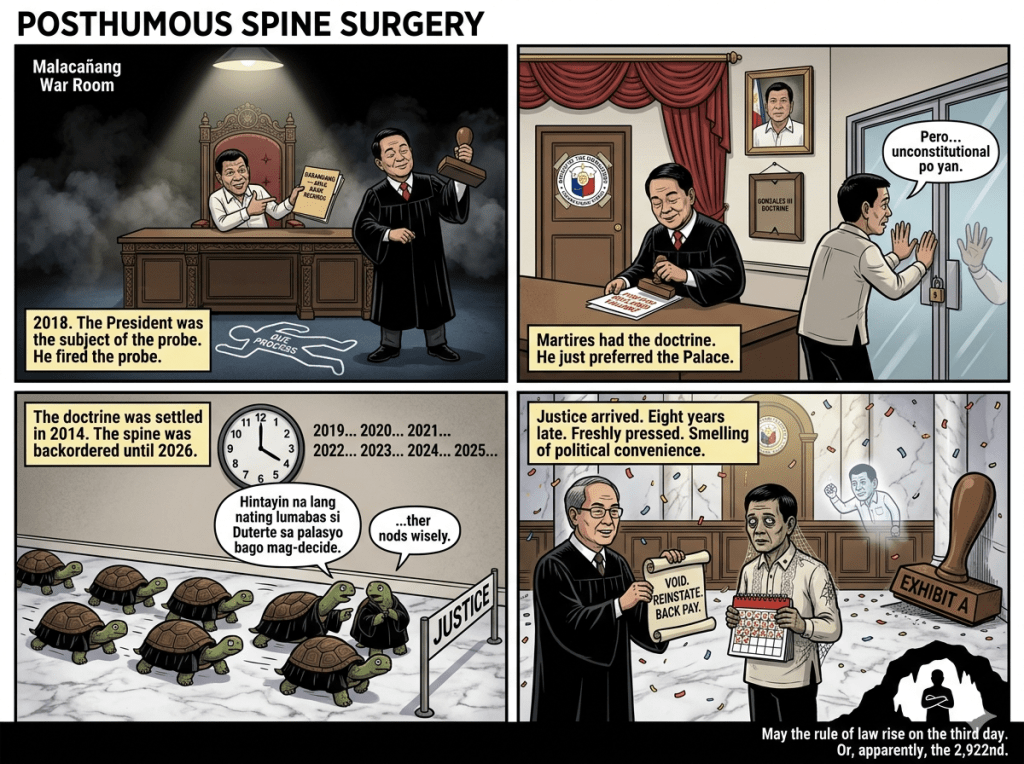
Act I: The Autopsy of a Purge
Scene: Malacañang, 2018. A Deputy Ombudsman named Melchor Arthur Carandang dares to confirm, in public, that the Anti-Money Laundering Council (AMLC) had generated bank transaction records linked to whispers of unexplained wealth. Boom. Suspension. Then outright dismissal. The President who was the subject of the probe suddenly becomes judge, jury, and firing squad.
Fast-forward eight years. The Supreme Court’s Third Division, in a ruling that reads like a slow-burn revenge thriller, voids the entire ouster. Three killer findings:
- The President has zero power to remove or discipline a Deputy Ombudsman.
- Even if he had the power, the “evidence” was vapor.
- Ombudsman Samuel Martires’ subsequent declaration of vacancy was built on the same constitutional quicksand.
The Court leaned hard on the Gonzales III doctrine (Emilio A. Gonzales III v. Office of the President, G.R. No. 196231). There, the en banc already castrated Section 8(2) of Republic Act No. 6770 (The Ombudsman Act of 1989) insofar as it allowed presidential discipline over Deputy Ombudsmen. Why? Because Article XI, Section 5 of the 1987 Constitution declares the Office of the Ombudsman independent. You cannot give the fox the key to the henhouse and then act shocked when the hens start disappearing. The Gonzales Court warned: allowing the President to dangle the axe over the very officials empowered to investigate him creates a “chilling effect” fatal to independence.
The 2026 ruling simply applies the scalpel again. Carandang’s statements? Not graft under Republic Act No. 3019 (Anti-Graft and Corrupt Practices Act). Not a betrayal of public trust under Republic Act No. 6713 (The Code of Conduct and Ethical Standards for Public Officials and Employees). Not even a violation of confidentiality rules. They were “neutral and preliminary” disclosures on a matter of “paramount public interest”—protected under the right to information (Article III, Section 7) and the Ombudsman’s constitutional mandate. The President was literally the target of the probe. Due process in that environment is a joke; impartiality is a myth.
Pro-ruling arguments, vivisected and then embalmed for display:
- Institutional independence – Bulletproof. If the Chief Executive can purge deputies investigating him, then Article XI is toilet paper. The Court called it a “constitutional paradox.” I call it a constitutional middle finger to the people.
- Obvious conflict of interest – Duterte disciplining the man probing Duterte’s wealth is like a arsonist firing the fire chief for confirming the smell of gasoline.
- Chilling effect prevention – Spot on. One public confirmation, one career execution. Future deputies would sooner eat their SALNs than touch a presidential bank record.
Counter-arguments, now flayed alive:
Critics scream “confidentiality breach!” and wave the AMLC rules. Cute. The Court already clarified: Carandang did not leak a “final report”; he confirmed the existence of authentic bank transaction records already in the Ombudsman’s possession. Preliminary disclosure on a matter of public concern is not treason. The AMLC’s later “no formal report” spin was semantic theater, not exculpatory evidence. Administrative liability demands substantial evidence. What the Palace offered was gossip, political panic, and a press statement. The Court laughed it out of the courtroom.
The real counter-argument—the one they whisper in Duterte chat groups—is “selective courage.” The Court waited until the tyrant had left the palace and the political heat had cooled. Fair point. But legality is not a popularity contest. The doctrine was settled in 2014. Applying it in 2026 is not judicial activism; it is judicial consistency wearing a very late name tag.
Act II: The Rogues’ Gallery
The Supreme Court – “Selective Institutional Courage” Edition
Behold the marble guardians of the Constitution who suddenly discovered their spines years after the crime. Yes, the ruling is jurisprudentially pristine. But justice delayed is justice served cold with a side of public cynicism. This was not a profile in courage; it was a cleanup operation after the dictator had already checked out. The remedy came too late to save the investigation, too late to protect the institution’s morale, too late for the whistleblowers who watched Carandang’s head roll and decided silence was safer. Posthumous whispers against a cannon are not heroism. They are book-keeping.
Rodrigo Duterte – The Man Who Torched the Fire Station
Let us be brutally clear. This was never about “discipline.” This was a textbook self-preservation hit job. When your own anti-graft office starts sniffing around your family’s bank records, what do you do? You don’t cooperate. You don’t recuse. You fire the deputy who refused to play dead. Conflict of interest? The man turned the entire Executive Department into a personal firewall. A violation of RA 3019’s prohibition on acting with “manifest partiality” never looked so manifest. He didn’t just torch the fire station—he made sure the hoses were pointed at the investigators.
Ombudsman Samuel Martires – The Sycophant in Robes
Here is the real institutional betrayal. Martires did not merely “rely” on the Palace order. He declared the position vacant, bypassed due process, and effectively rubber-stamped an unconstitutional purge. This was not administrative caution. This was intellectual surrender. The Gonzales doctrine was already the law of the land. To treat a void presidential order as gospel is not prudence; it is complicity. Martires turned the Office of the Ombudsman into an annex of Malacañang. He did not protect the institution—he facilitated its temporary castration. Accessory after the fact to a constitutional crime, at minimum.
Act III: The Unfinished War
The Duterte loyalists are already screaming “destabilization plot.” Carandang’s camp is popping champagne. The Marcos-era Court is quietly realigning the power map. But the real scandal remains unburied: the AMLC “non-report” versus the bank transaction records that actually existed. The unexplained wealth that was never fully explained. The chilling effect that still freezes every deputy who remembers what happened to Carandang.
If the ouster was unconstitutional in 2018, why the victory lap only when the target is politically dead? Because Philippine justice is not blind—it is fashionably late and politically opportunistic. The ruling corrects the doctrine but cannot rewind the damage: the investigation stalled, the public’s right to know delayed, the Ombudsman’s independence temporarily auctioned off.
Final Demands (The Barok Manifesto)
- Constitutional Firewall for the Ombudsman – Amend Article XI to make any executive attempt to discipline, suspend, or remove a Deputy Ombudsman a criminal offense punishable by perpetual disqualification and imprisonment. No more “reliance on Palace orders.” Make interference a felony.
- Forensic Asset Resurrection – Immediately revive and audit every SALN and AMLC record touched by this case under RA 1379 (forfeiture of unlawfully acquired property) and the full force of RA 3019 and RA 6713. No more “non-reports.” Forensic audit or bust.
- Arm the Watchdog – Increase the Ombudsman’s budget, grant it automatic subpoena power over bank records without court order in high-profile cases, and create a dedicated whistleblower protection fund. The institution must be feared, not pitied.
- Specific, Ruthless Rules – Automatic recusal of any President or Ombudsman from cases involving themselves or their immediate family. Accelerated penalties (administrative dismissal plus criminal charges) for any executive interference. Statutory protection for any official who makes preliminary, neutral disclosures on matters of public concern. And a new law: “If the President is the subject of an Ombudsman probe, he shall have the same rights as any other citizen—none more.”
The Supreme Court has spoken. The doctrine is reaffirmed. But doctrine without enforcement is just expensive paper. The Carandang ruling is not the end of the story. It is the opening chapter of the next war: whether the Philippines will finally build institutions that outlast the men who try to break them.
Or whether we will keep delivering justice—eight years late, with a polite apology and a back-pay check.
The Republic is watching.
So am I.
Barok out.
Key Citations
A. Legal & Official Sources
- Philippines. The 1987 Constitution of the Republic of the Philippines. Official Gazette of the Republic of the Philippines, 1987.
- Philippines, Supreme Court. Melchor Arthur H. Carandang v. Office of the President. G.R. No. 238387, 29 Jan. 2026.
- Philippines, Supreme Court. Emilio A. Gonzales III v. Office of the President. G.R. No. 196231, 28 Jan. 2014.
- Philippines. Republic Act No. 6770: An Act Providing for the Functional and Structural Organization of the Office of the Ombudsman. 1989, The LawPhil Project.
- Philippines. Republic Act No. 3019: Anti-Graft and Corrupt Practices Act. 1960, The LawPhil Project.
- Philippines. Republic Act No. 6713: An Act Establishing a Code of Conduct and Ethical Standards for Public Officials and Employees. 1989, The LawPhil Project.
- Philippines. Republic Act No. 1379: An Act Declaring Forfeiture in Favor of the State any Property Found to Have Been Unlawfully Acquired by any Public Officer or Employee and Providing for the Proceedings Therefor. 18 June 1955. The Lawphil Project, Arellano Law Foundation.
B. News Reports





Leave a Reply