
Cousin in the Crosshairs: Marcos Power Play Before 2028
By Louis ‘Barok‘ C. Biraogo — April 29, 2026
MGA ka-kweba, ladies and gentlemen of the Republic, dim the lights. The curtain rises on a grand Philippine opera of power, not the cheap telenovela kind, but the full Wagnerian clash where constitutional bedrock collides with the raw, unfiltered sledgehammer of state machinery. Enter Ferdinand Martin Romualdez, former House Speaker, Leyte’s favorite son, cousin to the throne—now cast as the tragic tenor shackled by a precautionary Hold Departure Order (PHDO) and an asset freeze before any formal complaint has even kissed the Sandiganbayan docket.
Opposite him: Ombudsman Jesus Crispin Remulla, the high priest of anti-graft, wielding the Republic Act No. 6770 (Ombudsman Act) and the Anti-Money Laundering Act (AMLA) like Excalibur pulled from the stone of presidential SONA thunder. And in the wings, lawyer Antonio Bucoy, the herald of due process, warning that this ex parte drama is reversible, premature, and constitutionally tone-deaf.
The libretto? The 2025 budget bloodbath and flood-control kickback scandal, starring the Discaya whistleblowers as the surprise chorus. The stakes: not just one man’s passport, but whether the Rule of Law still has teeth or has been replaced by the Rule of the Moment. Cue the ominous strings—because when the state freezes your assets and grounds your plane before it even files a case, the opera is no longer about justice. It is about who writes the score for 2028.
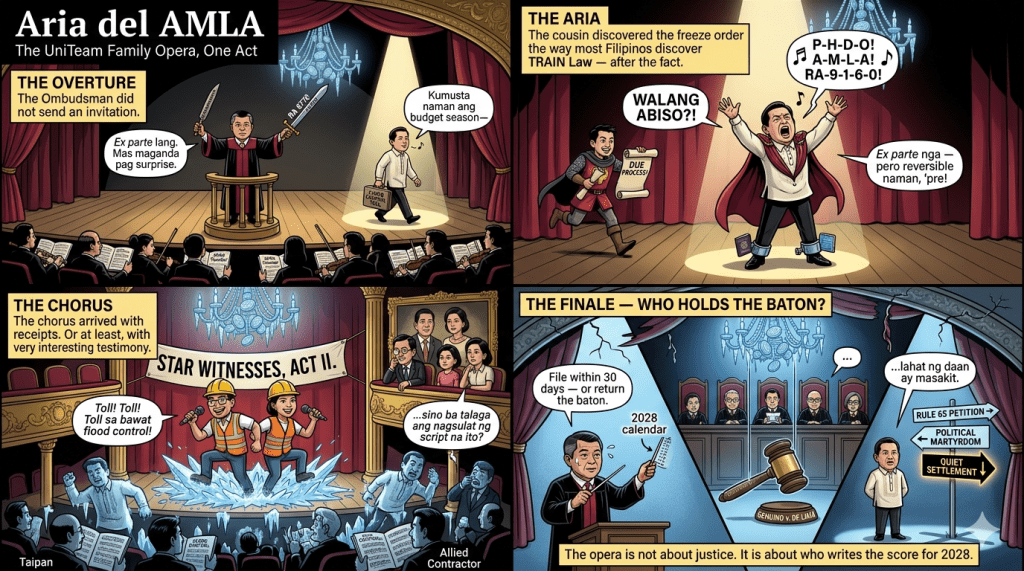
— No notice. No complaint. No problem — said the Ombudsman, conducting the most expensive family reunion in Philippine legal history.
Bucoy’s Evaporation: Half-Truths and Legal Smoke Screens
Bucoy’s radio monologue is a masterclass in partial truths delivered with the confidence of a man who has read the headlines but skimmed the footnotes. He is right—gloriously, surgically right—on two points. First, the PHDO was indeed ex parte: Ombudsman applied, Sandiganbayan granted, Romualdez’s camp received zero notice, zero chance to rebut. Second, the CA freeze order is in rem, not in personam—a preservative strike against the property, not a scarlet letter of guilt. Under Republic Act No. 9160 (Anti-Money Laundering Act), that is textbook AMLA procedure. Bucoy correctly reminds us the freeze does not mean “Romualdez is guilty”; it means “don’t let the money evaporate while we investigate.”
But here the soliloquy evaporates into legal vapor.
Bucoy treats “ex parte” like a get-out-of-jail-free card, as though the mere absence of notice renders the order void ab initio. Wrong. A.M. No. 18-07-05-SC (Rule on the Issuance of Precautionary Hold Departure Orders)
exists precisely because precautionary HDOs in graft and plunder cases must be summary and secret—otherwise the subject learns of the probe, books a one-way ticket to Singapore, and the evidence dissolves faster than a congressman’s alibi. Ex parte is not the bug; it is the feature.
He thunders that the order is “premature” because no complaint has been filed and no preliminary investigation concluded. Again, technically true, yet strategically incomplete. The same A.M. No. 18-07-05-SC (Rule on the Issuance of Precautionary Hold Departure Orders) and the Ombudsman’s constitutional powers under RA 6770 expressly allow provisional remedies during the investigative stage precisely when the potential penalty exceeds six years. Plunder carries reclusion perpetua. The law does not demand a fully cooked information before the state may stop the chef from fleeing the kitchen.
And the flight-risk argument? Bucoy’s third prong—“I am not a flight risk, I would not escape”—is the weakest reed. Romualdez’s camp did seek travel clearance for a medical follow-up. That is admirable transparency. But the Sandiganbayan does not require proof of a private jet on the tarmac; it requires only a reasonable apprehension that a high-stakes accused might become inconveniently unavailable. Courts have issued HDOs on far less. Bucoy’s assertions are not wrong; they are half-right in the way a surgeon’s scalpel is half-right when it stops at the epidermis. They invite challenge. They do not guarantee victory.
The Legal Crucible: Due Process on Trial Against Anti-Graft Overreach
Now we reach the crucible. Article III, Section 6 of the 1987 Constitution of the Republic of the Philippines is not decorative prose: “The right to travel… shall not be impaired except in the interest of national security, public safety, or public health, as may be provided by law.” Travel is a liberty interest protected by due process (Article III, Section 1 of the 1987 Constitution). The state may burden it—but only with a lawful court order backed by concrete necessity.
Enter the stress test. The Ombudsman and Sandiganbayan claim authority under the Ombudsman Act, Republic Act No. 3019 (Anti-Graft and Corrupt Practices Act), Republic Act No. 7080 (Plunder Law), Presidential Decree No. 1606, and A.M. No. 18-07-05-SC. They have the statutory keys. But do they have the constitutional fuel?
Genuino v. De Lima (2018) is the ghost haunting this case: the Supreme Court struck down DOJ circulars that let the executive issue HDOs unilaterally, insisting only the Judiciary may curtail travel. The Ombudsman did go to the Sandiganbayan—check. But Genuino also demands that the restraint not be arbitrary. Marcos v. Manglapus (1989) reminds us the right to travel is not absolute; yet Manglapus also required the impairment to be reasonable, not a preemptive political neutering. Silverio v. Court of Appeals and Paderanga v. CA further insist that procedural fairness cannot be sacrificed on the altar of expediency.
The central question, then, is mercilessly simple: Did the Ombudsman and Sandiganbayan possess enough concrete, pre-existing evidence, genuine urgency, and procedural fairness to justify burdening a constitutional liberty before any charges were formally filed?
The freeze order and PHDO were issued on the strength of an “endorsed complaint” to the AMLC and whispers from the Discayas—contractor couple turned star witnesses. No formal information. No completed preliminary investigation. No public showing of probable cause beyond “the President condemned kickbacks in his SONA.” That is not evidence; that is atmospherics. If the AMLC found red-flag transactions, show the court. If the whistleblowers have bank records linking Romualdez to the “toll” system, put them under oath. Until then, the state is not enforcing the law; it is performing it. The crucible reveals the crack: provisional remedies are lawful tools, not blank checks for dynastic surgery.
The Inquisitors’ Motives: UniTeam Fracture or Anti-Corruption Theater?
Let us speak plainly, as Barok does.
Romualdez’s camp: wounded pride and political survival. The man who once commanded the House now finds himself painted as the mastermind of flood-control graft despite Congress not wielding the implementing checkbook alone. His medical-travel request was public, his denial measured. Yet one cannot ignore the subtext: a Romualdez weakened is a Marcos dynasty unchallenged in 2028.
Ombudsman Remulla: the loyal inquisitor. Appointed by the President, he moves with the zeal of a man proving “no one is untouchable.” Noble on paper. But when the target is the President’s own cousin and the timing follows the SONA’s pointed finger at infrastructure kickbacks, the optics scream UniTeam fracture. Is this a genuine corruption crackdown or a dynastic purge scripted for the next electoral cycle?
The Discayas: classic whistleblowers with skin in the game. Potential immunity or leverage in their own legal hell—perfectly rational, perfectly suspect.
Bucoy: the principled defender or the hired mouthpiece? His analysis is legally literate but politically timed. He is not wrong to cry due process; he is merely silent on the fact that due process in graft cases sometimes begins with the handcuffs, not the invitation.
The real subtext is the UniTeam divorce. The President’s own blood relative is now collateral damage in the war on “tongpats.” When the ruling coalition begins devouring its own, the audience is not watching justice. It is watching a palace coup dressed in AMLA robes.
Forked Paths to 2028: Strategic Options and Looming Coalition Implosion
The drama reaches its critical fork. As the curtain rises on 2028 positioning, both sides face high-stakes choices that could either save careers or ignite a full-blown ruling coalition collapse.
Romualdez’s Survival Script
- Legal Counterstrike: File a motion to lift the PHDO by proving he is no flight risk — citing medical necessity, deep Philippine roots, and his high public profile.
- Supreme Court Assault: Launch a Rule 65 petition for certiorari, accusing the Sandiganbayan and Ombudsman of grave abuse of discretion.
- Political Martyrdom: Weaponize the asset freeze and travel ban, transform them into badges of persecution, and rally his loyal machinery for a fiery comeback.
Ombudsman’s Endgame Maneuvers
- Fast-track the filing of formal plunder and graft charges before the case collapses under procedural scrutiny.
- Carefully leak just enough evidence to sustain the media narrative — without crossing into contempt.
- Brace for a motion for inhibition if perceived bias becomes too glaring.
Possible Resolutions
- Landmark Conviction — The Ombudsman successfully bags a “big fish,” restoring Sandiganbayan credibility.
- Judicial Slapdown — The Supreme Court guts the PHDO and delivers a stern warning against premature state overreach.
- Quiet Political Settlement — Most likely outcome in this Republic: limited travel clearance for Romualdez, narrowed freeze order, and all parties emerge bloodied but breathing.
Looming Consequences
- Institutional: The Rule of Law either grows real teeth — or the anti-graft machinery stands fully exposed as a selective scalpel.
- Political: The UniTeam fracture widens into an open, irreparable wound before 2028.
- Economic: Asset freezes send ripples through allied corporations and flood-control contractors, reminding every taipan that proximity to power now carries serious frostbite risk.
Judicial Reckoning: The Supreme Court Must Drop the Gavel on Political Theater
The Republic cannot survive another cycle of selective justice wrapped in righteous anti-corruption rhetoric. The Supreme Court must intervene—now.
- To the Supreme Court: Accept any Rule 65 petition with urgency. Issue a definitive ruling clarifying the exact quantum of evidence required for a pre-filing PHDO under A.M. No. 18-07-05-SC. Declare that “probable cause” for provisional remedies cannot rest solely on whistleblower whispers and presidential soundbites. Enforce Genuino and Manglapus with teeth.
- To the Sandiganbayan Seventh Division: Lift or narrowly tailor the PHDO pending a full hearing on flight risk and medical necessity. Demand the Ombudsman produce, in camera if necessary, the concrete AMLC red flags and documentary evidence that supposedly justify this extraordinary restraint.
- To the Ombudsman: File the formal complaint within 30 days or withdraw the provisional remedies. Cease the media opera. Investigate every name linked to the flood-control mess with equal ferocity—selective prosecution is the death of credibility.
- To Romualdez: File the motion to lift. Submit to the process. If innocent, prove it in open court. If the case is weak, let the judiciary bury it. Political martyrdom is tempting; legal vindication is permanent.
The Rule of Law is not a suggestion. It is the only firewall between a republic and a revolving cast of untouchables. The opera must end not with a bang of political theater, but with the cold, merciless gavel of constitutional supremacy.
The stage is yours, Your Honors. Do not let the curtain fall on justice.
Key Citations
A. Legal & Official Sources
- Philippines, Supreme Court. Rule on Precautionary Hold Departure Order. 4 Feb. 2020. The Lawphil Project, Arellano Law Foundation.
- Philippines, Supreme Court. Genuino v. De Lima. G.R. No. 197930, 17 Apr. 2018, The LawPhil Projec.
- Philippines, Supreme Court. Marcos v. Manglapus. G.R. No. 88211, 15 Sept. 1989, The LawPhil Project.
- Philippines, Supreme Court. Paderanga v. Court of Appeals. G.R. No. 115407, 28 Aug. 1995, The LawPhil Project.
- Philippines, Supreme Court. Silverio v. Court of Appeals. G.R. No. 94284, 8 April 1991, The LawPhil Project.
- Philippines, Supreme Court. Paderanga v. Court of Appeals. G.R. No. 115407, 28 Aug. 1995, The LawPhil Project.
- Philippines. Presidential Decree No. 1606: Revising Presidential Decree No. 1486 Creating a Special Court to be Known as the “Sandiganbayan” and for Other Purposes. 10 Dec. 1978, The LawPhil Project.
- Philippines. Republic Act No. 3019: Anti-Graft and Corrupt Practices Act. 14 Apr. 1960, The LawPhil Project.
- Philippines. Republic Act No. 6770: Ombudsman Act of 1989. 17 Nov. 1989, https://lawphil.net/statutes/repacts/ra1989/ra_6770_1989.html.
- Philippines. Republic Act No. 7080: An Act Defining and Penalizing the Crime of Plunder. 12 July 1991, The LawPhil Project.
- Philippines. Republic Act No. 9160: Anti-Money Laundering Act of 2001. 29 Sept. 2001, The LawPhil Project.
- Philippines. The 1987 Constitution of the Republic of the Philippines. Official Gazette of the Republic of the Philippines.
- Philippines, Supreme Court. Rules of Court, Rule 65: Certiorari, Prohibition and Mandamus. The Lawphil Project, Arellano Law Foundation.
B. News Reports
- Lalu, Gabriel Pabico. “Precautionary Hold Order vs. Romualdez Can Be Challenged.” INQUIRER.net, 27 Apr. 2026.
- Punzalan, Jamaine. “Romualdez, Lawmakers Deny ‘False, Malicious’ Discaya Corruption Claims.” ABS-CBN News, 8 Sept. 2025.
- ₱8B BBM Pork: CCTV for Every Captain’s Kumpare?
- ₱8.9 Billion, 331 Ghost Police Stations: The TIKAS Scandal Explained

- ₱8.4 Billion, 42,000 Barangays, 1 Election: The “Bawat Barangay Makikinabang” Vote-Buying Masterclass

- ₱75 Million Heist: Cops Gone Full Bandit

- ₱6.77B Ghost Haunts Duterte: RTC Dismisses Mans Carpio’s Desperate Plea
- ₱6.77 Billion and Zero Cash: The Sara Duterte SALN Math That Doesn’t Add Up

- ₱6.7-Trillion Temptation: The Great Pork Zombie Revival and the “Collegial” Vote-Buying Circus

- ₱58.53B, Zero Receipts: The LGSF Pork Barrel Nobody Wants to Name
- ₱53 Million Man Tells ₱695-a-Day Workers to Stop Being ‘Mayabang’: The Audacity of BSP’s Remolona
- ₱4.4 Billion and a Witness Who Can’t Explain It: The Duterte Impeachment’s Most Expensive Non-Answer
- ₱3.06 Billion for Evacuation Centers—But Nobody Knows Where They’ll Stand (Or If They’ll Exist)
- ₱16 Billion, 280 Accounts, 8 Helicopters: Boying Remulla’s Case Against the Yaps Is Not a Drill








Leave a Reply