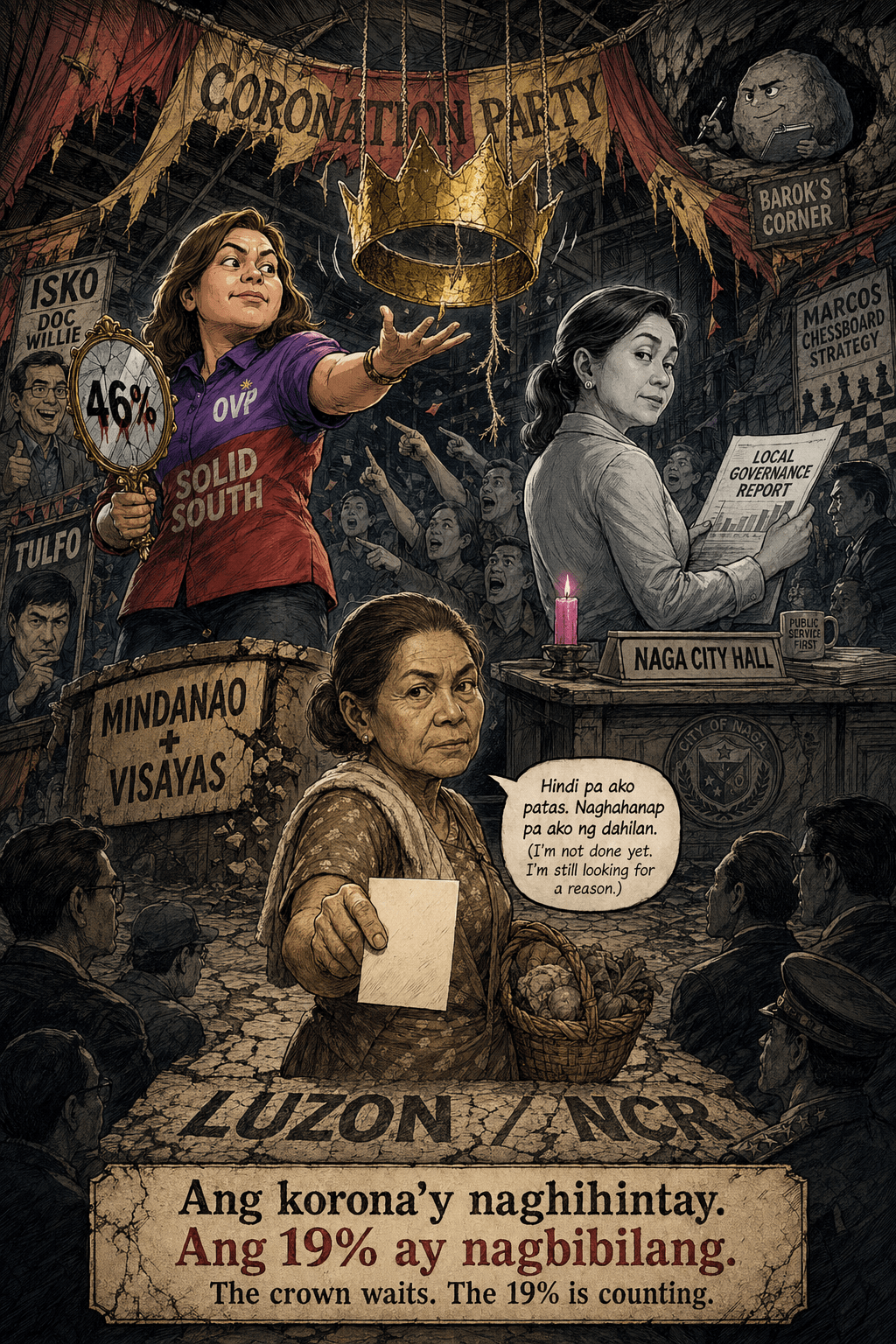
The 19% Undecided Just Killed the Coronation Party
By Louis “Barok” C. Biraogo — April 27, 2026
MGA ka-kweba, feel that? The faint tremor in the political ground two years before the ballots even whisper your names.
OCTA Research just dropped its latest “Tugon ng Masa” survey like a lit firecracker into a room full of dynastic egos, and the smoke is already choking the air.
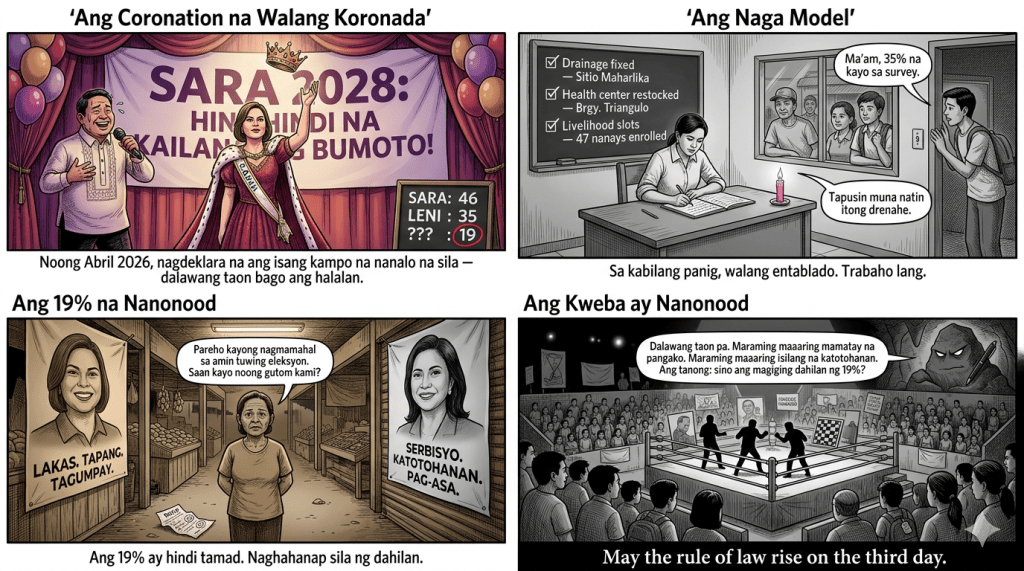
Sara Duterte leads Leni Robredo 46-35 in a head-to-head. Undecided: a screaming 19%.
In the multi-candidate scrum, Sara sits at 33%, Leni at 21%, with Isko Moreno, Raffy Tulfo, and the rest nibbling at the edges like vultures at a half-eaten carcass.
The headlines scream “Sara still dominates!” while the fine print laughs in our faces.
This is not prophecy. This is the opening scene of a political thriller where the hero hasn’t decided if she’s running, the villain is pretending she already won, and the audience—19% of it, at least—is still shopping for someone, anyone, who doesn’t feel like yesterday’s reheated adobo.
Let us eviscerate these numbers with the cold scalpel they deserve. A 46-35 lead sounds like a fortress until you remember it is built on name recall, not a contract signed in blood.
Sara’s 88% in Mindanao and 53% in Visayas? That is not national dominance; that is a Solid South redoubt that has always been her birthright and her cage.
The moment she steps outside that geographic fiefdom, the air thins. Luzon and NCR—vote-dense, unforgiving, wired to the internet and the price of rice—have already begun their quiet rebellion.
Leni’s 52% in the capital and 47% in Balance Luzon are not accidents; they are the sound of urban density remembering that governance is more than a surname and a tough-guy meme.
And that 13-point surge for Leni? A statistical sugar-high, yes—but one that reveals the electorate is restless, not resigned.
The 19% undecided in the binary matchup is the real dagger. In the crowded field it shrinks to 2%. Translation: Filipinos are not apathetic. They are waiting. They are watching. They are daring someone to give them a reason to show up.
Now watch me play both sides of the dialectic, then torch the stage.
For Sara’s Strength
She owns Class E like a warlord owns his turf—56% there, the masa vote that actually turns out. She has the machinery, the incumbency glow, the lingering perfume of her father’s populist tough love. The Duterte brand still sells “decisiveness” to people tired of elite lectures. Critics who sneer at her base as “disinformation victims” forget one uncomfortable truth: those voters feel seen. Patronage, welfare memory, the illusion of strength—these are not illusions to a family that eats once a day.
Against Sara’s Strength
That fortress is a house of cards in a typhoon. The lead has narrowed from a 30-point blowout. Impeachment whispers, SALN controversies, the slow-motion fracture of the Uniteam with the Marcoses—these are not background noise; they are termites in the foundation. Over-reliance on Mindanao is a demographic trap. When the anti-Duterte vote consolidates, the map shrinks to a regional redoubt. Overconfidence is her original sin. She acts as if 2028 is a coronation. History laughs at coronations.
For Leni’s Momentum
The woman isn’t even running and she’s surging. Her Naga City laboratory is producing visible competence—clean streets, actual services, the kind of local governance that makes dynastic theater look like a bad telenovela. Urban ABC voters, the youth, the remnants of the Pink Movement—they are tasting nostalgia for a politics that at least pretended to care about institutions. In a binary choice, the opposition vote snaps to her like iron filings to a magnet. That is not nothing.
Against Leni’s Momentum
She has publicly sworn off a national run. Volunteers without machinery are just enthusiastic ghosts. The 2022 ghosts still haunt: turnout problems, the “dilawan” branding that sticks like mud in the provinces. Class E may admire toughness more than spreadsheets. And let us be brutally honest: early surges for non-candidates have a way of evaporating when the real campaign begins and the attack ads roll.
The real culprits in this drama are not the poll numbers but the players and their deadly mix of action and inaction. Sara’s camp radiates the smugness of inevitability—early declaration games, “unbeatable” narratives—while quietly bleeding support in Luzon. Leni plays Hamlet: to run or not to run, that is the question she refuses to answer, letting volunteer energy simmer without a clear vessel. The Marcoses? Pure Machiavellian chess—quietly feeding the fracture, calculating whether a weakened Duterte or a resurgent Robredo better serves their dynasty’s long game. Isko Moreno and Raffy Tulfo circle like opportunistic sharks, ready to spoil or consolidate depending on which wind blows strongest.
And hovering over all of it like a bizarre global sideshow is the “Trump Gold Card” absurdity—that $1 million golden visa fantasy for the elite. While Class E worries about the next meal, some technocratic dreamers fantasize about importing American strongman aesthetics or paying their way to greener pastures. The disconnect is almost comedic. Almost. Because it feeds the very discontent the polls are measuring.
And now, the meta-statement that pollsters and pundits will treat like gospel, the one that deserves the sharpest blade in my drawer:
“Should the 2028 elections take place under evolving economic conditions, changing political alliances, shifting legal parameters, and altered public mood, the data and figures we see today may prove entirely irrelevant. Philippine elections are never decided by who is ahead in early surveys. Victory belongs instead to the candidate or group that most effectively turns public discontent into optimism, collective identity into strong political partnerships, and popular interest into active participation at the polls.”
Profound? Or the ultimate loser’s platitude? It is both, and that is the genius of it. On the surface, it is wisdom—elections are won in the streets and the barangays, not in a 1,200-respondent snapshot. But read it again with Barok’s cynical eye: it is also comfort food for the trailing side. It lets Leni’s camp pretend her non-candidacy is strategic brilliance. It lets Sara’s machine dismiss the narrowing gap as “early noise.” It lets everyone avoid the ugly truth that surnames still matter more than solutions, that patronage still buys votes, that the poor are counted in polls but forgotten the moment the cameras leave. The statement is correct. Philippine elections are decided by who turns grievance into hope. But the system is rigged so that only those with dynastic capital or elite networks get to play that game. The rest of us are extras.
So what can they actually do?
Sara can stop pretending the Solid South is enough. She must expand into Luzon without sounding like a carpetbagger, offer policy meat beyond “my father’s legacy,” and repair the Uniteam cracks before they become canyons. Leni can keep building the Naga model as living proof that local governance can be a national audition—quietly reassemble the volunteer army, court Class D and E without the elitist scent, and decide whether she is running or merely the kingmaker. The undecided 19%? They are the prize. A third-force candidate—Tulfo’s media reach, Isko’s centrist smile, or some technocratic “Gold Card” fantasy—could still hijack the narrative. Or the whole thing collapses into coalition math, the ultimate Philippine sport.
Project the consequences and feel the dread settle in your bones.These early numbers guarantee two more years of vicious character assassination, SALN fishing expeditions, impeachment theater, and endless social media bloodbaths. Expect the investment climate to freeze under a dark cloud of uncertainty — why would serious capital flow into a country whose next leader is already being pre-demolished in slow motion? Democratic erosion will accelerate as polls stop being mere snapshots and become weapons of premature destruction.Regional fractures will deepen. The Solid South will dig in harder, Luzon will grow more defiant, and the undecided 19% will become the most courted, most manipulated voting bloc in recent history. Meanwhile, the poor — those loyal Class E voters — will once again be counted as poll numbers today and conveniently forgotten as citizens tomorrow.And yet… a thin, subversive thread of hope remains. If Leni Robredo’s Naga governance model actually works, it could quietly prove that competence and results can challenge personality cults and patronage machines. If it fails, we will have confirmed what many already fear: in Philippine politics, surnames remain destiny.
The deeper meaning, mga ka-kweba, is this: the Duterte brand is still powerful, but no longer unchallenged. The Robredo brand was buried in 2022 but refuses to stay dead. The electorate is restless. That 19% undecided is not apathy—it is demand.
Here is the blistering call, the fire in my Filipino gut: enough with the horse-race hypnosis. Enough with treating citizens as poll numbers and the poor as vote banks to be harvested every six years. The real fight is not Sara versus Leni. It is between a politics that counts bodies and a politics that builds dignity.
To the electorate: stop rewarding dynasties with your silence. Demand policy platforms—on inflation, on jobs, on climate, on actual anti-corruption that doesn’t spare your favorite surname. Show up in barangay halls. Volunteer not for pink or red, but for competence. Turn that 19% undecided into an army of the discerning.
To the candidates: stop hiding behind surveys. Sara, give us a vision beyond toughness. Leni, if you’re not running, crown someone who can. Third-force pretenders, prove you are more than spoilers. And to the Marcos camp and the rest of the political class: the game of managed fracture ends when the people stop playing along.
Philippine elections are never decided by early polls. They are decided by who finally decides to treat the masa not as Class E statistics but as citizens who deserve more than dynastic reruns.
The stage is set. The undecided are watching. The 2028 thriller has only begun.
And Barok is in the front row, pen sharpened, ready to chronicle every twist, every betrayal, every moment this republic chooses hope over theater—or chooses to bleed again.
The floor is yours, 2028. Make it bleed. Make it think. Or make us angry enough, finally, to act.
Key Citations
- Rita, Joviland. “VP Sara Leads 46% While Leni Rises to 35% in 2028 Polls Matchup per OCTA Survey.” GMA News Online, 27 Apr. 2026.
- Rita Joviland. “Sara Duterte’s Numbers in Early Preferences for the 2028 Presidential Race Dipped to 33%.” GMA News Online, 24 Apr. 2026.
- Trump, Donald J. “The Trump Gold Card.” TrumpCard.gov, 2026.
- “Ang Hirap Maging Mahirap”: The PAO Scandal That Proves Government Contempt Is Nothing New

- “Far-Off” My Axx: Malacañang’s Claire Castro Drowns in Her Own Legal Gaslighting
- “Forthwith” to Farce: How the Senate is Killing Impeachment—And Why Enrile’s Right (Even If You Can’t Trust Him)
- “HINDI AKO NAG-RESIGN!”

- “I Know Nothing”: Baste Duterte’s Amnesia Defense Meets ₱33M in GenCorp Contracts

- “I’m calling you from my new Globe SIM. Send load!”

- “Mahiya Naman Kayo!” Marcos’ Anti-Corruption Vow Faces a Flood of Doubt

- “Manageable” Debt, Unmanageable Lies: DBM’s ₱21 Trillion Fairy Tale

- “Meow, I’m calling you from my new Globe SIM!”

- “Natrabaho”: One Word, One Ombudsman, and a Judiciary on Trial

- “No Special Jail for Crooks!” Boying Remulla Slams VIP Perks for Flood Scammers

- “Philippine-Controlled” or Yankee Gas Station? The Davao Fuel Depot Farce Exposed





Leave a Reply