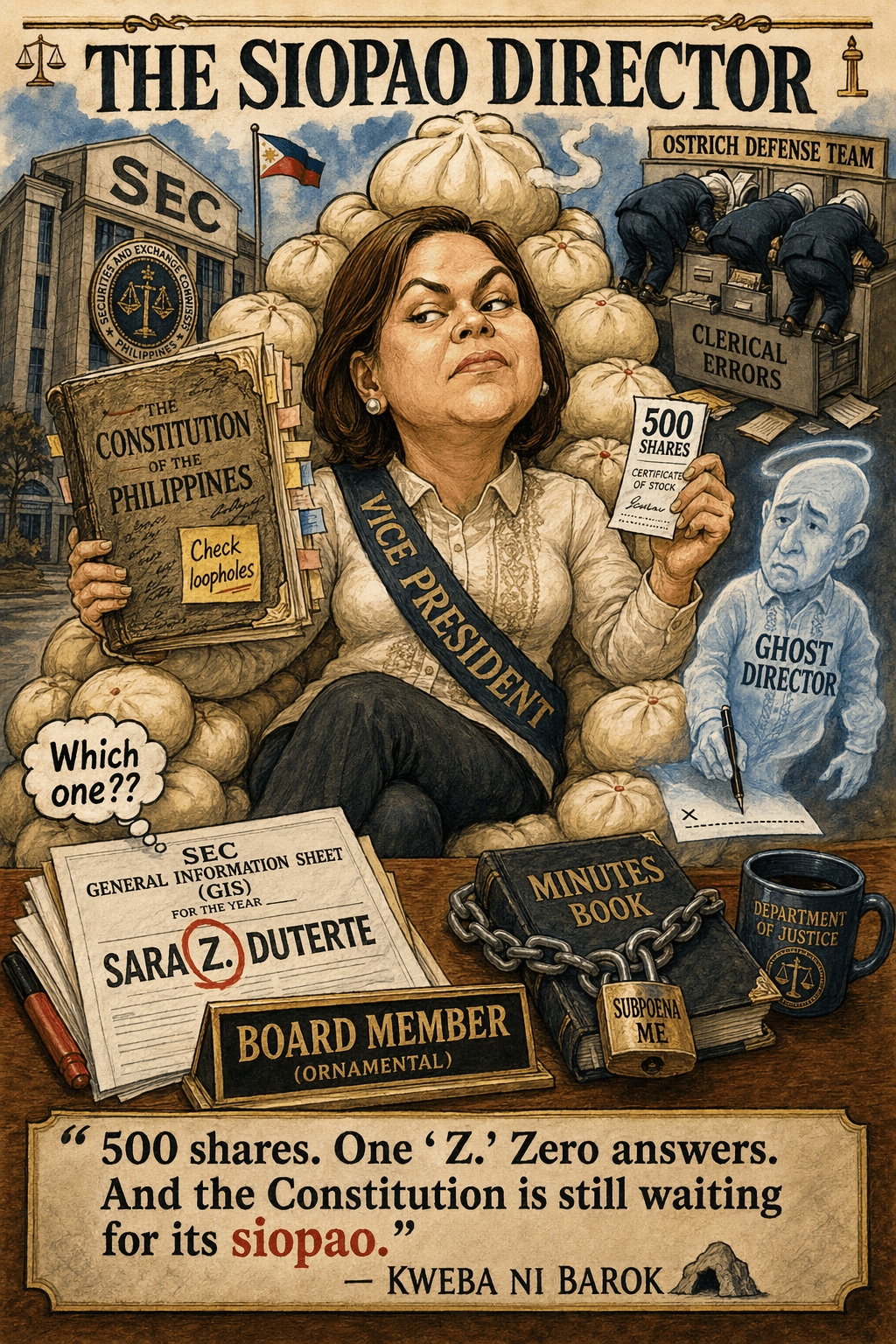
Siopao Empire or Constitutional Violation? The GIS Files Exposed
By Louis ‘Barok‘ C. Biraogo — April 25, 2026
The “Z” Identity Crisis
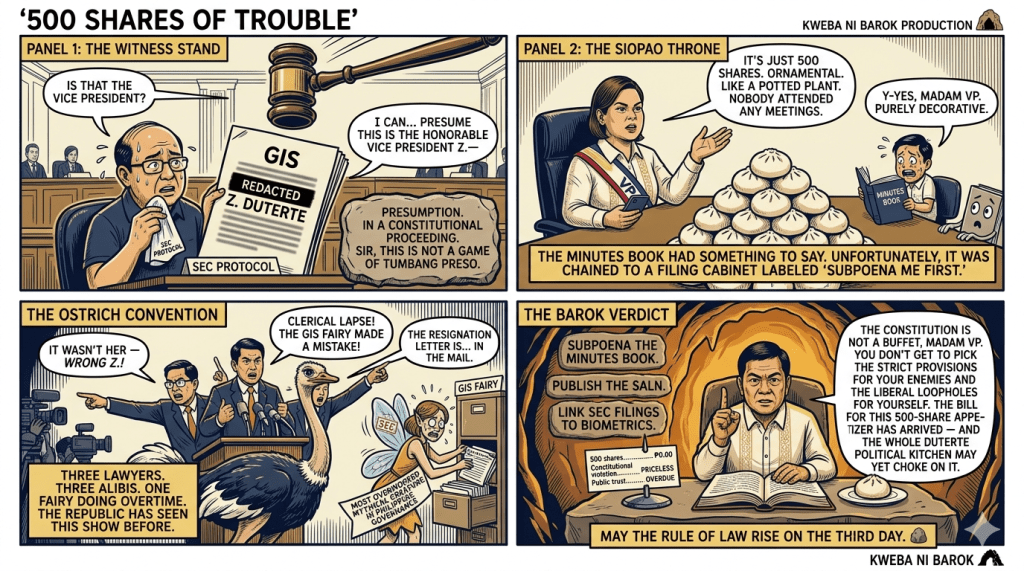
MGA ka-kweba, ladies and gentlemen of the Republic’s peanut gallery, grab your popcorn and your copy of the Rules of Court. The SEC’s own Company Registration and Monitoring Department Director, Gerardo del Rosario, took the witness stand before the House Committee on Justice and delivered what can only be described as the legal equivalent of a shrug with a law degree: “The reference here is Sara Z. Duterte, and I can presume this is the Honorable Vice President Sara Z. Duterte.”
Presumption? In a nation whose Constitution demands proof beyond reasonable doubt when the head of state’s integrity is on the line? Under the Best Evidence Rule (Rule 130, Rules of Court), the original General Information Sheet itself—or better yet, the Corporate Secretary’s sworn testimony identifying the signatory—should be trotted out like a star witness, not hidden behind a bureaucratic “I can presume.”
Is “Sara Z. Duterte” the rarest name in Davao corporate annals, or is this the legal version of mistaking one Duterte cousin for another at a family reunion? The House impeachment machine is revving its engines, ready to impeach the wrong “Sara Z.”—the one who merely wanted to sell siopao and adobo, not steer the ship of state. Yet here’s the delicious suspense: that single dangling “Z” is the only thread preventing a full-blown constitutional avalanche. One verified signature, one biometric match, and the entire House case either collapses or explodes. The ghost in the GIS is not yet exorcised.
Director vs. Ornament: The Board Seat Crucible
Now we reach the real knife fight: stockholder versus director under Section 23 of Republic Act No. 11232 (Revised Corporation Code of the Philippines). Owning 500 shares is one thing; sitting on the board is quite another. The Article VII, Section 13 of the 1987 Constitution of the Republic of the Philippines is not polite dinner conversation—it is an absolute and all-embracing prohibition. As the Supreme Court thundered in Funa v. Agra (G.R. No. 191644, February 19, 2013), the ban exists precisely so that the Vice President’s office remains a jealous mistress who brooks no corporate boardroom dalliances.
The critics’ argument is merciless: accepting even an ornamental board seat triggers fiduciary duties in potentia—loyalty, care, obedience. The moment the GIS lists her as “member of the board,” the constitutional offense is complete. The VP’s full-time devotion to the Republic does not include moonlighting as a corporate fiduciary, no matter how empty the chair looks.
The defense, of course, waves the de minimis flag: 500 shares as a mere “qualifying share,” no different from a library card. They will scream that ownership of property is not “holding office,” and demand the prosecution prove a single board resolution signed, a single meeting attended, or a single director’s fee deposited into any account during her incumbency.
Fair enough. The suspense is killing us. Subpoena the Corporate Secretary’s Minutes Book. Show us the signatures, the attendance sheets, the dividend stubs—or cease the theater and admit this may be nothing more than a 500-share ornament gathering dust in a Davao filing cabinet.
The Siopao State: Conflict of Interest Conundrum
Even if the board seat is ornamental, Republic Act No. 6713 (Code of Conduct and Ethical Standards for Public Officials and Employees) and Republic Act No. 3019 (Anti-Graft and Corrupt Practices Act) still hover like uninvited guests at the siopao counter. Section 9 of RA 6713 requires divestment or resignation within thirty days of assumption of office. Section 3(i) of RA 3019 slams the door on any financial interest that could tempt an official to intervene in her public capacity.
Has Metro City Chow Foods Corp. ever sniffed around OVP or DepEd contracts? Even without direct evidence, the appearance of influence over food safety regulations or Davao ordinances creates an ethical miasma thick enough to choke public trust. Article XI, Section 1 of the 1987 Constitution is not a suggestion: “Public office is a public trust.” When the Vice President’s name sits on a food company’s GIS while she holds the second-highest office in the land, the public is entitled to more than a presumption and a prayer.
Ostrich Defenses and Prosecutorial Gambits
The Ostrich Defense (Sara’s Playbook):
- “It Wasn’t Me” – classic identity error in a city full of Dutertes.
- “Clerical Lapse” – the corporation simply forgot to update the GIS.
- “Resignation Letter” Gambit – back-dated, lost in the mail, or conveniently misplaced.
The “Clerical Error” fairy must be the most overworked mythical creature in Philippine governance. She files more erroneous GIS documents than the entire SEC registry combined. Satirize it all you want; the public is tired of watching powerful people hide behind the same tired alibi.
The Prosecutorial Gambit (House of Representatives’ Playbook):
Relying solely on the SEC GIS is playing with fire. Without the Minutes Book, without proof of active participation, without a single peso traced to government dealings, the Senate will treat this the way it treated the Corona impeachment evidentiary standards—politely, then dismissively. The House has the GIS; it needs the smoking signature.
Constitutional Apocalypse: True or Technicality?
- If True: The path from GIS filing to Culpable Violation of the Constitution is a four-lane highway. Add an undeclared 500 shares in the 2022 or 2023 Statement of Assets, Liabilities, and Net Worth (SALN) and the crime upgrades from constitutional sloppiness to perjury and unexplained wealth. Impeachment becomes inevitable; the Senate trial becomes a spectacle.
- If False/Technicality Prevails: Then we have eviscerated the precedent. A Vice President could theoretically own 49% of a casino, call it “passive income,” and dare anyone to prove she attended a single board meeting. Where exactly is the line drawn in the Davao sand? The Constitution becomes a buffet—strict for enemies, liberal for allies.
The Barok Mandamus: Demand Confirmation, Not Presumption
- Immediate Investigation: The SEC and the Ombudsman must stop “presuming” and start confirming—sworn statements from the Corporate Secretary, production of the original GIS, and forensic comparison of signatures.
- Transparency: Publish the Vice President’s SALN Summary immediately. The people have waited long enough.
- Strengthening Institutions: The current SEC General Information Sheet regime is a nationwide fiction-writing contest. Congress should enact a law linking SEC filings with DILG/Comelec biometrics to prevent future “Ghost Directors.”
And finally, the non-negotiable closer:
The Constitution is not a buffet where the powerful pick the “strict” provisions for their enemies and the “liberal” loopholes for themselves. It is a prix fixe meal—and madam VP, the bill for this 500-share appetizer may yet choke the entire Duterte political kitchen.
Kweba ni Barok – Where the law bites back.
Key Citations
A. Legal & Official Sources
- The 1987 Constitution of the Republic of the Philippines. Official Gazette of the Republic of the Philippines, 1987.
- Philippines. Republic Act No. 11232: An Act Providing for the Revised Corporation Code of the Philippines. 2019.
- Philippines. Republic Act No. 6713: An Act Establishing a Code of Conduct and Ethical Standards for Public Officials and Employees. 1989, The LawPhil Project.
- Philippines. Republic Act No. 3019: Anti-Graft and Corrupt Practices Act. 1960, The LawPhil Project.
- Philippines, Supreme Court. Funa v. Agra. G.R. No. 191644, 19 Feb. 2013, The LawPhil Project.
- Philippines, Supreme Court. 2019 Amendments to the 1989 Revised Rules on Evidence (A.M. No. 19-08-15-SC). The LawPhil Project.
B. News Reports

- “Ang Hirap Maging Mahirap”: The PAO Scandal That Proves Government Contempt Is Nothing New
- “Far-Off” My Axx: Malacañang’s Claire Castro Drowns in Her Own Legal Gaslighting
- “Forthwith” to Farce: How the Senate is Killing Impeachment—And Why Enrile’s Right (Even If You Can’t Trust Him)
- “HINDI AKO NAG-RESIGN!”

- “I Know Nothing”: Baste Duterte’s Amnesia Defense Meets ₱33M in GenCorp Contracts

- “I’m calling you from my new Globe SIM. Send load!”

- “Mahiya Naman Kayo!” Marcos’ Anti-Corruption Vow Faces a Flood of Doubt

- “Manageable” Debt, Unmanageable Lies: DBM’s ₱21 Trillion Fairy Tale
- “Meow, I’m calling you from my new Globe SIM!”

- “Natrabaho”: One Word, One Ombudsman, and a Judiciary on Trial
- “No Special Jail for Crooks!” Boying Remulla Slams VIP Perks for Flood Scammers

- “Philippine-Controlled” or Yankee Gas Station? The Davao Fuel Depot Farce Exposed





Leave a comment