Disorderly Behavior or Dangerous Truths? The Real Reason Behind the Expulsion
By Louis ‘Barok‘ C. Biraogo — June 4, 2026
The Guillotine Disguised as Parliamentary Discipline
The House of Representatives did not merely discipline Francisco “Kiko” Barzaga on June 2, 2026. It performed a public political execution dressed in the borrowed robes of parliamentary dignity. With a 265-14-8 vote — a supermajority so lopsided it would embarrass a banana republic — the chamber expelled the Cavite 4th District representative for the sin of being persistently, inconveniently, and theatrically inconvenient.
The official narrative peddled by the Ethics Committee is a masterclass in institutional gaslighting. Barzaga, we are told, committed “disorderly behavior” and “conduct unbecoming a Member” through repeated interruptions, mockery of leadership, unauthorized livestreams, and social media posts that allegedly defamed powerful figures. Two prior 60-day suspensions failed to reform him, therefore expulsion was the measured, proportionate, and inevitable last resort.
This is comedic if it were not so dangerous. The same House that tolerated Arnie Teves’ prolonged absence while he was accused of masterminding a governor’s assassination now discovers zero tolerance for a first-term lawmaker who called his colleagues crocodiles on Facebook and went live from the session hall to say, in essence, “don’t steal so much.” The absurdity is not subtle. It is the Ethics Committee treating social media posts as equivalent to blood on the floor, while the real institutional hemorrhage — uninvestigated bribery allegations against a billionaire backer of the ruling coalition — is allowed to clot quietly.
Constitution, Speech, and the Proportionality Trap
The 1987 Constitution of the Republic of the Philippines grants each House the power to punish its Members for disorderly behavior and, with two-thirds concurrence, suspend or expel under Article VI, Section 16(3). The 265 votes satisfied the numerical threshold. The procedural checklist — notice, hearing, deliberation, vote — was formally observed. Under Osmeña v. Pendatun (G.R. No. L-17144, October 28, 1960), the Supreme Court has historically deferred to congressional autonomy in internal discipline. That deference, however, is not a suicide pact for the Bill of Rights.
Barzaga’s defenders correctly invoke Article III, Section 4 (freedom of speech) and Article VI, Section 11 (the Speech or Debate Clause). Jimenez v. Cabangbang (G.R. No. L-15905, August 3, 1966) limits the latter’s protection to utterances made “in the performance of official duty.” Livestreaming from the floor and Facebook posts made during suspended sessions sit in a gray zone. Yet when those utterances concern alleged bribery in the speakership contest and anomalies in the national budget — core legislative concerns — the gray area darkens into protected territory. The House treated this as mere “disorderly behavior.” It was, in truth, the weaponization of parliamentary rules against legislative speech that embarrassed the majority.
The proportionality argument collapses under its own weight. Philippine jurisprudence recognizes recidivism as an aggravating factor. But the “recidivism” here consists of speech acts and procedural flamboyance, not criminal convictions. Compare the precedents the House itself created. Arnie Teves was expelled amid murder charges and prolonged absence — conduct with grave criminal gravity. Nicanor de Guzman faced gun-smuggling allegations and resigned before expulsion. Barzaga was removed for mocking images, crocodile metaphors, and unproven (but never disproven) accusations against Enrique Razon and the National Unity Party (NUP). This is not progressive discipline. This is selective escalation against a defector who joined the Partido ng Demokratiko Pilipino (PDP) and refused to stay silent.
Republic Act No. 6713 (The Code of Conduct and Ethical Standards for Public Officials and Employees) demands professionalism and integrity. It does not, and cannot, criminalize criticism of public officials on matters of public concern. Borjal v. Court of Appeals (G.R. No. 126466, 1999) and Disini v. Secretary of Justice (G.R. No. 203335, 2014) teach that public figures and matters of public interest enjoy breathing space. The House chose to suffocate that space instead.
Due process was observed in form. Whether it was observed in substance — an Ethics Committee chaired by a party-list representative whose bloc benefits from the ruling coalition’s largesse — is the question the Supreme Court may one day be forced to answer if a petition for certiorari reaches it. Grave abuse of discretion remains justiciable even under the political question doctrine.
Peeling Back the Masks: Motivations of the Key Players
Motivations in this affair are not mysterious; they are merely unacknowledged.
The Marcos-Romualdez bloc gained the permanent removal of a media-savvy irritant who had defected from assistant majority leader to PDP critic. Barzaga’s trajectory — from insider to accuser of Romualdez’s financial backer — mapped too neatly onto his legal jeopardy. The bloc preserved the appearance of unity without the messiness of a criminal trial that might have compelled testimony on the very allegations Barzaga promised to prove.
Enrique Razon, facing a P110-million cyberlibel complaint under Republic Act No. 10175 (Cybercrime Prevention Act of 2012), gains the silencing of his most persistent public accuser. The expulsion conveniently muzzles the one legislator who vowed to “disclose everything” upon return. The NUP, whose members Barzaga accused of taking Razon money to support Romualdez’s speakership, gains institutional vindication and the suppression of an embarrassing internal narrative. That Barzaga’s late father once led the NUP adds a Shakespearean sting to the irony.
The Duterte-aligned PDP and Vice President Sara Duterte, who penned an open letter of support, gain a ready-made martyr. Barzaga’s expulsion hands the opposition a narrative of free-speech martyrdom that travels better outside the chamber than inside it. Barzaga himself appears to have calculated the political arithmetic: compliance inside Congress offered diminishing returns compared with the platform of the expelled dissident.
The unresolved threads remain radioactive. The Razon-Solaire bribery allegations were never investigated by any independent body with subpoena power. The NBI’s ethics complaint over Barzaga’s posts linking agency personnel to an alleged assassination plot during the May 13 Senate shooting incident raises its own questions — both about the truth of the claims and about the speed with which the state moved to punish the messenger. These issues did not disappear with the expulsion. They simply lost their most vocal congressional amplifier.
The Democratic Frostbite: Chilling Effects and Voter Disenfranchisement
The chilling effect is immediate and measurable. Every remaining member of the House now understands that a 265-vote supermajority can expel a colleague for speech that the majority finds embarrassing. Future lawmakers contemplating public accusations of graft against House leadership or its patrons will perform the Barzaga calculus: Is the platform worth the career? The answer the House has supplied is chillingly clear.
Barzaga becomes a political martyr with enhanced mobility. Stripped of parliamentary constraints, he retains his social media reach, his pending cases, and his narrative. The Dasmariñas electorate — whose mandate the House effectively nullified — faces a special election estimated to cost P200 million, with no sitting representative until late August 2026 at the earliest. This is not merely disenfranchisement; it is the conversion of voter sovereignty into a costly administrative afterthought.
Kweba Verdict: Rule of Law or Rule of the Clique?
The form of the expulsion was constitutional. The substance was institutional retaliation masquerading as discipline. When a ruling supermajority expels a first-term lawmaker nine months into his term — primarily for accusing their political patrons of bribery and for refusing to observe the decorum of complicit silence — the rules have been followed, but the rule of law has been mocked.
The House of Representatives must choose. It can continue down the path of weaponized ethics proceedings, creating a chamber where dissent is tolerated only when it is decorative. Or it can remember that parliamentary sovereignty exists to protect the institution’s integrity, not to shield its powerful from accountability.
Concrete recommendations:
- The Supreme Court, should a petition be filed, must not abdicate review. Distinguish between genuine disorder and protected legislative speech on matters of public concern.
- The Ombudsman and Sandiganbayan must investigate the underlying corruption allegations Barzaga raised — the Solaire gatherings, the alleged NUP-Razon arrangements — rather than allow the expulsion to serve as a de facto immunity shield.
- The House must reform its ethics rules to include explicit protections for good-faith allegations of corruption made by members, even when delivered with theatrical excess.
- The Commission on Elections (COMELEC) must conduct the special election with dispatch and transparency. Let the voters of Dasmariñas render the political verdict the House preempted.
Barzaga told his colleagues on his last day not to steal so much. The House responded by removing him from the premises. The cave does not forget such ironies.
🪨 May the rule of law rise on the third day — and may the House remember that expelling one man does not expel the questions he raised.
Key Citations
A. Legal & Official Sources
- The 1987 Constitution of the Republic of the Philippines. Official Gazette of the Republic of the Philippines, 1987, http://www.officialgazette.gov.ph/constitutions/1987-constitution/.
- Republic Act No. 6713. An Act Establishing a Code of Conduct and Ethical Standards for Public Officials and Employees. Official Gazette of the Republic of the Philippines, 20 Feb. 1989, http://www.officialgazette.gov.ph/1989/02/20/republic-act-no-6713/.
- Republic Act No. 10175. An Act Defining Cybercrime, Providing for the Prevention, Investigation, Suppression and the Imposition of Penalties Therefor and for Other Purposes (Cybercrime Prevention Act of 2012). Official Gazette of the Republic of the Philippines, 12 Sept. 2012, http://www.officialgazette.gov.ph/2012/09/12/republic-act-no-10175/.
- Osmeña v. Pendatun. G.R. No. L-17144. Supreme Court of the Philippines, 28 Oct. 1960. Lawphil, https://lawphil.net/judjuris/juri1960/oct1960/gr_l-17144_1960.html.
- Jimenez v. Cabangbang. G.R. No. L-15905. Supreme Court of the Philippines, 31 Aug. 1966. Lawphil, https://lawphil.net/judjuris/juri1966/aug1966/gr_l-15905_1966.html.
- Borjal v. Court of Appeals. G.R. No. 126466. Supreme Court of the Philippines, 14 Jan. 1999. Lawphil, https://lawphil.net/judjuris/juri1999/jan1999/gr_126466_1999.html.
- Disini v. Secretary of Justice. G.R. No. 203335. Supreme Court of the Philippines, 18 Feb. 2014. Lawphil, https://lawphil.net/judjuris/juri2014/feb2014/gr_203335_2014.html.
B. News Reports
- Rappler. “House Expels Kiko Barzaga.” Rappler, Rappler Inc., 3 June 2026, http://www.rappler.com/philippines/house-representatives-expels-kiko-barzaga/.
- Philippine News Agency. “House Expels Kiko Barzaga over Repeated Violations of Chamber Rules.” Philippine News Agency, 3 June 2026, http://www.pna.gov.ph/articles/1276409.
- GMA News Online. “House Expels Kiko Barzaga over Disorderly Behavior, Conduct Unbecoming of a Member.” GMA Network, 3 June 2026, http://www.gmanetwork.com/news/topstories/nation/989948/kiko-barzaga-house-rules-ethics/story/.
- ₱9 Billion in ‘Savings’? DILG’s Fire Truck Deal Smells Like Smoke
- ₱8B BBM Pork: CCTV for Every Captain’s Kumpare?
- ₱8.9 Billion, 331 Ghost Police Stations: The TIKAS Scandal Explained

- ₱8.4 Billion, 42,000 Barangays, 1 Election: The “Bawat Barangay Makikinabang” Vote-Buying Masterclass
- ₱75 Million Heist: Cops Gone Full Bandit

- ₱63 to the Dollar: The Only Thing Falling Faster Than the Peso Is the Government’s Credibility
- ₱6.77B Ghost Haunts Duterte: RTC Dismisses Mans Carpio’s Desperate Plea
- ₱6.77 Billion and Zero Cash: The Sara Duterte SALN Math That Doesn’t Add Up

- ₱6.7-Trillion Temptation: The Great Pork Zombie Revival and the “Collegial” Vote-Buying Circus

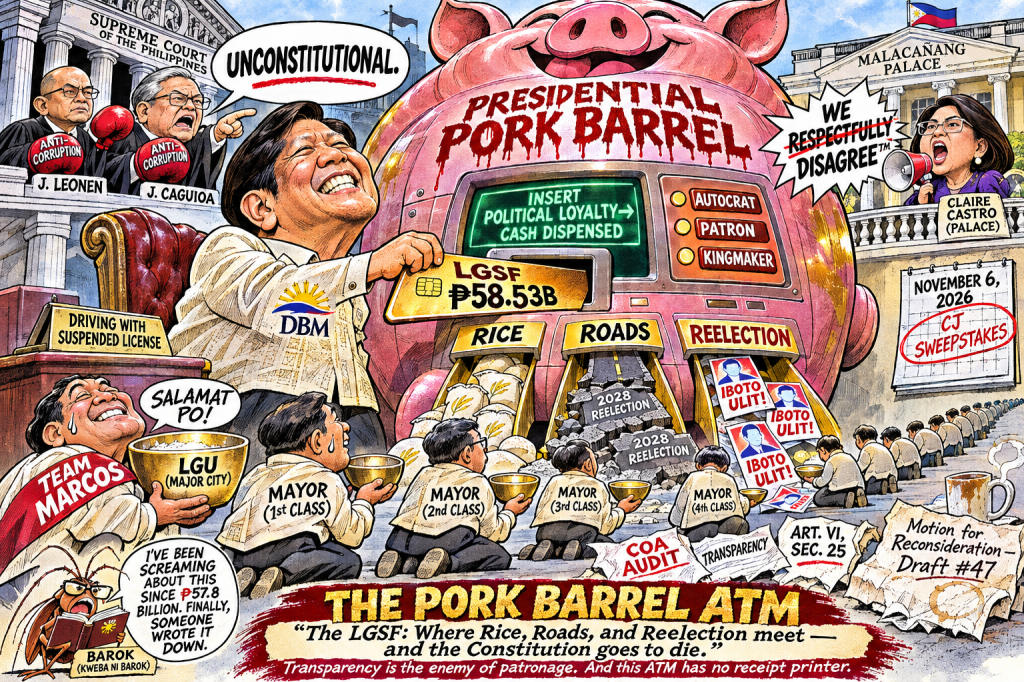
- ₱58.53B, Zero Receipts: The LGSF Pork Barrel Nobody Wants to Name
- ₱53 Million Man Tells ₱695-a-Day Workers to Stop Being ‘Mayabang’: The Audacity of BSP’s Remolona
- ₱4.4 Billion and a Witness Who Can’t Explain It: The Duterte Impeachment’s Most Expensive Non-Answer



Leave a Reply