This Was Never About Quorum — It Was About Who Controls Sara Duterte’s Impeachment Trial
By Louis ‘Barok’ C Biraogo — June 3, 2026
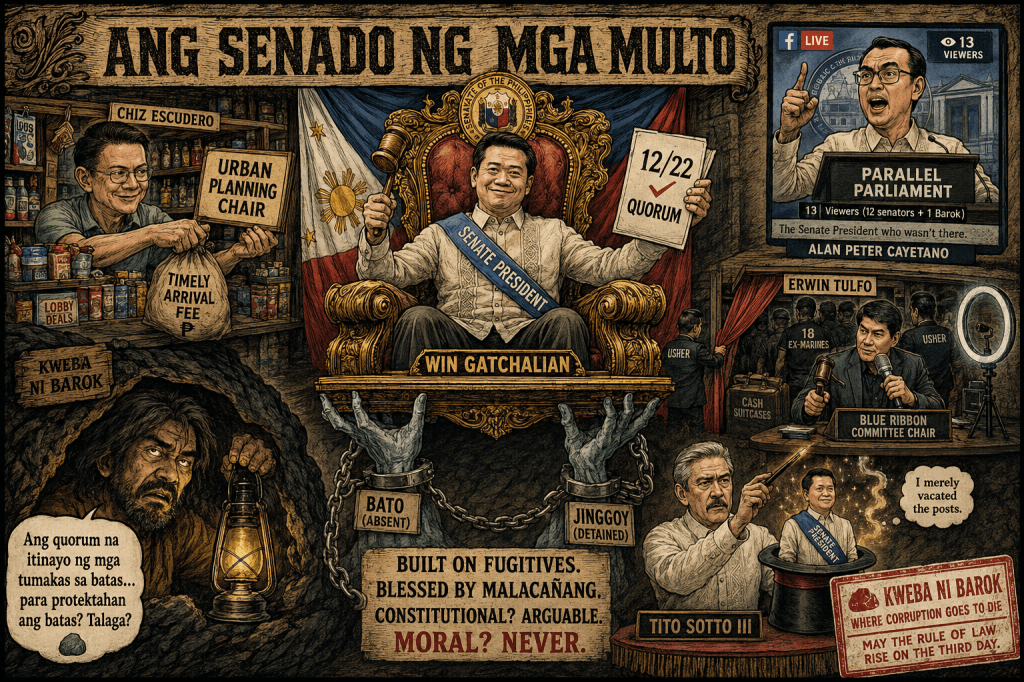
AND lo, on the third day, the Senate rose from the dead—not by divine constitutional intervention, but by a quorum stitched together from the absent, the fugitive, and the exquisitely timed defector. Twelve senators, citing Avelino v. Cuenco (G.R. No. L-2821, March 4, 1949) and the ghost of a 2015 precedent, declared the chamber open while Senate President Alan Peter Cayetano conducted his parallel parliament via Facebook Live, decrying an “illegal” session. Sherwin “Win” Gatchalian took the oath as President Pro Tempore and acting presiding officer. Committee chairs were reshuffled with surgical precision. Proposed Resolution 432 slipped through, amending impeachment trial rules. And the 18 former Marines—those inconvenient witnesses allegedly delivering cash-filled suitcases to former Speaker Martin Romualdez and ex-Appropriations Chair Elizaldy Co—found their Blue Ribbon inquisitors suddenly reassigned.
This was never a routine reorganization. It was a constitutional autopsy performed on live television, with the Philippine Senate’s integrity as the corpse.

Cayetano’s Collapse: Boycott as Shield or Constitutional Violation?
Gatchalian’s defenders wield a formidable arsenal. Article VI, Section 16(5) of the 1987 Constitution of the Republic of the Philippines prohibits either House from adjourning for more than three days without the other’s consent. After two days of Cayetano-induced paralysis, the minority bloc invoked a genuine constitutional duty to convene and prevent breach. Avelino v. Cuenco (G.R. No. L-2821, March 4, 1949) and the May 5, 2015 Senate precedent support calculating quorum from senators “over whom jurisdiction can be obtained”—here, 22 rather than 24, excluding International Criminal Court (ICC) fugitive Ronald “Bato” dela Rosa and detained plunder suspect Jinggoy Estrada. Gatchalian did not formally oust Cayetano; he merely reorganized subordinate positions. Senator Panfilo Lacson’s endorsement painted him as the prepared technocrat, the Boy Scout who knew his brief on budgets and infrastructure. Malacañang itself blessed the outcome as “naayon sa batas at rule of law.”
Yet the smell test fails spectacularly. Chiz Escudero’s solitary arrival converted an 11-senator minority into a 12-senator “quorum.” He emerged with the Urban Planning, Housing and Resettlement chair—transactional politics dressed as institutional statesmanship. The political geometry is damning: a Marcos-aligned bloc “rescues” the Senate on the very eve of a Blue Ribbon hearing that threatened to detonate inside the administration’s own coalition. The “effective Senate” theory, while arguably supported by Avelino v. Cuenco, this theory sits uneasily with the plain command of Article VI, Section 16(2) of the 1987 Constitution that “a majority of each House shall constitute a quorum.” Reorganizing committees on the last session day before sine die, without notice to the excluded majority, raises audi alteram partem (hear the other side) due-process concerns. Gatchalian may not have lit the match, but he accepted the accelerant.
The Senate’s Shadow Players: Escudero, Sotto, Tulfos, and the Ghosts of Accountability
Cayetano’s boycott was framed as a “parliamentary tool” to protect Senate independence. In reality, it was a self-inflicted constitutional wound. Two days of deliberate non-attendance produced the functional equivalent of a prohibited three-day adjournment under Article VI, Section 16(5) of the 1987 Constitution. Pending measures for hospitals, farmers, and fisherfolk died. Under Republic Act No. 3019 (Anti-Graft and Corrupt Practices Act), Section 3(e), a public officer who causes undue injury to the government through manifest partiality or bad faith faces liability. Cayetano’s calculated absence meets that test. His Facebook Live counter-sessions constituted a digital Potemkin parliament—constitutionally untenable under Santiago v. Guingona (G.R. No. 134577, November 18, 1998), which held that internal rules yield to constitutional commands.
Worse, the boycott preserved Pia Cayetano’s Blue Ribbon chairmanship precisely when the 18 ex-Marines and their counsel, Atty. Levito Baligod, were poised to testify about cash deliveries to Romualdez and Co. Cayetano cannot credibly pose as defender of Senate independence while shielding his sister’s gavel from touching administration allies. Article XI, Section 1 of the 1987 Constitution’s public trust doctrine—“Public office is a public trust”—was violated in real time. The “13 magic number” defense collapses under its own weight: Cayetano himself ascended through prior leadership maneuvers he now condemns.
Impeachment Proxy War and the Blue Ribbon Massacre
Chiz Escudero: The Transactional Kingmaker
Chiz Escudero, the self-proclaimed kingmaker who “took a stand for the Senate,” decoded the Malacañang bat-phone with exquisite timing. His reward—the Urban Planning chair—reeks of consulship politics, not civic virtue.
A former Senate president knows institutional damage when he sees it; he also knows which side of the emerging impeachment divide offers the better vantage point.
Tito Sotto III: Guardian or Ghost of Senates Past?
Tito Sotto III, the most senior senator, moved to vacate all leadership posts except the presidency before administering Gatchalian’s oath. Guardian of tradition or vengeful ghost of Senates past? The distinction matters less than the outcome: restoration of a pre-May order with new management.
The Tulfo Bloc: Media Populists Armed with Investigative Power
The Tulfo Bloc received the most dangerous prize. Erwin Tulfo now chairs Blue Ribbon and Social Justice; Raffy Tulfo takes Public Services. Media populists with untested impartiality toward the administration now control the investigative machinery that was about to examine cash suitcases allegedly delivered to Romualdez and Co.
This is not oversight. This is a protection racket wearing the mask of Senate accountability.
The Fugitive and the Detainee: The Quorum Built on Evasion
The Fugitive and the Detainee—Bato dela Rosa hiding from an ICC warrant and Jinggoy Estrada detained for plunder in the flood control scandal—stand as the ultimate constitutional irony. Their physical absence, born of evading justice, mathematically enabled the 12/22 quorum that “rescued” the chamber.
A quorum ghost-written by the very corruption it claims to combat. The Senate effectively self-amputated members who chose to flee accountability, then used that amputation to reorganize itself.
The Impeachment Machinery and the Accountability Massacre
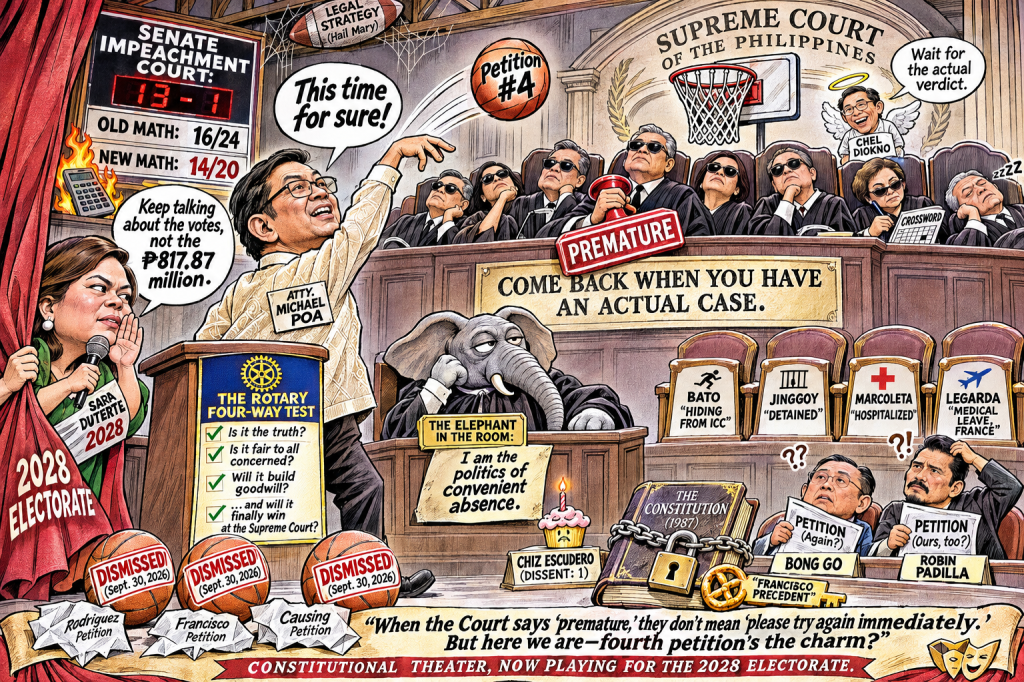
Proposed Resolution 432, passed in the same reorganization session, amended impeachment trial rules to provide for election of a presiding officer. This was not housekeeping. It was structural architecture for Vice President Sara Duterte’s looming trial. The entire June 3 war was a proxy battle over who would control the constitutional machinery of her accountability—or her acquittal. The flood control scandal was the mine; the impeachment trial the factory; the Senate presidency the control room.
The transfer of Blue Ribbon from Pia Cayetano to Erwin Tulfo is the gravest outcome. Baligod warned that “the Senate is undergoing immolation, courtesy of the minority bloc which is enabled by the executive and the HOR.” If the probe into Romualdez and Co. is now buried under new management, June 3 will be remembered not as constitutional rescue but as a premeditated, constitutionally-cloaked obstruction of justice. The 18 ex-Marines and their counsel stand as witnesses about to be interred in a procedural landslide.
Barok’s Fire and Brimstone: Non-Negotiable Demands for the Rule of Law
Full transparency now. Every communication, every deal, every executive branch signal that preceded June 3 must be laid bare. No face-saving power-sharing arrangements. No more constitutional toilet paper for factional ambitions.
The Rule of Law demands supremacy: a quorum built on the backs of International Criminal Court (ICC) fugitives and plunder detainees is a constitutional abomination, even if legally arguable under Avelino v. Cuenco (G.R. No. L-2821, March 4, 1949). The soul of the law dies if this becomes the new normal.
The Supreme Court must clarify—via advisory opinion if necessary—how Article VI, Section 16(2) of the 1987 Constitution quorum computation applies when senators evade justice through flight or detention, before the impeachment trial turns this circus into sequel.
Put politics aside. These actors must cease using the Constitution as toilet paper for factional survival. The Filipino people whose legislation died in the boycott deserve a Senate that serves the Republic, not its own survival.
Specific remedies: Immediate, unimpeded continuation of the flood control probe with full witness protection under Republic Act No. 6981 (Witness Protection, Security and Benefit Act). Public accounting of any executive role in the “quorum.” Ombudsman investigation into the legislative paralysis itself under Republic Act No. 3019 (Anti-Graft and Corrupt Practices Act). And a Senate that remembers it exists to legislate, investigate, and hold power accountable—not to stage gladiatorial farces with the Constitution as collateral damage.
The rule of law demands both things simultaneously: that the boycott be condemned, and that the probe be pursued without fear or favor. Gatchalian’s credibility, and the credibility of June 3, will be measured entirely by what happens next in the flood control investigation.
May the rule of law rise on the third day.
Key Citations
A. Legal & Official Sources
- Philippines. The 1987 Constitution of the Republic of the Philippines. 1987. Official Gazette of the Republic of the Philippines, www.officialgazette.gov.ph/constitutions/1987-constitution/.
- Philippines. Republic Act No. 3019: Anti-Graft and Corrupt Practices Act. 1960. The Lawphil Project, lawphil.net/statutes/repacts/ra1960/ra_3019_1960.html.
- Philippines, Supreme Court. Avelino v. Cuenco. G.R. No. L-2821, 4 Mar. 1949. The Lawphil Project, lawphil.net/judjuris/juri1949/mar1949/gr_l-2821_1949.html.
- Philippines, Supreme Court. Santiago v. Guingona. G.R. No. 134577, 18 Nov. 1998. The Lawphil Project, lawphil.net/judjuris/juri1998/nov1998/gr_134577_1998.html.
- Philippines. Republic Act No. 6981: Witness Protection, Security and Benefit Act. 1991. The Lawphil Project, lawphil.net/statutes/repacts/ra1991/ra_6981_1991.html.
B. News Reports
- Cruz, James Patrick. “Win Gatchalian Is Acting Senate President.” Rappler, 3 June 2026, www.rappler.com/philippines/win-gatchalian-new-senate-president-pro-tempore/.
- ₱9 Billion in ‘Savings’? DILG’s Fire Truck Deal Smells Like Smoke

- ₱8B BBM Pork: CCTV for Every Captain’s Kumpare?
- ₱8.9 Billion, 331 Ghost Police Stations: The TIKAS Scandal Explained

- ₱8.4 Billion, 42,000 Barangays, 1 Election: The “Bawat Barangay Makikinabang” Vote-Buying Masterclass

- ₱75 Million Heist: Cops Gone Full Bandit

- ₱63 to the Dollar: The Only Thing Falling Faster Than the Peso Is the Government’s Credibility

- ₱6.77B Ghost Haunts Duterte: RTC Dismisses Mans Carpio’s Desperate Plea
- ₱6.77 Billion and Zero Cash: The Sara Duterte SALN Math That Doesn’t Add Up

- ₱6.7-Trillion Temptation: The Great Pork Zombie Revival and the “Collegial” Vote-Buying Circus

- ₱58.53B, Zero Receipts: The LGSF Pork Barrel Nobody Wants to Name
- ₱53 Million Man Tells ₱695-a-Day Workers to Stop Being ‘Mayabang’: The Audacity of BSP’s Remolona
- ₱4.4 Billion and a Witness Who Can’t Explain It: The Duterte Impeachment’s Most Expensive Non-Answer



Leave a Reply